Customer Involvement in Hospitality: Why Guests Help Shape the Service Experience
Introduction
Customer involvement is one of the most important characteristics of the hospitality and service industries because hospitality services are rarely delivered in isolation from the customer. In many sectors, goods are produced first and then sold to the customer at a later stage. In hospitality, however, the customer is usually present while the service is being delivered and often takes part in shaping how that service unfolds. This means that the customer is not simply the receiver of the service, but an active participant in its production, delivery, and final outcome.
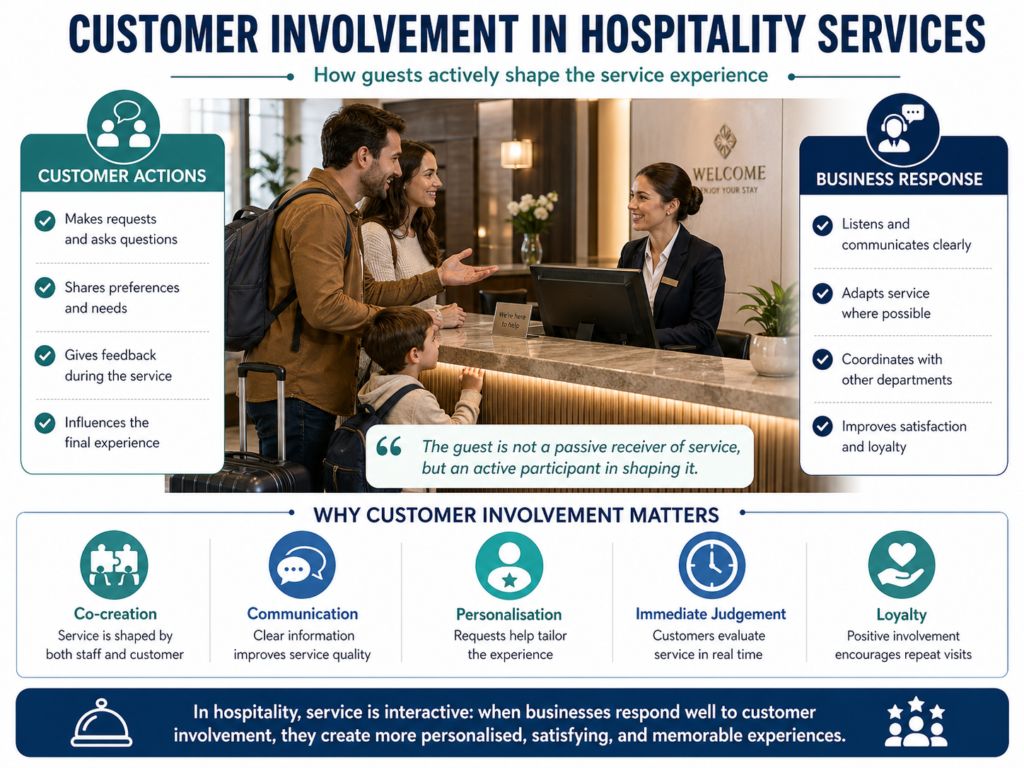
This feature makes hospitality distinct from industries that rely primarily on standardised physical products. In a restaurant, the customer decides what to order, asks questions about ingredients, makes special requests, and evaluates the service in real time. In a hotel, guests may request early check-in, ask for extra amenities, report problems, or seek local recommendations. Each of these actions influences the service process while it is taking place. As a result, hospitality service is interactive rather than one-directional. It is shaped through ongoing contact between staff and customers, and the quality of that interaction often determines whether the overall experience is judged positively or negatively.
Understanding customer involvement is therefore essential for understanding hospitality itself. It helps explain why communication, flexibility, personalisation, and responsiveness are so central to service quality. It also shows why hospitality managers must pay attention not only to staff performance, but also to how customers are guided, informed, and engaged throughout the service experience.
What Customer Involvement Means in Hospitality
Customer involvement refers to the direct role that the customer plays in influencing the production and delivery of the service. In hospitality, services are not usually prepared in full before the customer arrives. Instead, the service often develops through interaction. The customer asks, chooses, responds, requests, and reacts, while staff adapt their actions accordingly. The final service experience is therefore shaped by both parties.
This is different from the purchase of a manufactured product. When someone buys a physical product, such as a kettle or a chair, they usually have no involvement in the production process at the point of purchase. The item has already been made, packaged, and prepared for sale. In hospitality, by contrast, much of the value is created during the service encounter itself. A meal in a restaurant may be adjusted to customer preferences. A hotel stay may be improved or disrupted by the way requests are handled. A guided tour may be made more enjoyable by the group’s pace, questions, and level of interest. In each case, the customer contributes directly to the form and quality of the service being experienced.
For this reason, hospitality services are often described as co-created. This means that service outcomes depend not only on what staff do, but also on how customers participate. The service is not simply delivered to the customer; it is developed through the interaction between provider and guest.
The Role of Communication in Service Co-Creation
One of the main reasons customer involvement matters so much in hospitality is that service quality often depends on clear and effective communication. Hospitality employees may be fully trained and prepared to provide excellent service, but the outcome can still vary depending on how well customers express their needs and how well staff interpret and respond to them.
A simple example can be seen in food service. If a customer clearly communicates a dietary requirement, staff can take the necessary precautions to ensure the meal is safe and suitable. If that information is unclear, delayed, or not communicated at all, the quality of the experience may be reduced and, in some cases, safety may even be compromised. Similarly, in hotels, a guest who explains a need for a quiet room, accessibility support, or a later check-out gives staff the opportunity to adapt the service more effectively. Without such involvement, the service may still be competent, but it may not be appropriate to the guest’s individual circumstances.
This demonstrates that hospitality service often depends on mutual participation. Staff must listen carefully, ask useful questions, and communicate with professionalism, while customers must provide accurate and timely information. When this exchange works well, the service is more likely to meet or exceed expectations. When it breaks down, dissatisfaction becomes more likely, even if the business has good facilities and trained employees.
Why Customer Involvement Creates Both Value and Complexity
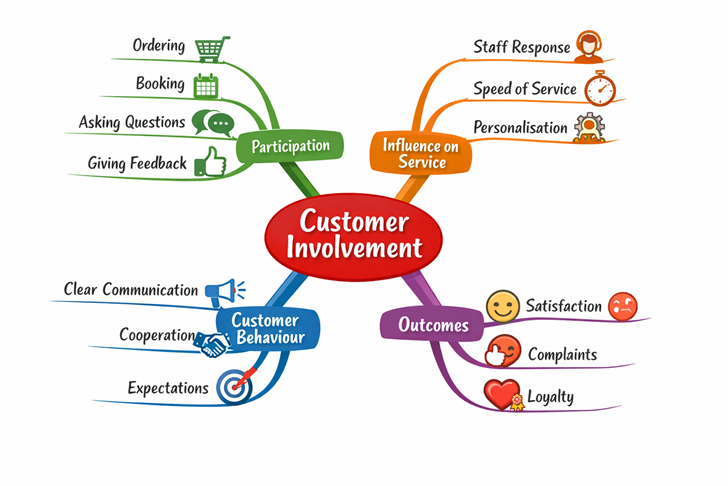
Customer involvement is highly valuable because it creates opportunities for hospitality businesses to provide more personalised and satisfying experiences. By listening to customers and responding to their requests, businesses can make the service feel more individual, attentive, and memorable. This is particularly important in hospitality because customers often value recognition and personal care just as much as the physical aspects of the service.
A returning hotel guest may prefer a quiet room, extra pillows, or a room away from the lift. A café customer may want a drink prepared in a very specific way. A tour participant may need a slower pace or more explanation. In each of these situations, customer involvement allows the service to be adapted to suit personal needs and preferences. This can strengthen the relationship between the business and the customer because the customer feels heard, respected, and valued. Personalised service often contributes significantly to customer satisfaction, repeat visits, and positive word of mouth.
At the same time, this involvement introduces complexity. Every customer may want something slightly different, and staff must be capable of responding without losing efficiency or consistency. This means that hospitality workers need more than technical competence. They need listening skills, emotional intelligence, patience, adaptability, and problem-solving ability. The more involved the customer becomes in shaping the service, the more important it is for staff to manage that involvement constructively. Businesses must therefore balance flexibility with operational control, ensuring that personalisation enhances the experience without creating confusion or reducing service quality for others.
Customer Behaviour and Its Influence on Service Outcomes
Customer involvement is not always positive or easy to manage. Because the customer takes part in the service process, their behaviour can support or hinder successful service delivery. This is one of the reasons hospitality is often more unpredictable than sectors based on standardised production.
Customers who communicate clearly, behave respectfully, and engage cooperatively often make it easier for staff to deliver a high-quality experience. They help create a smoother and more efficient service process. By contrast, customers who arrive late, provide incomplete information, make unrealistic demands, or behave impatiently may make service delivery more difficult. This does not mean that the customer is always at fault when service problems occur, but it does show that the customer’s role can influence the quality of the final outcome.
This is especially important because customers usually judge the service while it is happening. They do not wait until the process is complete before forming opinions. If they feel ignored, misunderstood, or poorly handled at any stage, dissatisfaction may emerge immediately. In hospitality, the experience is not only consumed in real time; it is also evaluated in real time. This makes customer involvement a particularly powerful factor in shaping satisfaction, complaints, and perceptions of quality.
Personalisation as a Direct Result of Customer Involvement
One of the strongest arguments in favour of customer involvement is that it allows hospitality businesses to deliver more personalised service. In many cases, the customer actively provides the information that makes personalisation possible. Without that participation, staff may only be able to offer a standardised service rather than one tailored to individual preferences.
Personalisation often plays a major role in customer satisfaction because it makes the experience feel thoughtful rather than generic. When a hotel adjusts a booking to accommodate a family’s needs, when a restaurant adapts a dish to suit dietary requirements, or when a member of staff remembers a returning guest’s preferences, the service becomes more meaningful. These gestures can create emotional value as well as practical value. The customer feels recognised not merely as a transaction, but as an individual.
However, successful personalisation requires systems as well as good intentions. Businesses need methods for recording preferences, sharing information between departments, and ensuring that special requests are acted upon correctly. In this way, customer involvement must be supported by internal communication and service management. A customer may express a preference clearly, but unless the business has the ability to respond in an organised way, the benefit of that involvement may be lost.
Customer Involvement and Immediate Judgements of Quality
Because customers are directly involved in the delivery of hospitality services, they often form opinions about quality very quickly. Their judgement is not based only on the final result, but also on how the service responds to their input as it unfolds. This is one of the most distinctive features of hospitality service management.
A guest may be pleased with the physical quality of a hotel room, but if their request for assistance was ignored or handled poorly, the overall experience may still be negative. A diner may enjoy the food, but if staff failed to respond properly to a question or special request, customer satisfaction may decline. This shows that in hospitality, quality is not judged only through tangible outcomes. It is also judged through interaction, responsiveness, and the sense of being listened to.
For this reason, many hospitality businesses encourage real-time feedback and service recovery. Rather than waiting for customers to complain after the experience, they try to identify and address concerns while the service is still taking place. This reflects a deeper understanding of customer involvement: the guest is not outside the process but inside it, shaping the experience moment by moment.
Managing Customer Involvement Effectively
If customer involvement is central to hospitality, then businesses must actively manage it rather than simply react to it. This means creating systems and environments that support smooth cooperation between staff and customers. Menus, booking systems, check-in procedures, signage, digital communication tools, and service rules all play a part in guiding customers through the service process.
Clear guidance helps reduce confusion and improves efficiency. If customers understand how to book, what information to provide, what to expect, and how to communicate requests, the service process becomes easier for both sides. In this sense, customer involvement should not be left entirely informal. It needs to be supported by thoughtful service design.
Staff training is equally important. Employees must know how to listen carefully, ask clarifying questions, respond with empathy, and manage requests professionally. They must also know how to handle situations in which customer expectations cannot be fully met. Effective hospitality service does not require staff to agree to every request, but it does require them to respond in a way that makes the customer feel respected and understood.
Case Study: Hotel Guest Requests and Personalised Service
The importance of customer involvement can be clearly seen in the example of a hotel guest travelling with a young child. On arrival, the guest explains to the receptionist that they would prefer a quiet room away from the lift, and they also request an extra blanket and a later check-out time due to their return flight. The receptionist checks availability, updates the booking details, and informs the relevant departments so that the request can be accommodated.
This example illustrates customer involvement in a practical and realistic way. The guest is not passively receiving whatever room and service happen to be provided. Instead, the guest takes part in shaping the experience by communicating specific needs. The receptionist, in turn, responds by coordinating action across the service system. The final outcome is more suitable, more personal, and more satisfying because the service was influenced by direct interaction.
The example also highlights the importance of flexibility and internal communication. The receptionist alone cannot create the full solution without support from other departments. Customer involvement therefore does not only affect the interaction between guest and employee; it also influences the coordination of the business as a whole. This is why customer involvement should be viewed as a strategic issue in hospitality rather than just a frontline concern.
Why Customer Involvement Is a Defining Characteristic of Hospitality
Customer involvement is a defining characteristic of hospitality because it reflects the interactive nature of service delivery. Hospitality is not a one-way process in which businesses simply provide and customers simply receive. Instead, it is a relationship-based activity in which both sides influence the final result. The customer participates through requests, preferences, communication, behaviour, and feedback, while staff respond through service skills, flexibility, and professionalism.
This has major implications for how hospitality businesses are managed. Success depends not only on physical facilities or operational efficiency, but also on the quality of interaction between customers and employees. Businesses that recognise this are better able to create positive experiences, recover from problems, and build loyalty over time. Those that ignore the active role of the customer may struggle to understand why service quality varies or why customer expectations are not always met.
Customer involvement therefore lies at the centre of hospitality service quality. It explains why hospitality requires strong communication, why personalisation matters, and why customer experience is shaped in real time. More broadly, it reinforces the idea that hospitality is a human-centred industry in which service is created through interaction rather than simply delivered as a finished product.
Final Thoughts
Customer involvement is one of the key characteristics that distinguishes hospitality from product-based industries. Because customers are present during service delivery and actively influence how the service takes place, hospitality experiences are shaped through participation rather than passive consumption. This means that service quality depends not only on staff competence and business systems, but also on customer communication, behaviour, expectations, and engagement.
Although customer involvement can create complexity, it also creates value. It makes personalisation possible, strengthens relationships between businesses and guests, and allows hospitality services to respond to individual needs in meaningful ways. For this reason, customer involvement should not be seen as an obstacle to service delivery, but as a central part of what hospitality service actually is.
The challenge for hospitality businesses is to manage this involvement effectively. They must guide customers clearly, train staff thoroughly, and create systems that support interaction, flexibility, and service recovery. When this is done well, customer involvement becomes a major source of satisfaction, loyalty, and service excellence.
View Courses in Hospitality and Tourism…
Start your journey in hospitality and tourism with an accredited Click College course. Enrol today and build the skills, knowledge, and confidence to progress into a management role.







Recent Posts
Which Online Management Course Should I Choose? Business, Marketing, Finance, HR, Hospitality or Project Management
Which Online Management Course Should I Choose? Business, Marketing, Finance, HR, Hospitality or Project Management Choosing an online management course can be difficult because Business Management, Marketing, Finance, Human Resources, Hospitality and Project Management all overlap. Every organisation needs to attract customers, manage money, support its staff and deliver work effectively. The best choice depends […]
How Consumers Evaluate Alternatives: Shortlists, Decision Rules and Choice Overload
How Consumers Evaluate Alternatives: Shortlists, Decision Rules and Choice Overload Why can two customers examine the same products and reach completely different conclusions? One may choose the least expensive option, another may pay more for reassurance, and a third may postpone the decision altogether. Consumers evaluate alternatives by reducing a broad market to a manageable […]
How Social Influences Shape Consumer Buying Behaviour
How Social Influences Shape Consumer Buying Behaviour Why do people ask friends for recommendations, check reviews before buying or choose products that appear popular within their professional or social group? Social influences shape consumer buying behaviour by providing information, establishing expectations and signalling which choices appear credible, accepted or appropriate. The main social influences include […]