Accommodation in Hospitality: The Sector at the Centre of Guest Experience
Introduction
The accommodation sector is one of the most important parts of the hospitality and service industries because it provides the temporary lodging that allows travel, tourism, business activity, and leisure experiences to take place. While hospitality is often associated with customer care more broadly, accommodation holds a particularly central position because many journeys depend on access to a safe, comfortable, and suitable place to stay. Whether a person is travelling for a holiday, a work trip, a family visit, education, or an event, accommodation is often a basic and unavoidable requirement. For this reason, the sector forms a major foundation of the wider hospitality environment.
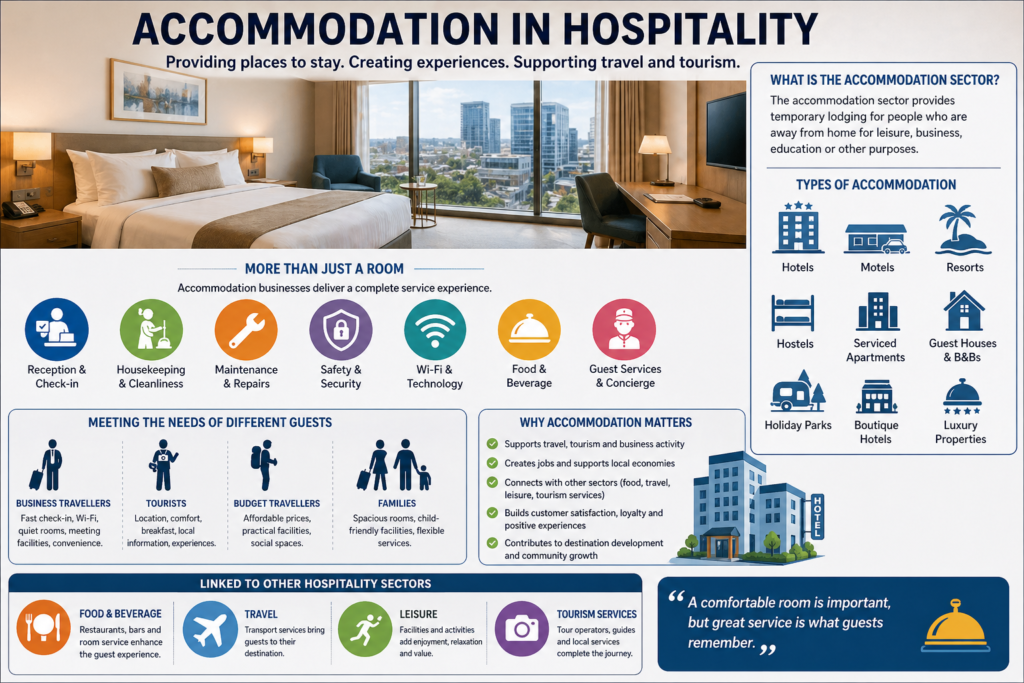
Accommodation includes a wide range of business types, including hotels, motels, hostels, resorts, guest houses, serviced apartments, holiday parks, bed-and-breakfast establishments, and other short-stay providers. These businesses vary greatly in price, style, size, service level, and target market, yet they share a common purpose: to provide temporary lodging that meets the needs of guests while they are away from home. The importance of this sector does not lie only in the provision of rooms. Accommodation businesses also deliver a broader service experience that includes reception, housekeeping, maintenance, safety, support, and often additional facilities such as food service, leisure amenities, and customer assistance.
Understanding the accommodation sector is essential because it helps explain how hospitality operates in practice. It shows that accommodation is not simply about buildings and beds, but about service quality, operational coordination, customer expectations, and economic contribution. It also demonstrates how accommodation businesses support the wider hospitality and service industries by connecting with travel, tourism, food and beverage, and local attractions.
What the Accommodation Sector Includes
The accommodation sector consists of businesses that provide temporary places for people to stay. Although this may seem straightforward, the sector is highly diverse because different customers require different forms of lodging depending on their purpose of travel, budget, and personal expectations.
Hotels are perhaps the most recognised form of accommodation and can range from budget properties offering basic overnight stays to luxury establishments providing premium facilities and extensive guest services. Motels are traditionally designed to serve road travellers and often offer convenient parking and simple access. Guest houses and bed-and-breakfast establishments usually provide smaller-scale, more personal forms of lodging. Hostels are often aimed at budget-conscious travellers and may provide shared rooms and communal spaces. Resorts typically combine accommodation with leisure facilities and are often designed around holiday experiences. Serviced apartments offer more space and flexibility for longer stays, while holiday parks appeal to families and leisure travellers seeking informal and recreational environments.
Despite these differences, the underlying purpose remains the same. Each type of accommodation business exists to provide a place where guests can stay temporarily in conditions that are safe, functional, and appropriate to their needs. What changes is the form in which this service is delivered and the level of additional support that surrounds it.
Why Accommodation Is Central to Hospitality
Accommodation occupies a central role in hospitality because it supports many of the other activities that take place within the wider industry. Travel and tourism are often only possible when suitable lodging is available. A tourist visiting a city needs somewhere to stay near attractions or transport links. A business traveller may require a hotel with meeting facilities and reliable internet access. A family on holiday may need extra space, leisure facilities, and services that support children. In each case, accommodation acts as an enabling service that allows the wider trip or experience to happen successfully.
This centrality means that accommodation is more than a standalone sector. It is closely connected to the functioning of hospitality as a whole. Restaurants benefit from guests staying nearby. Tourist attractions depend partly on the availability of suitable lodging in the local area. Transport services connect travellers to accommodation providers. Event venues often rely on hotels and guest houses to support attendees. In practical terms, accommodation often acts as the base from which other hospitality and service experiences are organised.
Because of this, the success of accommodation businesses can influence the success of wider destinations and local economies. A place with strong accommodation provision is better positioned to attract visitors, support conferences, encourage longer stays, and increase local spending. In this sense, accommodation is not only a service for individual guests but also an essential part of destination infrastructure.
Accommodation as a Service, Not Just a Physical Product
One of the most important things to understand about the accommodation sector is that it is not limited to the provision of a physical room. While the room itself is clearly important, guest satisfaction is usually shaped by far more than the bed, furniture, or décor alone. Accommodation is fundamentally a service-based sector in which the guest experience depends on the interaction between physical facilities and service delivery.
A guest does not judge a hotel only by the appearance of the room. They also judge it by the efficiency of check-in, the helpfulness of staff, the cleanliness of the environment, the speed with which requests are handled, the sense of safety provided, and the overall comfort and convenience of the stay. An attractive property may still disappoint guests if communication is poor, problems are ignored, or housekeeping standards are inconsistent. By contrast, a simpler property may receive positive reviews if staff are attentive, the environment is clean and safe, and customer needs are dealt with professionally.
This is why accommodation businesses must manage both tangible and intangible elements of the guest experience. Tangible elements include the room, facilities, location, and physical environment. Intangible elements include customer care, professionalism, responsiveness, atmosphere, and reliability. The most successful accommodation providers understand that both dimensions are inseparable in shaping how the stay is experienced and remembered.
The Main Services Provided Within Accommodation
Although different forms of accommodation vary in what they offer, most businesses in the sector provide more than a sleeping space alone. They usually combine lodging with a range of supporting services designed to improve convenience, comfort, and customer satisfaction.
Reception and check-in services are often the guest’s first direct point of contact with the business and play a major role in shaping first impressions. Housekeeping is equally central, since cleanliness and room preparation are basic expectations in almost all forms of accommodation. Maintenance services ensure that rooms, facilities, and equipment remain functional and safe. Security is critical because guests expect to feel protected while staying away from home. Many accommodation providers also offer Wi-Fi, breakfast, luggage support, room service, laundry, concierge assistance, or leisure facilities such as gyms and swimming pools.
These supporting services demonstrate that accommodation is a layered hospitality product. The guest may book a room, but what they actually experience is a package of interrelated services. If one part of this package fails, the overall impression of the stay may be harmed. For example, a comfortable room may not compensate for poor reception service, delayed problem resolution, or inadequate cleanliness. Accommodation businesses must therefore manage service quality across multiple functions rather than focusing narrowly on the room itself.
Meeting the Needs of Different Customer Groups
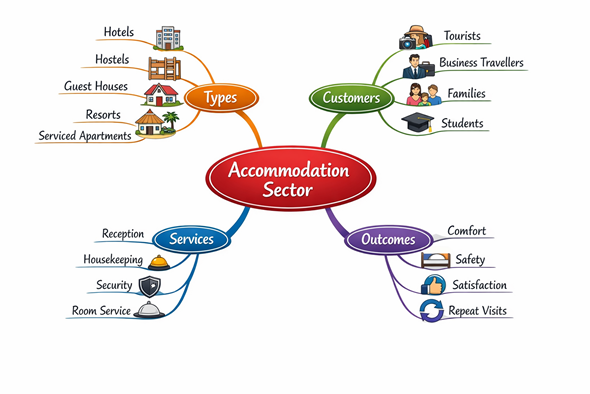
A major feature of the accommodation sector is the need to serve different kinds of guests whose needs, preferences, and expectations may vary significantly. Not all travellers are looking for the same type of experience, and accommodation businesses must design their services accordingly.
Business travellers often prioritise speed, convenience, and reliability. They may expect fast check-in, quiet rooms, strong internet access, workspace facilities, and proximity to business districts or transport hubs. Tourists may be more concerned with comfort, location, breakfast, local advice, and access to attractions. Budget travellers often focus on affordability and practicality, accepting fewer extras in exchange for lower cost. Families may look for larger rooms, flexible sleeping arrangements, child-friendly facilities, and a relaxed environment. Long-stay guests may prefer serviced apartments or accommodation with self-catering options.
This diversity of demand means that the accommodation sector must be flexible and market-aware. Providers need to understand who their customers are, what those customers value, and how services should be organised to meet those expectations. A property that fails to match its offer to its target market may struggle, even if its facilities are of reasonable quality. Successful accommodation businesses align pricing, services, design, and communication with the needs of their chosen customer groups.
Service Quality in the Accommodation Sector
Service quality is one of the most important factors determining success in accommodation. Because guests are often physically present within the property for extended periods, they experience service in a continuous rather than momentary way. This makes quality particularly important, since problems in accommodation are often felt directly and over time rather than as isolated incidents.
Cleanliness is one of the clearest examples. Guests generally expect rooms, bathrooms, communal spaces, and facilities to be well maintained and hygienic. If this standard is not met, dissatisfaction can be immediate and severe. Safety is equally fundamental. Guests expect secure access, functioning locks, safe environments, and confidence that the property is responsibly managed. Comfort is another major factor and includes not only bed quality and room condition, but also temperature control, noise levels, lighting, and ease of use.
However, service quality in accommodation is not limited to operational basics. Staff behaviour also matters greatly. Professionalism, friendliness, responsiveness, and problem-solving ability all shape how guests interpret their stay. When issues arise, the ability of staff to resolve them quickly and courteously often has a strong influence on whether the guest leaves satisfied or disappointed. In many cases, guests remember how problems were handled as much as the problems themselves.
Because of this, accommodation providers must view service quality as a whole-system issue. It depends on physical standards, staff training, communication, internal coordination, and consistency across departments. It is not enough to provide good rooms if service delivery around those rooms is weak.
The Economic and Employment Importance of Accommodation
The accommodation sector makes a substantial contribution to employment and the wider economy. It creates direct roles for receptionists, managers, housekeepers, chefs, maintenance teams, customer service staff, security personnel, cleaners, and supervisors, among many others. In larger establishments, there may also be specialised roles in reservations, events, sales, revenue management, and guest relations. This makes accommodation an important source of employment at both entry and management levels.
The economic contribution of accommodation also extends beyond the business itself. Accommodation providers purchase goods and services from suppliers, including food distributors, laundry services, cleaning companies, linen providers, maintenance contractors, technology firms, and transport operators. Guests staying in accommodation also spend money in the surrounding area, using restaurants, shops, attractions, and local services. In this way, accommodation stimulates wider economic activity and helps support local communities.
The relationship between accommodation and tourism is particularly important. Destinations with strong accommodation infrastructure are generally better able to attract visitors, host events, and encourage longer stays. As a result, accommodation businesses often play a key role in regional development, urban economies, and visitor destination planning. Their contribution is not confined to the building they operate from; it extends into the wider hospitality ecosystem.
Links Between Accommodation and Other Hospitality Sectors
Accommodation does not operate in isolation. It is closely linked to the other main sectors within hospitality and the service industries, including food and beverage, travel, leisure, and tourism services. These links are important because they show how accommodation functions as part of a broader network of customer experience.
Hotels and resorts often incorporate food and beverage operations directly through restaurants, bars, breakfast services, or room service. Accommodation providers also depend on the travel sector because guests arrive by air, rail, road, or other forms of transport. Leisure services may be included within the property, such as gyms, spas, or entertainment spaces, or they may be accessed externally through partnerships with local businesses. Tourism services such as tour operators, visitor information centres, and local excursion providers often work closely with accommodation businesses to improve the guest experience and help visitors make the most of their stay.
These connections mean that accommodation businesses are often part of a wider service chain. A guest’s overall impression of a trip may depend on how smoothly these sectors work together. For that reason, accommodation providers frequently collaborate with taxis, attractions, travel organisers, and restaurants to strengthen customer satisfaction and support destination quality more broadly.
Case Study: A Business Hotel Serving Different Guest Needs
The role of accommodation can be seen clearly in the example of a city-centre hotel serving tourists, conference visitors, and business travellers. Although all of these customers require a place to stay, their priorities are not identical. Business travellers often expect fast and efficient check-in, reliable Wi-Fi, quiet rooms, and access to meeting facilities. Tourists may place greater emphasis on location, comfort, breakfast, and local travel advice. Conference visitors may require convenient scheduling, flexible room arrangements, and coordinated support linked to event timings.
In response, the hotel provides a range of room types, a 24-hour reception desk, housekeeping services, breakfast packages, and concierge support. This example illustrates that accommodation businesses must offer more than a bed for the night. They must manage customer expectations, service quality, and operational flexibility across different market segments. It also shows how accommodation providers support wider travel and tourism activity by acting as service hubs for guests with different purposes and priorities.
Most importantly, the case highlights that success in accommodation depends on understanding customer needs and translating that understanding into practical service delivery. The hotel’s value lies not simply in offering rooms, but in making those rooms and services suitable for the people using them.
Why Understanding Accommodation Matters
Studying the accommodation sector is important because it reveals the scale and complexity of hospitality as an industry. It helps learners understand that hospitality is not just about serving food or greeting guests; it also involves providing the essential environments within which travel, business, and leisure can take place. Accommodation demonstrates how physical assets and service delivery work together, how different customer groups require different responses, and how hospitality businesses contribute to broader social and economic systems.
It also helps learners appreciate the service-based nature of the sector. Even though accommodation involves buildings and rooms, customer satisfaction depends heavily on people, systems, and operations. This makes accommodation an ideal example of how hospitality combines tangible provision with intangible service quality. To understand accommodation is therefore to understand many of the wider principles of hospitality itself, including comfort, safety, personalisation, professionalism, and customer care.
Concluding Remarks
The accommodation sector is one of the main sectors within the hospitality and service industries because it provides the temporary lodging that supports travel, tourism, work, leisure, and many other activities. It includes a wide variety of business types, from hotels and hostels to resorts and serviced apartments, all of which aim to provide safe, comfortable, and convenient places for guests to stay.
However, accommodation is not simply about supplying rooms. It is a service-based sector in which customer satisfaction depends on the quality of supporting services such as reception, housekeeping, maintenance, security, and guest assistance. It must respond to the needs of different customer groups, maintain high standards of cleanliness, safety, and comfort, and work closely with other parts of the hospitality and service industries.
Its importance is also economic and social. Accommodation creates employment, supports local business networks, and contributes to the success of destinations and wider tourism systems. For all of these reasons, accommodation is not only a major sector within hospitality, but one of the clearest examples of how hospitality combines service, comfort, organisation, and customer experience into a single industry function.
View Courses in Hospitality and Tourism…
Start your journey in hospitality and tourism with an accredited Click College course. Enrol today and build the skills, knowledge, and confidence to progress into a management role.







Recent Posts
Professional Diploma or Higher Qualification Pathway: Which Should You Choose?
Professional Diploma or Higher Qualification Pathway: Which Should You Choose? Choosing the right online qualification is not always simply a question of choosing the longest course or the highest level. For many learners, the better question is: what kind of study route fits my goals right now? Some learners want a focused qualification in one […]
Professional Diploma in Leadership and Management: Course Guide
Professional Diploma in Leadership and Management: Course Guide A Professional Diploma in Leadership and Management is designed for learners who want to develop advanced leadership, strategic thinking and organisational management skills without committing immediately to a full degree programme. Leadership and management are essential in almost every sector. Whether you work in business, education, hospitality, […]
Professional Diploma in Business Management: Who Is It For?
Professional Diploma in Business Management: Who Is It For? A Professional Diploma in Business Management is designed for learners who want to build practical business knowledge without committing immediately to a full degree or long higher education programme. It can be a useful option for people who want to understand how organisations work, how teams […]