Demand Management in Hospitality: A Practical Guide for Future Managers
Introduction
If you’re studying hospitality or planning a career in the industry, one concept you’ll come across again and again is demand management. It might sound technical at first, but in reality, it sits at the centre of how hotels, restaurants and tourism businesses actually survive and grow.
The hospitality industry doesn’t operate on steady demand. Instead, it moves in waves. A hotel might be fully booked one week and half-empty the next. A restaurant may struggle to find seats on a Saturday night but have plenty of availability midweek. Understanding how to respond to these patterns is what separates well-run businesses from those that constantly struggle with costs, staffing and customer satisfaction.
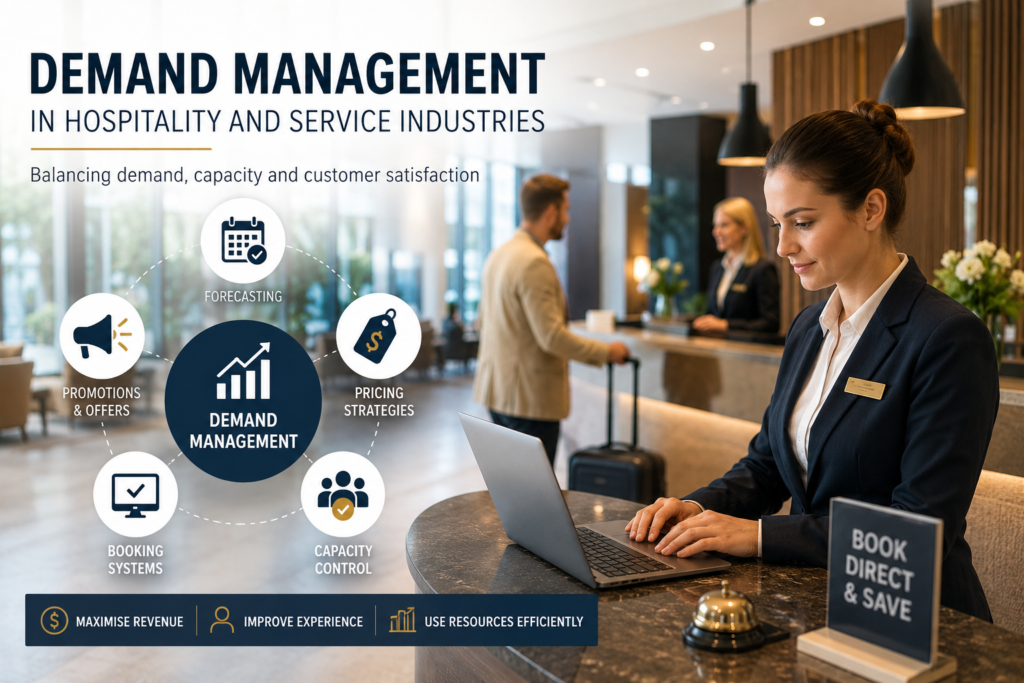
Demand management is, ultimately, about control. It’s the process of predicting customer demand, influencing when and how customers use a service, and making sure the business can deliver consistently without wasting resources or damaging the customer experience.
Why demand management is essential in hospitality
What makes hospitality different from many other industries is the fact that its services are perishable. This means they cannot be stored or saved for later.
If a hotel room goes unsold tonight, that revenue is gone permanently. The same applies to an empty table in a restaurant or unused tickets for an attraction. There is no second chance to sell that exact service.
This creates constant pressure on businesses to get their planning right. When demand is too low, money is lost through unused capacity. When demand is too high, service quality can drop, leading to long-term damage through poor reviews and dissatisfied customers.
Because of this, demand management becomes a critical operational skill — not just something managers think about occasionally, but something that shapes daily decisions across the business.
Understanding how demand really behaves
Demand in hospitality is rarely predictable in a simple way. It changes depending on a wide range of factors, many of which are outside the business’s control.
Seasonality is one of the most obvious influences. Coastal hotels experience peaks in summer, while ski resorts thrive in winter. But beyond that, demand is shaped by weekends, public holidays, local events, weather conditions and even broader economic trends.
A city hotel, for example, may depend heavily on business travel during the week and leisure guests at the weekend. A restaurant may see patterns that shift based on office working habits or nearby events. This constant variation means businesses must rely on data and forecasting rather than assumptions.
For students studying hospitality operations, this is where theory meets practice. Analysing trends, interpreting booking data and anticipating demand are all essential skills that underpin effective decision-making in the industry.
How hospitality businesses influence demand
Predicting demand is only one side of the equation. The other is actively shaping it.
One of the most visible ways businesses do this is through pricing. If you’ve ever noticed that hotel rooms are cheaper midweek or that flights cost more during peak travel periods, you’ve already seen demand management in action. These pricing strategies are designed to spread demand more evenly, encouraging customers to choose times that would otherwise be quieter.
Restaurants often take a similar approach, offering early evening menus or lunch deals to attract customers outside peak hours. Attractions and tourism providers frequently adjust pricing depending on demand, using discounts to increase footfall during off-peak periods.
These strategies are closely linked to revenue management, another key topic in hospitality courses, where businesses aim to maximise income from limited capacity.
The role of booking systems and planning
Another important element of demand management is the use of booking systems. Advance reservations give businesses a much clearer picture of what lies ahead.
A hotel with strong booking data can plan staffing levels, prepare rooms efficiently and manage guest expectations. A restaurant can control table turnover and avoid overcrowding. Attractions can use timed entry systems to spread visitors throughout the day, improving both safety and the overall experience.
Without these systems, businesses are left reacting to demand rather than managing it. With them, they can make informed decisions that improve both efficiency and customer satisfaction.
This is why operational planning is such a key part of hospitality management qualifications. It connects directly to real-world challenges that businesses face every day.
Balancing profit with customer experience
One of the biggest misconceptions about demand management is that it’s only about increasing revenue. In reality, it’s just as much about protecting the customer experience.
When demand is not managed properly, the effects are immediate. Customers may face long queues, slow service or overcrowded environments. Staff may become overwhelmed, leading to mistakes and reduced service quality. Over time, this can damage a business’s reputation far more than a quiet day ever could.
Successful hospitality businesses understand that there is a limit to how much demand they should accept. Sometimes, controlling or even reducing demand during peak periods is the best decision for long-term success.
This balance between profitability and service quality is a recurring theme in hospitality education, particularly in courses focused on operations and customer experience management.
A real-world example: theme parks and peak demand
A clear example of demand management can be seen in theme parks during school holidays. Visitor numbers can increase dramatically, putting pressure on rides, staff and facilities.
To manage this, many parks now require advance booking and use timed entry systems to control how many visitors arrive at any one time. They may also adjust pricing, offering lower rates during quieter weekdays and higher prices during peak periods.
These strategies allow the park to maintain safety standards, reduce overcrowding and improve the overall visitor experience, while still maximising revenue where possible.
This kind of approach reflects exactly what students learn when studying hospitality operations — how to respond to demand in a structured, strategic way rather than simply reacting to it.
Why demand management matters for your career
For anyone studying hospitality or business management, understanding demand management is more than just passing an assignment. It’s a practical skill that applies across the entire industry.
Whether you’re working in a hotel, running a restaurant, managing events or operating within tourism, you will constantly face the challenge of balancing demand with capacity. Employers value individuals who can think ahead, analyse patterns and make decisions that improve both efficiency and customer satisfaction.
At Click College, this is exactly the kind of real-world knowledge built into our Level 3, 4 and 5 Business and Hospitality programmes, helping students move beyond theory and develop skills that employers are actively looking for.
Final thoughts
Demand management sits at the core of hospitality operations because it deals with one of the industry’s biggest challenges: unpredictability.
By understanding how demand behaves, how it can be influenced and how it impacts both profit and service quality, students gain insight into how successful hospitality businesses actually operate.
In an industry where timing, experience and efficiency all matter, managing demand effectively isn’t optional — it’s essential.
View Courses in Hospitality and Tourism…
Start your journey in hospitality and tourism with an accredited Click College course. Enrol today and build the skills, knowledge, and confidence to progress into a management role.







Recent Posts
Professional Diploma or Higher Qualification Pathway: Which Should You Choose?
Professional Diploma or Higher Qualification Pathway: Which Should You Choose? Choosing the right online qualification is not always simply a question of choosing the longest course or the highest level. For many learners, the better question is: what kind of study route fits my goals right now? Some learners want a focused qualification in one […]
Professional Diploma in Leadership and Management: Course Guide
Professional Diploma in Leadership and Management: Course Guide A Professional Diploma in Leadership and Management is designed for learners who want to develop advanced leadership, strategic thinking and organisational management skills without committing immediately to a full degree programme. Leadership and management are essential in almost every sector. Whether you work in business, education, hospitality, […]
Professional Diploma in Business Management: Who Is It For?
Professional Diploma in Business Management: Who Is It For? A Professional Diploma in Business Management is designed for learners who want to build practical business knowledge without committing immediately to a full degree or long higher education programme. It can be a useful option for people who want to understand how organisations work, how teams […]