What Is a Diploma in Travel and Tourism? A Beginner’s Guide
A Complete Introduction to Travel, Tourism, Open-Access Study and Career Pathways
A Diploma in Travel and Tourism is an introductory qualification designed to help learners understand the travel and tourism sector, including how travel services operate, how customers are supported, how destinations attract visitors and how tourism businesses contribute to the wider visitor economy.
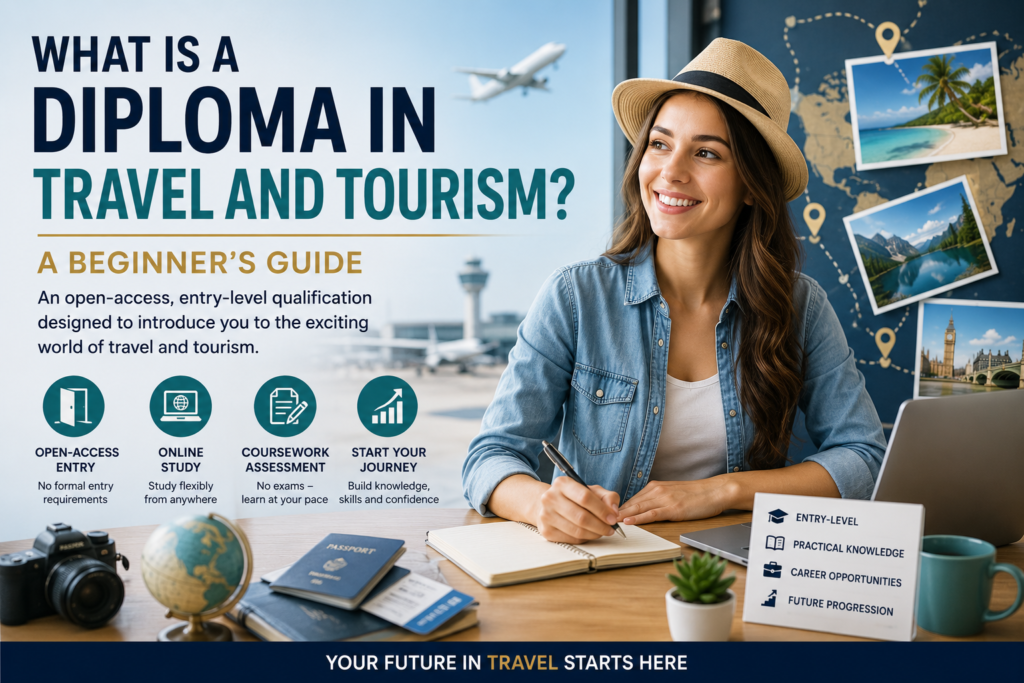
For many learners, travel and tourism is an exciting area of study because it connects people, places, services and experiences. The sector is not only about holidays. It includes travel agencies, visitor attractions, tour operators, transport services, hotels, destination organisations, events, cultural tourism, business travel, heritage sites, leisure travel and customer support services.
A travel and tourism diploma can be a useful starting point for learners who want to enter the sector, develop career-relevant knowledge or build confidence before progressing to further study. It can also support people already working in customer service, hospitality, retail, travel or tourism who want to formalise their knowledge with a recognised qualification.
At Click College, learners interested in this area can study the Professional Diploma in Tourism and Travel (EduQual Level 4). This flexible online qualification provides an open-access route into travel and tourism study, meaning learners do not need to follow a traditional university-style admissions process to get started.
This makes the course particularly suitable for beginners, adult learners, career changers and working professionals who want a practical, accessible and flexible way to begin studying the travel and tourism sector.
This beginner’s guide explains what a Diploma in Travel and Tourism is, what learners may study, who it is suitable for, what open-access entry means, the skills it can help develop, possible career pathways and how online study can support flexible progression.
What Is a Diploma in Travel and Tourism?
A Diploma in Travel and Tourism is a qualification that introduces learners to the organisations, services and customer experiences that make up the travel and tourism industry.
It helps learners understand how the sector works and how different services connect to support travellers and visitors.
A travel and tourism diploma may explore areas such as:
- Travel services
- Tourism operations
- Visitor attractions
- Customer service
- Destination awareness
- Tourism organisations
- Bookings and reservations
- Tourism marketing
- Visitor experience
- Travel planning
- Tourism trends
- The wider hospitality and tourism sector
In simple terms, a Diploma in Travel and Tourism helps learners understand how travel and tourism services are planned, delivered and supported.
A customer’s travel experience rarely depends on one organisation alone. A single trip may involve a travel agency, airline, hotel, transfer provider, attraction, restaurant, tour guide, visitor information centre and online booking platform. Travel and tourism study helps learners understand how these services work together to create a complete visitor experience.
This makes the qualification useful for learners who are interested in travel, destinations, customer service and the business side of tourism.
Why Study Travel and Tourism?
Travel and tourism is a large and varied sector that supports many different types of employment. It includes organisations that help people plan journeys, book services, visit destinations, enjoy attractions and experience different places.
Studying travel and tourism can help learners develop a clearer understanding of:
- How travel services operate
- How tourism businesses support customers
- How visitor attractions create experiences
- How destinations attract tourists
- How customer service affects satisfaction
- How tourism supports local economies
- How travel and hospitality services connect
- How tourism organisations respond to changing customer needs
For learners who enjoy working with people, solving problems, organising services and learning about destinations, travel and tourism can be an attractive subject area.
It can also be a useful choice for learners who are not yet sure which part of the sector they want to enter. A diploma provides a broad introduction, helping learners explore different areas before deciding whether to specialise later in tourism management, hospitality, hotel operations, customer service, events or destination development.
What Does Open-Access Entry Mean?
One of the most important benefits of the Click College Professional Diploma in Travel and Tourism (EduQual Level 4) is that it is designed as an open-access qualification.
Open-access entry means that learners can begin the course without needing to meet the traditional entry requirements often associated with college or university programmes.
This is especially helpful for learners who may not have followed a conventional academic route. For example, some learners may have work experience but limited formal qualifications. Others may be returning to study after a long break. Some may be changing career and looking for an accessible starting point in a new sector.
Open-access study removes unnecessary barriers and allows motivated learners to begin developing their knowledge.
This does not mean that the course lacks academic value. It means that the starting point is accessible. Learners still complete structured learning and assessment, but they are not prevented from enrolling simply because they do not have a traditional academic background.
Open-access entry is particularly useful for:
- Adult learners returning to education
- Career changers
- Learners without recent qualifications
- People with practical work experience but limited academic study
- Learners who want to test their interest in travel and tourism
- People seeking a flexible first step into higher-level learning
For many students, open-access study provides the confidence to begin. Rather than feeling excluded by entry requirements, learners can start at an appropriate level and build their knowledge step by step.
Why an Open-Access Travel and Tourism Diploma Is Ideal for Beginners
A Diploma in Travel and Tourism is often an ideal first qualification because it introduces the sector in a structured and manageable way.
Some learners are interested in travel and tourism but are unsure whether they are ready for a large qualification. Others may be nervous about returning to education. A shorter, focused diploma can make the first step feel more achievable.
The Click College Professional Diploma in Tourism and Travel is a 40-credit Level 4 qualification, which makes it more focused than a full 120-credit qualification but still academically meaningful.
This makes it suitable for learners who want to:
- Begin with a shorter course
- Study an accessible Level 4 qualification
- Explore travel and tourism before committing to a larger pathway
- Build confidence in online learning
- Develop sector knowledge without taking a traditional degree route
- Study while continuing to work or manage other commitments
For beginners, this type of qualification can be especially valuable because it provides structure. Rather than simply reading general information online, learners follow a course that introduces key ideas, terminology and industry concepts.
This helps learners move from general interest to more confident understanding.
Who Is a Diploma in Travel and Tourism For?
A Diploma in Travel and Tourism can suit a wide range of learners.
It may be suitable for:
- School leavers considering a career in travel or tourism
- Adult learners returning to study
- Career changers interested in the visitor economy
- People already working in customer service
- Hospitality workers wanting broader tourism knowledge
- Travel or tourism staff seeking a formal qualification
- Learners interested in visitor attractions
- Individuals considering future hospitality and tourism study
- People who want an open-access online course
- Learners who prefer coursework-based assessment
The qualification may also suit learners who enjoy travel and destinations but want to understand the industry in a more professional way.
For example, someone may enjoy planning holidays and want to know how travel businesses operate. Another learner may work in a hotel and want to understand how tourism demand affects accommodation businesses. Someone else may work in customer service and want to move towards a role in travel, tourism or visitor services.
Because the course is open access, learners can start even if they do not already have travel and tourism qualifications.
What Might You Study on a Travel and Tourism Diploma?
The exact content of a diploma depends on the qualification structure, but travel and tourism study commonly introduces learners to the main services, organisations and customer experiences that shape the sector.
Learners may explore areas such as:
The Travel and Tourism Industry
This includes understanding the size, structure and importance of the sector. Learners may study different types of tourism, such as leisure tourism, business tourism, cultural tourism, heritage tourism and adventure tourism.
Travel Services
Travel services include the organisations that help customers plan, book and manage journeys. This may include travel agencies, online booking platforms, tour operators, transport providers and reservations services.
Tourism Destinations
Destinations are places that attract visitors. A destination may be a city, coastal resort, rural area, heritage site, national park or country. Learners may explore how destinations attract tourists and support visitor experiences.
Customer Service
Customer service is central to travel and tourism. Learners may study how organisations support customers, handle enquiries, solve problems and create positive experiences.
Visitor Attractions
Visitor attractions include museums, theme parks, heritage sites, galleries, landmarks, wildlife attractions and cultural venues. Learners may explore how attractions are managed and how they contribute to tourism.
Tourism Marketing
Tourism businesses and destinations need to attract customers. Learners may explore how destinations and services are promoted through websites, social media, campaigns, brochures, travel platforms and partnerships.
The Visitor Experience
The visitor experience includes every stage of the journey, from initial research and booking to arrival, service delivery, activities, feedback and repeat visits.
The Link Between Hospitality and Tourism
Tourism and hospitality are closely connected. Tourists often need hotels, restaurants, transport, entertainment and local services. Understanding this connection helps learners see the wider visitor economy.
Key Skills Developed Through Travel and Tourism Study
A Diploma in Travel and Tourism can help learners develop skills that are useful in travel, tourism, hospitality and wider customer service roles.
These may include:
Customer Service Skills
Travel and tourism organisations depend on positive customer experiences. Learners can develop understanding of customer expectations, service quality and complaint handling.
Communication Skills
Clear communication is essential when dealing with customers, suppliers, colleagues and partners. Travel arrangements often involve important details, so accuracy matters.
Organisation
Travel and tourism involves bookings, schedules, itineraries, customer information, documents and deadlines. Organisational skills help services run smoothly.
Problem-Solving
Travel plans can change. Customers may need support with delays, cancellations, booking errors or unexpected problems. Learners can develop the ability to think calmly and practically.
Cultural Awareness
Tourism involves people from different backgrounds and cultures. Cultural awareness helps professionals communicate respectfully and support diverse customers.
Commercial Awareness
Tourism businesses need to attract customers, manage costs and remain competitive. Learners can begin to understand the business side of the sector.
Digital Awareness
Modern travel and tourism relies heavily on websites, online reviews, digital bookings, social media and travel platforms. Learners can develop awareness of how digital tools influence customer behaviour.
Confidence in Professional Study
For open-access learners, one of the most valuable outcomes can be increased confidence. Completing a Level 4 diploma can help learners feel more prepared for further study or career development.
Travel and Tourism Career Pathways
A Diploma in Travel and Tourism can support entry-level and early career development in a range of customer-facing and tourism-related roles.
Possible career areas include:
- Travel consultancy
- Tourism support
- Visitor attractions
- Customer service in travel or tourism
- Reservations and bookings
- Tour operations support
- Visitor information
- Destination support
- Tourism administration
- Hospitality and tourism services
Possible job roles may include:
- Travel Consultant
- Tourism Assistant
- Visitor Attraction Assistant
- Customer Service Adviser in travel or tourism
- Reservations Assistant
- Bookings Assistant
- Tour Operations Assistant
- Visitor Services Assistant
- Tourism Administration Assistant
- Destination Support Assistant
A qualification does not guarantee employment, but it can help learners build knowledge, confidence and a stronger understanding of the sector. It can also show employers that the learner is committed to professional development.
Travel and tourism careers often develop through a combination of experience, customer service ability, confidence, communication skills and relevant study.
Is a Diploma in Travel and Tourism a Management Qualification?
A Diploma in Travel and Tourism can introduce learners to business and management ideas, but it should not be confused with a full management degree or advanced management qualification.
At Level 4, the focus is usually on building foundations. Learners are introduced to the sector, key services, customer expectations and how tourism organisations operate.
This can be an excellent starting point for future management study, but it is not the same as a Level 5 or Level 6 management qualification.
For learners who later want to progress into broader management study, Click College also offers Hospitality and Tourism Management qualifications at Level 4, Level 5 and Level 6, including:
- Higher International Certificate in Hospitality & Tourism Management (EduQual Level 4)
- Higher International Diploma in Hospitality & Tourism Management (EduQual Level 5)
- International Graduate Diploma in Hospitality & Tourism Management (Level 6)
This means learners can begin with a focused travel and tourism diploma and later consider a broader hospitality and tourism management pathway if they wish to continue developing.
Why Study a Travel and Tourism Diploma Online?
Online study is particularly useful for learners who need flexibility.
Many people interested in travel and tourism are already working, caring for family members or managing other commitments. A traditional classroom-based course may not be practical.
Online study allows learners to:
- Study from home
- Learn around work commitments
- Avoid travel to campus
- Progress at a manageable pace
- Continue earning while studying
- Fit education around family life
- Access learning materials online
- Build confidence gradually
This is especially helpful for adult learners and those returning to education. Rather than rearranging life around a fixed timetable, learners can study in a way that fits their circumstances.
Online learning can also help learners connect study to real experience. For example, someone working in customer service may relate course ideas to handling enquiries, solving problems and supporting customers. Someone working in hospitality may connect tourism study to visitor demand and guest experience.
Coursework-Based Assessment: No Traditional Exams
Another important feature of Click College’s approach is coursework-based assessment.
Many learners prefer coursework because it allows them to demonstrate understanding through written work rather than timed examinations.
This can be especially helpful for open-access learners who may not have studied recently or who feel anxious about exams.
Coursework-based assessment allows learners to:
- Research topics
- Organise their ideas
- Apply knowledge to realistic situations
- Demonstrate understanding in writing
- Develop academic confidence
- Work at a manageable pace
- Reflect on practical examples
This approach can feel more relevant to travel and tourism because the sector depends on communication, analysis, customer understanding and practical problem-solving.
Professional Diploma in Tourism and Travel at Click College
Click College offers the Professional Diploma in Travel and Tourism (EduQual Level 4).
This qualification is:
- Level 4
- 40 credits
- Delivered online
- Open access
- Coursework-based
- Suitable for beginners and career changers
- Focused on the travel and tourism sector
The course is designed for learners who want an accessible introduction to the sector and a qualification that can support entry-level career development or further study.
It may be particularly suitable for learners interested in:
- Travel services
- Tourism support roles
- Visitor attractions
- Customer service in travel or tourism
- Reservations and bookings
- Tourism and travel operations
- The wider visitor economy
>> View Course page for Professional Diploma in Travel and Tourism
How This Diploma Can Support Further Study
A travel and tourism diploma can be a valuable first step. Some learners may complete the qualification for personal development or career confidence. Others may use it as a stepping stone towards broader study.
Learners who want to continue developing after the Professional Diploma in Tourism and Travel may explore the wider Click College Hospitality and Tourism Management pathway.
This includes:
Higher International Certificate in Hospitality & Tourism Management
This is a Level 4 qualification worth 120 credits. It provides a broader foundation in hospitality and tourism management.
Higher International Diploma in Hospitality & Tourism Management
This is a Level 5 qualification worth 240 credits. It develops more advanced management knowledge and supports progression towards higher-level study.
International Graduate Diploma in Hospitality & Tourism Management
This is a Level 6 qualification worth 360 credits. It provides degree-level study in hospitality and tourism management.
This progression structure means learners can start with a focused, open-access diploma and later move into a larger qualification pathway if their goals develop.
Diploma in Travel and Tourism vs Hospitality and Tourism Management
A Diploma in Travel and Tourism is usually more focused on the travel and tourism sector. It is suitable for learners interested in travel services, visitor attractions, customer support, bookings, tourism operations and destinations.
Hospitality and Tourism Management is broader. It includes tourism, but also covers hospitality areas such as hotels, guest services, service operations, hospitality management and strategic leadership.
In simple terms:
- A Travel and Tourism Diploma is a focused starting point.
- Hospitality and Tourism Management is a broader management pathway.
- Both can support learners interested in the visitor economy.
A learner who wants an accessible entry point may begin with the Professional Diploma in Tourism and Travel. A learner who already knows they want a larger qualification may choose the wider Hospitality and Tourism Management pathway.
Is a Diploma in Travel and Tourism Worth It?
A Diploma in Travel and Tourism can be worth it if it matches your goals.
It may be especially valuable if you want to:
- Start studying travel and tourism without traditional entry barriers
- Build confidence through an open-access course
- Understand the sector more professionally
- Develop customer service and tourism knowledge
- Study online around your current commitments
- Avoid traditional exams
- Gain a focused Level 4 qualification
- Explore the sector before progressing further
It is important to choose a course for the right reason. A diploma is not a guarantee of employment, and it is not the same as a full degree. However, it can provide structured learning, confidence, knowledge and a useful starting point for future development.
For many learners, especially beginners and career changers, that first accessible step is extremely valuable.
Frequently Asked Questions
What is a Diploma in Travel and Tourism?
A Diploma in Travel and Tourism is a qualification that introduces learners to the travel and tourism sector. It may cover tourism services, customer experience, visitor attractions, travel operations, destinations and the wider visitor economy.
Is a Travel and Tourism Diploma suitable for beginners?
Yes. A Level 4 travel and tourism diploma can be suitable for beginners, especially when it is designed as an open-access course.
What does open-access entry mean?
Open-access entry means learners can enrol without needing traditional academic entry qualifications. This makes the course more accessible for adult learners, career changers and people returning to education.
Does Click College offer a Diploma in Travel and Tourism?
Click College offers the Professional Diploma in Tourism and Travel (EduQual Level 4). This is the relevant course for learners searching for a Diploma in Travel and Tourism.
Is the Click College Professional Diploma in Travel and Tourism online?
Yes. The course is delivered online, allowing learners to study flexibly from home or anywhere with internet access.
Is the Click College Professional Diploma in Tourism and Travel accredited?
Yes, the Professional Diploma in Travel and Tourism is accredited by EduQual, a UK awarding body and is recognised internationally.
Are there exams?
No. Click College courses are assessed through coursework rather than traditional timed examinations.
What level is the Professional Diploma in Travel and Tourism?
It is an EduQual Level 4 qualification.
How many credits is the qualification?
The Professional Diploma in Tourism and Travel is a 40-credit qualification.
What jobs can a Travel and Tourism Diploma support?
It can support early career pathways in areas such as travel consultancy, tourism support, visitor attractions, reservations, bookings, customer service and tourism administration.
Can I progress after completing a Travel and Tourism Diploma?
Yes. Learners who want broader study may later explore Hospitality and Tourism Management qualifications at Level 4, Level 5 or Level 6.
Start Your Travel and Tourism Study Journey
A Diploma in Travel and Tourism can be an excellent starting point for learners who want to understand the travel and tourism sector, build confidence and explore future career opportunities.
The Click College Professional Diploma in Travel and Tourism (EduQual Level 4) provides a flexible, open-access online route into this subject area. It is designed for learners who want to study around work or family commitments, avoid traditional exams and begin with a focused 40-credit qualification.
Whether you are entering the sector, changing career, returning to study or simply want to understand travel and tourism more professionally, this diploma can provide a practical first step.
Professional Diploma in Tourism and Travel:
https://clickcollege.com/course/professional-diploma-in-tourism-and-travel-eduqual-level-4
Explore Hospitality & Tourism Management courses:
https://clickcollege.com/hospitality-tourism-management
Enrol online:
https://clickcollege.com/enrol-now
Explore Online Hospitality and Tourism Management Courses
Choosing the right hospitality and tourism management course depends on your current experience, career ambitions and preferred level of study.
Whether your goal is to enter the industry, move into management, specialise in hotel revenue, strengthen tourism expertise or build degree-level strategic capability, online study provides a flexible route towards your next step.
Explore the full Hospitality & Tourism Management course range here:
Ready to enrol?
Take Your Next Step Today
Ready to advance your professional management career with an accredited, flexible qualification? Visit Click College to explore their comprehensive online courses or discover detailed information about their range of qualifications.
For further enquiries or to enrol today, visit the Click College website and begin your journey toward professional excellence.

Recent Posts
How to Build Trust Before a Customer Buys
How to Build Trust Before a Customer Buys Before a customer buys from an unfamiliar business, they are making more than a price comparison. They are deciding whether the offer is genuine, whether the organisation will deliver what it promises and whether help will be available if something goes wrong. That is why trust is […]
Why Customers Switch: The Trust and Value Signals That Drive Churn
Why Customers Switch: The Trust and Value Signals That Drive Churn Customers rarely switch simply because a competitor is cheaper. They switch when the relationship no longer feels safe, fair or worth the effort. A price rise may trigger the search, but unclear charges, poor support, weak proof and uncertainty about what happens next are […]
How to Find and Fix Friction in the Buying Journey
How to Find and Fix Friction in the Buying Journey Customers rarely decide not to buy for one dramatic reason. More often, small difficulties build up: a confusing product page, unclear pricing, a slow reply, an awkward form, conflicting information or a delivery promise that feels uncertain. Each issue may appear minor in isolation. Together, […]