What Is Hospitality Revenue Management? A Guide for Future Managers
Hospitality revenue management is one of the most important skills for future hotel, tourism and hospitality managers. It is the process of using data, pricing strategy and demand forecasting to sell the right room, product or service, to the right customer, at the right time, for the right price.
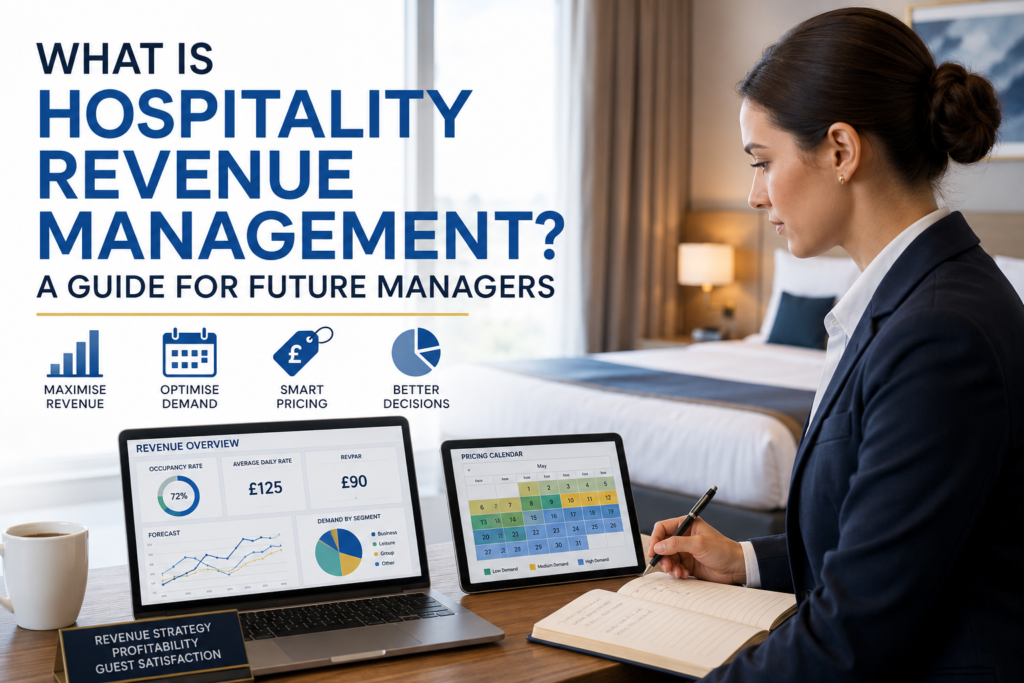
In simple terms, hospitality revenue management helps businesses make better decisions about pricing and availability. For hotels, this often means deciding how much to charge for rooms on different dates. For wider hospitality businesses, it may also involve restaurant reservations, events, meeting spaces, spa treatments, package deals and seasonal offers.
For future managers, understanding hospitality revenue management is essential because the hospitality industry is highly changeable. Demand can rise or fall depending on the season, local events, school holidays, flight patterns, economic conditions, customer behaviour and competitor pricing. A manager who understands revenue management can make informed decisions that support both profitability and customer satisfaction.
What does hospitality revenue management mean?
Hospitality revenue management is the strategic use of pricing, inventory and demand data to maximise income from a limited supply of products or services.
In a hotel, the most obvious example is the number of rooms available. A hotel cannot sell yesterday’s empty room tomorrow. Once the night has passed, that opportunity to earn revenue has gone. This is why hospitality businesses must think carefully about pricing and capacity.
For example, a hotel may charge different rates for the same room depending on:
- the day of the week
- the time of year
- local events or conferences
- how far in advance the booking is made
- the number of rooms still available
- competitor prices
- expected demand
- cancellation patterns
- customer type, such as business or leisure guests
This does not mean simply charging the highest possible price. Effective hospitality revenue management is about balance. If prices are too low, the business may fill rooms but lose potential revenue. If prices are too high, customers may book elsewhere. The aim is to find the best price for the market conditions at that time.
Why is revenue management important in hospitality?
Revenue management is important because hospitality businesses often have fixed capacity and perishable inventory.
A hotel has a set number of rooms. A restaurant has a limited number of tables. An event venue has a maximum capacity. If those spaces are not sold at the right time, the revenue opportunity may be lost.
Hospitality businesses also have significant operating costs, including staffing, utilities, maintenance, marketing, technology, cleaning, food and beverage supplies, and property costs. Revenue management helps managers make more informed commercial decisions so that the business can remain competitive and profitable.
For example, a hotel manager may need to decide whether to:
- reduce room rates during a quiet period
- increase prices during a major event
- offer early booking discounts
- restrict discounted rates when demand is strong
- create packages that include breakfast or spa access
- work with online travel agencies
- encourage direct bookings through the hotel website
- adjust staffing levels based on expected occupancy
These decisions affect revenue, guest experience and long-term business performance.
Key terms in hospitality revenue management
Future hospitality managers need to understand some of the main terms used in revenue management.
Occupancy rate
Occupancy rate shows the percentage of available rooms that have been sold.
For example, if a hotel has 100 rooms and sells 80 of them on a particular night, the occupancy rate is 80%.
A high occupancy rate may suggest strong demand, but it does not always mean the hotel is maximising revenue. If all rooms are sold too cheaply, the business may still miss out on potential income.
Average Daily Rate
Average Daily Rate, often called ADR, shows the average room revenue earned from each occupied room.
For example, if a hotel earns £8,000 from 80 occupied rooms, the ADR is £100.
ADR helps managers understand whether pricing is strong, weak or changing over time.
Revenue per Available Room
Revenue per Available Room, known as RevPAR, combines occupancy and average daily rate. It is one of the most widely used hotel performance measures because it considers both how many rooms were sold and the price achieved.
For example, a hotel with high occupancy but low prices may have a lower RevPAR than a hotel with slightly lower occupancy but stronger rates.
RevPAR helps managers assess how effectively the hotel is using its available room capacity.
Forecasting
Forecasting is the process of predicting future demand. Revenue managers use past booking data, market trends, competitor information and upcoming events to estimate how many customers are likely to book.
Good forecasting helps managers decide when to increase prices, when to offer discounts and when to hold back rooms for higher-value bookings.
Dynamic pricing
Dynamic pricing means changing prices in response to demand, availability and market conditions.
This is common in hotels, airlines and travel businesses. Prices may rise when demand is high and fall when demand is low. Dynamic pricing allows hospitality businesses to respond more quickly to changes in the market.
How does hospitality revenue management work?
Hospitality revenue management usually involves several connected stages.
First, managers collect data. This may include booking patterns, cancellation rates, customer segments, competitor prices, seasonal trends, online search behaviour and historical sales.
Second, they analyse demand. They look at when customers are likely to book, which dates are expected to be busy, which customer groups are most profitable and how price-sensitive different guests may be.
Third, they set pricing and availability rules. This may involve adjusting room rates, limiting discounts, creating packages, setting minimum-stay requirements or encouraging direct bookings.
Fourth, they monitor performance. Managers track results using measures such as occupancy, ADR, RevPAR and total revenue.
Finally, they adjust the strategy. Revenue management is not a one-time activity. It requires continuous review because market conditions can change quickly.
Revenue management beyond hotel rooms
Although hospitality revenue management is often associated with hotels, the same principles can apply across the wider hospitality and tourism industry.
Restaurants may use revenue management by adjusting table availability, managing peak-time bookings, offering set menus, or using deposits for high-demand periods.
Event venues may change prices depending on the season, day of the week, event type or expected demand.
Resorts may use revenue management across accommodation, spa services, restaurants, activities and package holidays.
Airlines, cruise companies, conference centres and travel operators also use similar methods to manage capacity, pricing and demand.
For future managers, this means revenue management is not only a hotel skill. It is a wider commercial management skill that can support careers across hospitality, tourism and travel.
The role of technology in hospitality revenue management
Technology now plays a major role in hospitality revenue management. Many hotels use property management systems, channel managers, booking engines and revenue management software to help track bookings and recommend pricing decisions.
Modern systems can process large amounts of data much faster than a manager could do manually. They may analyse competitor pricing, booking pace, market demand, historical trends and customer behaviour.
Artificial intelligence is also becoming more important. AI-supported revenue management tools can help managers forecast demand, identify pricing opportunities and respond more quickly to changes in the market.
However, technology does not replace management judgement. Future hospitality managers still need to understand the principles behind the data. A system may recommend a price, but managers must consider brand positioning, guest expectations, customer loyalty, service quality and long-term reputation.
Revenue management and customer experience
One common misunderstanding is that revenue management is only about increasing prices. In reality, successful hospitality revenue management should also support the customer experience.
Customers are more likely to accept variable pricing when it feels fair, transparent and linked to value. For example, guests generally understand that hotel rooms cost more during school holidays, major events or peak travel seasons.
Problems can occur when pricing feels confusing, excessive or inconsistent. Managers must therefore balance commercial goals with customer trust.
Good revenue management considers questions such as:
- Does the price reflect the quality of the experience?
- Are customers clear about what is included?
- Are cancellation terms fair and easy to understand?
- Are direct booking benefits clearly explained?
- Are loyal customers being recognised?
- Is the business protecting its brand reputation?
Future managers need to understand that revenue management is not just a financial activity. It is also linked to marketing, operations, customer service and brand strategy.
Skills needed for hospitality revenue management
A successful revenue manager needs a mixture of analytical, commercial and communication skills.
Analytical skills are important because revenue management involves interpreting data, identifying patterns and making evidence-based decisions.
Commercial awareness is also essential. Managers must understand pricing, profitability, customer demand, competitor behaviour and market positioning.
Communication skills matter because revenue management decisions affect different departments. Front office teams, sales teams, marketing staff, finance departments and general managers all need to understand the strategy.
Future managers should also develop confidence with technology, spreadsheets, booking systems and performance dashboards.
Important skills include:
- data analysis
- forecasting
- pricing strategy
- financial awareness
- problem solving
- communication
- decision-making
- market research
- customer understanding
- adaptability
These skills are valuable not only in hotels but across the wider hospitality, tourism and service sectors.
Example of hospitality revenue management in practice
Imagine a city hotel with 120 rooms.
During a normal weekday in January, demand may be low. The hotel may reduce rates, offer breakfast packages, promote direct bookings or target business travellers.
During a major concert weekend, demand may rise sharply. The hotel may increase rates, remove discounted offers, require a two-night minimum stay and monitor competitor prices closely.
During a school holiday, the hotel may create family packages that include breakfast, late checkout or attraction tickets.
In each case, the manager is not simply choosing a price at random. They are using demand, customer behaviour and business objectives to make a more informed decision.
This is the practical purpose of hospitality revenue management.
Why future managers should study hospitality revenue management
Hospitality revenue management is a valuable area of study because it connects theory with real business decision-making. It helps learners understand how hospitality organisations generate income, respond to demand and compete in changing markets.
For students aiming to become hotel managers, resort managers, operations managers, front office managers, sales managers or entrepreneurs, revenue management provides an important commercial foundation.
It also helps learners understand the relationship between pricing and service. A hospitality business must attract customers, deliver value and remain profitable. Revenue management supports all three aims when used effectively.
Study hospitality revenue management online with Click College
Click College offers flexible online hospitality and tourism courses designed for learners who want to develop their knowledge of the industry while studying around work, family or other commitments.
Our hospitality-related courses are delivered online, allowing learners to study from anywhere and progress at their own pace. This makes them suitable for both new learners and those already working in hospitality who want to strengthen their management knowledge.
For learners interested in pricing, performance, demand forecasting and hotel profitability, the Professional Diploma in Hospitality Revenue Management provides a focused route into this important area of hospitality management.
The course is especially relevant for learners who want to understand how hospitality businesses use data, pricing and strategy to improve performance.
Final thoughts
Hospitality revenue management is about making smarter commercial decisions in a fast-moving industry. It involves understanding demand, setting appropriate prices, managing capacity and using data to improve business performance.
For future managers, it is a key skill because hospitality organisations must balance customer satisfaction with profitability. Whether working in hotels, resorts, restaurants, events or tourism businesses, managers who understand revenue management are better prepared to make informed decisions.
As technology, data and artificial intelligence continue to shape the hospitality sector, revenue management is likely to become even more important. Studying hospitality revenue management can therefore help future managers build the confidence and knowledge needed for modern hospitality careers.
Explore Online Hospitality and Tourism Management Courses
Choosing the right hospitality and tourism management course depends on your current experience, career ambitions and preferred level of study.
Whether your goal is to enter the industry, move into management, specialise in hotel revenue, strengthen tourism expertise or build degree-level strategic capability, online study provides a flexible route towards your next step.
Explore the full Hospitality & Tourism Management course range here:
Ready to enrol?
Take Your Next Step Today
Ready to advance your professional management career with an accredited, flexible qualification? Visit Click College to explore their comprehensive online courses or discover detailed information about their range of qualifications.
For further enquiries or to enrol today, visit the Click College website and begin your journey toward professional excellence.







Recent Posts
Which Online Management Course Should I Choose? Business, Marketing, Finance, HR, Hospitality or Project Management
Which Online Management Course Should I Choose? Business, Marketing, Finance, HR, Hospitality or Project Management Choosing an online management course can be difficult because Business Management, Marketing, Finance, Human Resources, Hospitality and Project Management all overlap. Every organisation needs to attract customers, manage money, support its staff and deliver work effectively. The best choice depends […]
How Consumers Evaluate Alternatives: Shortlists, Decision Rules and Choice Overload
How Consumers Evaluate Alternatives: Shortlists, Decision Rules and Choice Overload Why can two customers examine the same products and reach completely different conclusions? One may choose the least expensive option, another may pay more for reassurance, and a third may postpone the decision altogether. Consumers evaluate alternatives by reducing a broad market to a manageable […]
How Social Influences Shape Consumer Buying Behaviour
How Social Influences Shape Consumer Buying Behaviour Why do people ask friends for recommendations, check reviews before buying or choose products that appear popular within their professional or social group? Social influences shape consumer buying behaviour by providing information, establishing expectations and signalling which choices appear credible, accepted or appropriate. The main social influences include […]