Professional Diploma vs Certificate: What Is the Difference?
If you are comparing online qualifications, you may have seen terms such as professional diploma, certificate, higher certificate, diploma, award and degree-level qualification. At first, these titles can seem confusing. Is a professional diploma higher than a certificate? Is a certificate shorter? Which one is better for your career? And how do you know which option is right for you?
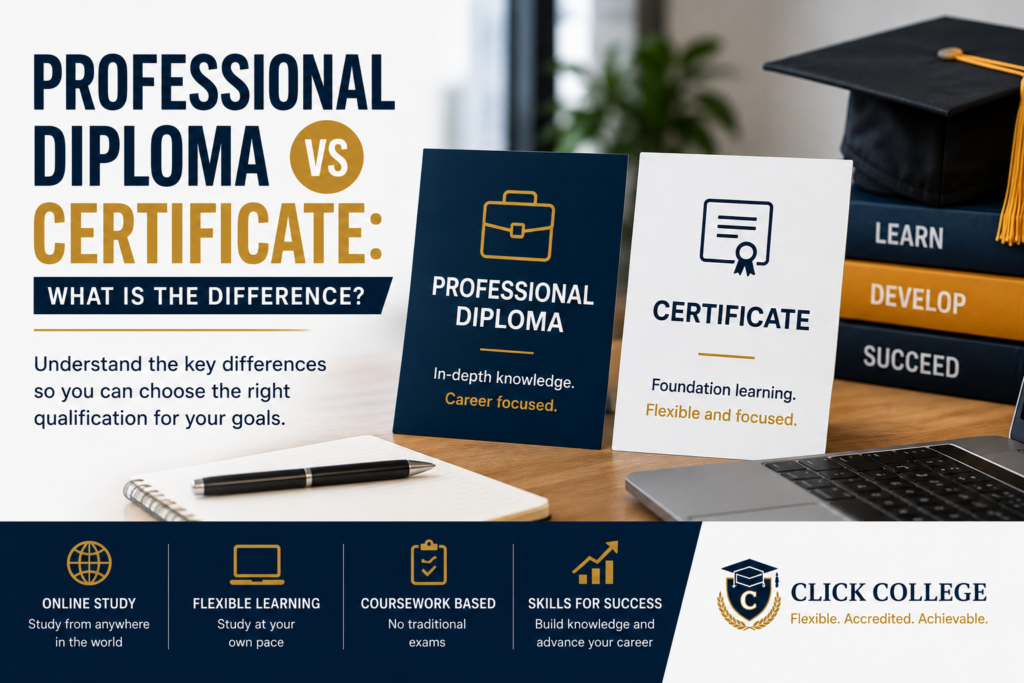
The key difference between a professional diploma and a certificate is usually the depth, size and purpose of the qualification.
A certificate is often shorter and may introduce a subject or confirm completion of a specific area of learning. A professional diploma is usually more detailed, career-focused and designed to develop practical knowledge in a professional field. However, the exact meaning depends on the qualification level, credit value, awarding body and course provider.
This means you should not judge a course by the word “certificate” or “diploma” alone. A certificate at Level 4 may be more advanced than a diploma at Level 2. A 120-credit certificate may be larger than a 40-credit diploma. A professional diploma may be ideal for career development, while a certificate may be better for a shorter introduction to a subject.
Understanding the difference can help you choose the right qualification for your goals.
Professional diploma vs certificate: quick answer
A professional diploma is usually a career-focused qualification designed to develop applied knowledge in a specific subject area. It often includes structured assessment and may carry academic credits.
A certificate can mean different things. It may be a short certificate of completion, a CPD certificate, or a formal academic qualification such as a Level 4 Certificate or Higher International Certificate.
The main difference is not just the title. The most important factors are:
- the qualification level
- the number of credits
- the assessment method
- the subject depth
- the awarding or accrediting body
- the purpose of the course
- whether it supports progression to further study
In simple terms, a professional diploma is often more detailed and career-focused, while a certificate is often shorter or more introductory. However, there are exceptions, so learners should always check the course details carefully.
What is a professional diploma?
A professional diploma is a qualification designed to develop knowledge and skills for a particular career area or professional subject. It is often more applied than a purely academic course and is usually aimed at learners who want to build practical understanding for work, career progression or further study.
Professional diplomas are commonly available in areas such as business, management, project management, marketing, finance, human resources, hospitality, tourism, engineering management and other professional fields.
A professional diploma may help learners:
- gain knowledge in a specific subject
- develop career-relevant skills
- build confidence before higher-level study
- support professional development
- change career direction
- strengthen their CV
- progress towards larger qualifications
At Click College, Professional Diplomas are typically 40-credit qualifications. They are designed as focused, modular routes into professional study and may also support progression towards larger qualifications, depending on the subject and pathway.
This makes them useful for learners who want a structured qualification but do not necessarily want to commit immediately to a longer 120-credit, 240-credit or 360-credit programme.
What is a certificate?
A certificate is a broad term, and this is where confusion often begins.
In education, a certificate may mean several different things.
It may be a certificate of attendance, which simply confirms that someone attended a course or training session. It may be a certificate of completion, which confirms that a learner completed an online course. It may be a CPD certificate, which shows continuing professional development. Or it may be a formal qualification, such as a Level 4 Certificate, Higher National Certificate or Higher International Certificate.
This means that the word certificate does not automatically tell you the level, size or value of the course.
Some certificates are very short. Others are substantial higher education qualifications. For example, a Higher International Certificate may carry 120 credits and represent a significant amount of study.
A certificate may be suitable for learners who want:
- an introduction to a subject
- a shorter study route
- evidence of completion
- professional development
- a first step into higher education
- a foundation before moving to a diploma
- a qualification with a specific credit value
The important point is that not all certificates are the same. Learners should check whether the certificate is formally assessed, what level it is, how many credits it carries, and whether it supports progression.
Professional diploma vs certificate: comparison table
| Feature | Professional Diploma | Certificate |
|---|---|---|
| Main purpose | Career-focused professional development | Introduction, completion evidence, CPD or formal qualification |
| Typical depth | Often more focused and applied | Can be short or substantial, depending on the course |
| Assessment | Often assessed through assignments or coursework | May be assessed or non-assessed, depending on the type |
| Credit value | May carry credits, such as 40 credits | May carry no credits, few credits or substantial credits |
| Career use | Often used to build subject knowledge for work or progression | Often used to show completion, foundation knowledge or formal study |
| Progression | May support progression to larger qualifications | May support progression if it is a formal qualification |
| Best for | Learners wanting practical, career-related knowledge | Learners wanting a shorter introduction or recognised foundation |
| Important check | Level, credits and assessment | Whether it is formal, assessed and credit-bearing |
Is a diploma always higher than a certificate?
No, a diploma is not always higher than a certificate.
This is one of the most common misunderstandings. In the UK qualification system, certificates and diplomas can exist at different levels. For example, there can be Level 3 certificates, Level 4 certificates, Level 5 diplomas and Level 6 diplomas.
The word “diploma” often suggests a larger or more detailed course, but it does not automatically mean the qualification is higher.
For example, a Level 4 certificate is academically higher than a Level 3 diploma because Level 4 is above Level 3. However, a Level 5 diploma is academically higher than a Level 4 certificate because Level 5 is above Level 4.
A great example of this is the range of Higher International Certificates available from Click College, which are all aligned to Level 4 and carry a credit-value of 120 credits (60 ECTS), making them academically comparable to studying the first year of a university undergraduate course.
This is why learners should always look at the level first.
A simple rule is:
Level tells you the difficulty.
Credits tell you the size.
The qualification title tells you the type of award.
You need all three pieces of information to understand what you are studying.
What does “professional” mean in professional diploma?
The word professional usually means that the course is designed to support career development or workplace knowledge. It does not always mean the qualification gives you a professional licence or automatic membership of a professional body.
A professional diploma is usually practical, applied and connected to real working environments. For example, a Professional Diploma in Project Management may focus on planning, operations, risk and delivery. A Professional Diploma in Hospitality Revenue Management may focus on pricing, demand, customer behaviour and profitability in hospitality settings.
The professional focus can make these qualifications attractive to learners who want more than a short course but do not necessarily want a full degree programme.
Professional diplomas can be especially useful for:
- adult learners
- career changers
- working professionals
- learners seeking promotion
- international learners
- people wanting flexible online study
- learners building towards higher-level qualifications
The value of a professional diploma depends on its level, credit value, subject relevance and how well it matches your goals.
What does “certificate” mean in professional education?
In professional education, a certificate may mean a short course, a formal qualification or evidence of completion.
This can make the term difficult to compare.
For example, a free online course may offer a certificate of completion after a few hours of learning. This can be useful for personal development, but it may not carry academic credits or formal assessment.
By contrast, a Higher International Certificate may be a substantial qualification with a defined level, credit value and assessment structure.
This means that when comparing a professional diploma vs certificate, you should ask:
Is the certificate assessed?
Does it carry credits?
What qualification level is it?
Who awards or accredits it?
Is it recognised for progression?
Does it match my career goals?
Without these details, the word certificate alone does not tell you enough.
Which is better: professional diploma or certificate?
Neither is automatically better. The right choice depends on what you want to achieve.
A professional diploma may be better if you want a career-focused qualification, more subject depth, practical assignments and a stronger link to professional development.
A certificate may be better if you want a shorter introduction, a foundation course, evidence of completion or a first step before committing to a larger qualification.
For example, if you are exploring a new subject and want to see whether it suits you, a certificate may be enough. If you want to build practical knowledge in a specific professional area, a professional diploma may be more suitable.
If you are planning long-term progression, such as moving from Level 4 to Level 5 and Level 6, you should look carefully at the pathway. In some cases, a certificate may form part of a larger academic route. In other cases, a professional diploma may provide a modular entry point that can be combined with further study.
Why credits matter when comparing qualifications
Credit value is one of the clearest ways to understand the size of a qualification.
Credits represent the amount of learning involved. A course with more credits usually involves more study time, more content and more assessment than a course with fewer credits at the same level.
For example, a 40-credit professional diploma is smaller than a 120-credit higher certificate. However, both may still be valuable for different reasons.
A 40-credit professional diploma may be ideal for focused professional development in a specific area. A 120-credit certificate may provide a broader foundation across a wider subject area.
At Click College, the main qualification sizes include:
- Professional Diploma: 40 credits
- Higher International Certificate: 120 credits
- Higher International Diploma: 240 credits
- International Graduate Diploma: 360 credits
This gives learners different entry points depending on how much study they want to complete and how far they want to progress.
Why qualification level matters
The level of a qualification tells you how advanced the study is.
For example, Level 4 is often associated with the first stage of higher education. Level 5 is more advanced and is often compared with the second year of undergraduate study. Level 6 is degree-level and is commonly associated with final-year undergraduate study.
This means a 40-credit Level 6 professional diploma may be more academically advanced than a 120-credit Level 4 certificate, even though it is smaller.
That is why level and credits must be considered together.
A good way to think about this is:
Level answers the question: “How difficult is the study?”
Credits answer the question: “How much study is involved?”
Subject answers the question: “What will I actually learn?”
Progression answers the question: “Where can this lead next?”
When comparing a professional diploma and a certificate, all four questions matter.
Professional diploma vs certificate for career development
For career development, a professional diploma is often useful because it focuses on practical knowledge in a defined subject area.
For example, a learner who wants to move into operations management may choose a Professional Diploma in Operations Management. A learner interested in hospitality may choose a Professional Diploma in Hospitality Management. A learner interested in finance may choose a Professional Diploma in Finance.
These courses can help learners build confidence, understand professional concepts and show commitment to development.
A certificate can also support career development, especially if it is relevant, assessed and recognised. It may be useful for building foundation knowledge or demonstrating interest in a subject.
However, employers will usually look at the whole picture. They may consider the level of the qualification, its relevance, the learner’s experience, communication skills, practical ability and attitude.
A qualification can support career progression, but it does not guarantee a specific job or promotion on its own.
Professional diploma vs certificate for changing career
If you are changing career, both certificates and professional diplomas can be useful.
A certificate may be a good starting point if you are exploring a subject for the first time. It can help you understand the basics before deciding whether to invest in a larger qualification.
A professional diploma may be better if you are more serious about entering a new field and want structured, career-focused learning.
For example, someone moving from retail into hospitality management may benefit from a professional diploma that introduces service operations, customer experience or revenue management. Someone moving from general administration into project management may benefit from a professional diploma covering planning, operations and project delivery.
The best choice depends on how much knowledge you need, how much time you can commit and whether you want the course to lead into further study.
Professional diploma vs certificate for further study
If your goal is further study, you should check whether the qualification supports progression.
Some certificates are designed as foundation qualifications that lead to higher-level study. Some professional diplomas may also be combined towards larger qualifications or used as modular entry points.
At Click College, Professional Diplomas can provide focused study in specific subject areas and may support progression towards larger qualifications, depending on the pathway. Higher International Certificates, Higher International Diplomas and International Graduate Diplomas provide broader credit-based progression routes.
If you want to progress to a specific course, institution or university, you should always check entry requirements directly before enrolling. Different providers may have different rules about what they accept.
This is especially important if you are using a qualification for postgraduate entry, university top-up, professional recognition, employment criteria or immigration purposes.
Why online professional diplomas are popular
Online professional diplomas have become popular because they offer flexibility. Learners can study from home, from work or from another country. They can often study around employment, family commitments or other responsibilities.
This flexibility is especially useful for adult learners and working professionals who cannot attend fixed classes on a campus.
Online professional diplomas may also be assessed through coursework rather than traditional timed exams. This can appeal to learners who prefer written assignments, applied tasks and independent study.
However, flexible study still requires discipline. Learners need to manage their time, complete the course materials and submit their assignments properly.
The advantage is that they can often do this in a way that fits around real life.
Study professional diplomas online with Click College
Click College offers flexible online Professional Diplomas across a range of career-focused subject areas. These qualifications are designed for learners who want practical, structured study without committing immediately to a full-length programme.
Click College Professional Diplomas are typically 40-credit qualifications. They can provide focused learning in areas such as business, management, project management, marketing, finance, hospitality, tourism and related professional subjects.
The courses are delivered online, allowing learners to study from anywhere. Assessment is completed through coursework, so learners can demonstrate their understanding through written assignments rather than traditional timed exams.
This makes Professional Diplomas suitable for learners who want a flexible, accessible and career-focused route into professional development.
For learners who want a larger qualification, Click College also offers Higher International Certificates, Higher International Diplomas and International Graduate Diplomas. These provide broader progression routes at 120, 240 and 360 credits.
How to choose between a professional diploma and a certificate
Before choosing between a professional diploma and a certificate, ask yourself what you want the qualification to do for you.
If you want a short introduction to a subject, a certificate may be suitable.
If you want career-focused, applied learning in a professional area, a professional diploma may be more appropriate.
If you want a substantial foundation for higher study, a higher certificate with a larger credit value may be a better fit.
If you want to progress towards degree-level study, you may need a longer pathway that builds through Level 4, Level 5 and Level 6.
Useful questions include:
- What level is the course?
- How many credits does it carry?
- Is it assessed?
- Is it online, classroom-based or blended?
- Does it involve exams or coursework?
- Who awards or accredits it?
- Does it support progression?
- Does the subject match my career goals?
- How much time can I realistically commit?
- Do I need the qualification for a specific employer, university or professional body?
These questions will give you a much clearer answer than the title alone.
Common mistakes when comparing diplomas and certificates
One common mistake is assuming that every diploma is better than every certificate. This is not always true. A certificate at a higher level may be more advanced than a diploma at a lower level.
Another mistake is ignoring credit value. A short professional diploma and a full higher certificate may both be useful, but they are not the same size.
A third mistake is assuming that all certificates are formal qualifications. Some are simply certificates of completion, while others are credit-bearing qualifications.
A fourth mistake is focusing only on the title rather than the course content. A qualification is only useful if the subject, level and assessment match your goals.
Finally, some learners forget to check progression. If you want to move on to a higher qualification, you should make sure your chosen course supports that route.
Professional diploma vs certificate: which should you choose?
Choose a professional diploma if you want focused, career-related learning in a specific subject area. This may be the better option if you are looking for practical knowledge, professional development or a modular route into further study.
Choose a certificate if you want an introduction, a shorter course, evidence of completion or a broader foundation qualification. This may be the better option if you are new to the subject or want a first step before committing to a diploma.
Choose a higher certificate or larger credit-bearing qualification if you want a more substantial academic pathway with progression to higher levels.
The best choice is the one that fits your starting point, goals, time commitment and preferred study style.
Frequently asked questions
Is a professional diploma better than a certificate?
Not always. A professional diploma is often more career-focused and detailed, but a certificate can be valuable if it is at the right level, carries credits and matches your goals. You should compare level, credits, assessment and progression rather than relying only on the title.
Is a certificate lower than a diploma?
A certificate is not always lower than a diploma. Certificates and diplomas can exist at different qualification levels. A Level 4 certificate is higher than a Level 3 diploma, while a Level 5 diploma is higher than a Level 4 certificate.
Is a professional diploma a recognised qualification?
A professional diploma can be a recognised qualification if it is properly awarded or accredited and has a clear level, credit value and assessment structure. Always check the course provider, awarding body, credits and progression options before enrolling.
Can a professional diploma help my career?
A professional diploma can support career development by helping you build knowledge in a relevant subject area. However, it does not guarantee a job or promotion. Employers will also consider your experience, skills, communication and suitability for the role.
Can I study a professional diploma online?
Yes, many professional diplomas can be studied online. Click College offers flexible online Professional Diplomas with coursework-based assessment, allowing learners to study from anywhere and progress at their own pace.
What is the difference between a diploma and a certificate of completion?
A diploma is usually a structured qualification with assessment and defined learning outcomes. A certificate of completion may simply confirm that you completed a course or training session. It may not carry academic credits unless clearly stated.
Final thoughts
The difference between a professional diploma and a certificate depends on more than the title.
A professional diploma is usually career-focused, applied and designed to develop knowledge in a specific professional area. A certificate may be shorter, introductory or simply evidence of completion, although some certificates are substantial formal qualifications.
The most important things to check are the qualification level, credit value, assessment method, awarding or accrediting body, course content and progression route.
For learners who want focused, flexible and career-related study, a professional diploma can be a strong option. For learners who want an introduction or foundation, a certificate may be the right starting point.
If you are comparing professional diploma vs certificate options, do not ask only which one sounds better. Ask which one fits your goals, your experience and your next step.
Explore Online Management Courses
Take Your Next Step Today
Ready to advance your professional management career with an accredited, flexible qualification? Visit Click College to explore their comprehensive online courses or discover detailed information about their range of qualifications.
For further enquiries or to enrol today, visit the Click College website and begin your journey toward professional excellence.:
Ready to enrol?




Recent Posts
Professional Diploma or Higher Qualification Pathway: Which Should You Choose?
Professional Diploma or Higher Qualification Pathway: Which Should You Choose? Choosing the right online qualification is not always simply a question of choosing the longest course or the highest level. For many learners, the better question is: what kind of study route fits my goals right now? Some learners want a focused qualification in one […]
Professional Diploma in Leadership and Management: Course Guide
Professional Diploma in Leadership and Management: Course Guide A Professional Diploma in Leadership and Management is designed for learners who want to develop advanced leadership, strategic thinking and organisational management skills without committing immediately to a full degree programme. Leadership and management are essential in almost every sector. Whether you work in business, education, hospitality, […]
Professional Diploma in Business Management: Who Is It For?
Professional Diploma in Business Management: Who Is It For? A Professional Diploma in Business Management is designed for learners who want to build practical business knowledge without committing immediately to a full degree or long higher education programme. It can be a useful option for people who want to understand how organisations work, how teams […]