Service Speed in Hospitality: Managing Waiting Times Without Rushing Guest
A guest waiting to pay a restaurant bill may want immediate attention. The same guest, halfway through a relaxed dinner, may resent being hurried. Both situations involve service speed, but each calls for a different response.
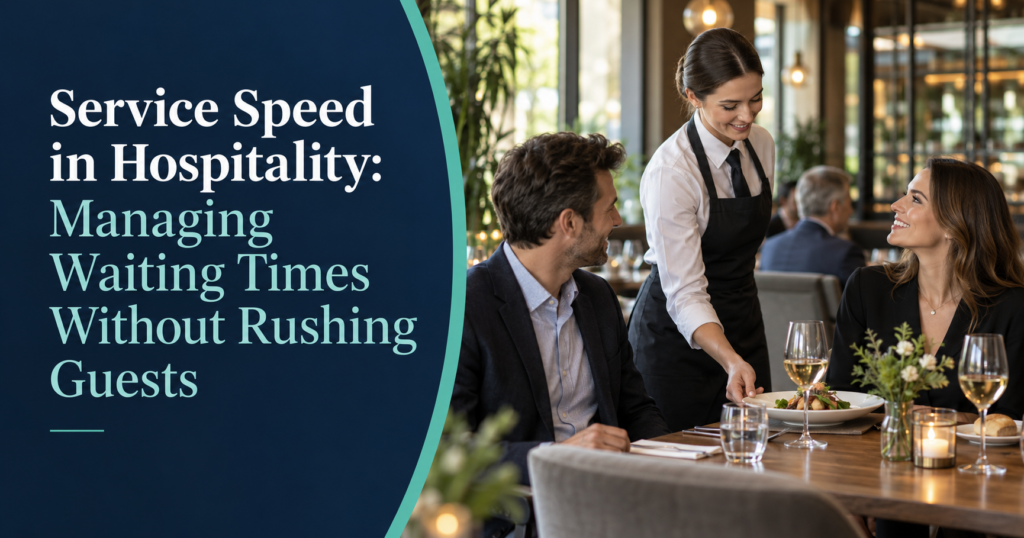
Good service speed in hospitality means delivering timely, reliable attention at a pace suited to the guest and the situation. Improving it involves removing avoidable delays, communicating realistic waiting times and coordinating staff effectively, while protecting accuracy, safety and the time customers need to enjoy their visit.
What does service speed mean in hospitality?
Service speed describes how quickly a business acknowledges customers, starts serving them, completes a task and responds when further help is needed.
These are separate parts of the experience. A receptionist might greet someone immediately, yet take several minutes to resolve a booking query. A restaurant might prepare meals efficiently but leave customers waiting to order or pay.
It is therefore useful to distinguish three measures:
| Measure | What it captures | Hospitality example |
|---|---|---|
| Time to acknowledgement | How long before the customer knows they have been noticed | A receptionist greets an arriving guest. |
| Time to service | How long before the requested activity begins | A server takes the customer’s order. |
| Time to completion | How long before the request is fulfilled | The meal arrives or the guest receives a working room key. |
A business can perform well on one measure and poorly on another. A quick greeting helps, but it does not remove the need to complete the service within a reasonable time.
Why faster service is not always better
The pace customers appreciate depends on what they are doing. Someone buying coffee before a train may prioritise speed. A couple celebrating an anniversary may value uninterrupted time at the table.
Research published in 2007 on restaurant meal pace found that excessively fast service during the meal could reduce satisfaction, while faster bill settlement was often appreciated. Responses also varied with the restaurant type and stage of the experience. 1
The practical lesson is to identify where time creates value for the guest and where it creates inconvenience. Enjoying a meal can be valuable time; searching for someone to bring the bill usually adds little to that experience.
Staff should also check individual preferences. A simple question about whether diners have a time commitment can reveal information that would otherwise remain hidden. Any promise about timing should then reflect what the kitchen can realistically deliver.
Actual waiting time and perceived waiting time
Actual waiting time is the time measured by a clock. Perceived waiting time is the customer’s judgement of how long the wait feels.
An earlier Cornell report on dining duration highlighted the importance of perceived pace and the mismatch between expected and experienced timing. Diners could react negatively both to excessive delays and to feeling rushed. 2
Consider two illustrative café experiences. In one, the customer receives an estimated collection time and can see where completed orders will appear. In the other, there is no information about the queue or whether the order has reached the preparation team.
Even if the actual waits are equal, the first arrangement gives the customer more useful information and a clearer basis for deciding whether to wait.
Managing perception should never involve misleading customers. A pleasant waiting area and regular updates can improve the experience, but recurring delays still require operational attention.
How to improve service speed in hospitality
Acknowledge customers promptly
Acknowledgement establishes that the customer has been noticed. This might be a greeting at reception, confirmation that a message has been received or a server explaining that a colleague will shortly take an order.
It should be brief enough to avoid unnecessarily interrupting the person already being served. Staff should also avoid promises such as “just a second” when they know the wait will be longer.
Acknowledgement is particularly useful when the next step is unclear. Customers need to know where to stand, whether to take a seat and how they will be called.
Give realistic estimates and update them
An estimate helps customers make decisions. However, it needs to reflect the current workload and the nature of the request.
For example, staff should check with the kitchen before giving a preparation time for a large food order. A receptionist should establish room readiness before promising immediate access.
If the estimate changes, the customer should receive an update before having to ask repeatedly. Staff can explain the revised position and any genuine options, such as luggage storage while a room is prepared.
Honesty is more useful than a precise time that the business cannot support.
Find the point where work is backing up
Slow service often becomes visible at the customer-facing stage even when its cause lies elsewhere.
A queue at reception may reflect rooms awaiting a readiness update. Delayed drinks may result from missing supplies or an unclear collection process. A payment queue may form because only one terminal is available.
Managers can follow a request from beginning to end and identify where it stops moving. Useful questions include whether information is missing, tasks are being repeated, equipment is unavailable or staff are waiting for approval.
Adding staff at the wrong point may leave the actual constraint unchanged.
Coordinate staffing and handovers
Staffing decisions should account for the work expected at particular times. Arrival patterns, bookings and scheduled events can all help managers anticipate pressure.
Clear handovers matter just as much as numbers. If a guest has already requested assistance, the next colleague should know what has been agreed and what still needs doing. Repeating the same explanation to several people adds effort for the customer without advancing the request.
These issues sit within the wider approach explored in Click College’s guide to customer service delivery in hospitality.
Keep queues understandable
Customers should be able to identify the correct queue and understand the order in which requests are handled.
Where a café accepts both mobile and counter orders, it can help to distinguish ordering from collection. Otherwise, customers may join the wrong line or repeatedly interrupt staff to check whether their drinks are ready.
Priority arrangements also need clear communication. An accessible service option or a separate collection point should be explained so customers can use it appropriately.
Use technology where it removes a specific delay
Digital check-in, ordering systems and mobile payment can help with particular tasks when they are reliable and suitable for the users.
However, moving a task onto a screen does not automatically shorten the whole process. A quicker ordering system may simply send more requests to a kitchen already working at capacity.
Managers should check what happens after the digital interaction, and ensure help remains available when a customer cannot use the system or encounters a problem.
Worked example: a café with slow order collection
The following is an illustrative management example, not a report of a real business.
A café receives complaints about lunchtime waits. Initial observations show that drinks are often ready before customers collect them. Ordering and collection take place at the same crowded counter, and completed orders are difficult to identify.
The manager separates the collection point, introduces clear order identification and gives one member of staff responsibility for communicating completed orders during the busiest period.
The proposed change targets the delay between preparation and collection. It does not assume that every part of the operation needs to run faster.
To judge whether the change works, the café could compare the time from order acceptance to handover before and after the trial. It should also check order errors, customer feedback and staff workload. If collection improves but preparation delays increase, the next investigation would focus on that stage.
How should service speed be measured?
A useful measurement approach combines timing with service quality.
| Indicator | What it can reveal |
|---|---|
| Typical waiting time | Whether the usual experience is improving |
| Longest waits or a high-percentile measure | Whether some customers still face substantial delays |
| Completion within the stated estimate | Whether timing promises are dependable |
| Errors and repeat work | Whether speed is being gained at the expense of accuracy |
| Guest comments about delays or rushing | Whether the pace suits the experience |
| Staff feedback | Where practical obstacles remain |
There is no single suitable waiting-time target for every hospitality business. Targets should reflect the service offered, the task involved, customer requirements and observed operating conditions.
Comparisons are most useful when the circumstances are similar. A quiet weekday breakfast and a fully booked weekend dinner are different operating conditions.
The aim is a dependable experience: customers receive attention when they need it, understand unavoidable waits and have enough time to enjoy the service they chose.
Frequently asked questions
What causes slow service in hospitality?
Possible causes include uneven demand, missing information, unsuitable staffing, equipment problems and poor coordination between departments. The visible queue does not always identify the underlying cause.
How can staff manage delays professionally?
Staff can acknowledge the customer, establish a realistic estimate, explain relevant options and provide updates when circumstances change. They should also ensure someone is responsible for progressing the request.
Does faster service always improve customer satisfaction?
No. Fast completion can be welcome for tasks such as payment, but guests may feel rushed if staff accelerate an experience they intended to enjoy at a relaxed pace.
How can hotels reduce check-in delays?
Hotels can review room-readiness updates, booking information, arrival patterns and the handling of complex enquiries. The most appropriate change depends on where the actual delay occurs.
References
[1] Noone, B. M., Kimes, S. E., Mattila, A. S. and Wirtz, J. (2007). The Effect of Meal Pace on Customer Satisfaction. Cornell University repository.
[2] Noone, B. and Kimes, S. E. (2005). Dining Duration and Customer Satisfaction. Cornell University repository.
Build Your Future in Hospitality and Tourism
Develop the knowledge to deliver better guest experiences, support effective operations and prepare for greater responsibility in hospitality and tourism.
Click College’s online courses cover customer service, hotel operations, tourism management and business leadership—skills relevant to hotels, restaurants, travel services, events and visitor attractions.
| Course | Level | Credits | Focus |
|---|---|---|---|
| Professional Diploma in Hospitality Management | 5 | 40 | Focused development in hospitality operations and management. |
| Professional Diploma in Hotel Management | 5 | 40 | Specialist knowledge of hotel operations and management. |
| Higher International Certificate in Hospitality and Tourism Management | 4 | 120 | A foundation in hospitality, tourism and business management. |
| Higher International Diploma in Hospitality and Tourism Management | 4–5 | 240 total | Broader operational, management and leadership knowledge. |
| International Graduate Diploma in Hospitality and Tourism Management | 4–6 | 360 total | Comprehensive study including strategic management and a research project. |
All courses are 100% online and self-paced, with no classes, no fixed schedules, no deadlines and no exams. Assessment is through coursework, with tutor support available throughout, so learning can fit around work and other commitments.
Compare Hospitality and Tourism Management courses and find the right route for your goals.
Explore Hospitality Courses
Start your journey in hospitality and tourism with an accredited Click College course. Enrol today and build the skills, knowledge, and confidence to progress into a management role.







Recent Posts
How to Build Trust Before a Customer Buys
How to Build Trust Before a Customer Buys Before a customer buys from an unfamiliar business, they are making more than a price comparison. They are deciding whether the offer is genuine, whether the organisation will deliver what it promises and whether help will be available if something goes wrong. That is why trust is […]
Why Customers Switch: The Trust and Value Signals That Drive Churn
Why Customers Switch: The Trust and Value Signals That Drive Churn Customers rarely switch simply because a competitor is cheaper. They switch when the relationship no longer feels safe, fair or worth the effort. A price rise may trigger the search, but unclear charges, poor support, weak proof and uncertainty about what happens next are […]
How to Find and Fix Friction in the Buying Journey
How to Find and Fix Friction in the Buying Journey Customers rarely decide not to buy for one dramatic reason. More often, small difficulties build up: a confusing product page, unclear pricing, a slow reply, an awkward form, conflicting information or a delivery promise that feels uncertain. Each issue may appear minor in isolation. Together, […]