Why Customers Switch: The Trust and Value Signals That Drive Churn
Customers rarely switch simply because a competitor is cheaper. They switch when the relationship no longer feels safe, fair or worth the effort. A price rise may trigger the search, but unclear charges, poor support, weak proof and uncertainty about what happens next are often what turn dissatisfaction into churn.
For businesses, the practical question is not only “Why did they leave?” It is: which trust and value signals made staying feel less sensible than switching?
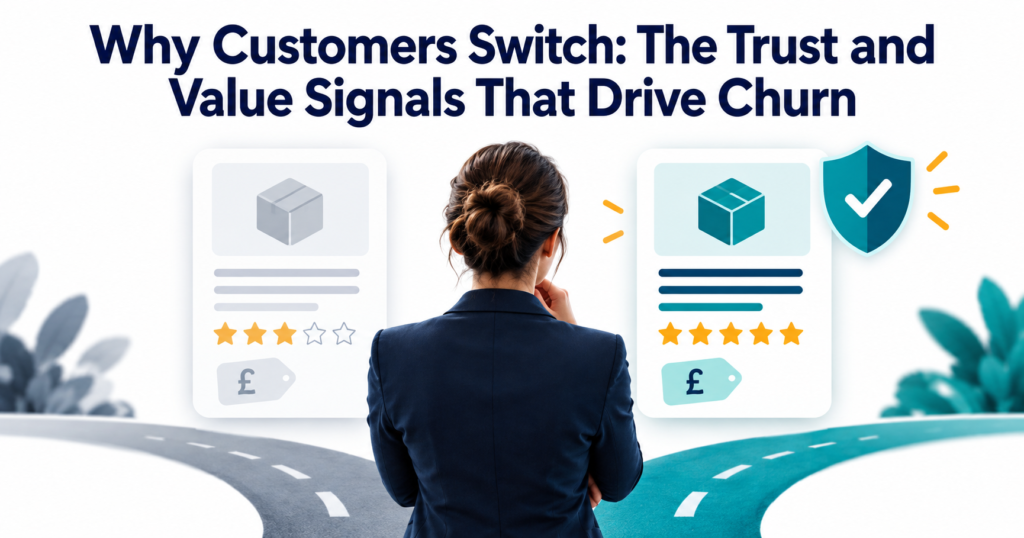
This article explains how those signals work, how trust and social proof interact, and how to spot the warning signs before a customer leaves.
Customer switching is a decision, not a single event
Churn is the loss of customers over a period of time. In subscription, contract and repeat-purchase markets, it is usually the final outcome of a decision process rather than an instant reaction.
Customers first notice a gap between what they are receiving and what they believe they should receive. That gap might be a higher renewal price, a service failure, a confusing bill, an offer that no longer fits their needs, or a competitor that makes a better outcome look possible. They then decide whether changing provider feels worthwhile and safe.
The effort of moving can protect an incumbent business for a while. Customers may delay research because comparing options, transferring data, returning a product or learning a new system feels inconvenient. But inertia is not loyalty. When a trigger makes the value gap visible, a previously passive customer can become an active switcher.
The four signals behind a switching decision
An editorial framework for diagnosing churn is the SAFE test: satisfaction, assurance, fairness and evidence. It is not a formal research scale, but it gives teams a practical way to examine why a customer may stay, delay or leave.
1. Satisfaction: is the current experience still good enough?
Customers compare the experience they receive with their expectations. Dissatisfaction can begin with a large failure, such as an unresolved complaint, but it can also develop through small repeated frictions: late delivery, an unreliable app, difficult contact routes or promises that do not match the service.
The commercial risk is greatest when a customer has a clear alternative. A poor experience is easier to tolerate when switching feels complicated; it becomes more dangerous when a competitor offers an obvious, credible and low-effort alternative.
Useful warning signs include repeat contacts about the same issue, lower usage, declining engagement, postponed renewals, cancelled add-ons and a rise in complaints that refer to competitors.
2. Assurance: does staying—or switching—feel safe?
Perceived risk is the customer’s sense that a decision could lead to a loss, disappointment or avoidable hassle. The loss may be financial, but it can also involve time, privacy, reliability, status or the risk of choosing badly.
For a customer considering a new provider, uncertainty increases the need for reassurance. Clear product information, realistic availability, straightforward cancellation terms, visible contact details and reliable problem resolution all reduce the risk of trying something new. In online markets, traders must provide specified pre-contract information; transparent information is therefore both a customer-experience issue and a compliance consideration.[1]
For the incumbent, assurance matters differently. A customer who trusts the organisation to explain a price change, correct a problem and treat them consistently may renew even when the offer is not the cheapest. A customer who expects friction or surprise costs is more likely to investigate alternatives.
3. Fairness: does the price still make sense?
Price and value are related, but they are not identical. A customer may accept a higher price where the offer is dependable, the benefits are clear and the total cost is easy to understand. Equally, a competitive headline price can lose credibility if mandatory charges appear late or the conditions feel difficult to interpret.
Fairness is especially important at renewal. Existing customers often compare what they are being asked to pay with promotional prices for new customers, a competitor’s offer or their own recent experience. If the organisation cannot make the difference understandable, the customer may interpret it as unfair rather than as a reflection of changing costs or service levels.
The response is not automatically a discount. A better response may be to present the full price early, explain what it includes, show meaningful options and make the trade-offs clear. The UK’s consumer-protection framework also places importance on transparent information and pricing in distance selling.[1]
4. Evidence: can the customer see proof that the choice is sound?
When a choice feels uncertain, people often look to other customers for information. Reviews, recommendations, case studies, ratings and visible adoption can act as social proof: evidence that others have had a satisfactory experience.
Social proof is most powerful when it answers the customer’s actual concern. A first-time buyer may want evidence that delivery is reliable. A contract customer may want to know whether changing provider is straightforward. A business buyer may look for relevant sector experience and proof that onboarding will not disrupt operations.
However, proof only works if it is credible. The Competition and Markets Authority’s guidance addresses fake reviews, concealed incentives and misleading review information, so businesses should treat authentic review collection and publication as a trust obligation rather than a marketing shortcut.[2]
Why trust and social proof work together
Trust is the customer’s confidence that the organisation will act reliably and fairly. Social proof is the external evidence they use to judge that confidence. They are connected, but they do different jobs.
Consider a customer at the end of a mobile contract:
- A renewal increase creates a reason to reassess value.
- Clear pricing, simple terms and responsive support reduce the perceived risk of staying or changing.
- Recent, specific reviews and recommendations help the customer decide which provider is most credible.
If risk is high, social proof is often used as a filter: customers search for reassurance before they progress. If reviews are vague, mixed or visibly unmanaged, they may delay the purchase or remain with the familiar provider. If the process appears clear and low-risk, social proof can become the tie-breaker between similar offers.
This is why a business should not treat reviews as a separate reputation-management task. They are part of the buying and retention journey.
First-time buyers, renewers and switchers need different reassurance
Not every buyer has the same starting point. A useful retention plan distinguishes between three groups.
| Buyer group | Main question | Most useful signals |
|---|---|---|
| First-time buyer | “Can I trust this organisation?” | Clear information, independent reviews, visible policies, proof of delivery or service quality |
| Renewing customer | “Is this still worth the money?” | Price explanation, recognition of their history, relevant options, reliable service record |
| Potential switcher | “Will changing make things better without creating new problems?” | Simple comparison, clear transfer or cancellation process, specific peer evidence, responsive support |
Sending every group the same promotion is rarely enough. A first-time buyer needs confidence to try. A renewing customer needs a reason to continue. A switcher needs proof that the disruption of change is justified.
A practical churn review: five questions to ask
Before launching a retention campaign, examine the decision from the customer’s perspective.
- What has changed? Identify the trigger: price, service quality, customer circumstances, competitor activity or a renewal date.
- Where is the customer uncertain? Map the points where they must search, compare, contact support or accept terms.
- Which cost feels unfair or unclear? Check the total price, mandatory extras, renewal communications and the language used to explain them.
- What proof is visible at the moment of doubt? Review ratings, recent comments, case studies, complaint responses and comparison information.
- What would make staying easier than leaving? Prioritise a genuine improvement—clarity, service recovery, a better-fitting option or less effort—rather than relying only on a short-term incentive.
This review turns churn from a retrospective metric into an operational improvement process. It also prevents a common mistake: trying to persuade customers to stay before understanding why staying feels risky or poor value.
Measure the leading indicators, not only cancellations
Cancellation numbers tell a business what has already happened. To act earlier, combine churn data with signals that suggest weakening confidence:
- renewal-page exits and abandoned quotations;
- a rise in comparison-related searches or competitor mentions in customer contacts;
- repeated billing, delivery or access queries;
- falling product use or reduced repeat-purchase frequency;
- changes in review themes, especially around fairness, clarity or support; and
- a widening gap between new-customer conversion and existing-customer renewal.
These signals should be reviewed by customer segment. A rising cancellation rate among price-sensitive customers may need a different response from declining retention among customers who cite service reliability. Treating every departure as a price problem can hide the real source of lost trust.
Make retention credible
Effective retention is not about trapping customers or making cancellation difficult. It is about making continued custom a decision the customer can defend to themselves.
That means matching the promise to the experience: prices should be understandable, key terms should be easy to find, service recovery should be prompt, and customer evidence should be genuine. Where the offer no longer fits, a lower-cost tier, a pause option or a more suitable alternative may protect trust better than a blanket discount.
Customers will always compare. The commercial objective is to ensure that, when they do, your business provides the clearest and most credible answer to two simple questions: Is this worth it? Can I trust it?
Build stronger marketing and retention capability with Click College
Understanding buyer behaviour helps marketing teams improve the full customer journey—from attracting first-time buyers to retaining customers at renewal.
- The Professional Diploma in Marketing is a focused 40-credit route for developing practical marketing and consumer-behaviour knowledge.
- The Higher International Certificate in Marketing Management is a Level 4, 120-credit foundation in contemporary marketing principles and practice.
- The Higher International Diploma in Marketing Management provides a 240-credit pathway incorporating Level 4 study where specified.
- The International Graduate Diploma in Marketing Management provides a 360-credit route incorporating earlier levels where specified, with advanced strategic and digital marketing study.
Compare the Marketing Management qualifications and choose the route that matches your current experience and professional goals.
Frequently asked questions
What is the main cause of customer churn?
There is rarely one universal cause. Churn commonly follows a change in perceived value, trust or fit: for example, a price rise that is not explained clearly, unresolved service problems, a better competitor offer or a customer whose needs have changed.
Can a business reduce churn without cutting prices?
Yes. Clear pricing, relevant options, reliable service, simple support and credible customer evidence can improve perceived value without reducing the headline price. The right approach depends on why customers are considering leaving.
Why are reviews important when customers are switching?
Switchers often face uncertainty about whether a new provider will be genuinely better. Specific, recent and authentic customer evidence can reduce that uncertainty and help them compare alternatives.
What should a business do when a customer complains at renewal?
First identify the source of concern—price, service, fit or uncertainty—then give a clear, proportionate response. A quick discount may not solve a problem caused by poor communication or a lack of trust.
References
[1] The Consumer Contracts (Information, Cancellation and Additional Charges) Regulations 2013, legislation.gov.uk.
[2] Fake reviews: guidance for businesses, Competition and Markets Authority, 2025.
Develop Your Marketing and ManagementSkills
Want to develop your understanding of marketing and business management? Explore Click College’s Marketing Management courses and choose the flexible online qualification that best supports your next step.
Alternatively, view our Business Management courses and start studying online today.







Recent Posts
How to Build Trust Before a Customer Buys
How to Build Trust Before a Customer Buys Before a customer buys from an unfamiliar business, they are making more than a price comparison. They are deciding whether the offer is genuine, whether the organisation will deliver what it promises and whether help will be available if something goes wrong. That is why trust is […]
How to Find and Fix Friction in the Buying Journey
How to Find and Fix Friction in the Buying Journey Customers rarely decide not to buy for one dramatic reason. More often, small difficulties build up: a confusing product page, unclear pricing, a slow reply, an awkward form, conflicting information or a delivery promise that feels uncertain. Each issue may appear minor in isolation. Together, […]
How Service Recovery Protects Customer Trust After Something Goes Wrong
How Service Recovery Protects Customer Trust After Something Goes Wrong No organisation delivers a perfect experience every time. A delivery arrives late, a booking is incorrect, an app fails at a crucial moment or a customer receives conflicting information. The original problem matters, but the response often determines what the customer remembers most clearly. This […]