Barriers to Communication in the Workplace and How They Can Be Overcome
Effective communication is central to the successful operation of any organisation. Employees must be able to exchange information, explain decisions, coordinate tasks, raise concerns and respond to change. However, communication does not always take place as intended.
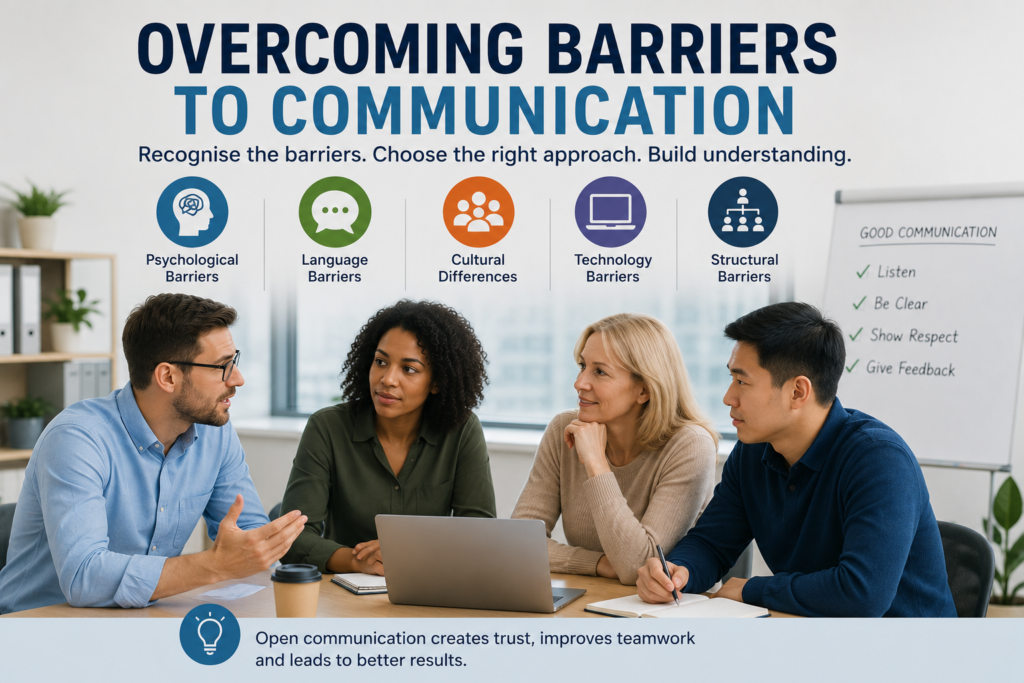
A message may be clear in the mind of the sender but misunderstood by the recipient. Important information may be delayed, distorted or overlooked. Employees may also avoid speaking openly because of anxiety, organisational hierarchy or a lack of trust.
These difficulties are known as communication barriers. They can arise from language, emotion, culture, technology, organisational structures, working environments and interpersonal relationships.
Understanding barriers to communication in the workplace is important because even a minor misunderstanding can have wider consequences. Errors may be repeated, deadlines may be missed and relationships may deteriorate. Over time, ineffective communication can weaken employee morale, productivity and organisational trust.
Communication barriers cannot always be eliminated completely. They can, however, be reduced through careful planning, inclusive practices, suitable communication channels and a workplace culture that encourages questions and feedback.
What Are Barriers to Communication?
A communication barrier is anything that interferes with the accurate transmission, reception or interpretation of a message.
Communication is often represented through a simple model in which a sender creates a message, delivers it through a channel and expects the receiver to understand it. In practice, each stage of this process can be affected by interference.
The sender may use unclear language. The selected communication channel may be unsuitable. The recipient may be distracted, anxious or unfamiliar with the subject. The message may also be influenced by organisational culture, hierarchy or previous experiences between the people involved.
Communication barriers therefore do not only prevent messages from being delivered. They may also cause a message to be interpreted differently from how it was intended.
For example, a manager may send a short email requesting an urgent update. The manager may believe the message is clear and efficient, while the recipient may interpret its brevity as criticism or frustration.
Recognising that communication is influenced by human interpretation is the first step towards improving it.
Why Communication Barriers Matter
Communication problems can affect almost every area of organisational activity.
When instructions are misunderstood, work may be completed incorrectly. When employees do not feel able to raise concerns, risks may remain hidden. When departments fail to share information, tasks may be duplicated or delayed.
Communication barriers may also affect workplace relationships. Employees who repeatedly feel ignored or misunderstood may become disengaged. Managers may lose trust in their teams, while employees may begin to rely on assumptions or informal rumours rather than official information.
The consequences are not always immediate. A series of small communication failures may gradually create a culture in which people become cautious, defensive or reluctant to contribute.
Organisations must therefore treat communication barriers as operational and cultural risks rather than as occasional personal misunderstandings.
Psychological and Emotional Barriers
Psychological and emotional barriers arise from the way people feel, think and respond to situations.
Stress, anxiety, fatigue and low confidence can all affect how a message is received. An employee working under pressure may misinterpret a neutral observation as criticism. Someone concerned about job security may view a routine organisational update as evidence that their position is at risk.
Previous experiences also shape communication. An employee who has been dismissed or embarrassed when raising concerns in the past may be reluctant to speak openly again.
Perceptual filters contribute to this problem. People interpret messages through their own beliefs, expectations and experiences. Two employees may therefore respond very differently to the same information.
Psychological barriers may result in defensive behaviour, avoidance or selective listening. The individual may hear only the parts of a message that confirm their existing concerns.
These barriers can be reduced by creating a psychologically safe communication climate. Employees should feel able to ask questions, admit uncertainty and express concerns without fear of ridicule or unfair consequences.
Managers can support this by responding calmly, listening carefully and avoiding unnecessarily confrontational language. Regular one-to-one discussions, mentoring and opportunities for reflection can also help employees process information more thoughtfully.
Emotional intelligence is especially important. Communicators must be aware not only of their own emotions but also of how the timing, tone and context of a message may affect others.
Language and Semantic Barriers
Language and semantic barriers occur when the words used by the sender are not understood in the intended way.
Organisations often use technical terminology, abbreviations and acronyms. While these may be familiar to experienced specialists, they can confuse new employees, customers or colleagues from other departments.
Ambiguous wording can also create problems. Instructions such as “complete this soon” or “make the necessary changes” do not explain the required action or deadline clearly.
Complex sentence structures and unnecessarily formal language may further reduce understanding. A message may appear professional but still fail to communicate effectively.
Semantic barriers are particularly significant in technical, legal and regulated environments, where precise interpretation is important. A small difference in wording may affect how a procedure is followed or how a decision is understood.
The most effective response is to use clear, audience-appropriate language. Specialist terms should only be used where necessary and should be explained when the audience may not understand them.
The structure of the message also matters. Important information should be presented logically, and responsibilities, deadlines and expected actions should be made explicit.
Feedback loops can help confirm understanding. The recipient may be asked to summarise the instruction or explain what they intend to do next. This is not a test of the individual but a way of checking whether the communication process has been successful.
Cultural and Inclusion-Related Barriers
Cultural differences influence how people communicate, interpret behaviour and respond to authority.
In some cultures, direct communication is viewed as honest and efficient. In others, the same approach may be considered blunt or disrespectful. Attitudes towards hierarchy also differ. Some employees may feel comfortable challenging a manager, while others may believe that disagreement with senior staff is inappropriate.
Non-verbal communication may also be interpreted differently. Eye contact can indicate confidence in one cultural context but may be considered confrontational in another. Silence may represent reflection, respect, uncertainty or disagreement.
Generational differences, language proficiency, neurodiversity and individual communication preferences add further complexity.
An organisation may unintentionally exclude employees when it assumes that one communication method will work equally well for everyone. A rapid verbal briefing may be difficult for someone who requires additional processing time. A digital platform may be inaccessible to some employees, while others may find long formal meetings unnecessarily difficult to follow.
Overcoming cultural and inclusion-related barriers requires more than recognising that people are different. Communication systems must be designed with those differences in mind.
Important information may need to be provided in more than one format. Written guidance can support a verbal briefing, while video content may require captions or transcripts. Employees should also be encouraged to explain their communication needs without being treated as difficult or uncooperative.
Inclusive communication is based on respect, flexibility and a willingness to adapt.
Organisational and Structural Barriers
Some communication barriers are created by the design of the organisation itself.
Rigid hierarchies may discourage employees from sharing information with senior leaders. Messages may need to pass through several management levels, increasing the possibility that details will be delayed or altered.
Departmental silos create another barrier. Teams may focus narrowly on their own responsibilities and fail to share relevant information with other parts of the organisation.
Unclear reporting lines can also result in confusion. Employees may not know who should receive an update, who has authority to make a decision or who is responsible for communicating a change.
Structural barriers become more serious when an organisation lacks clear communication procedures. Different managers may use different channels, provide inconsistent information or assume that another person has already communicated the message.
These problems can be reduced by clarifying reporting relationships and assigning responsibility for important communications. Employees should know where official information is stored and which channels should be used for urgent issues, routine updates and confidential concerns.
Organisations may also benefit from communication audits. These examine how information moves through the organisation, where delays occur and which groups are regularly excluded or poorly informed.
Open-door policies, staff forums and confidential reporting systems can support upward communication. However, these channels only work when employees believe that their views will be taken seriously.
Environmental and Situational Barriers
The physical and situational context in which communication takes place can influence whether the message is understood.
Noise, poor lighting, interruptions and uncomfortable working conditions may make it difficult to concentrate. A sensitive conversation held in an open-plan office may prevent the employee from speaking honestly because they fear being overheard.
Time pressure is another common barrier. Employees may receive instructions while they are distracted by several urgent tasks. Managers may communicate too quickly because they are under pressure, leaving insufficient time for questions.
Remote and hybrid working create different environmental challenges. Employees may have poor internet connections, inadequate equipment or unsuitable home working spaces. They may also miss informal conversations that would normally take place in an office.
Without spontaneous interaction, small misunderstandings may remain unresolved for longer. Remote employees may also feel excluded if important discussions occur informally among office-based colleagues.
Environmental barriers can be reduced by choosing an appropriate place and time for communication. Important or sensitive discussions should take place in a private and reasonably quiet setting.
In remote teams, organisations should establish clear expectations about response times and channel use. Employees should know when to use email, instant messaging, telephone calls or video meetings.
Managers should also ensure that remote staff receive the same information as colleagues who are physically present.
Technological Barriers
Digital technology has expanded the range and speed of workplace communication, but it has also introduced new barriers.
Unreliable internet connections, incompatible systems and poorly designed software can interrupt communication. Employees may struggle to use a platform if they have not received appropriate training.
Information overload is another major problem. Staff may receive messages through email, instant messaging, video platforms, project systems and automated notifications. Important information can be lost among routine updates.
This can create message fatigue, where employees become less attentive because they receive too many notifications.
Digital communication also removes many non-verbal cues. An email or instant message does not communicate facial expression, body language or vocal tone. This increases the possibility that the message will be interpreted emotionally.
Video meetings restore some of these cues but bring other difficulties, including screen fatigue, delayed audio and reduced concentration.
Technological barriers can be reduced by standardising platforms and clearly defining the purpose of each system. Employees should not have to check several different locations to find official information.
Training should be provided, and communication tools should be accessible and reliable. Organisations should also avoid using digital technology simply because it is available.
Complex or sensitive issues may require a richer channel, such as a video or face-to-face conversation. Written systems are generally more suitable for straightforward information and matters requiring a permanent record.
Interpersonal and Relationship-Based Barriers
Communication is strongly influenced by the quality of relationships between individuals.
A lack of trust may cause employees to withhold information or question the motives behind a message. Personality clashes can lead to defensiveness, while previous disagreements may influence how even neutral communication is interpreted.
Poor listening is another interpersonal barrier. A person may focus on preparing their response rather than trying to understand the speaker. They may interrupt, dismiss concerns or make assumptions before the full message has been expressed.
Status and power can also affect interpersonal communication. An employee may be reluctant to disagree with a senior manager, even when they possess important information.
These barriers cannot be resolved through technology or procedures alone. They require respect, empathy and consistent behaviour.
Active listening is particularly important. This involves concentrating on the speaker, asking relevant questions and summarising the message to confirm understanding.
Conflict resolution training can also help employees address disagreements constructively. Managers should model respectful communication and demonstrate that feedback is welcomed rather than treated as a personal challenge.
Trust develops over time. It is strengthened when leaders communicate consistently, keep commitments and respond fairly when employees raise concerns.
Physical and Accessibility Barriers
Physical barriers may affect employees who have hearing, visual, mobility or cognitive impairments.
A presentation without captions may exclude someone with hearing loss. A scanned document that cannot be read by screen-reading software may prevent a visually impaired employee from accessing important information.
Small text, poor colour contrast and complex document layouts can also reduce accessibility.
Accessibility should be considered at the beginning of the communication process rather than added as an afterthought. Digital documents should use clear headings and accessible formatting. Video content may need captions, while important verbal communication should often be supported in writing.
Employees should also have opportunities to request alternative formats or reasonable adjustments.
Accessible communication benefits the wider workforce. Clear layouts, concise wording and multiple ways of receiving information can improve understanding for everyone.
Comparing Communication Barriers and Solutions
The following table summarises common barriers to communication in the workplace and appropriate ways in which they may be addressed.
| Communication barrier | How it affects communication | How it can be overcome |
|---|---|---|
| Stress and anxiety | Neutral messages may be interpreted as criticism or threat. | Use calm language, allow questions and create a psychologically safe environment. |
| Jargon and technical language | Recipients may not understand specialist terms or acronyms. | Use plain language and explain necessary technical terminology. |
| Cultural differences | Tone, body language and levels of directness may be interpreted differently. | Develop cultural awareness and use inclusive, adaptable communication methods. |
| Organisational hierarchy | Employees may feel unable to raise concerns or challenge decisions. | Provide safe upward communication channels and encourage open dialogue. |
| Departmental silos | Relevant information may not be shared between teams. | Clarify cross-department responsibilities and use shared communication systems. |
| Noise and distraction | Recipients may not hear or concentrate on the message. | Select a suitable environment and minimise interruptions. |
| Digital overload | Important messages may be ignored among excessive notifications. | Reduce unnecessary platforms and define the purpose of each communication channel. |
| Poor relationships | Mistrust or defensiveness may distort how messages are interpreted. | Build trust through active listening, consistency and respectful feedback. |
| Lack of accessibility | Some employees may be unable to access or understand the information. | Provide accessible formats, captions, transcripts and reasonable adjustments. |
| Ambiguous instructions | Employees may be uncertain about actions, deadlines or responsibilities. | State the required action clearly and use feedback loops to confirm understanding. |
The barriers shown in the table frequently overlap. For example, a remote employee may experience technological problems, limited access to informal information and uncertainty about whom to contact. Effective solutions must therefore consider the wider communication environment rather than addressing each issue in isolation.
Overcoming Communication Barriers Through Feedback
Feedback is one of the most effective ways to identify and reduce communication barriers.
A message cannot be assumed to have been understood simply because it was delivered. The recipient should have an opportunity to ask questions, seek clarification and explain their understanding.
Feedback may be immediate, as in a conversation, or delayed, as in a written response or staff survey.
Managers should also pay attention to indirect feedback. Repeated errors, missed actions or inconsistent interpretations may indicate that the original message was not sufficiently clear.
A strong feedback culture allows communication systems to improve over time. Employees can explain which channels work well, where information is difficult to find and how communication could become more inclusive.
The organisation must then demonstrate that feedback leads to meaningful action. Repeatedly inviting opinions without responding to them may reduce trust rather than strengthen it.
The Role of Leadership
Leaders have a significant influence on whether communication barriers are reduced or reinforced.
Employees observe how managers respond to questions, mistakes and disagreement. A leader who becomes defensive or dismissive may discourage open communication, even if the organisation formally claims to value feedback.
Leaders should communicate consistently and explain the reasons behind important decisions. Where uncertainty exists, it is often better to acknowledge it than to delay all communication until every detail is known.
They should also consider the needs of the audience. A message that is clear to senior managers may not provide enough context for employees who were not involved in the decision-making process.
Leadership communication should therefore be transparent, respectful and appropriate to the situation.
Developing a Communication-Friendly Culture
Communication barriers are rarely overcome through a single policy or training session.
Organisations need an integrated approach that combines leadership, structure, technology, training and feedback.
Communication procedures should explain where official information is stored, how urgent concerns should be reported and which channels are appropriate for different types of message.
Employees may also benefit from training in active listening, plain-language writing, cultural awareness, conflict resolution and digital communication.
Important messages should sometimes be communicated through more than one channel. A major organisational change, for example, may be explained through a live briefing and supported by a written document that employees can consult later.
Communication practices should be reviewed regularly. As teams, technologies and working arrangements change, methods that were previously effective may become unsuitable.
A communication-friendly culture exists when employees understand how to obtain information, feel safe to raise concerns and trust that important messages will be communicated accurately and respectfully.
Practical Example
Consider an organisation introducing a new digital system for recording customer information.
If the change is announced only through a lengthy email containing technical terminology, several communication barriers may arise. Employees may not understand the language, some may overlook the email, and others may feel anxious about using unfamiliar technology.
A more effective approach would combine several communication methods.
The organisation could begin with a briefing explaining why the system is being introduced and how it will affect employees. A written guide could provide step-by-step instructions, while practical training would allow staff to use the system in a supported environment.
Employees could then be given access to a named contact or help channel for questions.
This approach reduces semantic, psychological and technological barriers at the same time. It also creates opportunities for feedback, allowing the organisation to identify problems before they affect customers or operational performance.
Improving Organisational Communication
Effective communication requires more than sending information. It requires consideration of how the message will be experienced by the recipient.
Communicators should reflect on the language they use, the channel they select and the emotional or cultural context in which the message will be received.
They should also avoid assuming that silence indicates understanding. An employee may remain quiet because they are confused, uncomfortable or uncertain whether questions are welcome.
The most successful organisations treat communication as an ongoing process of explanation, listening, feedback and adjustment.
When barriers are identified and addressed, communication becomes clearer and more inclusive. Employees are better able to collaborate, make decisions and respond constructively to change.
Develop Your Business and Management Skills
Explore Click College’s flexible online Business Management courses and gain the knowledge, practical skills and recognised qualifications needed to progress in your career.
View our Business Management courses and start studying online today.







Recent Posts
Level 4 Business Management Courses: 40 or 120 Credits
Level 4 Business Management Courses: 40 or 120 Credits Click College offers two Level 4 Business Management courses: a focused 40-credit Professional Diploma and a broader 120-credit Higher International Certificate. The Professional Diploma suits learners seeking a shorter introduction or targeted professional development. The Higher International Certificate suits those seeking a more comprehensive foundation in […]
What Are Management Accounts? How Internal Reports Support Better Decisions
What Are Management Accounts? How Internal Reports Support Better Decisions They usually combine financial information—such as sales, costs, profit and cash flow—with operational measures that explain the numbers. A useful management-accounting report does not simply state that profit fell or costs increased. It helps managers understand why, decide what to investigate and identify possible action. […]
Why a Profitable Business Can Still Have a Loss-Making Product or Department
Why a Profitable Business Can Still Have a Loss-Making Product or Department A business can make a healthy overall profit while one of its products, departments, locations or projects makes a loss. This is not a contradiction. Overall profit combines the results of many different activities. A profitable product line may generate enough contribution to […]