Communication Channels in the Workplace: Types, Uses and How to Choose the Right Method
Effective communication within an organisation depends not only on the content of a message, but also on the method used to deliver it. A message may be accurate, relevant and carefully prepared, yet still fail to achieve its purpose if it is communicated through an unsuitable channel.
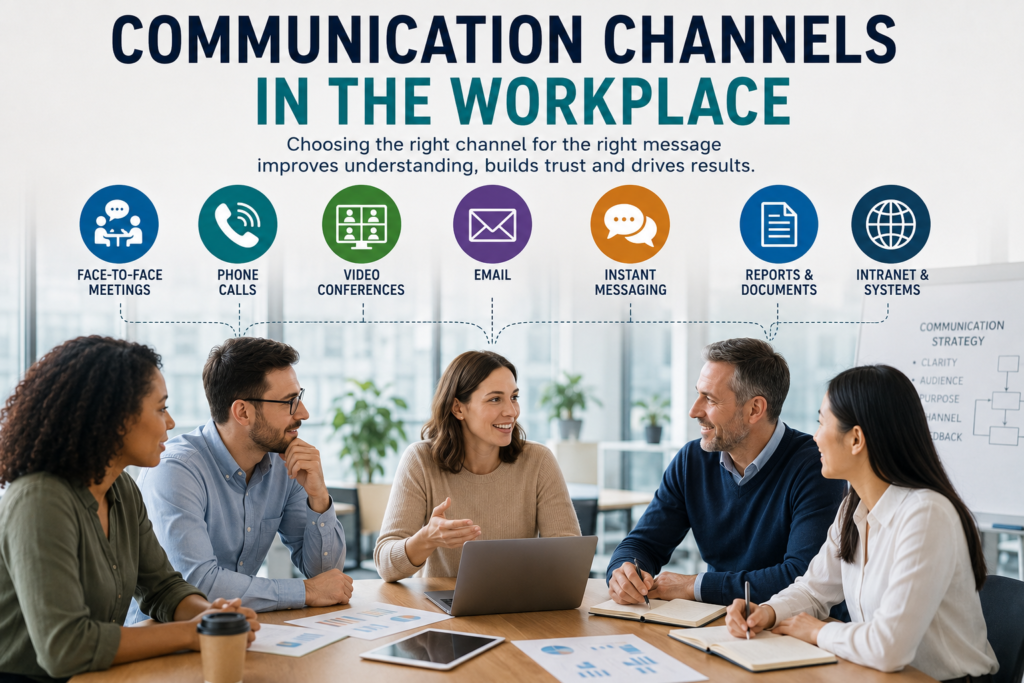
A communication channel is the route or medium through which information passes from a sender to a recipient. In modern workplaces, communication may take place through face-to-face conversations, telephone calls, video meetings, emails, instant messaging platforms, formal reports, intranets and project management systems. Each channel offers a different combination of speed, formality, detail, interaction and permanence.
Choosing the right communication channel is therefore an important organisational skill. The decision should be based on the purpose of the message, the complexity of the information, the relationship between the people involved, the urgency of the situation and whether a formal record is required.
What Is a Communication Channel?
A communication channel is the method used to transmit a message from one person or group to another. Within an organisation, communication channels allow employees to exchange instructions, ideas, feedback, decisions and operational information.
Although channel selection may appear to be a practical matter, it can strongly influence how a message is interpreted. A manager may communicate the same information through an email, a telephone call or a face-to-face meeting, but each method creates a different experience for the recipient.
An email provides a written record and gives the recipient time to consider the information. A telephone call allows immediate discussion but removes visual cues. A face-to-face meeting provides access to tone, body language and facial expression, which can be particularly important when the subject is complex or sensitive.
Communication channels should therefore be viewed as organisational tools rather than matters of personal habit. The most familiar or convenient method is not always the most appropriate one.
The Importance of Channel Selection
The communication channel affects not only whether a message reaches its audience, but also whether it is understood, accepted and acted upon.
A routine administrative update may be communicated effectively through email. A serious performance concern, however, would usually require a private discussion in which the employee has an opportunity to respond. Similarly, an urgent safety warning should be delivered through a method that is likely to attract immediate attention rather than through a platform that employees may not check until later.
Poor channel selection can create unnecessary confusion. A complex decision communicated through a brief instant message may be misunderstood, while a simple update delivered through a lengthy meeting may waste time and reduce engagement.
Effective organisational communication therefore requires alignment between the message, the audience and the chosen medium.
Media Richness and Communication
Communication theory often distinguishes between richer and leaner forms of communication.
A rich communication channel carries several types of information at the same time. Face-to-face communication is considered particularly rich because it includes spoken language, tone of voice, facial expressions, posture, gestures and immediate feedback.
By contrast, a written message is a leaner channel because it relies mainly on words and may not allow immediate clarification.
Rich channels are generally better suited to matters that involve ambiguity, emotion, negotiation or uncertainty. A manager explaining a significant organisational change, for example, may need to respond to concerns, observe reactions and clarify misunderstandings. A live meeting would therefore usually be more appropriate than a short written announcement alone.
Leaner channels remain valuable when the information is routine, straightforward or needs to be recorded. A formal written confirmation may be more suitable than a conversation when accuracy and accountability are important.
The concept of media richness does not suggest that one channel is always superior to another. Rather, it emphasises that different channels are suited to different communication needs.
Face-to-Face Communication
Face-to-face communication remains one of the most complete forms of workplace communication because it combines spoken language with non-verbal information.
During an in-person discussion, participants can observe changes in tone, expression and body language. They can also ask questions immediately and respond to points as they arise. This makes face-to-face communication particularly valuable when the subject requires trust, empathy or detailed discussion.
Performance feedback, complaints, conflict resolution, negotiation and major organisational changes are often best addressed through direct conversation. The richness of the channel allows both parties to check their understanding and reduces the risk that a sensitive message will be interpreted as impersonal or dismissive.
Face-to-face communication also supports relationship development. Informal discussions between colleagues can strengthen rapport and make future collaboration easier.
However, this channel has limitations. It may be difficult to arrange when staff work remotely or across several locations. It also does not automatically create a permanent record. Where important decisions are made verbally, it is often good practice to confirm the outcome in writing afterwards.
Telephone Communication
Telephone calls retain the immediacy of spoken communication but remove the visual elements available in a face-to-face meeting.
They are particularly useful when speed is important and the issue does not require visual material. A short telephone call may quickly clarify a point, confirm availability or resolve a misunderstanding that might otherwise develop through a lengthy email exchange.
Tone of voice becomes especially important in telephone communication because the recipient cannot observe facial expression or posture. The meaning of the message may therefore be influenced by pace, emphasis and emotional tone.
Telephone calls are less suitable when detailed documents need to be reviewed or when the conversation is highly sensitive. They also provide no automatic written record unless notes are taken or the discussion is confirmed later in writing.
Video Communication
Video calls occupy a position between face-to-face meetings and telephone conversations. They allow participants to hear one another and observe some facial expressions and gestures, while also making it possible to share documents, presentations and screens.
This channel has become central to remote and hybrid working. It enables employees in different locations to participate in meetings, training sessions, interviews and collaborative discussions.
Video communication is particularly useful when a matter is too complex for email but an in-person meeting is not practical. It may also be suitable for sensitive discussions because it allows some visual engagement and immediate feedback.
However, video communication can become tiring when used excessively. Repeated meetings may contribute to screen fatigue, and technical problems can disrupt the flow of discussion. Organisations should therefore avoid treating video meetings as the default response to every communication need.
A short routine update may be handled more efficiently through a written message, while a genuinely collaborative or complex discussion is more likely to justify a video call.
Email Communication
Email is one of the most widely used communication channels in contemporary organisations.
Its main advantage is that it creates a written record. It allows information to be shared with several recipients and can include attachments, links and detailed explanations. Recipients can also read the message at a convenient time and refer back to it later.
Email is therefore appropriate for confirming decisions, distributing documents, providing instructions and communicating routine updates.
However, email can easily become ineffective when it is overused. Employees may receive such a high volume of messages that they skim rather than read carefully. Important information can become buried among less relevant communication, creating the appearance that a message has been delivered even though it has not been properly understood.
Tone is another challenge. Without facial expressions or vocal cues, a concise email may appear abrupt, while a carefully worded message may still be interpreted differently by different readers.
Email is usually less suitable for emotionally sensitive matters, complex disagreements or situations requiring immediate dialogue. In such cases, a conversation may be more appropriate, followed by written confirmation where necessary.
Instant Messaging and Workplace Chat
Instant messaging platforms provide a fast and relatively informal form of written communication.
They are particularly useful for brief questions, quick updates and day-to-day coordination. In remote teams, they can also help maintain a sense of social connection and allow employees to communicate without arranging a formal meeting.
The speed and convenience of instant messaging can improve productivity, but these benefits depend on the channel being used appropriately.
Conversations can quickly become fragmented when several topics are discussed within the same thread. Important decisions may be difficult to locate later, and employees may feel pressure to respond immediately even when the message is not urgent.
Instant messaging is therefore better suited to short and informal communication than to formal decisions, confidential matters or detailed instructions. Where a discussion leads to an important decision, the outcome should normally be recorded through a more permanent channel.
Reports, Policies and Formal Documents
Formal written documents are essential when information must be accurate, authoritative and permanent.
Reports, policies, procedures, meeting minutes and official briefings provide a structured record of organisational decisions and expectations. They are often subject to approval processes and may have legal, regulatory or operational significance.
The formal nature of these documents signals that the information has been considered carefully and should be treated as official.
This places a responsibility on the organisation to ensure that the writing is clear, precise and up to date. Poorly structured or outdated documents can cause confusion and may reduce confidence in the organisation’s systems.
Formal documents are not always sufficient on their own. A new policy, for example, may need to be supported by a briefing or training session so that employees can ask questions and understand how it applies to their work.
Intranets and Internal Knowledge Systems
An organisational intranet can serve as a central location for policies, guidance, news, templates and staff resources.
When it is well designed and regularly maintained, it can provide a reliable source of information. Employees are less likely to rely on outdated files or informal explanations when they know where the current version of a document can be found.
However, an intranet is only effective when information is organised logically and can be found easily. If the platform is difficult to search or contains obsolete material, staff may stop using it and return to informal channels.
An intranet should therefore support communication rather than simply store information. Responsibility for reviewing and updating content must be clearly allocated.
Project Management and Workflow Systems
Project management systems allow communication to be connected directly to tasks, deadlines and work activities.
Instead of sending separate emails about a project, employees can record comments, decisions and questions alongside the relevant task. This improves transparency and allows colleagues to understand the history of a piece of work.
Such systems are particularly useful in complex projects involving several people or departments. They can clarify responsibility, record progress and preserve continuity if team membership changes.
The benefit is reduced when organisations use too many overlapping platforms. Employees may become uncertain about where information should be recorded or which system contains the official version.
Clear procedures are therefore necessary so that each communication channel has a defined purpose.
Automated Alerts and Notifications
Automated communication can be useful when information needs to reach people quickly and consistently.
Organisations may use automatic alerts to communicate system failures, safety incidents, rota changes, missed deadlines or production problems.
The effectiveness of an automated message depends on its relevance and urgency. When alerts are used selectively, they can direct attention to important information. When they are overused, employees may begin to ignore them.
This effect is often described as alert fatigue. It occurs when people receive so many notifications that they stop distinguishing between routine and critical messages.
Automated communication should therefore be carefully targeted. The audience, timing and level of importance should all be considered before notifications are issued.
Formal and Informal Communication Channels
Organisations usually operate through both formal and informal communication systems.
Formal communication includes official emails, scheduled meetings, policies, reports and authorised announcements. Its purpose is to provide consistency, accountability and a reliable record.
Informal communication includes everyday conversations, private messages and unplanned discussions between colleagues. It often helps employees interpret official information and relate it to their own work.
Both systems are necessary.
Formal communication ensures that employees receive accurate and consistent information. Informal communication helps build relationships, allows practical questions to be discussed and can reveal concerns before they become more serious.
Problems arise when informal channels become the main source of organisational information. Rumours may spread when official communication is unclear or delayed. Employees may receive different versions of the same message and become uncertain about which information is correct.
A well-managed organisation supports healthy informal communication while ensuring that key decisions and policies are always available through dependable formal channels.
The Direction of Communication
Communication channels are also influenced by the direction in which information flows.
Downward communication moves from senior leaders and managers to employees. It may include instructions, policies, expectations and organisational announcements. Because this information carries authority, employees generally expect it to be clear and consistent.
Upward communication moves from employees to managers. It may involve feedback, concerns, suggestions or requests for support. The effectiveness of upward communication depends heavily on psychological safety. Employees are unlikely to raise concerns if they believe they will be ignored or criticised.
Lateral communication takes place between employees or teams at a similar organisational level. It supports cooperation, knowledge sharing and everyday coordination.
Diagonal communication occurs between individuals in different departments and at different levels of the organisation. It can improve efficiency by allowing employees to access specialist expertise, but it may require clear protocols to avoid confusion about authority and responsibility.
The perceived safety and appropriateness of the channel often matters as much as the technology itself.
Choosing the Right Communication Channel
Channel selection should begin with the purpose of the message.
If the aim is to provide a simple factual update, a short written message may be sufficient. If the aim is to resolve conflict, discuss a sensitive issue or negotiate a decision, a richer and more interactive channel will usually be more effective.
Complexity is also important. Detailed information may need to be communicated through more than one method. A live meeting may allow explanation and questions, while a written document provides a permanent reference.
Urgency affects the decision because some channels are more likely to attract immediate attention than others. A serious health and safety risk should be communicated through a direct warning, telephone call or emergency alert rather than relying only on email.
The need for a record must also be considered. Important decisions, changes to employment arrangements and formal instructions should normally be documented in writing, even when they are initially discussed verbally.
Audience size and location are further considerations. A message intended for a single employee may require a private discussion, while information for the whole organisation may need to be distributed through several coordinated channels.
Accessibility should form part of the decision-making process. Remote workers, shift workers and employees with visual or hearing impairments may not have equal access to every channel.
Comparing Communication Channels
The following table illustrates how different communication channels may be matched to common organisational situations.
| Situation | Most suitable communication channel | Reason |
|---|---|---|
| Confirming a meeting time | Email or instant message | The message is simple, routine and benefits from a written record. |
| Discussing poor performance | Private face-to-face or video meeting | The issue is sensitive and requires dialogue, empathy and immediate clarification. |
| Reporting an immediate safety risk | Direct verbal warning, telephone call or emergency alert | The message is urgent and must attract immediate attention. |
| Publishing a new organisational policy | Formal document supported by email or an intranet announcement | The information must be accurate, consistent and permanently accessible. |
| Resolving a minor misunderstanding | Telephone call or direct conversation | Immediate discussion is more efficient than a prolonged written exchange. |
| Announcing a major organisational change | Live briefing supported by written information | Employees require context, an opportunity to ask questions and a reliable reference afterwards. |
| Tracking project activity | Project management or workflow system | Communication remains linked to the relevant task, deadline and decision. |
| Gathering confidential staff feedback | Secure survey or confidential meeting | The channel should encourage honesty and protect the individual’s identity where appropriate. |
| Sharing a routine team update | Email, team chat or a short meeting | The appropriate choice depends on the complexity and urgency of the update. |
| Confirming an agreed action | Email or formal task record | Written confirmation reduces later uncertainty about responsibilities. |
These examples provide general guidance rather than fixed rules. The most appropriate channel will always depend on the specific circumstances and the needs of the audience.
Risk, Confidentiality and Ethics
Channel selection has ethical and legal implications.
Sensitive personal, financial or disciplinary information should only be shared through secure and authorised communication systems. Discussing confidential matters in open spaces or sending them through informal messaging platforms may be unprofessional and could breach organisational policy or data protection requirements.
The sender should consider who is authorised to receive the information, whether the channel is secure and whether the conversation might be accessed by unintended recipients.
Ethical communication also requires respect. A manager should not use an impersonal written message to avoid a difficult conversation where the employee reasonably deserves a direct explanation.
The choice of channel can therefore communicate something about the organisation’s values. A respectful channel recognises the significance of the message and the needs of the people receiving it.
Inclusion and Accessibility
An effective communication channel must be accessible to its intended audience.
Employees may have different requirements because of disability, location, working patterns, language or confidence with technology. A communication method that works well for office-based staff may not be suitable for employees working remotely, at night or in operational environments.
Video material may need captions or transcripts. Written documents may need to be compatible with screen readers. Important verbal announcements may need to be confirmed in writing.
Inclusive communication does not mean that every message must be issued through every possible format. It means that organisations should consider whether anyone is likely to be excluded by the selected channel and make reasonable adjustments where necessary.
Managing Communication Overload
Modern organisations often use several digital communication systems at the same time.
Employees may receive emails, instant messages, video invitations, automated alerts and project notifications throughout the working day. Without a clear communication strategy, this can lead to information overload.
When too much information is distributed through too many channels, employees may struggle to identify what is important. They may also waste time checking several platforms or encounter the same message repeatedly.
Organisations can reduce this problem by giving each communication channel a clear purpose. Staff should know where official documents are stored, which system should be used for urgent matters and where project decisions should be recorded.
The objective is not to communicate more frequently, but to communicate more effectively.
Developing an Organisational Communication Strategy
A strong communication strategy establishes how channels should be used across the organisation.
It may explain which matters require a meeting, when email is appropriate, how confidential information should be handled and which platform holds the official record of a decision.
It should also set reasonable expectations about response times. Not every instant message requires an immediate reply, and not every email should be treated as urgent.
Managers play an important role in modelling appropriate channel use. When leaders use informal chat for sensitive decisions or arrange unnecessary meetings for routine updates, employees are likely to adopt the same habits.
Consistency helps employees understand where information can be found and how they are expected to communicate with others.
Improving Workplace Communication Through Better Channel Choices
Communication problems are not always caused by unclear language. They may arise because the message was sent through a channel that did not support understanding.
A brief telephone call may resolve an issue more effectively than a long email chain. A written confirmation may prevent disagreement following a verbal conversation. A private meeting may demonstrate more respect than an impersonal message.
The most effective organisations use a balanced combination of verbal, written, digital, formal and informal communication.
The aim is not to select the fastest or most convenient channel in every situation. It is to select the channel that best supports understanding, appropriate action, confidentiality and trust.
Develop Your Business and Management Skills
Explore Click College’s flexible online Business Management courses and gain the knowledge, practical skills and recognised qualifications needed to progress in your career.
View our Business Management courses and start studying online today.
Discover our courses…
Flexible UK-accredited courses and qualifications
Develop Your Business and Management Skills
Explore Click College’s flexible online Business Management courses and gain the knowledge, practical skills and recognised qualifications needed to progress in your career.
View our Business Management courses and start studying online today.







Recent Posts
Level 4 Business Management Courses: 40 or 120 Credits
Level 4 Business Management Courses: 40 or 120 Credits Click College offers two Level 4 Business Management courses: a focused 40-credit Professional Diploma and a broader 120-credit Higher International Certificate. The Professional Diploma suits learners seeking a shorter introduction or targeted professional development. The Higher International Certificate suits those seeking a more comprehensive foundation in […]
What Are Management Accounts? How Internal Reports Support Better Decisions
What Are Management Accounts? How Internal Reports Support Better Decisions They usually combine financial information—such as sales, costs, profit and cash flow—with operational measures that explain the numbers. A useful management-accounting report does not simply state that profit fell or costs increased. It helps managers understand why, decide what to investigate and identify possible action. […]
Why a Profitable Business Can Still Have a Loss-Making Product or Department
Why a Profitable Business Can Still Have a Loss-Making Product or Department A business can make a healthy overall profit while one of its products, departments, locations or projects makes a loss. This is not a contradiction. Overall profit combines the results of many different activities. A profitable product line may generate enough contribution to […]