Revenue vs Profit: What Is the Difference?
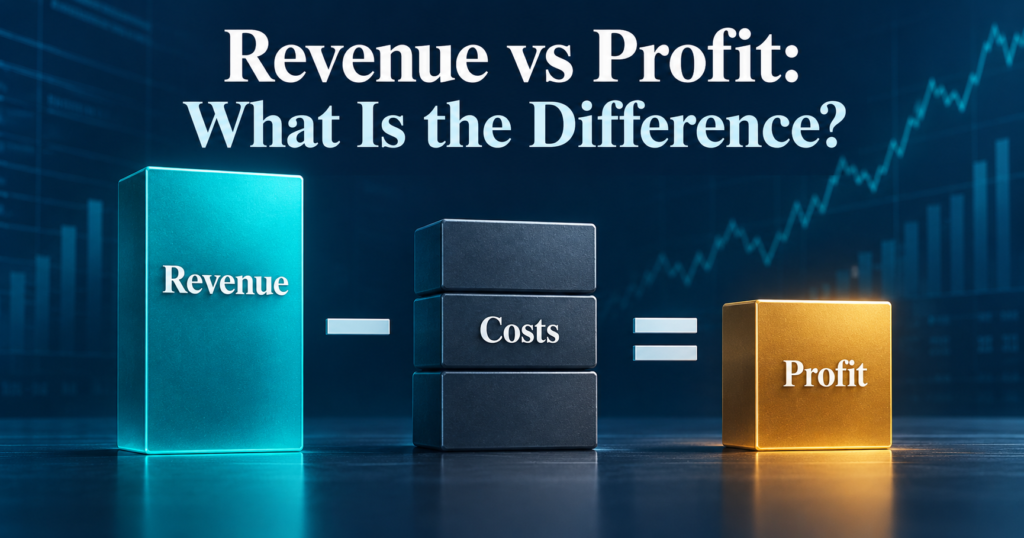
Revenue and profit are both used to describe business performance, but they do not mean the same thing. Revenue is the value earned from a business’s ordinary activities before the relevant costs and expenses are deducted. Profit is what remains after specified costs and expenses have been deducted from income.
This means a business can generate substantial revenue without being profitable. It can also report rising revenue while its profit falls. Understanding the difference helps managers, investors and business owners look beyond sales activity and examine how effectively the organisation converts that activity into a financial return.
Revenue explained
Revenue is generated through the ordinary activities of a business. A retailer earns revenue by selling products, a consultancy earns it by delivering professional services, and a subscription company earns it by providing customers with access to its service.
In the UK, turnover is often used as another term for sales revenue. The terminology used in a set of accounts can depend on the reporting framework and context, so readers should check how each figure is defined rather than relying only on its label.
Revenue is normally presented near the top of an income statement or profit and loss account. For this reason, it is sometimes called the top line. It provides evidence of the scale of trading activity, but it does not show how much of that value the business has retained after meeting its costs.
Revenue is not necessarily cash received
A business may earn revenue before or after the related cash movement.
Suppose a design consultancy completes a £15,000 project and gives the customer 30 days to pay. The consultancy may recognise £15,000 of revenue when it has satisfied the relevant service obligation, even though it has not yet received the cash.
Conversely, a customer may pay £15,000 in advance for work that will be performed over the next six months. Receiving the money does not necessarily mean that the whole £15,000 becomes revenue immediately. IFRS 15 expresses the core principle as recognising revenue when or as the organisation satisfies a performance obligation to its customer.[1]
This distinction is important because a manager who treats every cash receipt as revenue could misinterpret both trading activity and financial performance.
Gross revenue and net revenue
Gross revenue may require adjustment for items such as sales returns, refunds or agreed discounts to identify the net amount retained as revenue.
If a retailer invoices customers £250,000, accepts £7,000 of returns and grants £3,000 of discounts:
Net revenue = £250,000 − £7,000 − £3,000 = £240,000
The £240,000 figure is still not profit. The retailer must deduct the applicable costs and expenses before determining its profit.
Profit explained
Profit is the excess of recognised income over recognised expenses for a specified period. When expenses exceed income, the result is a loss.
The IFRS Conceptual Framework defines income and expenses through the changes they create in assets, liabilities and equity. It also makes clear that contributions from owners are not income and distributions to owners are not expenses.[2] This helps distinguish genuine financial performance from financing transactions such as a shareholder investing money in the business.
Unlike revenue, profit is not a single universal figure. Different stages of profit answer different questions.
Gross profit
Gross profit is calculated by deducting the direct cost of the goods or services sold from revenue:
Gross profit = Revenue − Cost of sales
If a retailer has net revenue of £240,000 and cost of sales of £138,000:
Gross profit = £240,000 − £138,000 = £102,000
Gross profit shows what remains after the direct cost of generating the sales. It must still contribute towards administration, premises, marketing and other operating expenses.
Operating profit
Operating profit deducts operating expenses from gross profit:
Operating profit = Gross profit − Operating expenses
If the retailer’s operating expenses are £76,000:
Operating profit = £102,000 − £76,000 = £26,000
Operating profit helps the reader assess the performance of the core operation before considering items outside that measure, subject to the organisation’s reporting format.
Net profit
Net profit is the residual result after further relevant items have been recognised. These may include finance costs and tax, depending on the reporting presentation and the type of organisation.
The phrase “the business made £26,000 profit” is therefore incomplete unless the reader knows which profit measure is being discussed. Gross profit, operating profit and net profit describe different stages of the calculation.
Revenue vs profit at a glance
| Measure | What it shows | Basic calculation | Question it answers |
|---|---|---|---|
| Revenue | Value earned from ordinary business activities | Sales or service income, adjusted where appropriate | How much trading value did the business generate? |
| Gross profit | Amount remaining after the direct cost of sales | Revenue − cost of sales | How much remained to cover operating expenses? |
| Operating profit | Performance after operating expenses | Gross profit − operating expenses | How effectively did the core operation perform? |
| Net profit | Residual result after further relevant items | Income − all applicable expenses | What remained after the complete set of recognised expenses? |
Companies House explains that company accounts generally include a profit and loss account, a balance sheet and supporting notes, although filing requirements and exemptions differ according to company circumstances.[3] The profit and loss account brings together revenue, costs and profit for a reporting period.
Can revenue increase while profit falls?
Yes. This is one of the most important reasons to analyse revenue and profit separately.
Consider Northway Furniture Ltd, an illustrative business with the following results:
| Year 1 | Year 2 | Change | |
|---|---|---|---|
| Revenue | £600,000 | £690,000 | +15.0% |
| Cost of sales | £330,000 | £390,000 | +18.2% |
| Gross profit | £270,000 | £300,000 | +11.1% |
| Operating expenses | £210,000 | £255,000 | +21.4% |
| Operating profit | £60,000 | £45,000 | −25.0% |
Revenue increased by £90,000, which may initially look positive. However, both cost of sales and operating expenses increased faster than revenue. Operating profit consequently fell from £60,000 to £45,000.
The operating profit margin makes the deterioration even clearer:
Year 1 operating margin = £60,000 ÷ £600,000 × 100 = 10.0%
Year 2 operating margin = £45,000 ÷ £690,000 × 100 ≈ 6.5%
In Year 1, the business generated 10 pence of operating profit for each £1 of revenue. In Year 2, it generated only about 6.5 pence. Sales activity grew, but the business became less effective at converting revenue into operating profit.
The figures do not reveal the cause by themselves. Managers would need to investigate what changed. Possible explanations include lower selling prices, a less profitable sales mix, higher material costs, increased staffing, greater premises costs or deliberate investment intended to produce benefits in a later period.
Why might revenue rise without improving profit?
Prices have been reduced
Discounting may attract more customers and increase sales volume, but each sale may contribute less towards fixed costs and profit. Revenue can rise while the margin on each transaction declines.
The sales mix has changed
A business may sell more low-margin products and fewer high-margin products. Total revenue grows, but the mix produces less profit than expected.
Direct costs have increased
Materials, production labour, delivery or supplier charges may rise faster than selling prices. This reduces gross profit even when revenue is growing.
Operating expenses have grown
Additional staff, premises, technology or marketing can increase operating expenses. These commitments may support future growth, but they reduce current-period profit unless the additional gross profit is sufficient to cover them.
Revenue has been pursued without enough cost control
Sales teams may focus on achieving a revenue target while overlooking the cost of fulfilling the work. A large contract can increase revenue but weaken profit if it is underpriced or requires excessive resources.
Can profit increase while revenue stays flat?
Profit can improve without substantial revenue growth if the business changes its pricing, sales mix or cost structure.
For example, an organisation may:
- renegotiate supplier prices;
- reduce waste and rework;
- improve staff scheduling;
- sell a greater proportion of higher-margin services;
- remove an activity that generates revenue but makes a loss; or
- automate a repetitive process where the investment is justified.
However, a manager should consider how the improvement was achieved. Cutting essential maintenance or training could raise short-term profit while creating operational problems later. A higher profit figure is most valuable when it reflects an improvement that the organisation can sustain without undermining quality, capacity or customer relationships.
Profit is not the same as cash
A profitable business can still experience cash-flow pressure. Revenue may have been earned but not yet collected from customers. Cash may also be tied up in inventory, used to purchase equipment or required to settle existing liabilities.
Equally, a business can receive cash without generating profit. A bank loan increases cash but creates a liability. An investment by an owner increases cash and equity but is not trading revenue.
This is why managers should not use revenue, profit and cash as interchangeable measures:
- Revenue describes value earned through ordinary activities.
- Profit describes financial performance after specified expenses.
- Cash flow describes movements of cash into and out of the business.
Each measure answers a different question.
Which is more important: revenue or profit?
Neither figure should be assessed in isolation.
Revenue shows the scale and direction of trading activity. It can help managers assess customer demand, market reach and sales performance. Profit shows whether the income generated is sufficient to cover the relevant expenses and leave a residual return.
A useful review considers both the amount and the relationship between them. Managers might ask:
- Is revenue increasing or decreasing?
- What has caused the movement in revenue: price, volume or sales mix?
- Are direct costs rising faster or more slowly than revenue?
- How have gross and operating profit margins changed?
- Are changes in profit temporary, deliberate or likely to continue?
These questions form a practical editorial framework for moving from description to analysis. They prevent a headline such as “sales increased by 15%” from being treated as proof that the business has become more successful.
Develop your business finance knowledge
The ability to interpret revenue, profit, margins and costs supports budgeting, financial planning and management decision-making. Click College offers several flexible online routes for learners who want to develop these skills further:
- The Professional Diploma in Finance is a focused 40-credit introduction to business finance and investment decision-making.
- The Higher International Certificate in Finance Management is a 120-credit Level 4 qualification combining finance with wider organisational knowledge.
- The Higher International Diploma in Finance Management incorporates Level 4 and extends the pathway to 240 credits in total.
- The International Graduate Diploma in Finance Management incorporates the Level 5 pathway and develops finance and strategic-management learning across 360 credits in total.
Compare the full range of Finance Management courses and select the pathway that best matches your present knowledge and professional aims.
Frequently asked questions
Is revenue the same as turnover?
Turnover is commonly used in the UK to describe the revenue generated from ordinary trading activities. Readers should nevertheless check the definitions and accounting policies used in the particular report.
Is revenue the same as income?
Revenue is a form of income generated through ordinary activities. Income can be a broader category that also includes other gains or income arising outside the organisation’s main trading activities.
What is the difference between gross profit and net profit?
Gross profit deducts the direct cost of sales from revenue. Net profit reflects the residual result after the wider set of applicable expenses and other relevant items has been recognised.
Can a company have revenue but make a loss?
Yes. If recognised expenses exceed recognised income, the company makes a loss even though it generated revenue from customers.
Why is profit margin useful?
Profit margin expresses a profit measure as a percentage of revenue. It helps compare how effectively a business converts sales into profit across different periods or organisations, although differences in accounting policies and business models must be considered.
Does higher revenue always mean a business is growing successfully?
No. Higher revenue indicates greater sales value, but managers must also examine costs, profit, cash flow, capacity, customer retention and the sustainability of the growth.
References
[1] IFRS Foundation, IFRS 15 Revenue from Contracts with Customers
[2] IFRS Foundation, Conceptual Framework for Financial Reporting, Chapter 4
[3] Companies House, Preparing and filing Companies House accounts
Develop Your Finance and Management Skills
Want to develop your understanding of finance and business management? Explore Click College’s Finance Management courses and choose the flexible online qualification that best supports your next step.
Alternatively, view our Business Management courses and start studying online today.







Recent Posts
Level 4 Business Management Courses: 40 or 120 Credits
Level 4 Business Management Courses: 40 or 120 Credits Click College offers two Level 4 Business Management courses: a focused 40-credit Professional Diploma and a broader 120-credit Higher International Certificate. The Professional Diploma suits learners seeking a shorter introduction or targeted professional development. The Higher International Certificate suits those seeking a more comprehensive foundation in […]
What Are Management Accounts? How Internal Reports Support Better Decisions
What Are Management Accounts? How Internal Reports Support Better Decisions They usually combine financial information—such as sales, costs, profit and cash flow—with operational measures that explain the numbers. A useful management-accounting report does not simply state that profit fell or costs increased. It helps managers understand why, decide what to investigate and identify possible action. […]
Why a Profitable Business Can Still Have a Loss-Making Product or Department
Why a Profitable Business Can Still Have a Loss-Making Product or Department A business can make a healthy overall profit while one of its products, departments, locations or projects makes a loss. This is not a contradiction. Overall profit combines the results of many different activities. A profitable product line may generate enough contribution to […]