Can You Study Hospitality and Tourism Without Exams?
For many learners, the idea of studying hospitality and tourism is exciting. The sector is practical, people-focused and full of career possibilities across hotels, resorts, travel, events, visitor attractions and service-based businesses. However, one concern often holds people back: exams.
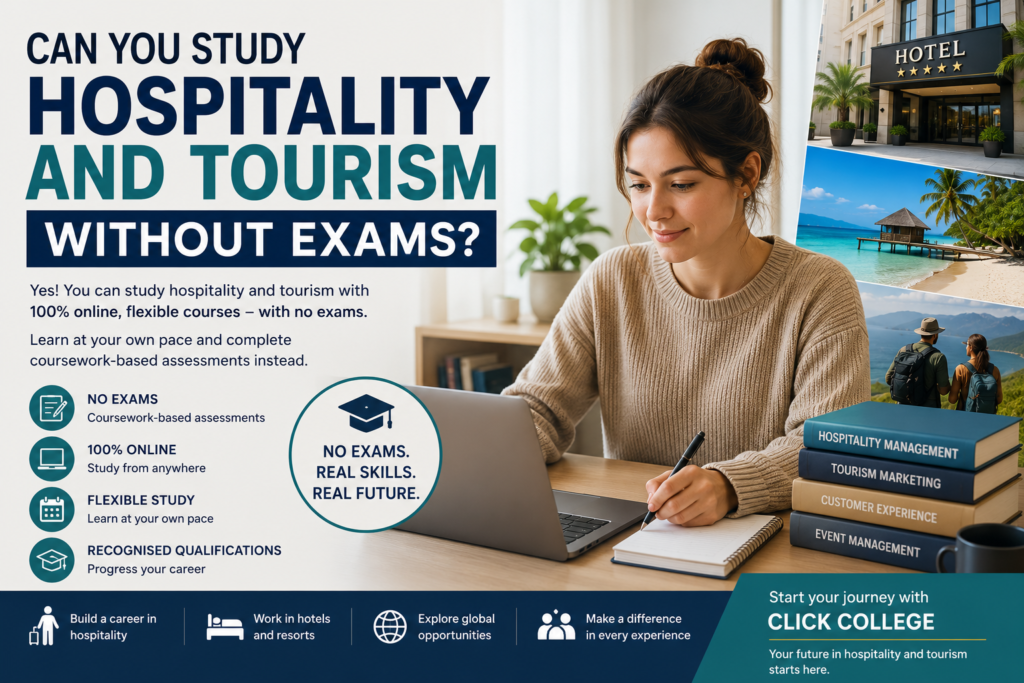
Some learners have had negative experiences with exams at school or college. Others may be returning to education after several years away and feel anxious about timed assessments. Some are already working full-time and need a flexible study route that fits around their schedule. For these learners, the question is simple: can you study hospitality and tourism without exams?
The answer is yes. It is possible to study hospitality and tourism through flexible online courses that use coursework-based assessment instead of traditional timed exams. This means learners can demonstrate their understanding through written assignments, practical tasks and applied responses rather than sitting in an exam hall under time pressure.
For many future hospitality and tourism managers, this can be a much more suitable way to learn.
Why do some learners prefer courses without exams?
Exams do not suit everyone. A learner may understand a subject well but struggle to show that knowledge in a timed exam. Exam pressure, anxiety, memory demands and strict time limits can affect performance, even when the learner has prepared carefully.
This can be especially true for adult learners, career changers and people who are returning to education after a long break. Many of these learners have strong practical skills, work experience and motivation, but may not feel confident in a traditional academic exam setting.
Hospitality and tourism are also highly applied subjects. They involve customer service, operations, planning, communication, management, decision-making and problem-solving. These skills can often be assessed effectively through written coursework, case studies, reflective tasks and practical scenarios.
For this reason, hospitality courses with no exams can provide a more accessible and realistic way to study the subject.
What does “no exams” actually mean?
When a course says there are no exams, it does not mean there is no assessment. A recognised qualification still needs proper academic standards, clear learning outcomes and structured assessment.
Instead, “no exams” usually means that learners are assessed through coursework. This may include written assignments, reports, case study responses, research tasks, applied scenarios or reflective work.
For example, instead of answering questions in a two-hour exam, a learner might be asked to explain how a hotel can improve customer service, analyse tourism trends, discuss the role of marketing in visitor attractions, or evaluate management approaches in hospitality organisations.
This type of assessment gives learners more time to think, research, plan and produce a considered response. It can also feel more relevant to real management practice, where professionals are usually expected to analyse information, prepare reports, make recommendations and justify decisions.
How does coursework-based assessment work?
Coursework-based assessment usually involves completing written assignments for each unit or module. Learners study the course materials, complete guided tasks and then submit work that demonstrates their understanding of the topic.
In hospitality and tourism, coursework may ask learners to explore subjects such as:
- customer experience
- hospitality operations
- tourism destinations
- service quality
- front-of-house management
- marketing and customer insight
- people and teamwork
- hospitality revenue management
- tourism development
- strategic decision-making
The aim is to show that the learner can understand concepts and apply them to realistic hospitality and tourism settings.
This can be particularly useful for learners who want to develop management skills. Managers are rarely asked to memorise information and reproduce it under exam conditions. Instead, they need to evaluate situations, communicate clearly, solve problems and make informed decisions.
Coursework can therefore support the development of professional thinking as well as academic knowledge.
Is a no-exam hospitality course still valuable?
A no-exam course can still be valuable, provided it is properly structured, externally accredited and assessed against clear academic standards.
The presence or absence of exams is not the only measure of quality. What matters is whether the course has recognised learning outcomes, appropriate academic level, meaningful assessment and a clear progression route.
Many respected qualifications use coursework, assignments or projects as part of their assessment model. This is especially common in vocational, professional and management education, where learners need to apply knowledge to realistic situations.
For hospitality and tourism learners, coursework can be especially useful because the sector is practical and applied. A written assignment can ask learners to consider real challenges, such as improving guest satisfaction, managing demand, developing a tourism product, supporting team performance or responding to changes in customer behaviour.
In this sense, coursework is not an easier alternative. It is a different form of assessment. It requires reading, planning, writing, analysis and independent thinking.
Who are no-exam hospitality and tourism courses suitable for?
Hospitality and tourism courses without exams can be suitable for a wide range of learners.
They may be particularly useful for people who:
- feel anxious about traditional exams
- prefer written assignments to timed tests
- are returning to education as adults
- are working full-time or part-time
- need flexible study around family commitments
- want to study online from another country
- are already working in hospitality or tourism
- want to progress into supervisory or management roles
- are considering a career change
- want a structured route into higher-level study
This type of course can also appeal to learners who are confident practically but less confident academically. Because coursework gives learners time to reflect and improve their responses, it can help build confidence gradually.
Why hospitality and tourism suit coursework assessment
Hospitality and tourism are closely linked to real-world business situations. Managers in these sectors must understand customers, staff, service quality, operations, finance, marketing and strategy. They also need to respond to changing demand, customer expectations and market conditions.
These are not always best assessed through short exam answers. Coursework allows learners to explore these ideas in more depth.
For example, a learner studying hospitality management might examine how a hotel can improve its front-of-house service. They could consider customer expectations, staff training, complaint handling, communication, service standards and guest feedback.
A learner studying tourism management might analyse how a destination can attract more visitors while managing sustainability and local community impact.
These types of tasks encourage applied thinking. They help learners connect theory to practice, which is especially important in a service-based industry.
Can you study hospitality and tourism online without exams?
Yes, online study is one of the most flexible ways to complete a hospitality and tourism qualification without exams.
An online course allows learners to study from home, at work, while travelling, or from another country. Instead of attending fixed classes, learners can access digital materials, work through units at their own pace and submit assignments when ready.
This is especially useful for hospitality and tourism learners because many people in the sector work irregular hours. Hotel, restaurant, travel and events roles often involve evenings, weekends, shifts and seasonal peaks. A fixed classroom timetable may not be realistic.
A flexible online route can allow learners to continue working while building their qualifications.
Study hospitality and tourism without exams at Click College
Click College offers flexible online Hospitality and Tourism Management qualifications for learners who want to study without traditional exams.
The courses are designed for independent online study, allowing learners to work at their own pace without fixed classroom schedules. Assessment is completed through written assignments, so learners can demonstrate their understanding without sitting timed exams.
This approach can be especially helpful for learners who want a more flexible and accessible route into hospitality and tourism management.
Click College’s Hospitality and Tourism Management pathway includes Level 4, Level 5 and Level 6 study options. This allows learners to begin at an appropriate level and progress step by step towards higher-level study.
The pathway includes:
- Level 4 study, which introduces core hospitality, tourism and business concepts
- Level 5 study, which develops more advanced management knowledge
- Level 6 study, which focuses on strategic leadership, decision-making and degree-level understanding
There are also shorter Professional Diploma options for learners who want to focus on specific areas of hospitality or tourism.
What can you study in a no-exam hospitality and tourism course?
Hospitality and tourism management courses can cover a wide range of topics. These usually combine general business knowledge with specialist sector understanding.
Typical areas may include hospitality operations, tourism systems, customer service, front-of-house operations, marketing, people management, service quality, finance, revenue management, destination management and strategic decision-making.
At Level 4, learners usually build foundational knowledge. This may include understanding organisations, teamwork, marketing fundamentals, customer insight and the structure of hospitality and tourism industries.
At Level 5, learners often move into more applied management topics. This can include operations, quality management, digital transformation, people management and hospitality or destination management.
At Level 6, learners may explore strategic issues such as competitive advantage, strategic hospitality management, revenue management, hospitality finance and applied research.
This progression allows learners to move from introductory knowledge towards more advanced management thinking.
Are there deadlines on no-exam hospitality courses?
This depends on the provider. Some online courses may still have deadlines, even if they do not have exams. Others may allow learners to study at their own pace.
A self-paced model can be particularly useful for adult learners and working professionals. It allows learners to fit study around busy periods, work commitments and personal responsibilities.
However, flexibility also requires discipline. Without fixed classes or exam dates, learners need to plan their own study routine. This may involve setting weekly goals, creating a study timetable, keeping notes and submitting assignments steadily rather than leaving everything until later.
The best approach is to treat online learning seriously, even when the course is flexible.
Is no-exam study easier than exams?
Not necessarily. Coursework-based study removes the pressure of timed exams, but it still requires effort and academic engagement.
Learners need to read materials, understand concepts, structure written answers, use examples and meet the assessment requirements. In many ways, coursework can require deeper thinking because learners are expected to produce developed responses rather than short exam answers.
The main advantage is not that coursework is easy. The advantage is that it gives learners more control over how they demonstrate their knowledge.
For learners who are organised, reflective and motivated, coursework-based study can be a very effective way to learn.
Career opportunities after studying hospitality and tourism
A hospitality and tourism qualification can support a range of career pathways across the global service economy.
Depending on the level of study, prior experience and career goals, learners may progress towards roles such as:
- hotel supervisor
- front office supervisor
- guest services manager
- food and beverage supervisor
- hospitality operations manager
- tourism officer
- destination management assistant
- events coordinator
- visitor attraction supervisor
- travel and tourism coordinator
- revenue or reservations assistant
- customer experience manager
For learners already working in the sector, further study can help support progression into supervisory, management or specialist roles. For learners new to the sector, it can provide a structured introduction to the knowledge and skills used in hospitality and tourism organisations.
Why no-exam study can support adult learners
Many adult learners are capable, motivated and experienced, but may feel nervous about returning to formal education. A no-exam study route can remove one of the biggest psychological barriers.
Instead of preparing for a high-pressure final exam, learners can build confidence through steady progress. They can take time to understand each topic, produce written assignments and receive feedback.
This can be particularly valuable for learners who have been out of education for several years or who did not enjoy school-based exams.
Hospitality and tourism are also sectors where life experience can be an advantage. Communication, customer service, organisation, cultural awareness and problem-solving are all important. Coursework allows learners to connect their own experience with academic ideas.
What should you look for in hospitality courses with no exams?
If you are comparing hospitality courses with no exams, it is important to look beyond the phrase “no exams” and consider the overall quality of the course.
You should check:
- whether the qualification is accredited
- what level the course is
- how many credits it carries
- whether the course is fully online or blended
- whether there are fixed deadlines
- how assessment is completed
- what support is available
- whether there is a progression route
- whether the course content matches your career goals
A good course should be flexible, but it should also be academically clear and professionally relevant.
For example, if you want to progress into hotel management, you may want a course that includes hospitality operations, front-of-house, customer experience, revenue management and strategic hospitality management.
If you are more interested in tourism, you may want to study destination management, tourism development, visitor behaviour and tourism marketing.
Final thoughts
So, can you study hospitality and tourism without exams? Yes, you can.
Click College is UK-Accredited online college providing fully accredited courses in hospitality and tourism across level 4-6
For learners who prefer coursework, flexible study and practical written assignments, no-exam hospitality and tourism courses can provide an accessible route into higher-level learning. They are especially useful for adult learners, working professionals, international students and anyone who wants to avoid traditional timed exams.
However, no exams does not mean no standards. A good hospitality and tourism course should still involve proper assessment, structured learning and meaningful academic progression.
For future managers, coursework-based study can be a strong option because it reflects the kind of thinking used in real hospitality and tourism workplaces: analysing situations, solving problems, making recommendations and communicating clearly.
If you want to develop your knowledge of hospitality and tourism without sitting exams, a flexible online course with assignment-based assessment may be the right route.
Explore Online Hospitality and Tourism Management Courses
Choosing the right hospitality and tourism management course depends on your current experience, career ambitions and preferred level of study.
Whether your goal is to enter the industry, move into management, specialise in hotel revenue, strengthen tourism expertise or build degree-level strategic capability, online study provides a flexible route towards your next step.
Explore the full Hospitality & Tourism Management course range here:
Ready to enrol?
Take Your Next Step Today
Ready to advance your professional management career with an accredited, flexible qualification? Visit Click College to explore their comprehensive online courses or discover detailed information about their range of qualifications.
For further enquiries or to enrol today, visit the Click College website and begin your journey toward professional excellence.





Recent Posts
Professional Diploma or Higher Qualification Pathway: Which Should You Choose?
Professional Diploma or Higher Qualification Pathway: Which Should You Choose? Choosing the right online qualification is not always simply a question of choosing the longest course or the highest level. For many learners, the better question is: what kind of study route fits my goals right now? Some learners want a focused qualification in one […]
Professional Diploma in Leadership and Management: Course Guide
Professional Diploma in Leadership and Management: Course Guide A Professional Diploma in Leadership and Management is designed for learners who want to develop advanced leadership, strategic thinking and organisational management skills without committing immediately to a full degree programme. Leadership and management are essential in almost every sector. Whether you work in business, education, hospitality, […]
Professional Diploma in Business Management: Who Is It For?
Professional Diploma in Business Management: Who Is It For? A Professional Diploma in Business Management is designed for learners who want to build practical business knowledge without committing immediately to a full degree or long higher education programme. It can be a useful option for people who want to understand how organisations work, how teams […]