Customer Expectations in Hospitality: Six Essentials Explained
A hotel can offer an attractive room and still leave a guest disappointed. A restaurant can serve a good meal and receive a complaint about the experience. The reason is that customers judge hospitality through several connected expectations, from how they are welcomed to whether they can relax.
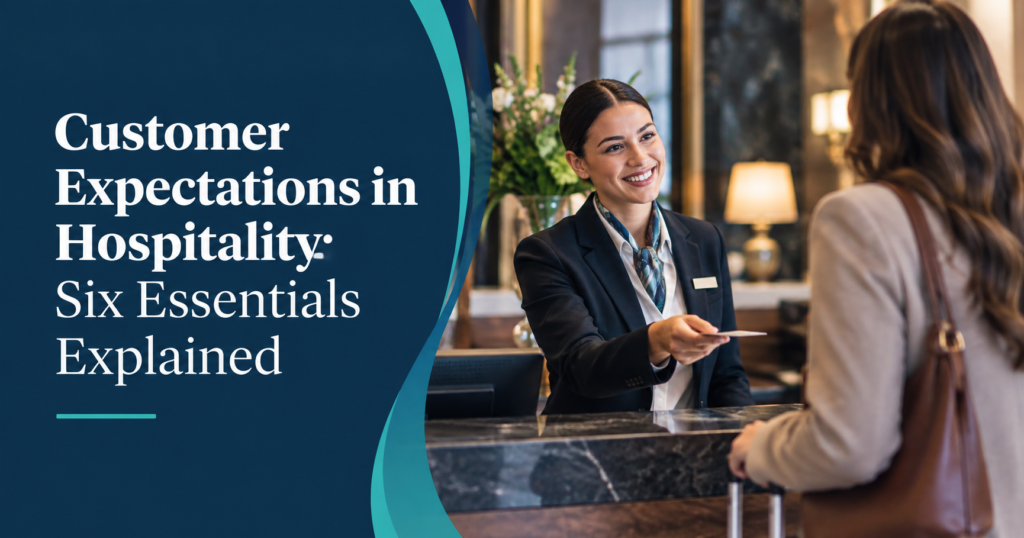
Six common customer expectations in hospitality are timely service, courtesy, consistency, value, safety and comfort. Together, they provide a useful way to understand what guests want from hotels, restaurants, cafés and other service settings. They are not an exhaustive checklist: individual requirements, accessibility and the purpose of a visit also matter.
Understanding these expectations helps hospitality staff recognise what good service means from the customer’s perspective.
What is the difference between customer needs and expectations?
A customer need is the underlying requirement that a service must fulfil. A customer expectation is the standard or experience the person anticipates when that requirement is met.
For example, a hotel guest needs somewhere to sleep. Their expectations may include clean bedding, a quiet room, a secure door and a straightforward check-in. A café customer needs refreshment, but may also expect an accurate order, a courteous greeting and enough time to enjoy their drink.
Expectations can be shaped by the advertised offer, price, previous visits, recommendations and the immediate situation. The same person may want a quick breakfast before a meeting and a leisurely dinner later that evening.
This is why understanding customers involves more than deciding what a “typical guest” wants. Staff also need to establish what matters during the particular visit.
Six customer expectations in hospitality at a glance
| Expectation | The customer’s underlying question | Example of meeting it |
|---|---|---|
| Service speed | Will someone help me within a reasonable time? | Reception acknowledges an arriving guest and explains any delay. |
| Courtesy | Will I be treated with respect and consideration? | Staff listen carefully and respond calmly to a request. |
| Consistency | Can I rely on the promised standard? | Room preparation remains dependable across different days and shifts. |
| Value | Is the experience worth the money, time and effort? | The service delivers the advertised benefits at a clearly explained price. |
| Safety | Can I use the service without avoidable risks? | Staff follow appropriate procedures and respond properly to safety concerns. |
| Comfort | Can I relax and use the facilities easily? | Seating, temperature, noise and layout suit the setting and guest’s needs. |
1. Service speed: timely help at the right pace
Service speed concerns how promptly an organisation acknowledges, serves and responds to customers. It applies throughout the experience, including booking enquiries, ordering, check-in, payment and requests for assistance.
The appropriate pace depends on the situation. A takeaway customer may prioritise receiving an order quickly. A guest enjoying an evening meal may appreciate prompt attention while still wanting time between courses.
Research on restaurant meal pace found that customers could be dissatisfied when service felt rushed, while faster bill settlement was often appreciated. This supports a useful distinction between removing unnecessary delays and accelerating every part of an experience. 1
Consider an illustrative hotel arrival. Reception is helping another guest when a new customer approaches. A brief acknowledgement and realistic explanation of the wait give the arriving customer useful information. Silence leaves them uncertain about whether anyone has noticed them.
Good practice combines appropriate staffing, organised processes and honest communication. A cheerful explanation cannot compensate indefinitely for avoidable delays, but it can help customers understand what is happening.
2. Courtesy: feeling recognised and respected
Courtesy is the respectful, considerate behaviour customers experience through their interactions with staff. It includes tone of voice, attentive listening, patience and the way questions or difficulties are handled.
A courteous welcome does not need to be elaborate. It should make clear that the customer has been noticed and that their request will receive proper attention.
For example, a restaurant customer asking about an unfamiliar menu item should be able to do so without feeling hurried or embarrassed. A receptionist explaining a booking issue should remain calm and avoid language that sounds dismissive.
Courtesy also requires judgement. Some guests welcome conversation, while others prefer a brief, efficient interaction. Staff should respond to the person’s expressed preferences and behaviour rather than assume everyone wants the same style of attention.
This human element forms part of the wider process explored in Click College’s article on customer service delivery in hospitality.
3. Consistency: confidence in the promised experience
Consistency means that essential service standards remain dependable across visits, staff members, shifts and locations.
A guest should not have to wonder whether their room will be properly prepared because a different housekeeping team is working. A restaurant customer should receive accurate information about the same booking policy regardless of who answers the telephone.
Consistency is especially relevant when a business makes a clear promise. If a hotel advertises a particular check-in time or included service, customers have a basis for expecting it to be delivered.
Practical support includes clear procedures, effective handovers and checks that confirm important tasks have been completed. For example, recording an agreed late arrival allows the evening team to honour an arrangement made earlier in the day.
Reliable standards still leave room for individual attention. Two guests may receive different forms of assistance while both experience the same underlying commitment to care and accuracy.
4. Value: an experience worth the total cost
Value describes the customer’s judgement of what they receive compared with what they give up. The cost includes money, but can also include time, effort and inconvenience.
A low room price may offer limited value to someone who then faces an expensive journey to their destination. A higher-priced hotel may feel worthwhile if its location and facilities meet that person’s needs.
The same reasoning applies to restaurants. Customers may judge the overall experience through food quality, portion suitability, service, atmosphere and the clarity of the final bill.
For an illustrative comparison, two hotels charge the same room rate. One clearly explains which services are included; the other reveals additional charges late in the booking process. Even if the final costs are similar, the clarity of the first offer gives customers a firmer basis for deciding whether it meets their requirements.
Hospitality businesses therefore need to understand what their customers value and communicate the offer accurately. Adding extras has limited benefit if the core service remains unreliable.
5. Safety: confidence that essential protections are in place
Safety is a basic expectation across hospitality settings. Guests expect the organisation to manage relevant risks, including food hygiene, unsafe equipment, insecure access and hazards in public areas.
Much of this work happens behind the scenes. Customers may see clean surfaces and clear signage, while effective protection also depends on procedures, maintenance and staff competence.
Food hygiene ratings provide one example of information customers can check. The Food Standards Agency’s rating service allows people to look up food businesses and explains that a hygiene rating is not a guide to food quality. A rating should therefore not be presented as a judgement of taste or the overall dining experience. 2
A practical example is a guest raising a concern about a damaged door lock. The appropriate response is to take the concern seriously, follow the organisation’s procedure and arrange a suitable resolution. Reassuring language alone does not resolve the underlying problem.
Safety should be treated as part of normal service delivery, with action proportionate to the risk.
6. Comfort: being able to relax and use the service easily
Comfort concerns how physically and emotionally easy the environment is to use. It includes temperature, noise, lighting, seating, bedding, privacy and the arrangement of facilities.
In a hotel, attractive décor offers limited benefit if the guest cannot sleep because of noise or an unsuitable room temperature. In a café, comfortable seating and a usable layout may matter as much as the appearance of the interior.
Comfort is also individual. One guest may prefer a lively dining area, while another needs a quieter space to communicate comfortably. Clear information about facilities and a willingness to discuss requirements help avoid assumptions.
Accessibility can cut across all six expectations. A service may be quick and polite yet remain difficult to use if a guest cannot access the booking information or move around the premises comfortably.
Staff can gain useful insight by considering the experience from arrival to departure: where might someone struggle, feel uncertain or need assistance?
How the six expectations work together
The following illustrative example shows why these expectations should be considered together.
A guest arrives at a hotel before an important meeting the next morning. Their room is ready at the advertised time, and reception completes check-in efficiently. The receptionist listens when the guest asks for a quiet room and confirms what has been arranged.
The room matches the booking description, its lock works correctly, and the temperature controls are straightforward. The guest understands the breakfast arrangements and the total charge.
Each detail meets a different expectation, but the guest experiences them as one stay. Now suppose the room is noisy and the agreed quiet-room request has not been passed to the evening team. Good service speed and courtesy remain valuable, but the failures in comfort and consistency still need attention.
For managers, the useful question is: which expectation is currently being missed, and what specific action would address it? This helps turn a general comment such as “the stay was disappointing” into a problem that can be investigated.
Developing hospitality management knowledge
Understanding customer expectations provides a foundation for improving service, supporting staff and making better operational decisions.
Click College offers focused study through the Professional Diploma in Hospitality Management (EduQual Level 5) and the Professional Diploma in Hotel Management (EduQual Level 5). Both are 40-credit options for developing knowledge in their respective areas.
For broader study, the Higher International Certificate in Hospitality and Tourism Management (EduQual Level 4) provides a 120-credit foundation. The Higher International Diploma in Hospitality and Tourism Management (EduQual Level 5) extends the pathway to 240 credits in total, while the International Graduate Diploma in Hospitality and Tourism Management (Level 6) offers 360 credits in total, including strategic study and a research project.
These programmes offer self-paced online learning with coursework assessment, no classes, no fixed schedules, no deadlines and no exams.
Compare Click College’s hospitality and tourism management courses to select the route that matches the knowledge and responsibilities you want to develop.
Frequently asked questions
What are common customer expectations in hospitality?
Customers commonly expect timely service, respectful treatment, dependable standards, fair value, safety and comfort. Their specific requirements depend on the service, its promises and their individual circumstances.
Do customers always want the fastest possible service?
No. Customers usually want a pace appropriate to their visit. Quick payment may be welcome, while rushing a leisurely meal can undermine the experience.
Can a budget hotel meet customer expectations?
Yes. A budget hotel can meet expectations by delivering its advertised offer reliably, including cleanliness, safety, courteous service and suitable comfort. Customer value depends on how well the experience meets their needs at the price paid.
How can a hospitality business identify unmet expectations?
Staff can combine direct questions, guest feedback and observations of the service journey. Specific comments about delays, unclear charges, noise or inconsistent information are more actionable than a satisfaction score alone.
References
[1] Noone, B. M., Kimes, S. E., Mattila, A. S. and Wirtz, J. (2007). The Effect of Meal Pace on Customer Satisfaction. Cornell University repository.
[2] Food Standards Agency. Food hygiene ratings. Accessed 19 September 2026.
Build Your Future in Hospitality and Tourism
Develop the knowledge to deliver better guest experiences, support effective operations and prepare for greater responsibility in hospitality and tourism.
Click College’s online courses cover customer service, hotel operations, tourism management and business leadership—skills relevant to hotels, restaurants, travel services, events and visitor attractions.
| Course | Level | Credits | Focus |
|---|---|---|---|
| Professional Diploma in Hospitality Management | 5 | 40 | Focused development in hospitality operations and management. |
| Professional Diploma in Hotel Management | 5 | 40 | Specialist knowledge of hotel operations and management. |
| Higher International Certificate in Hospitality and Tourism Management | 4 | 120 | A foundation in hospitality, tourism and business management. |
| Higher International Diploma in Hospitality and Tourism Management | 4–5 | 240 total | Broader operational, management and leadership knowledge. |
| International Graduate Diploma in Hospitality and Tourism Management | 4–6 | 360 total | Comprehensive study including strategic management and a research project. |
All courses are 100% online and self-paced, with no classes, no fixed schedules, no deadlines and no exams. Assessment is through coursework, with tutor support available throughout, so learning can fit around work and other commitments.
Compare Hospitality and Tourism Management courses and find the right route for your goals.
Explore Hospitality Courses
Start your journey in hospitality and tourism with an accredited Click College course. Enrol today and build the skills, knowledge, and confidence to progress into a management role.







Recent Posts
How to Build Trust Before a Customer Buys
How to Build Trust Before a Customer Buys Before a customer buys from an unfamiliar business, they are making more than a price comparison. They are deciding whether the offer is genuine, whether the organisation will deliver what it promises and whether help will be available if something goes wrong. That is why trust is […]
Why Customers Switch: The Trust and Value Signals That Drive Churn
Why Customers Switch: The Trust and Value Signals That Drive Churn Customers rarely switch simply because a competitor is cheaper. They switch when the relationship no longer feels safe, fair or worth the effort. A price rise may trigger the search, but unclear charges, poor support, weak proof and uncertainty about what happens next are […]
How to Find and Fix Friction in the Buying Journey
How to Find and Fix Friction in the Buying Journey Customers rarely decide not to buy for one dramatic reason. More often, small difficulties build up: a confusing product page, unclear pricing, a slow reply, an awkward form, conflicting information or a delivery promise that feels uncertain. Each issue may appear minor in isolation. Together, […]