Customer Service Delivery in Hospitality: What Really Defines a Great Experience
Introduction
In hospitality, the product is never just a room, a meal, or a ticket. What customers actually remember — and what ultimately determines whether they return — is the experience.
This is why customer service delivery sits at the core of the hospitality and service industries. It shapes how customers feel during every interaction, from the first point of contact to the final goodbye. Whether someone is checking into a hotel, ordering in a restaurant, or speaking to travel staff, the way service is delivered often matters just as much as what is being delivered.
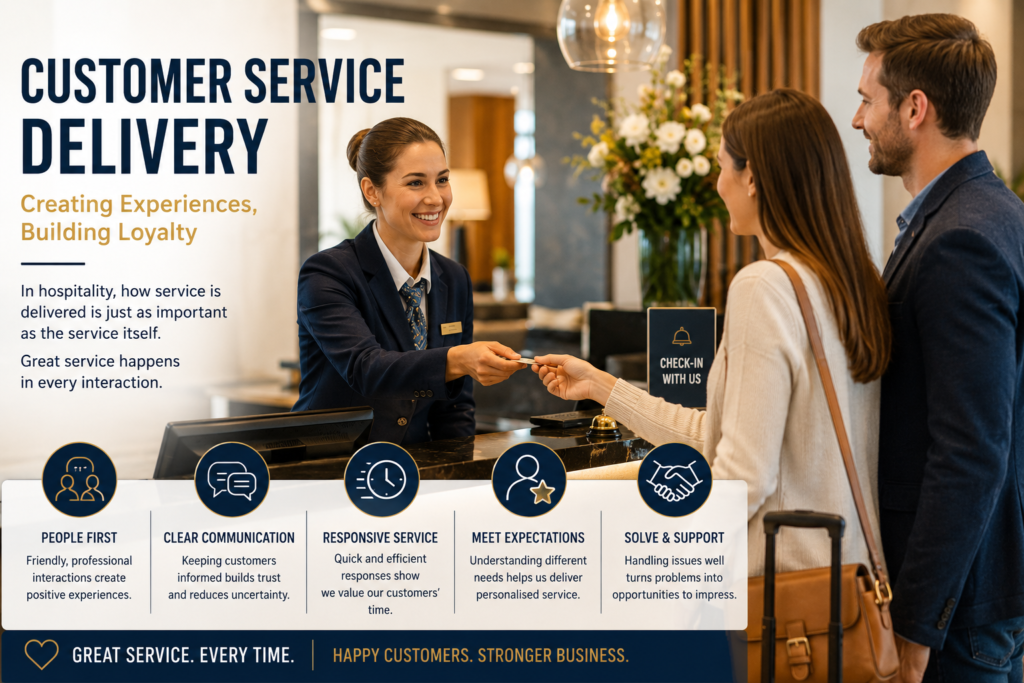
For students and future managers, understanding customer service delivery isn’t just theory. It’s a practical skill that directly impacts customer satisfaction, business reputation and long-term success.
Why customer service delivery matters in hospitality
Hospitality businesses operate in an environment where customers are not simply purchasing a product — they are experiencing a service in real time. This creates a level of pressure that doesn’t exist in many other industries.
When a guest checks into a hotel, the service is happening in front of them. When a customer orders food, the interaction with staff becomes part of the overall experience. If something goes wrong, there is no buffer or delay — the customer notices immediately.
This means businesses must focus heavily on how service is delivered, not just on operational efficiency. Speed, communication and professionalism all play a critical role in shaping customer perceptions. A technically correct service delivered poorly can still result in dissatisfaction, while a well-handled interaction can often improve the overall experience, even if there are minor issues.
The challenge of high and varied customer expectations
One of the defining characteristics of hospitality is that customer expectations are rarely the same. They vary depending on the type of business, the price point and the purpose of the visit.
A business traveller staying in a hotel may prioritise efficiency, fast check-in and reliable Wi-Fi. A family on holiday may expect a welcoming atmosphere, flexibility and support for children. In a restaurant setting, expectations can shift even within the same day, with customers wanting quick service at lunchtime but a more relaxed and attentive experience in the evening.
This variation means that customer service delivery cannot be rigid. It must be adaptable, allowing staff to respond to different needs while maintaining consistent standards. For hospitality businesses, this balance between consistency and flexibility is one of the most important operational challenges.
Why the “invisible” elements of service matter
Unlike physical products, hospitality services are largely intangible. Customers cannot fully judge the quality of a service before they experience it, so they rely on visible and behavioural cues to form their opinions.
Small details often make a significant difference. The tone of a greeting, the appearance of staff, the cleanliness of the environment and the clarity of communication all contribute to how customers perceive quality. Even when the core service remains the same, these elements can dramatically change how it is experienced.
Because of this, hospitality businesses invest heavily in training, service standards and operational procedures. These systems are designed to ensure that service is delivered consistently, regardless of who is working or how busy the business becomes.
Delivering service under pressure
Hospitality environments are often fast-moving and unpredictable. During peak periods, staff may need to serve multiple customers at once while maintaining a high level of professionalism.
This creates a unique challenge. Customers still expect individual attention, even when demand is high. A restaurant team may be managing dozens of tables, while hotel staff may be dealing with a large number of arrivals at the same time. In these situations, the quality of customer service depends heavily on teamwork, communication and organisation.
Well-managed operations ensure that staff can work efficiently without appearing rushed or overwhelmed. When systems are clear and teams are well coordinated, customers are more likely to feel supported, even during busy periods.
The role of technology in modern customer service
Technology has become an important part of customer service delivery in hospitality. Online bookings, mobile check-in, digital menus and automated systems have all improved convenience and speed.
However, technology does not replace the need for human interaction. In fact, in many cases, it increases expectations. Customers may use technology for efficiency, but they still value personal attention when it matters.
The most successful hospitality businesses are those that combine both. They use technology to streamline processes while ensuring that staff remain available to provide reassurance, solve problems and create a more personalised experience.
Why complaint handling defines service quality
No hospitality business operates perfectly all the time. Mistakes happen, especially in fast-paced environments where services are delivered instantly.
What truly defines customer service delivery is how these situations are handled. A delayed meal, a booking issue or a room not being ready can quickly lead to dissatisfaction if not managed properly. However, when handled well, these situations can actually strengthen customer trust.
Effective complaint handling relies on staff having the confidence, authority and training to respond quickly. Customers want to feel listened to, understood and supported. A calm, professional response can often turn a negative experience into a positive one.
This is why service recovery is considered a key part of hospitality operations. It reflects not only how problems are solved, but also how much the business values its customers.
A real-world example: service delivery in a busy restaurant
Consider a busy restaurant serving office workers at lunchtime and families in the evening. During peak hours, the pressure on staff increases significantly. Orders must be taken quickly, food prepared efficiently and communication between kitchen and front-of-house teams must remain clear.
On one particularly busy day, the team works closely together to manage demand. Staff communicate waiting times clearly, keep customers informed and respond quickly when a meal is delayed. Instead of becoming frustrated, customers feel reassured because they are being kept updated and treated professionally.
This example highlights an important point. Customer service delivery is not just about the final product — in this case, the food — but about the entire experience. The way staff communicate, coordinate and respond under pressure directly shapes how customers feel about the service.
Why customer service delivery matters for your career
For students studying hospitality or business management, customer service delivery is one of the most valuable areas to understand. It connects directly to real-world roles across hotels, restaurants, tourism and events.
Employers are not only looking for technical skills. They want individuals who can communicate effectively, adapt to different situations and maintain professionalism under pressure. These are the qualities that define strong customer service.
At Click College, these concepts are built into our Level 3, 4 and 5 Business and Hospitality courses, helping students develop practical skills that go beyond theory and prepare them for real industry environments.
Final thoughts
Customer service delivery is what brings hospitality to life. It transforms a simple transaction into an experience and plays a major role in determining whether a business succeeds or fails.
Because service is delivered in real time, shaped by human interaction and influenced by constantly changing demand, it requires careful planning, strong teamwork and a consistent focus on the customer.
For anyone entering the hospitality industry, understanding how service is delivered — not just what is delivered — is one of the most important steps towards building a successful career.
View Courses in Hospitality and Tourism…
Start your journey in hospitality and tourism with an accredited Click College course. Enrol today and build the skills, knowledge, and confidence to progress into a management role.







Recent Posts
Professional Diploma or Higher Qualification Pathway: Which Should You Choose?
Professional Diploma or Higher Qualification Pathway: Which Should You Choose? Choosing the right online qualification is not always simply a question of choosing the longest course or the highest level. For many learners, the better question is: what kind of study route fits my goals right now? Some learners want a focused qualification in one […]
Professional Diploma in Leadership and Management: Course Guide
Professional Diploma in Leadership and Management: Course Guide A Professional Diploma in Leadership and Management is designed for learners who want to develop advanced leadership, strategic thinking and organisational management skills without committing immediately to a full degree programme. Leadership and management are essential in almost every sector. Whether you work in business, education, hospitality, […]
Professional Diploma in Business Management: Who Is It For?
Professional Diploma in Business Management: Who Is It For? A Professional Diploma in Business Management is designed for learners who want to build practical business knowledge without committing immediately to a full degree or long higher education programme. It can be a useful option for people who want to understand how organisations work, how teams […]