Food and Beverage in Hospitality: A Sector at the Heart of Customer Experience
Introduction
The food and beverage sector is one of the most important and visible sectors within the hospitality and service industries. It includes all businesses that prepare, serve, and sell food and drinks to customers, and it plays a central role in shaping the overall hospitality experience. Although eating and drinking are basic human needs, in hospitality they go far beyond simple nourishment. Meals, refreshments, and dining experiences are often linked to leisure, celebration, comfort, convenience, culture, and social interaction. For this reason, food and beverage is not only a practical service, but also an essential contributor to customer satisfaction and business success.
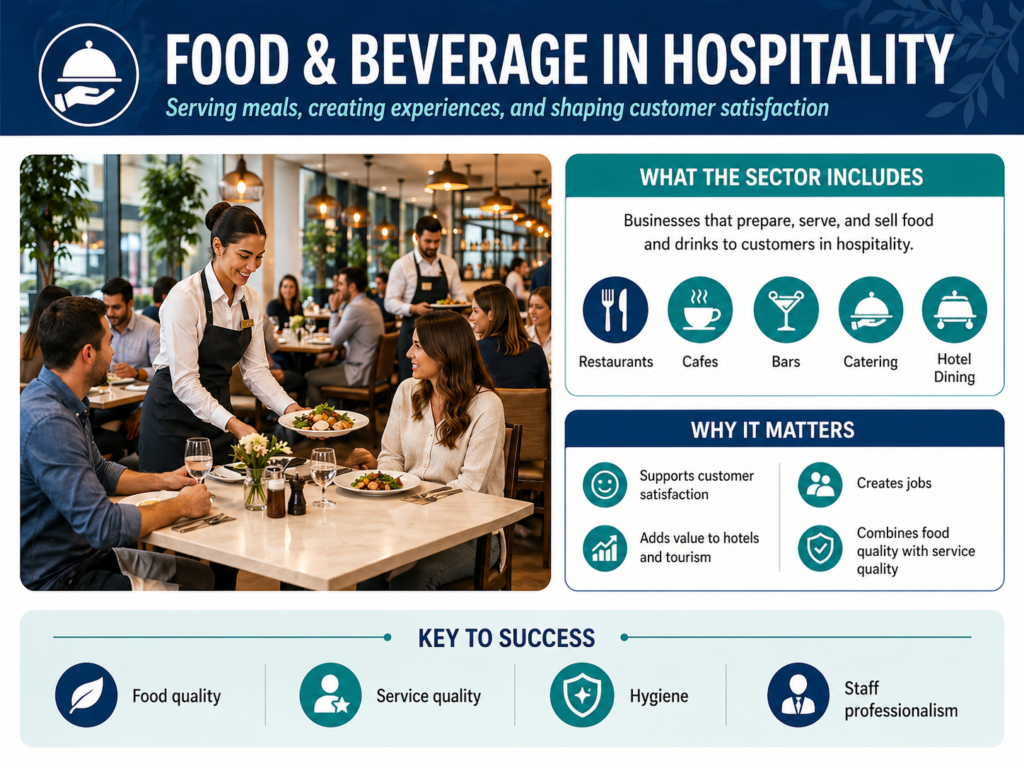
This sector is broad and diverse. It includes restaurants, cafés, coffee shops, bars, pubs, fast food outlets, catering services, takeaways, canteens, fine dining establishments, and hotel dining operations. These businesses vary in size, style, service level, price range, and target market, but they all share the same broad purpose: to provide food and drink in a way that meets customer expectations and delivers a satisfying experience. In some cases, the focus may be on speed, affordability, and convenience. In others, the emphasis may be on atmosphere, presentation, service quality, and memorable dining occasions. This variety shows that the food and beverage sector must be highly adaptable and responsive to a wide range of customer needs.
Understanding the food and beverage sector is important because it demonstrates how hospitality combines product quality with service delivery. Customers do not judge food and beverage businesses by the meal alone. They also judge them by cleanliness, service speed, communication, staff behaviour, ambience, and the way the business responds to individual needs. As a result, the sector provides a clear example of how customer experience in hospitality is shaped through the interaction of tangible and intangible elements.
What the Food and Beverage Sector Includes
The food and beverage sector consists of all businesses that prepare and serve food and drinks to customers. Although this may appear straightforward, the sector is highly varied because it caters for many different types of demand and occasions. A quick-service outlet serving low-cost meals to customers on a short lunch break operates very differently from a luxury restaurant offering a carefully designed fine dining experience. A café focused on drinks and light snacks has different priorities from a catering company serving a large corporate event or wedding. Yet despite these differences, each of these businesses belongs to the same broad sector because each provides food and drink as a core part of its service offer.
Restaurants are among the most recognisable forms of food and beverage business and can range from casual, family-friendly venues to upscale establishments offering premium ingredients and formal table service. Cafés and coffee shops often provide informal spaces for socialising, working, or taking a short break. Bars and pubs typically combine beverage service with social atmosphere and, in many cases, food provision as well. Fast food outlets and takeaways focus more strongly on speed, affordability, and efficiency. Catering businesses provide food and drink for events, institutions, and external venues, while hotel food and beverage departments may include breakfast service, room service, restaurants, banqueting, and conference catering.
This variety highlights the size and importance of the sector. Food and beverage businesses are found in everyday local environments, in tourism destinations, in business settings, and in leisure venues. Their widespread presence makes the sector one of the most accessible and economically significant parts of hospitality.
Why Food and Beverage Is Central to Hospitality
Food and beverage holds a central place in hospitality because it combines a basic need with a service experience. People need food and drink for everyday living, but in hospitality these needs are often connected to comfort, enjoyment, identity, and occasion. A meal out may be part of a family gathering, a business discussion, a holiday experience, or a celebration. A hotel breakfast may shape a guest’s impression of an overnight stay. A destination’s local cuisine may become one of the main attractions for visitors. In each case, food and beverage contributes directly to how customers experience hospitality as a whole.
The sector is also important because it often involves frequent and highly visible contact with customers. Unlike some hospitality functions that operate more in the background, food and beverage service is usually direct and immediate. Customers interact with staff while placing orders, asking questions, making requests, receiving food, and evaluating the experience. Because of this, the quality of customer service is highly noticeable. Businesses in this sector must therefore perform well not only in preparing food and drink, but also in delivering service in a professional, efficient, and welcoming way.
In many hospitality settings, food and beverage adds significant value beyond the core service. In hotels, for example, dining services can enhance guest satisfaction through breakfast provision, restaurants, bars, room service, and event catering. In tourism, food and beverage experiences may influence destination appeal and create memorable aspects of a trip. The sector is therefore not only important in its own right, but also as a contributor to the success of other parts of hospitality.
Serving Different Customers and Different Occasions
A major feature of the food and beverage sector is the wide range of customer needs it must accommodate. Not all customers are looking for the same type of service, and not all dining situations have the same purpose. Some customers want speed and low cost because they are eating during a busy working day. Others may be seeking a more leisurely and enjoyable experience, perhaps for a celebration, family meal, or social occasion. Some customers expect formal table service and carefully presented dishes, while others prioritise convenience, takeaway options, or flexible ordering.
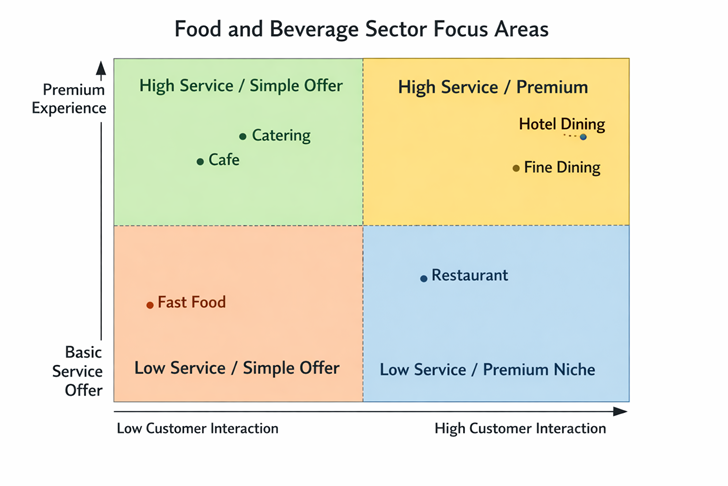
These differences mean that food and beverage businesses must define their market clearly and tailor their offer accordingly. A casual café may succeed by creating a relaxed atmosphere, affordable pricing, and easy service. A fine dining restaurant may compete more through quality ingredients, culinary skill, detailed presentation, and a refined environment. A catering company may focus on reliability, planning, and the ability to serve large groups efficiently. Hotel food and beverage services may need to meet the expectations of a broad mix of guests, including tourists, business travellers, families, and conference attendees.
Because customer expectations vary so widely, businesses in this sector often compete on several factors at once. Food quality remains essential, but so do service speed, cleanliness, menu variety, ambience, staff attitude, and value for money. This combination makes food and beverage one of the most demanding and dynamic sectors within hospitality.
Food Quality and Service Quality as Shared Priorities
One of the defining features of the food and beverage sector is that success depends on both product quality and service quality. In some industries, the product alone may be enough to determine whether the customer is satisfied. In food and beverage, however, the customer experience is shaped by the meal and the service environment together. Customers do not judge a restaurant or café only by taste. They also consider how they were welcomed, how long they waited, how clearly staff communicated, whether the dining area was clean, and how well requests or problems were handled.
This means that food and beverage businesses must manage two related forms of quality at the same time. Product quality includes the taste, freshness, presentation, portioning, and safety of the food and drink served. Service quality includes staff professionalism, communication, order accuracy, responsiveness, speed, and the overall comfort and cleanliness of the environment. A high-quality meal may be overshadowed by slow service, an unfriendly attitude, or poor hygiene. Likewise, excellent service may not fully compensate for food that is poorly prepared or disappointing in quality. The most successful businesses are therefore those that integrate both elements into a consistent customer experience.
This balance is especially important because customers often form judgements very quickly in food and beverage environments. A delay in greeting, an unclear explanation of menu items, or visible untidiness may shape perceptions before the food is even served. The dining experience is therefore cumulative, with each stage influencing how the final experience is remembered.
The Importance of Cleanliness, Hygiene, and Safety
Cleanliness and hygiene are especially important in the food and beverage sector because they are directly linked to customer trust, satisfaction, and safety. Customers expect the food they consume to be prepared, stored, and served in hygienic conditions. They also expect the dining environment itself to be clean, comfortable, and well maintained. If these expectations are not met, the consequences can be serious, ranging from dissatisfaction and negative reviews to health risks and damage to business reputation.
For this reason, food and beverage businesses place strong emphasis on food hygiene practices, kitchen standards, and staff training. Employees must understand safe food handling, cross-contamination risks, personal hygiene, cleaning routines, and correct procedures for storing and serving food. These operational requirements are not separate from hospitality; they are central to it. In food and beverage, good hospitality includes creating an environment in which customers feel confident about the quality and safety of what they are consuming.
Cleanliness also affects perception beyond health concerns. A well-maintained dining area, tidy service station, and clean table presentation all contribute to a positive impression of professionalism. In contrast, untidy surroundings or visible hygiene issues can undermine customer confidence even if the food itself is of good quality. This shows that hygiene in the food and beverage sector operates at both a technical and experiential level.
The Role of Staff in Delivering Customer Satisfaction
Staff play a critical role in the food and beverage sector because they connect the product to the customer. Chefs, kitchen assistants, waiters, bar staff, supervisors, and managers all contribute to the final experience, even though their roles may differ. In many cases, customers judge the quality of service as much by staff behaviour as by the food or drink itself. A warm welcome, attentive communication, and efficient handling of requests can greatly improve customer satisfaction, while poor staff attitude or ineffective communication can lead to complaints and reduced loyalty.
This is why staff training is so important in food and beverage operations. Employees must be prepared not only in technical tasks but also in customer care, communication, teamwork, and problem-solving. They may also need to deal with increasingly complex customer expectations, including dietary requirements, allergies, healthy options, sustainability concerns, and requests for personalised service. The ability to respond professionally to these expectations is now a major part of quality service.
Food and beverage service also depends strongly on teamwork. Front-of-house and kitchen staff must coordinate effectively to ensure that orders are accurate, meals are delivered promptly, and customer needs are met. If communication breaks down between departments, the customer experience is often affected immediately. This makes internal coordination a fundamental part of external service quality.
Responding to Changing Customer Expectations
In recent years, customer expectations in the food and beverage sector have become more demanding and more varied. Customers increasingly expect businesses to do more than provide appealing food at a reasonable price. They also expect attention to health, dietary needs, transparency, sustainability, and personal choice. For example, many customers now expect clear information about allergens, vegetarian and vegan options, and healthier menu alternatives. Others may be interested in the ethical sourcing of ingredients, environmentally responsible packaging, or support for local producers.
These changing expectations reflect the broader evolution of hospitality. Customers are often better informed and more selective than in the past, and they are more likely to compare experiences, leave reviews, and expect businesses to respond quickly to their individual needs. This creates both challenge and opportunity. Businesses that fail to adapt may struggle to remain competitive, while those that respond effectively can build stronger customer trust and loyalty.
The need to respond to change also demonstrates the dynamic nature of the sector. Food and beverage businesses must remain aware of trends in customer behaviour, lifestyle, and social values. They must continue refining menus, service methods, and operational practices to remain relevant and appealing in a competitive marketplace.
The Economic Importance of the Food and Beverage Sector
The food and beverage sector makes a major contribution to the economy and to the wider hospitality industry. It creates employment across a wide range of roles, including chefs, waiters, bar staff, supervisors, managers, kitchen assistants, delivery workers, and event staff. In addition to direct employment, the sector supports a large network of suppliers and related businesses, including farmers, food producers, wholesalers, logistics providers, equipment suppliers, and cleaning services.
Its economic importance is particularly strong because of its broad reach. Food and beverage businesses operate in city centres, local communities, travel hubs, hotels, leisure venues, schools, workplaces, and tourist destinations. They contribute to everyday economic activity while also supporting major events, tourism flows, and destination development. In many areas, they form a visible part of local business life and can influence how attractive a place feels to residents and visitors alike.
The sector also adds value to other hospitality services. In hotels, dining provision can significantly improve the guest experience and increase revenue through breakfast services, restaurants, bars, banqueting, and room service. In tourism, dining experiences may become attractions in themselves, especially where regional or national cuisine forms part of a destination’s identity. Food and beverage therefore contributes both directly and indirectly to business success across hospitality.
Links Between Food and Beverage and the Wider Hospitality Industry
Food and beverage is closely connected to the other sectors within hospitality and the service industries. In accommodation, it enhances guest stays through breakfast, dining, and event catering. In travel settings, food and drink provision supports passengers in airports, stations, ferries, and roadside services. In leisure environments, it contributes to the quality of cinemas, theme parks, sports venues, entertainment complexes, and event spaces. In tourism, it helps shape the overall destination experience, often becoming part of what visitors remember most strongly.
These links show that food and beverage is not an isolated sector. It operates as part of a wider network of services that together form the hospitality experience. A hotel guest may judge their stay partly by the breakfast service. A tourist may remember a destination because of its local food culture. A business conference may depend heavily on the quality and efficiency of event catering. In each case, food and beverage plays a role in strengthening or weakening the overall experience.
For this reason, understanding the food and beverage sector helps learners understand hospitality more broadly. It reveals how service quality, customer care, operational standards, and business performance are closely connected.
Case Study: A Restaurant Balancing Food Quality and Service
The importance of the sector can be seen clearly in the example of a busy casual dining restaurant serving lunch and dinner to office workers, families, and tourists. During peak hours, the kitchen must prepare meals quickly, while front-of-house staff greet customers, take orders, respond to special dietary requests, and maintain a clean and welcoming dining area. On one evening, the restaurant receives praise because staff handle a customer’s allergy request carefully, explain menu options clearly, and deliver meals promptly. As a result, the customer enjoys a positive dining experience and is more likely to return.
This case is useful because it shows that customer satisfaction in food and beverage depends on several elements working together. The kitchen must maintain food quality and speed. Front-of-house staff must communicate well and show professionalism. The business must also ensure cleanliness and respond effectively to individual needs. The customer does not evaluate these features separately; they experience them as one overall service encounter.
The example also shows why food and beverage is such a key part of hospitality. It combines the preparation of a physical product with real-time customer interaction. Success therefore depends on both operational efficiency and service excellence. Businesses that manage both effectively are more likely to build a strong reputation and encourage repeat custom.
Why Understanding Food and Beverage Matters
Studying the food and beverage sector is important because it shows how central food and drink are to hospitality, customer satisfaction, and business performance. It helps learners understand that the sector is not only about serving meals, but about designing and managing experiences. It also demonstrates the wide range of business models, customer expectations, and operational demands found within hospitality.
More broadly, the sector illustrates the importance of balancing technical standards with service quality. A successful food and beverage business must deliver safe, appealing, and appropriate products while also creating an environment in which customers feel welcomed, respected, and satisfied. This makes the sector an excellent example of hospitality in action, where physical provision, staff performance, and customer interaction come together to create value.
Conclusion
The food and beverage sector is one of the main sectors within the hospitality and service industries because it provides meals, refreshments, and dining experiences that are essential to both everyday life and wider hospitality activity. It includes a wide range of businesses, from cafés and fast food outlets to fine dining restaurants, catering services, bars, and hotel dining operations. Although these businesses differ in their service style and target market, they all contribute to customer experience through the preparation and service of food and drink.
Its importance lies not only in the products it provides, but also in the service it delivers. Customers judge food and beverage businesses on food quality, service quality, cleanliness, communication, speed, and atmosphere. The sector therefore requires a strong combination of operational control, staff professionalism, customer care, and adaptability to changing expectations.
The food and beverage sector also makes a major contribution to employment, local economies, tourism, and the wider hospitality industry. For all of these reasons, it is one of the most significant sectors within hospitality and one of the clearest examples of how customer satisfaction depends on the interaction between product, service, and experience.
View Courses in Hospitality and Tourism…
Start your journey in hospitality and tourism with an accredited Click College course. Enrol today and build the skills, knowledge, and confidence to progress into a management role.







Recent Posts
How to Build Trust Before a Customer Buys
How to Build Trust Before a Customer Buys Before a customer buys from an unfamiliar business, they are making more than a price comparison. They are deciding whether the offer is genuine, whether the organisation will deliver what it promises and whether help will be available if something goes wrong. That is why trust is […]
Why Customers Switch: The Trust and Value Signals That Drive Churn
Why Customers Switch: The Trust and Value Signals That Drive Churn Customers rarely switch simply because a competitor is cheaper. They switch when the relationship no longer feels safe, fair or worth the effort. A price rise may trigger the search, but unclear charges, poor support, weak proof and uncertainty about what happens next are […]
How to Find and Fix Friction in the Buying Journey
How to Find and Fix Friction in the Buying Journey Customers rarely decide not to buy for one dramatic reason. More often, small difficulties build up: a confusing product page, unclear pricing, a slow reply, an awkward form, conflicting information or a delivery promise that feels uncertain. Each issue may appear minor in isolation. Together, […]