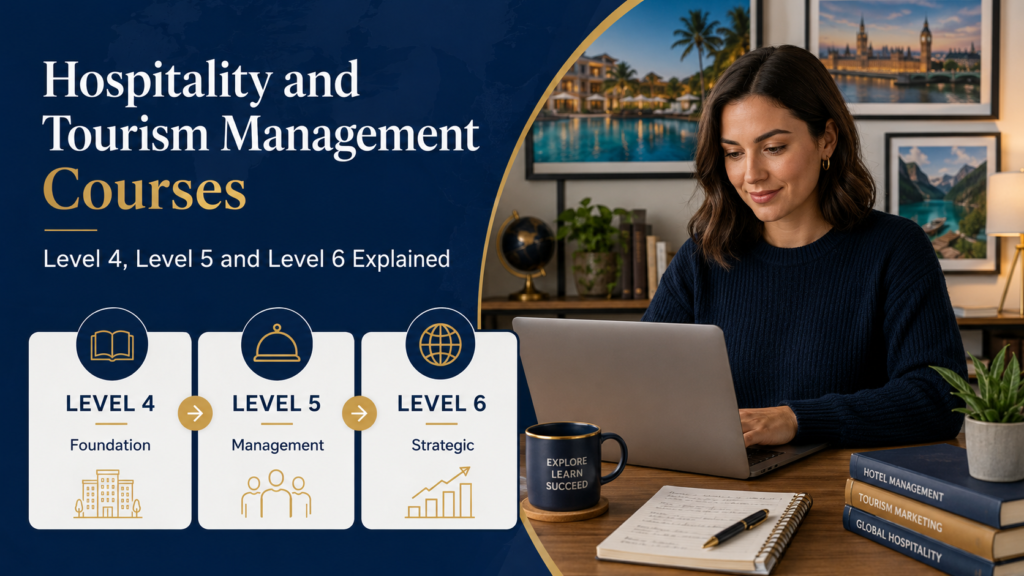
Hospitality and Tourism Management Courses: Level 4, Level 5 and Level 6 Explained
A Complete Guide to Online Hospitality and Tourism Qualifications
Hospitality and tourism management courses are designed for learners who want to develop the knowledge, skills and confidence needed to progress in one of the world’s most dynamic service industries.
The hospitality and tourism sector includes hotels, resorts, restaurants, travel companies, visitor attractions, events businesses, accommodation providers, destination management organisations and many other customer-focused services. It is a people-centred industry, but it is also a business-driven one. Successful hospitality and tourism organisations need managers who understand operations, customer experience, service quality, marketing, finance, leadership and strategic decision-making.
For learners who want to move into supervisory, management or leadership roles, choosing the right qualification level is important. A Level 4 course is not the same as a Level 5 course, and a Level 6 qualification is designed for a different stage of professional and academic development.
This guide explains the difference between Level 4, Level 5 and Level 6 hospitality and tourism management courses, how credits work, who each level is suitable for, and how Click College’s online qualification pathway can support your progression from foundation study through to degree-level learning.
What Are Hospitality and Tourism Management Courses?
Hospitality and tourism management courses focus on how service-based organisations are planned, operated and managed. They combine general business management knowledge with specialist understanding of the hospitality, tourism and travel industries.
A good hospitality and tourism management qualification may cover areas such as:
- Hospitality operations
- Tourism and destination management
- Customer experience
- Service quality
- Hotel and accommodation management
- Front-of-house operations
- Marketing and customer insight
- People and team management
- Leadership and organisational behaviour
- Revenue management
- Strategic hospitality management
- Business performance
- Innovation and change
These subjects help learners move beyond basic operational tasks and begin thinking like managers. Instead of only asking, “How do I complete this task?”, learners begin asking, “How does this operation work?”, “How do we improve customer experience?”, “How do teams perform effectively?” and “How can this business become more competitive?”
This is why hospitality and tourism management courses are valuable for learners at different stages of their career. They can support beginners entering the sector, experienced workers seeking promotion, and managers who want to develop more advanced leadership skills.
Why Qualification Levels Matter
When comparing hospitality and tourism management courses, you will often see qualifications described as Level 4, Level 5 or Level 6. These levels help explain the academic stage of the qualification.
In simple terms:
| Level | Broad Academic Stage | Best For |
|---|---|---|
| Level 4 | First year of university-level study | Learners building foundations |
| Level 5 | Second year of university-level study | Learners developing management capability |
| Level 6 | Final year / degree-level study | Learners developing strategic leadership skills |
The level tells you how advanced the study is. It does not simply describe how long the course takes. A Level 6 qualification is more academically advanced than a Level 4 qualification because it requires deeper analysis, stronger independent thinking and more strategic decision-making.
For hospitality and tourism learners, this matters because different career goals require different levels of study.
A learner who is new to the sector may benefit most from Level 4. A hospitality supervisor seeking promotion may be better suited to Level 5. A manager aiming for senior leadership or degree-level achievement may prefer Level 6.
The Click College Hospitality and Tourism Management Pathway
Click College offers a structured online pathway in Hospitality and Tourism Management across Level 4, Level 5 and Level 6.
The three main qualifications are:
| Qualification | Level | Credits |
|---|---|---|
| Higher International Certificate in Hospitality & Tourism Management | EduQual Level 4 | 120 credits |
| Higher International Diploma in Hospitality & Tourism Management | EduQual Level 5 | 240 credits |
| International Graduate Diploma in Hospitality & Tourism Management | Level 6 | 360 credits |
This pathway allows learners to progress step by step. You can begin with Level 4, move on to Level 5, and then progress to Level 6. This creates a structured route for learners who want to build towards degree-level hospitality and tourism management study online.
The Click College model is designed for flexibility. The courses are delivered online, assessed through coursework and designed for learners who want to study around work, family or other commitments.
>> Course links:
Higher International Certificate in Hospitality & Tourism Management (EduQual Level 4)
Higher International Diploma in Hospitality & Tourism Management (EduQual Level 5)
International Graduate Diploma in Hospitality & Tourism Management (Level 6)
What Is a Level 4 Hospitality and Tourism Management Course?
A Level 4 hospitality and tourism management course provides an introduction to higher education study in the subject area. It is designed to build foundational knowledge and help learners understand the core principles of hospitality, tourism, business and service management.
At Level 4, learners are usually developing their ability to understand key concepts, explain business ideas, analyse basic organisational situations and apply knowledge to practical examples.
Level 4 is often the right choice for learners who are:
- New to higher education
- Returning to study after a break
- Entering hospitality or tourism for the first time
- Working in the sector but lacking formal qualifications
- Seeking a structured foundation before progressing to Level 5
- Looking for an online alternative to the first year of university-level study
For hospitality and tourism learners, Level 4 helps build confidence. It introduces the language, concepts and expectations of higher-level study without assuming advanced prior knowledge.
Higher International Certificate in Hospitality & Tourism Management — EduQual Level 4
The Higher International Certificate in Hospitality & Tourism Management is Click College’s main Level 4 qualification in the hospitality subject area. It carries 120 credits and is designed as a strong foundation for further study and professional development.
This qualification is suitable for learners who want to understand how hospitality, tourism and service organisations operate. It introduces the business environment, people and teamwork, marketing fundamentals, customer insight, hospitality operations and customer experience.
The course is particularly useful for learners who want to develop a broad understanding of the sector before deciding whether to specialise in areas such as hotel management, tourism management, hospitality management or revenue management.
A Level 4 learner may explore questions such as:
- What are the main sectors within hospitality and tourism?
- How do service organisations create customer value?
- What makes customer experience important?
- How do teams contribute to service quality?
- How does marketing influence customer demand?
- What are the basic operational challenges in hospitality and tourism?
These questions are important because they help learners move from practical industry awareness to more structured management understanding.
The Higher International Certificate can also act as the first step towards the Higher International Diploma at Level 5 and the International Graduate Diploma at Level 6.
What Can a Level 4 Hospitality and Tourism Course Lead To?
A Level 4 hospitality and tourism management course can support both career development and academic progression.
Career-related opportunities may include:
- Hospitality supervisor
- Tourism assistant
- Guest services team leader
- Front-of-house supervisor
- Visitor services assistant
- Travel services coordinator
- Hotel operations assistant
- Events or visitor experience assistant
The qualification may also support learners already working in the sector who want to formalise their knowledge and improve their confidence.
From an academic progression perspective, Level 4 provides a foundation for Level 5 study. Learners who successfully complete the Higher International Certificate may progress to the Higher International Diploma in Hospitality & Tourism Management.
For many learners, this step-by-step structure is useful because it avoids the pressure of committing immediately to a full degree-level pathway. Instead, learners can begin with a recognised Level 4 qualification and progress when they are ready.
What Is a Level 5 Hospitality and Tourism Management Course?
A Level 5 hospitality and tourism management course builds on Level 4 study and develops more advanced management knowledge. It is more analytical, more applied and more focused on decision-making within real organisational contexts.
Level 5 is often suitable for learners who already have some industry experience or who have completed Level 4 study. It is also suitable for people who are working in supervisory roles and want to progress into management.
At this level, learners are expected to go beyond describing basic ideas. They begin to evaluate management approaches, compare options, apply models to practical situations and consider how decisions affect organisational performance.
Level 5 hospitality and tourism courses may explore areas such as:
- Hospitality operations management
- Tourism and destination management
- Digital transformation
- Operations and quality management
- People and organisational behaviour
- Service delivery
- Customer experience strategy
- Leadership and management
- Business decision-making
A Level 5 qualification can be valuable because many hospitality and tourism careers require practical management judgement. Managers must balance customer expectations, staff performance, operational pressures, cost control and commercial goals.
Level 5 helps learners understand these issues in more depth.
Higher International Diploma in Hospitality & Tourism Management — EduQual Level 5
The Higher International Diploma in Hospitality & Tourism Management is Click College’s main Level 5 qualification in the hospitality sector. It carries 240 credits and is designed to provide a broader and more advanced understanding of hospitality and tourism management.
This qualification is suitable for learners who want a substantial management qualification and a clear progression route towards Level 6 study.
It is particularly relevant for:
- Hospitality supervisors
- Tourism professionals
- Front office or guest services staff
- Team leaders
- Existing managers seeking formal qualifications
- Learners progressing from Level 4
- Adult learners seeking a flexible online route to higher education
The Higher International Diploma helps learners develop a stronger understanding of how hospitality and tourism organisations are managed. It encourages learners to connect theory with practice and apply management concepts to realistic industry situations.
For example, a learner might examine how a hotel improves service quality, how a destination manages visitor experience, how digital tools affect customer engagement, or how leadership influences staff performance in service environments.
This makes Level 5 particularly useful for learners who want to move from operational work into roles involving planning, coordination, supervision and decision-making.
What Can a Level 5 Hospitality and Tourism Course Lead To?
A Level 5 hospitality and tourism management course can support progression into more responsible roles across the sector.
Potential career pathways may include:
- Hospitality operations manager
- Hotel supervisor or assistant manager
- Front office manager
- Guest services manager
- Tourism operations coordinator
- Destination management assistant
- Customer experience manager
- Events supervisor
- Visitor attraction supervisor
- Service quality coordinator
The exact role a learner can pursue will depend on their previous experience, employer, location and career goals. However, Level 5 study can strengthen management knowledge and help learners demonstrate readiness for increased responsibility.
Level 5 can also support progression to Level 6. Learners who want degree-level study may use the Higher International Diploma as a stepping stone towards the International Graduate Diploma in Hospitality & Tourism Management.
For learners who are building a long-term career in the sector, Level 5 is often the stage where they move from understanding the industry to actively managing within it.
What Is a Level 6 Hospitality and Tourism Management Course?
A Level 6 hospitality and tourism management course is designed for advanced study. It focuses on strategic decision-making, leadership, analysis, organisational performance and long-term business development.
Level 6 is commonly associated with final-year undergraduate study. It requires learners to think critically, evaluate complex issues and apply advanced management concepts to real or realistic business situations.
In hospitality and tourism, Level 6 study may include:
- Strategic management
- Competitive advantage
- Strategic hospitality management
- Revenue management
- Hospitality finance
- Innovation and change leadership
- Applied research
- Organisational development
- Business performance analysis
- Senior-level decision-making
This level is suitable for learners who want to move beyond operational management into strategic leadership. It is also suitable for learners seeking degree-level knowledge through a flexible online route.
At Level 6, learners are not simply learning how hospitality and tourism businesses operate. They are examining how such organisations compete, adapt, grow and respond to change.
International Graduate Diploma in Hospitality & Tourism Management — Level 6
The International Graduate Diploma in Hospitality & Tourism Management is Click College’s main Level 6 qualification. It carries 360 credits and is designed for learners seeking degree-level study in hospitality and tourism management.
This qualification is suitable for:
- Hospitality managers
- Tourism managers
- Department heads
- Senior supervisors
- Business owners
- Learners seeking degree-level knowledge
- Professionals aiming for senior roles
- Learners planning further academic or professional progression
The International Graduate Diploma helps learners develop advanced knowledge of management, leadership and strategic decision-making. It is particularly relevant for those who want to understand how hospitality and tourism organisations can build competitive advantage, improve performance and respond to changing market conditions.
A learner at this level may examine questions such as:
- How can a hospitality business improve its competitive position?
- How should tourism organisations respond to changing visitor expectations?
- How can hotels use revenue management to improve performance?
- How can leaders manage innovation and organisational change?
- What strategic choices support long-term success in hospitality and tourism?
These are more advanced questions than those typically addressed at Level 4 or Level 5. They require learners to consider evidence, evaluate options and make reasoned judgements.
For learners who want to demonstrate advanced capability, the International Graduate Diploma provides a substantial and flexible online route.
What Can a Level 6 Hospitality and Tourism Course Lead To?
A Level 6 hospitality and tourism management course can support progression towards senior roles, strategic responsibilities and further study.
Possible career directions may include:
- Hospitality manager
- Tourism manager
- Hotel manager
- Resort manager
- Revenue manager
- Operations manager
- Destination manager
- Service quality manager
- Customer experience manager
- Hospitality consultant
- Tourism business owner
- Strategic project manager
- Senior supervisor or department head
Level 6 study is particularly useful for learners who want to show that they can think beyond daily operations. Senior roles often require managers to analyse market conditions, lead teams, manage change, control resources, understand financial performance and make decisions that affect long-term outcomes.
This is why Level 6 hospitality and tourism management courses are usually more strategic than earlier levels.
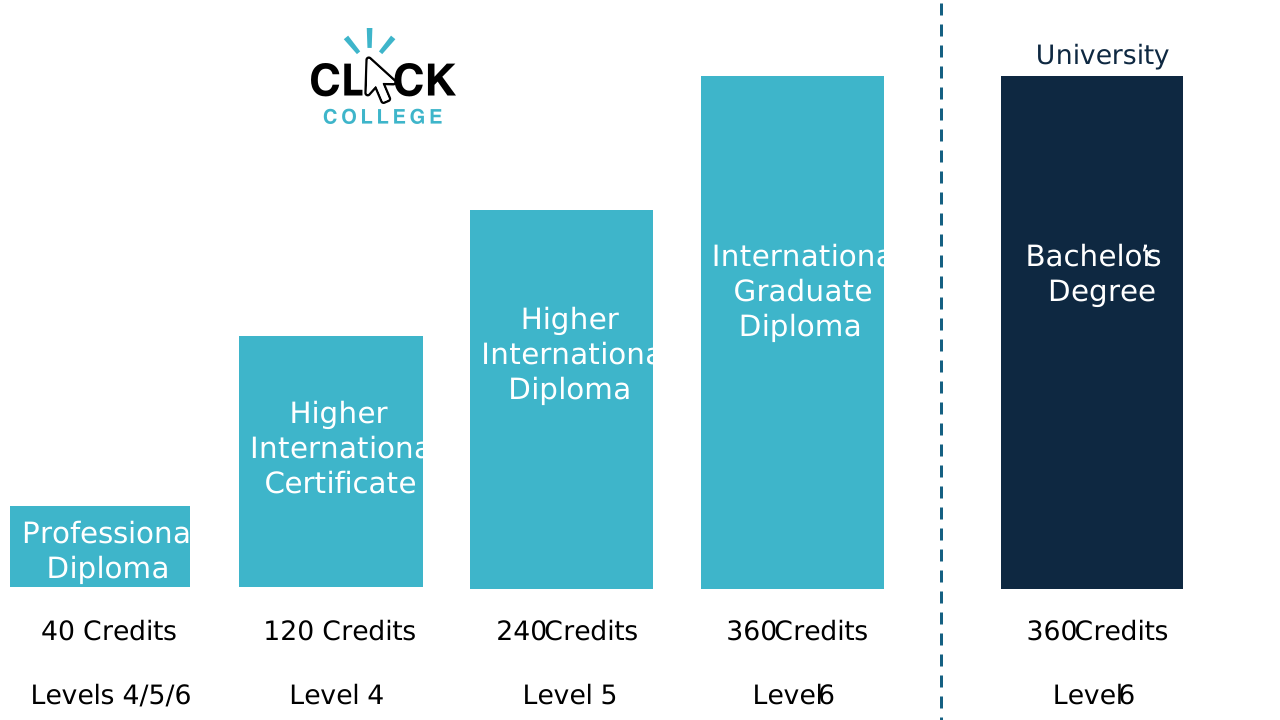
120, 240 and 360 Credits Explained
In addition to qualification levels, learners also need to understand credits.
A credit value indicates the size of a qualification. It gives a sense of how much learning is included.
At Click College, the three main Hospitality and Tourism Management qualifications carry the following credit values:
| Qualification | Credits |
|---|---|
| Higher International Certificate | 120 credits |
| Higher International Diploma | 240 credits |
| International Graduate Diploma | 360 credits |
A 120-credit qualification usually represents a full stage of higher education learning. A 240-credit qualification is larger and normally reflects two stages of study. A 360-credit qualification is a full degree-level credit volume.
Credits are useful because they help learners compare qualifications. Two courses may both be described as hospitality and tourism management courses, but one may be a short 40-credit diploma while another may be a 360-credit degree-level pathway. These are very different in size and purpose.
The right choice depends on what the learner wants to achieve.
A 120-credit Level 4 course is suitable for foundation study. A 240-credit Level 5 course provides broader management development. A 360-credit Level 6 course offers the most comprehensive pathway.
How Long Do Hospitality and Tourism Management Courses Take?
The time required depends on the size of the qualification, the learner’s pace and personal circumstances.
A learner studying full-time may complete more quickly than someone studying around full-time work or family commitments. This is why flexible online learning is useful. It allows learners to work at a pace that suits them.
Typical completion times for Click College hospitality and tourism qualifications are:
| Qualification Type | Typical Completion Time |
|---|---|
| 40-credit Professional Diploma | 2–6 months |
| 120-credit Higher International Certificate | 6–12 months |
| 240-credit Higher International Diploma | 12–24 months |
| 360-credit International Graduate Diploma | 24–36 months |
These timeframes are useful as a guide, but one of the advantages of self-paced study is that learners have greater control over their learning schedule.
How Do Professional Diplomas Fit Into the Pathway?
Alongside the main Level 4, Level 5 and Level 6 pathway, Click College also offers shorter 40-credit Professional Diplomas in hospitality and tourism-related areas.
These include:
| Professional Diploma | Level | Credits |
|---|---|---|
| Professional Diploma in Tourism and Travel | 4 | 40 |
| Professional Diploma in Hospitality Management | 5 | 40 |
| Professional Diploma in Tourism Management | 5 | 40 |
| Professional Diploma in Hotel Management | 5 | 40 |
| Professional Diploma in Hospitality Revenue Management | 5 | 40 |
| Professional Diploma in Strategic Hospitality Management | 6 | 40 |
Professional Diplomas are shorter and more focused than the main pathway qualifications. They are useful for learners who want targeted development in one area rather than a larger, broader qualification.
For example, a learner interested specifically in hotels may choose the Professional Diploma in Hotel Management. A learner interested in pricing, occupancy and commercial performance may choose the Professional Diploma in Hospitality Revenue Management. A learner seeking senior-level hospitality leadership knowledge may choose the Professional Diploma in Strategic Hospitality Management.
A Learner interested in getting in tot he travel and tourism industry sector can choose the Professional Diploma in Travel and Tourism, which is an excellent starter course for those wanting to broaden and develop their industry knowledge and skills.
All of these shorter 40-credit courses are open-access, meaning anyone can enrol. These shorter courses can be used for continuing professional development, career enhancement or as a stepping stone into a larger qualification.
Level 4 vs Level 5 vs Level 6: Which Exit Point Is Right for You?
When choosing between the Level 4, Level 5 and Level 6 Hospitality and Tourism Management courses, the most important question is not necessarily, “Where do I start?” but rather, “Where do I want to exit?”
Click College’s main Hospitality and Tourism Management pathway is designed as an open-access route. This means learners can enrol directly onto the Level 4, Level 5 or Level 6 qualification, depending on the final level of achievement they are aiming for.
In practical terms, each route begins from the same accessible starting point for learners who do not already hold relevant higher-level qualifications. The key difference is the amount of study completed and the qualification awarded at the end.
Learners who already hold relevant Level 4 or Level 5 qualifications may also be able to apply for Recognition of Prior Learning (RPL). Where appropriate, RPL can recognise previous achievement and may allow learners to advance more quickly through the pathway.
Choose the Level 4 route if you want to exit with a Higher International Certificate
The Level 4 route is suitable for learners who want a recognised foundation in Hospitality and Tourism Management without committing immediately to a larger qualification.
By completing this route, learners exit with the:
Higher International Certificate in Hospitality & Tourism Management (EduQual Level 4) — 120 credits
This may be the right option if you want to:
- Gain a strong introduction to hospitality and tourism management
- Build confidence in higher-level study
- Develop broad knowledge of the sector
- Achieve a recognised Level 4 qualification
- Keep the option open to progress later to Level 5 or Level 6
The Level 4 route is ideal for learners who want a substantial qualification but prefer to begin with a shorter exit point.
Choose the Level 5 route if you want to exit with a Higher International Diploma
The Level 5 route is suitable for learners who want to continue beyond the foundation stage and develop stronger management knowledge.
By completing this route, learners exit with the:
Higher International Diploma in Hospitality & Tourism Management (EduQual Level 5) — 240 credits
This may be the right option if you want to:
- Achieve a more substantial hospitality and tourism management qualification
- Develop applied management knowledge
- Strengthen your professional profile
- Prepare for supervisory or management responsibilities
- Keep the option open to progress later to Level 6
The Level 5 route is a strong choice for learners who want more than an introductory qualification and are aiming for a broader management-level award.
Choose the Level 6 route if you want to exit with the International Graduate Diploma
The Level 6 route is the most comprehensive option in the Hospitality and Tourism Management pathway.
By completing this route, learners exit with the:
International Graduate Diploma in Hospitality & Tourism Management (Level 6) — 360 credits
This may be the right option if you want to:
- Complete a degree-level qualification pathway
- Develop strategic leadership and management knowledge
- Strengthen your understanding of competitive advantage and organisational performance
- Prepare for senior management or leadership responsibilities
- Achieve the highest exit award within the Click College Hospitality and Tourism Management pathway
The Level 6 route is ideal for learners who want the most complete programme of study and are aiming for advanced, degree-level achievement.
The Key Point: Choose Based on Your Intended Outcome
Because these are open-access courses, learners do not need to think of Level 4, Level 5 and Level 6 only as separate entry points. Instead, they should think carefully about their intended exit point.
If you want to leave with a Level 4 qualification, choose the Higher International Certificate.
If you want to leave with a Level 5 qualification, choose the Higher International Diploma.
If you want to leave with a Level 6 qualification, choose the International Graduate Diploma.
For learners with existing relevant qualifications, RPL may help recognise previous study and reduce repetition. For learners without previous Level 4 or Level 5 qualifications, the pathway provides an accessible route from the beginning through to the chosen final award.
Why Study Hospitality and Tourism Management Online?
Online study is increasingly popular because it gives learners flexibility. This is particularly important in hospitality and tourism, where work patterns can involve evenings, weekends, shifts and seasonal schedules.
Online learning allows learners to:
- Study from home or work
- Fit study around employment
- Progress at their own pace
- Avoid travel to campus
- Continue earning while learning
- Study from anywhere in the world
- Balance learning with family commitments
For adult learners, this flexibility can make higher education far more accessible.
Online study can also make learning more immediately relevant. If you already work in hospitality or tourism, you can often connect course concepts directly to your workplace. For example, you may study service quality and then reflect on how your organisation manages guest complaints. You may study marketing and then consider how your business attracts customers. You may study revenue management and then relate it to room rates, occupancy or demand patterns.
This connection between study and practice is one of the major benefits of online professional education.
Why Choose Coursework-Based Assessment?
Many learners prefer coursework-based assessment because it allows them to demonstrate understanding through written assignments rather than timed exams.
This can be especially valuable in hospitality and tourism management because real-world management is rarely about memorising facts under exam pressure. Managers need to analyse situations, solve problems, communicate clearly and apply knowledge to practical scenarios.
Coursework can help learners develop:
- Research skills
- Written communication
- Critical thinking
- Problem-solving
- Application of theory to practice
- Reflection on workplace examples
- Structured argument and analysis
For adult learners, coursework-based assessment can feel more relevant and manageable than traditional examination-based study. It also allows learners to produce work that connects more naturally to their professional interests.
Careers Supported by Hospitality and Tourism Management Courses
Hospitality and tourism management courses can support many different career directions. The most appropriate route depends on the learner’s experience, qualification level and chosen specialism.
Potential career pathways include:
- Hotel manager
- Assistant hotel manager
- Front office manager
- Guest services manager
- Hospitality supervisor
- Resort manager
- Food and beverage manager
- Events manager
- Tourism manager
- Destination manager
- Visitor attraction manager
- Travel services coordinator
- Revenue manager
- Reservations manager
- Customer experience manager
- Operations manager
- Hospitality entrepreneur
- Tourism business owner
A Level 4 learner may be building the foundations for entry-level or junior supervisory roles. A Level 5 learner may be preparing for operational management or middle-management responsibilities. A Level 6 learner may be developing the strategic capability required for senior roles or business leadership.
It is important to remember that qualifications work best alongside experience. Hospitality and tourism are practical industries, so employers often value a combination of industry experience, customer service ability, leadership potential and recognised study.
Is a Hospitality and Tourism Management Course Worth It?
A hospitality and tourism management course can be worth it if it matches your career goals and provides recognised, relevant learning.
The main benefits include:
- Stronger understanding of the industry
- Improved management knowledge
- Better confidence in professional situations
- Clearer progression pathway
- Recognition of academic achievement
- More developed leadership and communication skills
- Ability to apply theory to real business situations
- Preparation for higher-level study
For learners already working in the sector, a qualification can help formalise experience and demonstrate commitment to professional development.
For learners entering the sector, it can provide structure, confidence and a stronger understanding of how hospitality and tourism organisations operate.
For managers, it can support more strategic thinking and better decision-making.
Which Click College Course Should You Choose?
The best course depends on your goal.
| Your Goal | Recommended Course |
|---|---|
| Start a broad hospitality and tourism pathway | Higher International Certificate in Hospitality & Tourism Management |
| Develop applied management knowledge | Higher International Diploma in Hospitality & Tourism Management |
| Build degree-level strategic capability | International Graduate Diploma in Hospitality & Tourism Management |
| Study a short introduction to travel and tourism | Professional Diploma in Tourism and Travel |
| Focus on hospitality operations | Professional Diploma in Hospitality Management |
| Focus on tourism businesses and destinations | Professional Diploma in Tourism Management |
| Focus on hotels and accommodation | Professional Diploma in Hotel Management |
| Specialise in pricing, occupancy and revenue | Professional Diploma in Hospitality Revenue Management |
| Develop strategic hospitality leadership | Professional Diploma in Strategic Hospitality Management |
A learner who wants the most complete route should consider the Level 4, Level 5 and Level 6 pathway.
A learner who wants shorter, focused development may prefer a 40-credit Professional Diploma.
Frequently Asked Questions
What are hospitality and tourism management courses?
Hospitality and tourism management courses teach learners how hospitality, tourism and service-based organisations are operated, managed and developed. They usually include topics such as customer experience, operations management, service quality, marketing, leadership, tourism management and business performance.
What is a Level 4 hospitality and tourism management course?
A Level 4 course introduces higher education study and provides a foundation in hospitality, tourism and management. It is suitable for beginners, career changers and learners who want to progress to Level 5.
What is a Level 5 hospitality and tourism management course?
A Level 5 course develops more advanced and applied management knowledge. It is suitable for learners seeking supervisory, operational or middle-management development.
What is a Level 6 hospitality and tourism management course?
A Level 6 course focuses on strategic and degree-level study. It is suitable for learners seeking advanced management knowledge, senior leadership development or a stronger platform for further study.
Are Click College hospitality and tourism courses online?
Yes. Click College hospitality and tourism management courses are delivered online, allowing learners to study flexibly from anywhere.
Are there exams?
No. The Click College model uses coursework-based assessment rather than traditional timed examinations.
Can I study while working full-time?
Yes. The courses are designed for flexible, self-paced study, making them suitable for learners who are working full-time or managing other commitments.
Which level should I start with?
If you are new to higher education or the sector, Level 4 is usually the most appropriate starting point. If you already have experience or previous study, Level 5 may be suitable. If you want advanced strategic study, Level 6 may be the right choice.
What is the difference between a 40-credit diploma and a 120-credit qualification?
A 40-credit Professional Diploma is shorter and more focused. A 120-credit qualification is larger and provides a broader stage of structured higher education study.
Can I progress from Level 4 to Level 6?
Yes. The Click College pathway is designed to support progression from the Higher International Certificate at Level 4 to the Higher International Diploma at Level 5 and then to the International Graduate Diploma at Level 6.
Start Your Hospitality and Tourism Management Journey
Hospitality and tourism management courses can provide a flexible route into one of the world’s most varied and customer-focused industries. Whether you want to work in hotels, tourism, travel, events, visitor attractions or service management, the right qualification can help you build confidence, knowledge and career direction.
The key is choosing the correct level.
Level 4 is ideal for building foundations.
Level 5 is ideal for developing management capability.
Level 6 is ideal for strategic, degree-level study.
Click College offers a structured online pathway through all three levels, allowing learners to begin at the stage that suits them and progress with confidence.
Explore Hospitality & Tourism Management courses:
https://clickcollege.com/hospitality-tourism-management
Enrol online:
https://clickcollege.com/enrol-now
Explore Online Hospitality and Tourism Management Courses
Choosing the right hospitality and tourism management course depends on your current experience, career ambitions and preferred level of study.
Whether your goal is to enter the industry, move into management, specialise in hotel revenue, strengthen tourism expertise or build degree-level strategic capability, online study provides a flexible route towards your next step.
Explore the full Hospitality & Tourism Management course range here:
Ready to enrol?
Take Your Next Step Today
Ready to advance your professional management career with an accredited, flexible qualification? Visit Click College to explore their comprehensive online courses or discover detailed information about their range of qualifications.
For further enquiries or to enrol today, visit the Click College website and begin your journey toward professional excellence.



Recent Posts
How to Build Trust Before a Customer Buys
How to Build Trust Before a Customer Buys Before a customer buys from an unfamiliar business, they are making more than a price comparison. They are deciding whether the offer is genuine, whether the organisation will deliver what it promises and whether help will be available if something goes wrong. That is why trust is […]
Why Customers Switch: The Trust and Value Signals That Drive Churn
Why Customers Switch: The Trust and Value Signals That Drive Churn Customers rarely switch simply because a competitor is cheaper. They switch when the relationship no longer feels safe, fair or worth the effort. A price rise may trigger the search, but unclear charges, poor support, weak proof and uncertainty about what happens next are […]
How to Find and Fix Friction in the Buying Journey
How to Find and Fix Friction in the Buying Journey Customers rarely decide not to buy for one dramatic reason. More often, small difficulties build up: a confusing product page, unclear pricing, a slow reply, an awkward form, conflicting information or a delivery promise that feels uncertain. Each issue may appear minor in isolation. Together, […]