Hospitality Management vs Tourism Management: What Is the Difference?
Hospitality and tourism are closely connected industries, and the terms are often used together. Hotels, resorts, restaurants, travel companies, visitor attractions and destination services all form part of a wider global service economy. However, while the two areas overlap, they are not exactly the same.
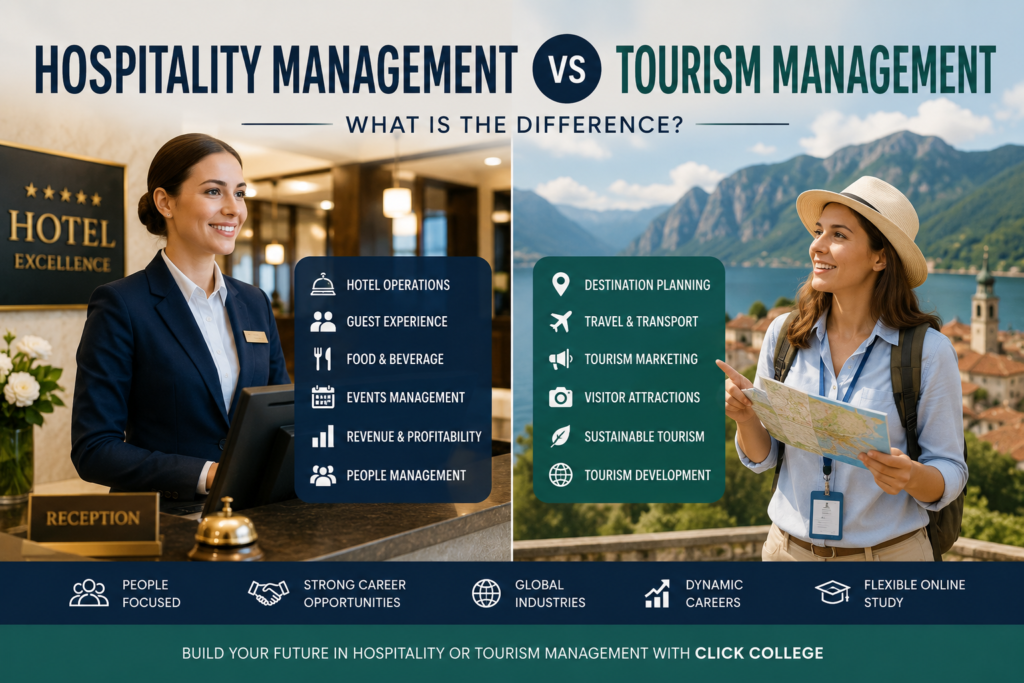
Understanding hospitality management vs tourism management is important for learners who are considering a future career in the sector. Both fields focus on people, service, customer experience and business performance, but they approach these areas from different angles.
Hospitality management is usually more focused on the management of services provided directly to guests, such as accommodation, food and beverage, events and customer-facing operations. Tourism management is more concerned with travel, destinations, visitor behaviour, tourism development and the wider movement of people for leisure, business or cultural reasons.
For future managers, both areas offer exciting opportunities. The best choice depends on your interests, career goals and the type of working environment you see yourself in.
What is hospitality management?
Hospitality management is the study and practice of managing businesses that provide services to guests and customers. It usually includes areas such as hotels, resorts, restaurants, bars, events, catering, serviced accommodation, cruise hospitality and guest services.
The word hospitality is closely linked to the idea of welcoming people. In a business context, this means creating a positive customer experience while also managing staff, operations, quality, costs and revenue.
A hospitality manager may be responsible for:
- managing hotel or accommodation operations
- supervising front-of-house teams
- overseeing food and beverage services
- improving customer service standards
- managing bookings and reservations
- handling guest complaints
- supporting staff training and development
- monitoring revenue and costs
- maintaining service quality
- ensuring health, safety and compliance standards are followed
Hospitality management is therefore highly practical and operational. It often involves managing what happens on-site, day by day, while also supporting the long-term success of the organisation.
For example, a hotel manager must think about room occupancy, guest satisfaction, staff rotas, housekeeping standards, online reviews, pricing, maintenance issues and customer loyalty. A restaurant manager must consider table bookings, service speed, menu quality, staff performance, stock control and customer feedback.
In both cases, the manager is responsible for delivering a high-quality customer experience while also making sure the business runs efficiently.
What is tourism management?
Tourism management focuses on the planning, development, marketing and management of travel and visitor experiences. It is concerned with how people travel, why they visit certain places, how destinations attract tourists and how tourism organisations operate.
Tourism is broader than hospitality because it includes the entire visitor journey. This may involve transport, accommodation, attractions, tours, destination marketing, travel agencies, cultural experiences, events, visitor information and sustainable tourism planning.
A tourism manager may be involved in:
- destination planning and development
- tourism marketing and promotion
- visitor attraction management
- travel and tour operations
- customer experience design
- sustainable tourism planning
- heritage and cultural tourism
- events and festival tourism
- travel product development
- working with local authorities, tourism boards or private operators
Tourism management often looks beyond one individual business and considers the wider destination or travel experience.
For example, a tourism manager working for a destination organisation may help promote a city, region or country to visitors. They may analyse visitor trends, work with hotels and attractions, plan campaigns, support sustainable tourism and help improve the overall visitor experience.
A manager working for a tour operator may design travel packages, manage supplier relationships, respond to customer demand and ensure that travel experiences are safe, attractive and commercially viable.
Hospitality management vs tourism management: the main difference
The simplest way to understand the difference is this:
Hospitality management focuses mainly on guest services and customer experience within hospitality businesses. Tourism management focuses more broadly on travel, destinations and visitor experiences.
Hospitality management is often centred on operations within a hotel, restaurant, resort, venue or service environment. Tourism management is more likely to involve the wider travel journey, destination planning, tourism products and visitor movement.
For example, if a family visits London for a weekend, hospitality management would include the hotel they stay in, the restaurant where they eat and the service they receive during their visit. Tourism management would include why they chose London, how the city attracts visitors, what attractions they visit, how tourism is promoted and how the destination manages visitor demand.
Both areas are connected, but they look at the industry from different perspectives.
How do hospitality and tourism overlap?
Although there are differences, hospitality and tourism are strongly linked. In many cases, one cannot succeed without the other.
Tourists need hospitality services such as hotels, restaurants, cafés, bars and leisure facilities. Hospitality businesses depend heavily on tourists, business travellers and visitors. A destination with strong tourism demand can create more opportunities for hotels, resorts, restaurants and event venues.
For example, a seaside resort relies on tourism to attract visitors, but the quality of the hotels, restaurants and guest services will influence whether those visitors enjoy their stay and return in the future.
Similarly, a city may attract tourists through museums, shopping, cultural events or sporting venues, but the overall visitor experience will also depend on accommodation, transport, hospitality service and customer care.
This is why many courses combine hospitality and tourism management. Learners benefit from understanding both the operational side of hospitality and the wider travel and destination context.
Key areas studied in hospitality management
Hospitality management courses usually include a strong focus on service operations, people management and business performance.
Common study areas may include:
- hotel operations
- front office management
- food and beverage management
- customer service
- hospitality marketing
- revenue management
- housekeeping and accommodation services
- hospitality finance
- people management
- service quality
- strategic hospitality management
These subjects help learners understand how hospitality organisations operate and how managers make decisions in fast-moving service environments.
Hospitality management is particularly suitable for learners who enjoy direct customer interaction, practical problem-solving and operational leadership.
Key areas studied in tourism management
Tourism management courses are more likely to focus on visitor behaviour, destination management, tourism development and travel services.
Common study areas may include:
- tourism systems and structures
- destination management
- travel and tourism operations
- sustainable tourism
- tourism marketing
- visitor attractions
- cultural and heritage tourism
- tour operations
- customer behaviour in tourism
- tourism planning and policy
- global tourism trends
These areas help learners understand how tourism destinations and travel organisations attract, manage and support visitors.
Tourism management may be especially suitable for learners interested in travel, destination development, cultural experiences, sustainability, tourism marketing or working with visitor attractions and travel organisations.
Career options in hospitality management
Hospitality management can lead to a wide range of career pathways across hotels, restaurants, resorts, events and customer service organisations.
Possible roles include:
- hotel manager
- front office manager
- guest relations manager
- food and beverage manager
- restaurant manager
- accommodation manager
- events manager
- resort manager
- revenue manager
- hospitality operations manager
- customer experience manager
Some learners may begin in supervisory roles and progress into management as they build experience. Others may use hospitality management study to support career change, professional development or future business ownership.
Hospitality management can also be useful for people who want to work internationally, as hotels, resorts and service businesses operate across the world.
Career options in tourism management
Tourism management can support careers in travel, destinations, visitor attractions, tour operations and tourism development.
Possible roles include:
- tourism officer
- destination manager
- travel consultant
- tour operations manager
- visitor attraction manager
- tourism marketing executive
- events and tourism coordinator
- sustainable tourism officer
- heritage tourism manager
- travel product manager
- destination marketing manager
Tourism management careers may involve working for private companies, public sector organisations, tourism boards, visitor attractions, tour operators, local authorities or international travel organisations.
This field can be particularly attractive to learners who are interested in travel trends, destination promotion, sustainability, cultural tourism and the wider visitor economy.
Which is better: hospitality management or tourism management?
Neither hospitality management nor tourism management is “better” overall. The right choice depends on your career aims and personal interests.
Hospitality management may be the better option if you are interested in hotels, restaurants, guest services, front-of-house operations, accommodation, events or service leadership.
Tourism management may be the better option if you are more interested in travel, destinations, visitor attractions, tourism planning, tour operations, destination marketing or sustainable tourism.
However, many learners benefit from studying both together. This is because real hospitality and tourism careers often overlap. A hotel manager needs to understand tourism demand. A tourism manager needs to understand the importance of hospitality service quality. A resort manager may need knowledge of both accommodation operations and destination appeal.
For this reason, a combined hospitality and tourism management qualification can provide a broader foundation than studying only one area in isolation.
Skills needed in both hospitality and tourism management
Although the two fields have different areas of focus, many of the skills are similar.
Both hospitality and tourism managers need strong communication skills because they work with customers, staff, suppliers and partners. They also need problem-solving skills, as service industries can be unpredictable and fast-moving.
Important skills include:
- customer service
- leadership
- teamwork
- communication
- organisation
- commercial awareness
- cultural awareness
- marketing knowledge
- financial understanding
- decision-making
- adaptability
- digital confidence
- problem-solving
These transferable skills can be valuable across many service-based industries, not just hospitality and tourism.
For example, a learner who studies hospitality and tourism management may later work in events, retail management, customer experience, business operations, travel services or general management.
Hospitality and tourism in a changing world
The hospitality and tourism industries continue to change as customer expectations, technology and global travel patterns evolve.
Customers now expect fast online booking, personalised service, flexible cancellation options, strong reviews, digital communication and memorable experiences. Businesses also need to respond to sustainability concerns, staffing challenges, economic pressures and changing travel behaviour.
Hospitality managers must think about guest experience, operational efficiency, pricing, staff development and service quality.
Tourism managers must think about destination appeal, visitor flows, environmental impact, tourism marketing and long-term destination development.
Future managers therefore need more than basic industry knowledge. They need a strong understanding of business, people, service, technology and strategy.
Why study hospitality and tourism management online?
Online study can be a practical option for learners who want to build their knowledge while continuing to work or manage other commitments.
A flexible online hospitality and tourism management course allows learners to study from home, progress at their own pace and develop knowledge without needing to attend a traditional campus.
This can be especially useful for:
- people already working in hospitality or tourism
- learners looking for career progression
- adults returning to education
- international learners
- people considering a career change
- learners who need flexible study around work or family commitments
Online study can also help learners develop independent learning skills, digital confidence and professional discipline.
Study hospitality and tourism management with Click College
Click College offers flexible online Hospitality and Tourism Management qualifications designed for learners who want to develop industry-relevant knowledge at their own pace.
The Click College Hospitality and Tourism Management pathway includes Level 4, Level 5 and Level 6 study routes, allowing learners to build knowledge progressively. These qualifications are designed to support learners who want to understand both hospitality operations and the wider tourism industry.
Learners can study areas such as hospitality operations, tourism management, customer experience, service quality, marketing, people management, destination management, strategic decision-making and hospitality finance.
Click College courses are delivered fully online, with flexible study and coursework-based assessment. This means learners can study from anywhere and progress without traditional timed exams.
For learners comparing hospitality management vs tourism management, a combined Hospitality and Tourism Management pathway can provide a balanced understanding of both sectors. This can be useful for those who want to keep their career options open across hotels, resorts, travel businesses, visitor attractions, events and destination organisations.
Final thoughts
Hospitality management and tourism management are closely connected, but they are not identical.
Hospitality management focuses mainly on guest services, accommodation, food and beverage, events and customer-facing operations. Tourism management focuses more broadly on travel, destinations, visitor behaviour and the wider visitor economy.
Both areas offer valuable career opportunities, and both require strong management, communication and customer service skills. For many learners, the best option is not to choose one narrow route too early, but to study a programme that gives a broad understanding of both hospitality and tourism.
By developing knowledge across both fields, future managers can prepare for a wider range of opportunities in one of the world’s most dynamic and people-focused industries.
Hospitality and tourism are closely connected industries, and the terms are often used together. Hotels, resorts, restaurants, travel companies, visitor attractions and destination services all form part of a wider global service economy. However, while the two areas overlap, they are not exactly the same.
Understanding hospitality management vs tourism management is important for learners who are considering a future career in the sector. Both fields focus on people, service, customer experience and business performance, but they approach these areas from different angles.
Hospitality management is usually more focused on the management of services provided directly to guests, such as accommodation, food and beverage, events and customer-facing operations. Tourism management is more concerned with travel, destinations, visitor behaviour, tourism development and the wider movement of people for leisure, business or cultural reasons.
For future managers, both areas offer exciting opportunities. The best choice depends on your interests, career goals and the type of working environment you see yourself in.
s, future managers can prepare for a wider range of opportunities in one of the world’s most dynamic and people-focused industries.
Explore Online Hospitality and Tourism Management Courses
Choosing the right hospitality and tourism management course depends on your current experience, career ambitions and preferred level of study.
Whether your goal is to enter the industry, move into management, specialise in hotel revenue, strengthen tourism expertise or build degree-level strategic capability, online study provides a flexible route towards your next step.
Explore the full Click College Hospitality & Tourism Management course range here:
Ready to enrol?
Take Your Next Step Today
Ready to advance your professional management career with an accredited, flexible qualification? Visit Click College to explore their comprehensive online courses or discover detailed information about their range of qualifications.
For further enquiries or to enrol today, visit the Click College website and begin your journey toward professional excellence.







Recent Posts
Professional Diploma or Higher Qualification Pathway: Which Should You Choose?
Professional Diploma or Higher Qualification Pathway: Which Should You Choose? Choosing the right online qualification is not always simply a question of choosing the longest course or the highest level. For many learners, the better question is: what kind of study route fits my goals right now? Some learners want a focused qualification in one […]
Professional Diploma in Leadership and Management: Course Guide
Professional Diploma in Leadership and Management: Course Guide A Professional Diploma in Leadership and Management is designed for learners who want to develop advanced leadership, strategic thinking and organisational management skills without committing immediately to a full degree programme. Leadership and management are essential in almost every sector. Whether you work in business, education, hospitality, […]
Professional Diploma in Business Management: Who Is It For?
Professional Diploma in Business Management: Who Is It For? A Professional Diploma in Business Management is designed for learners who want to build practical business knowledge without committing immediately to a full degree or long higher education programme. It can be a useful option for people who want to understand how organisations work, how teams […]