Is a Level 6 Diploma Equivalent to a Degree? Hospitality and Tourism Explained
If you are considering a career in hospitality and tourism management, you may have come across Level 6 diplomas and wondered how they compare with a university degree. This is a common question, especially for learners who want a flexible online route but still want a qualification that reflects advanced undergraduate study.
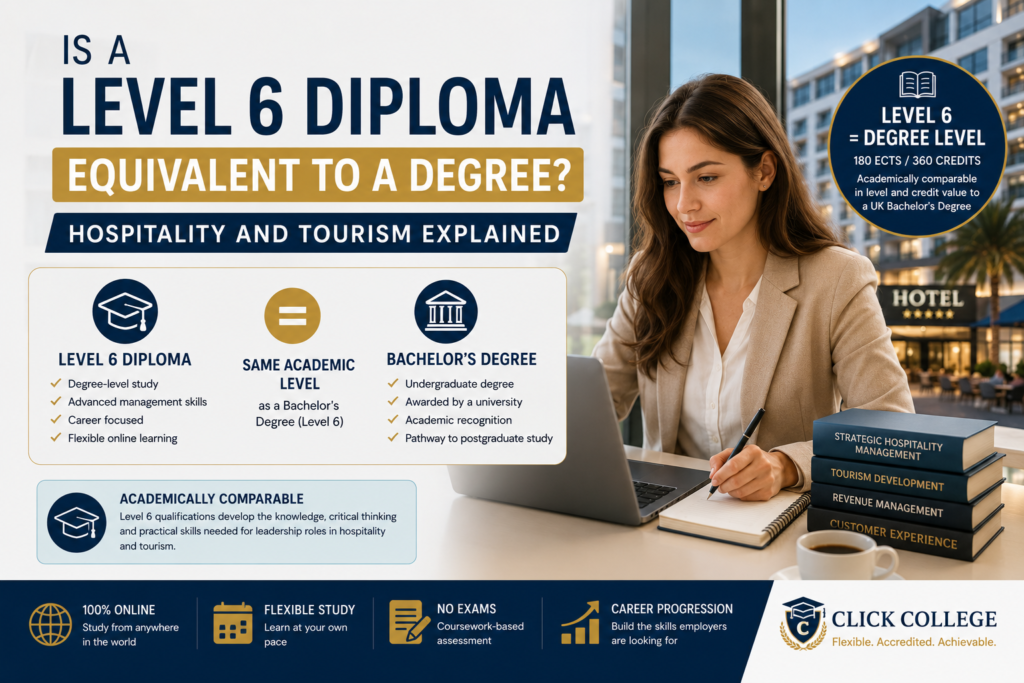
The short answer is that a Level 6 diploma is at the same academic level as a bachelor’s degree. However, it is important to understand the wording carefully. A Level 6 diploma is degree-level, but it is not automatically the same award as a university degree unless it is specifically awarded as a degree by a recognised degree-awarding institution.
This distinction matters. When people ask, “Is a Level 6 diploma equivalent to a degree?”, they are often asking several different things at once. They may want to know whether it is at the same academic level, whether it carries similar credit value, whether employers will understand it, whether it can support career progression, and whether it can help with postgraduate study.
For hospitality and tourism learners, a Level 6 diploma can be a valuable option because it allows learners to study advanced management topics without necessarily following the traditional three-year university route.
What does Level 6 mean?
In the UK qualification framework, Level 6 is associated with advanced undergraduate study. It is the level commonly linked with bachelor’s degrees, graduate diplomas, graduate certificates, degree apprenticeships and Level 6 diplomas.
This means that a Level 6 qualification is designed to involve complex knowledge, independent thinking, critical analysis and the ability to apply ideas to professional or academic contexts.
In hospitality and tourism, Level 6 study may involve topics such as strategic hospitality management, tourism development, hospitality revenue management, leadership, finance, service quality, sustainability, research and organisational decision-making.
At this level, learners are usually expected to go beyond simple description. They should be able to compare ideas, evaluate different approaches, apply theory to realistic situations and make reasoned judgements.
For example, a Level 4 learner may be asked to explain the basic functions of a hotel. A Level 5 learner may analyse how hotel departments work together. A Level 6 learner may evaluate strategic options for improving hotel performance in a competitive market.
Is a Level 6 diploma the same as a degree?
A Level 6 diploma is not always the same thing as a degree, but it can be comparable in academic level.
The difference is between level and award type.
A bachelor’s degree is a specific type of university award. It is normally awarded by a university or another institution with degree-awarding powers. A Level 6 diploma, by contrast, is a diploma qualification at Level 6. It may be awarded by an awarding organisation or accrediting body, depending on the structure of the course.
Both can sit at Level 6, but they are not identical awards.
A useful way to think about it is this:
A Level 6 diploma is degree-level study. A bachelor’s degree is a degree award. They can be comparable in level, but they are not always interchangeable in every situation.
This is why careful wording is important. It is usually more accurate to say that a Level 6 diploma is “degree-level” or “academically comparable to bachelor’s degree level” rather than simply saying it “is a degree”.
What about credit value?
Credit value is another important part of the comparison.
In the UK, one full year of undergraduate study is commonly associated with 120 UK credits. A full three-year bachelor’s degree is commonly associated with 360 UK credits.
Some Level 6 diplomas are shorter qualifications, such as 40-credit or 120-credit professional diplomas. These may still be at Level 6, but they do not carry the same total credit volume as a full bachelor’s degree.
Other Level 6 qualifications may carry 360 credits, particularly where they are designed as a full graduate diploma route incorporating earlier levels of study.
This is why learners should always look at both the level and the credit value. The level tells you the academic difficulty. The credit value tells you the size of the qualification.
For example:
- Level 4 is often associated with the first year of undergraduate study
- Level 5 is often associated with the second year of undergraduate study
- Level 6 is associated with final-year undergraduate or bachelor’s degree-level study
- 120 credits usually represents one full academic year of study
- 360 credits usually represents the credit size commonly associated with a full three-year undergraduate degree
A qualification can therefore be Level 6 without being 360 credits. Equally, a 360-credit Level 6 qualification may be much closer in size and level to a full undergraduate degree route.
Level 6 in hospitality and tourism management
A Level 6 diploma in Hospitality and Tourism Management is designed to develop advanced knowledge of the sector. It usually focuses on management, strategy, leadership and decision-making rather than basic operational tasks.
Hospitality and tourism are broad industries. They include hotels, resorts, restaurants, events, travel companies, visitor attractions, destination organisations, cruise operations, leisure businesses and service-based enterprises.
At Level 6, learners are expected to understand these industries from a management perspective. This means thinking about how organisations compete, how they serve customers, how they manage people, how they respond to changing demand and how they make strategic decisions.
Level 6 hospitality and tourism study may include areas such as:
- strategic hospitality management
- tourism and destination management
- hospitality revenue management
- service quality and customer experience
- marketing and brand positioning
- leadership and people management
- finance and performance
- sustainability and responsible tourism
- research and evidence-based decision-making
- international hospitality and tourism trends
These subjects are relevant to learners who want to progress beyond entry-level or supervisory roles and develop a broader understanding of management.
Why does Level 6 matter for future managers?
Level 6 matters because it shows that a learner has studied at an advanced undergraduate level. In management-related fields, this can be useful because employers often look for evidence of higher-level thinking, communication, organisation and problem-solving.
Hospitality and tourism managers need to make decisions in complex environments. They may need to manage teams, improve customer satisfaction, respond to complaints, control costs, increase revenue, analyse market trends, support sustainability, and compete with other businesses.
A Level 6 qualification can help learners develop the type of thinking needed for these responsibilities.
For example, a hospitality manager may need to evaluate whether a hotel should change its pricing strategy during peak season. A tourism manager may need to assess whether a destination should invest in cultural tourism, eco-tourism or business events. A resort manager may need to balance profitability, guest satisfaction and environmental impact.
These are not simple operational questions. They require analysis, judgement and strategic awareness.
Is a Level 6 diploma useful for employment?
A Level 6 diploma can be useful for employment, especially when it is combined with relevant experience, strong communication skills and practical sector knowledge.
In hospitality and tourism, employers often value a mixture of qualifications and experience. This is because the industry is practical and people-focused. A qualification can help demonstrate knowledge, but real workplace skills are also important.
A Level 6 diploma may support career progression into roles such as:
- hotel manager
- hospitality operations manager
- guest services manager
- front office manager
- food and beverage manager
- tourism manager
- destination management officer
- visitor attraction manager
- resort manager
- events manager
- revenue manager
- customer experience manager
- travel and tourism operations manager
It may also be useful for learners who already work in hospitality or tourism and want to move into supervisory, management or strategic roles.
However, no qualification can guarantee employment on its own. Career outcomes depend on many factors, including work experience, location, language skills, professional attitude, networking, interview performance and the requirements of individual employers.
Can a Level 6 diploma support postgraduate study?
A Level 6 diploma may support progression towards postgraduate study, but this depends on the receiving institution.
Universities and postgraduate providers set their own entry requirements. Some may consider Level 6 diplomas as part of an application, especially where the qualification is substantial, relevant and supported by transcripts or evidence of learning. Others may require a formal bachelor’s degree.
This is why learners who have a specific postgraduate course in mind should check directly with the university or institution before enrolling.
A Level 6 diploma can still be valuable preparation because it develops advanced academic and management skills. Learners may gain experience in reading, writing, research, analysis and critical evaluation, all of which are important for postgraduate study.
For hospitality and tourism learners, a Level 6 qualification may provide a strong foundation for further study in areas such as hospitality management, tourism management, international business, events management, service management or leadership.
Why choose a Level 6 diploma instead of a traditional degree?
A Level 6 diploma may appeal to learners who want a more flexible, career-focused route than a traditional university degree.
A traditional degree usually involves fixed academic years, scheduled lectures, campus attendance, exams or set assessment windows, and a more standard university structure. This route works well for many learners, particularly those who want the full campus experience.
However, not every learner can or wants to study in that way.
A Level 6 diploma may be more suitable for learners who:
- need flexible online study
- are working full-time or part-time
- are returning to education as adults
- want coursework-based assessment
- prefer independent study
- live outside the UK
- want to avoid relocation
- are already working in hospitality or tourism
- want to build qualifications step by step
- are looking for an alternative to the traditional university route
This does not mean one route is better than the other. It depends on the learner’s circumstances and goals.
Is a Level 6 diploma easier than a degree?
A Level 6 diploma should not be seen as an easy option. If it is genuinely Level 6, it should involve advanced study, independent thinking and demanding assessment.
The difference is usually in the structure and delivery, not necessarily the level of intellectual challenge.
For example, a flexible online Level 6 diploma may not require attendance at lectures or timed examinations, but it may still require detailed written assignments, research, analysis and applied management thinking.
Learners should expect to read carefully, plan their work, use examples, structure arguments and produce well-developed written responses.
In hospitality and tourism, this may include analysing case studies, evaluating management decisions, comparing business strategies or making recommendations for improving performance.
Hospitality and tourism as a degree-level subject
Hospitality and tourism is sometimes misunderstood as purely practical or operational. In reality, higher-level hospitality and tourism study involves serious management, commercial and strategic knowledge.
Modern hospitality and tourism organisations operate in competitive, international and fast-changing markets. Managers must understand customer behaviour, digital booking systems, online reviews, revenue management, brand reputation, sustainability, staffing, cultural awareness and global travel trends.
At Level 6, learners are not simply learning how hotels, restaurants or travel businesses operate. They are studying how these organisations are managed, how they compete and how they adapt.
This makes Level 6 hospitality and tourism study relevant for learners who want to move towards management or leadership roles.
Study a Level 6 Hospitality and Tourism qualification with Click College
Click College offers flexible online Hospitality and Tourism Management study routes for learners who want an alternative to traditional campus-based education.
The Click College International Graduate Diploma in Hospitality and Tourism Management at Level 6 is a 360-credit qualification, equivalent to 180 ECTS credits. It is designed to be academically comparable in level and credit value to a UK bachelor’s degree in Hospitality and Tourism Management.
This route allows learners to study hospitality and tourism through a flexible online model, making it suitable for learners who need to study around work, family or other commitments.
The Level 6 route is particularly relevant for learners who want to develop advanced knowledge of hospitality and tourism management, including strategic decision-making, operations, customer experience, revenue management and wider sector understanding.
For learners who are not ready to begin at Level 6, Click College also offers Level 4 and Level 5 Hospitality and Tourism Management pathways. This allows learners to build their knowledge progressively before moving towards degree-level study.
Level 4, Level 5 and Level 6: how the pathway works
A staged pathway can make higher-level study more accessible.
Level 4 is usually the starting point for learners who want to begin undergraduate-level study. It introduces key business, hospitality and tourism concepts.
Level 5 builds on this foundation and develops more advanced management knowledge. Learners may explore operations, customer service, marketing, finance, people management and sector-specific topics.
Level 6 then moves into final-year undergraduate-level thinking. Learners are expected to analyse, evaluate and apply knowledge to more complex hospitality and tourism management problems.
This step-by-step model can be useful for learners who want to progress gradually rather than committing immediately to a traditional full-time degree.
It can also suit adult learners, career changers and international learners who need a flexible route into higher-level study.
Questions to ask before choosing a Level 6 diploma
Before choosing a Level 6 diploma, learners should ask several important questions.
First, what is the level of the qualification? A Level 6 qualification should involve advanced undergraduate-level study.
Second, what is the credit value? A short Level 6 diploma may be useful for professional development, but it is not the same size as a 360-credit qualification.
Third, how is the course assessed? Some learners prefer coursework because it allows them to demonstrate understanding through structured written work rather than timed exams.
Fourth, what are your career goals? If you want to work in hotels, tourism, resorts, events or visitor management, a hospitality and tourism qualification may be more relevant than a general business course.
Fifth, do you need the qualification for a specific purpose? If you want to apply to a particular university, employer or professional body, you should check their entry or recognition requirements directly.
These questions can help you choose a course that fits your aims rather than relying only on the phrase “equivalent to a degree”.
Summing up
So, is a Level 6 diploma equivalent to a degree?
The most accurate answer is that a Level 6 diploma is degree-level. It sits at the same academic level as bachelor’s degree study, but it is not automatically the same award as a university degree unless it is specifically awarded as one.
For hospitality and tourism learners, a Level 6 diploma can be a flexible and valuable route into advanced management study. It can help develop knowledge of strategy, operations, customer experience, tourism development, revenue management and leadership.
The key is to look carefully at the level, credit value, assessment method and progression opportunities.
For learners who want a flexible online alternative to a traditional university route, a Level 6 Hospitality and Tourism Management diploma can offer a practical way to study at degree level while building knowledge for future management roles.
Explore Online Hospitality and Tourism Management Courses
Choosing the right hospitality and tourism management course depends on your current experience, career ambitions and preferred level of study.
Whether your goal is to enter the industry, move into management, specialise in hotel revenue, strengthen tourism expertise or build degree-level strategic capability, online study provides a flexible route towards your next step.
Explore the full Hospitality & Tourism Management course range here:
Ready to enrol?
Take Your Next Step Today
Ready to advance your professional management career with an accredited, flexible qualification? Visit Click College to explore their comprehensive online courses or discover detailed information about their range of qualifications.
For further enquiries or to enrol today, visit the Click College website and begin your journey toward professional excellence.





Recent Posts
Professional Diploma or Higher Qualification Pathway: Which Should You Choose?
Professional Diploma or Higher Qualification Pathway: Which Should You Choose? Choosing the right online qualification is not always simply a question of choosing the longest course or the highest level. For many learners, the better question is: what kind of study route fits my goals right now? Some learners want a focused qualification in one […]
Professional Diploma in Leadership and Management: Course Guide
Professional Diploma in Leadership and Management: Course Guide A Professional Diploma in Leadership and Management is designed for learners who want to develop advanced leadership, strategic thinking and organisational management skills without committing immediately to a full degree programme. Leadership and management are essential in almost every sector. Whether you work in business, education, hospitality, […]
Professional Diploma in Business Management: Who Is It For?
Professional Diploma in Business Management: Who Is It For? A Professional Diploma in Business Management is designed for learners who want to build practical business knowledge without committing immediately to a full degree or long higher education programme. It can be a useful option for people who want to understand how organisations work, how teams […]