Perishability in Hospitality: Why Time Really Is Money
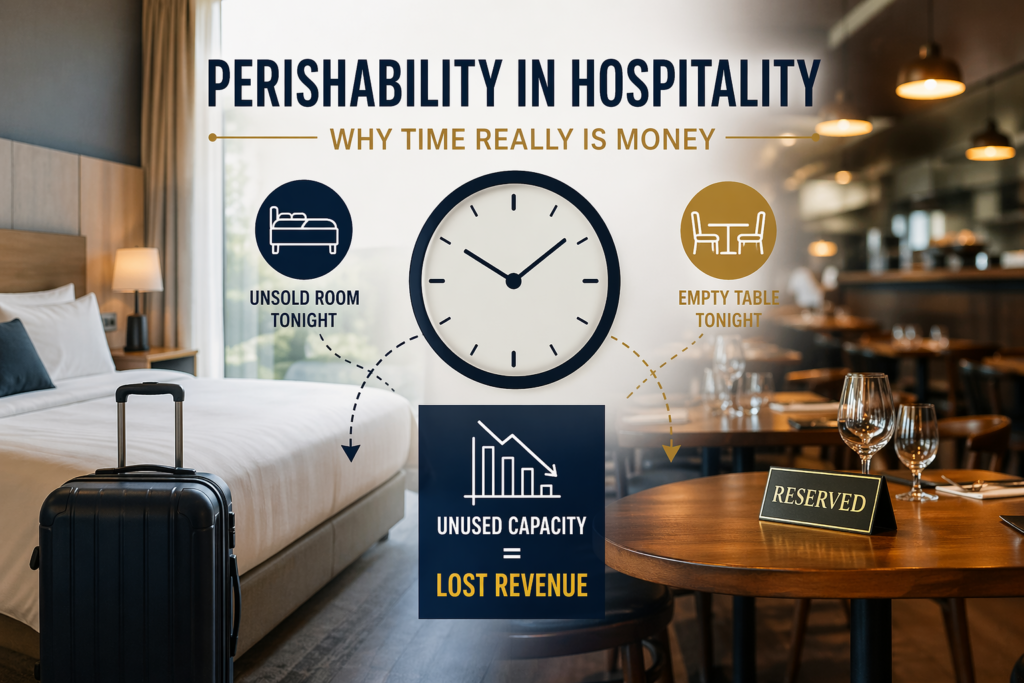
In most industries, unsold products can sit on a shelf and be sold another day. Hospitality doesn’t have that luxury. If a hotel room goes unsold tonight or a restaurant table remains empty during a dinner service, that revenue is gone permanently. This concept, known as perishability, is one of the defining characteristics of the hospitality and service industries, and it plays a central role in shaping how these businesses operate.
Understanding Perishability in Context
Perishability refers to the inability to store or inventory a service for future sale. In hospitality, services exist only at the moment they are delivered. A hotel room is only valuable for the specific night it is available. A restaurant table only generates revenue during a particular service period. Once that time has passed, the opportunity to sell that service disappears entirely.
This makes hospitality fundamentally different from product-based industries. A retailer can hold unsold stock, discount it later, or redistribute it across locations. Hospitality businesses, by contrast, operate within strict time and capacity constraints. Their “inventory” is constantly expiring.
This time-bound nature of services means that revenue potential is directly linked to how effectively a business can match supply with demand in real time.
The Economic Impact of Perishability
Perishability creates a unique economic challenge. Hospitality businesses must continuously attempt to maximise revenue from a fixed and perishable capacity. Whether it is hotel rooms, airline seats, restaurant tables, or event spaces, the supply is limited and cannot be expanded or stored in the short term.
At the same time, demand is highly variable. It fluctuates based on seasonality, day of the week, time of day, local events, economic conditions, and even weather patterns. This mismatch between fixed supply and unpredictable demand introduces risk.
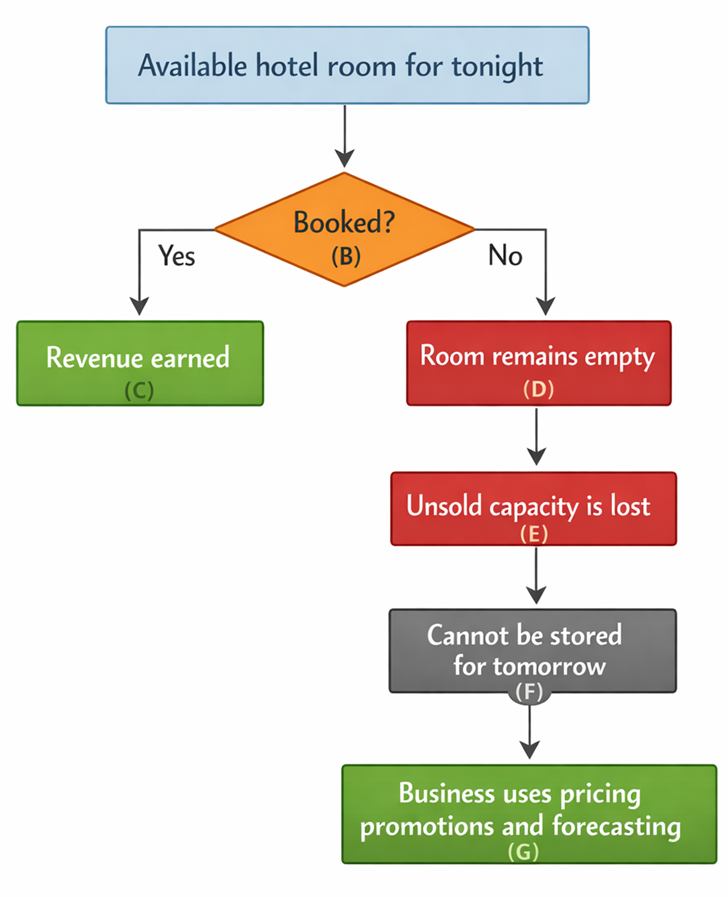
For example, a hotel may achieve full occupancy during peak tourist seasons, generating strong revenue. However, during off-peak periods, occupancy may fall significantly, leaving large portions of capacity unused. Those unsold rooms represent lost income that cannot be recovered.
As a result, hospitality businesses must adopt a proactive and data-driven approach to managing demand.
Revenue Management and Demand Forecasting
To address perishability, the industry has developed sophisticated approaches to forecasting and pricing. Revenue management, sometimes referred to as yield management, is the practice of adjusting prices and availability to maximise income from limited capacity.
This involves analysing historical data, booking patterns, market trends, and external factors to predict demand. Based on these insights, businesses can implement strategies such as:
- Increasing prices during high-demand periods to maximise revenue per unit
- Offering discounts or promotions during low-demand periods to stimulate demand
- Encouraging advance bookings to secure revenue earlier
- Segmenting customers and tailoring offers to different market groups
For instance, a hotel may charge premium rates during a major event when demand is high, while offering reduced midweek rates to attract business travellers during quieter periods. Airlines apply similar principles by varying ticket prices depending on how far in advance a seat is booked and current demand levels.
These strategies are not simply about increasing sales, but about optimising the value of each available unit of capacity at any given time.
Operational Pressures and Resource Management
Perishability also has significant implications for day-to-day operations, particularly in relation to staffing and service delivery.
Because demand is constantly changing, managers must ensure that resources are aligned with expected customer volumes. Overstaffing during quiet periods increases costs without generating additional revenue. Understaffing during busy periods can lead to service delays, reduced quality, and negative customer experiences.
This creates a need for careful workforce planning and flexible scheduling. Businesses often rely on part-time staff, shift systems, and demand-based rostering to adapt to fluctuations.
For example, a conference hotel may increase staffing levels significantly when hosting a large event, ensuring that service standards are maintained. In contrast, during quieter periods, staffing levels may be reduced to control costs. Restaurants may introduce special lunchtime offers or early-bird menus to attract customers during traditionally slower service times, helping to smooth demand and make better use of available capacity.
The key challenge is to maintain efficiency without compromising the quality of the customer experience.
Case Study: Festival Demand and Revenue Loss
A clear example of perishability can be seen in a city centre hotel during a major music festival. During the event, demand for accommodation is extremely high, and rooms are often sold at premium prices. Occupancy reaches maximum capacity, and revenue peaks.
However, once the festival ends, demand drops sharply. In the following days, many rooms may remain empty. These unsold rooms represent lost revenue that cannot be recovered or deferred.
To reduce the impact of this post-event decline, the hotel may introduce targeted strategies such as discounted midweek stays, corporate travel packages, or promotional offers aimed at different customer segments. The objective is to attract alternative sources of demand to fill otherwise unused capacity.
This example highlights the importance of flexibility and responsiveness in managing perishability. It also demonstrates how closely revenue performance is tied to external factors beyond the control of the business.
Final Thoughts
Perishability is a defining feature of the hospitality industry and one that introduces both risk and opportunity. The inability to store services means that every moment of unused capacity represents lost potential. At the same time, it creates opportunities for businesses to apply strategic thinking, dynamic pricing, and operational flexibility to optimise performance.
In hospitality, success depends on the ability to anticipate demand, adapt quickly, and make informed decisions in real time. Those who understand and manage perishability effectively are far better positioned to achieve sustainable profitability and deliver consistent customer satisfaction.
Explore hospitality management with Click College and develop a deeper understanding of industry concepts such as demand forecasting, revenue management, and service operations through flexible, fully online study pathways.
View Courses in Hospitality and Tourism…
Start your journey in hospitality and tourism with an accredited Click College course. Enrol today and build the skills, knowledge, and confidence to progress into a management role.







Recent Posts
Professional Diploma or Higher Qualification Pathway: Which Should You Choose?
Professional Diploma or Higher Qualification Pathway: Which Should You Choose? Choosing the right online qualification is not always simply a question of choosing the longest course or the highest level. For many learners, the better question is: what kind of study route fits my goals right now? Some learners want a focused qualification in one […]
Professional Diploma in Leadership and Management: Course Guide
Professional Diploma in Leadership and Management: Course Guide A Professional Diploma in Leadership and Management is designed for learners who want to develop advanced leadership, strategic thinking and organisational management skills without committing immediately to a full degree programme. Leadership and management are essential in almost every sector. Whether you work in business, education, hospitality, […]
Professional Diploma in Business Management: Who Is It For?
Professional Diploma in Business Management: Who Is It For? A Professional Diploma in Business Management is designed for learners who want to build practical business knowledge without committing immediately to a full degree or long higher education programme. It can be a useful option for people who want to understand how organisations work, how teams […]