Preventive vs Reactive Hotel Maintenance: Which Approach Protects the Guest Experience?
Few guests think about hotel maintenance when everything works. They expect the room key to open the door, the shower to run, the air conditioning to be comfortable, the lift to operate and the restaurant equipment to support a smooth meal service. Maintenance becomes visible only when something fails.
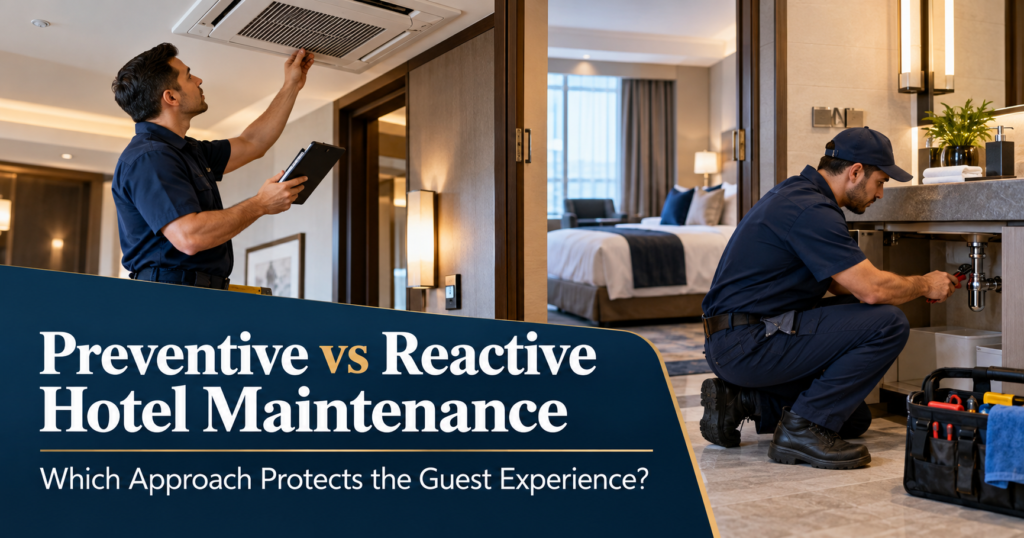
That is precisely why it matters. Hotel maintenance is not simply a technical support function. It protects comfort, safety, room readiness and the reliability of the entire guest experience.
The best answer is not to choose only one approach. Hotels need preventive maintenance to reduce the likelihood of avoidable faults and reactive maintenance to deal quickly with unexpected failures. The difference is when the work happens: preventive maintenance is planned before a problem affects service; reactive maintenance begins after a fault has been identified.
Preventive vs reactive hotel maintenance at a glance
| Approach | Preventive maintenance | Reactive maintenance |
|---|---|---|
| When it happens | Before a known fault or breakdown | After a fault, damage or service problem is reported |
| Main purpose | Reduce risk, improve reliability and protect service continuity | Restore safe, working service as quickly as possible |
| Typical examples | Servicing air conditioning, checking plumbing, testing equipment, inspecting room fixtures | Repairing a leaking tap, replacing a failed light fitting, fixing a room-door lock |
| Main strength | Fewer avoidable disruptions and better planning | Essential response to faults that cannot be predicted or prevented |
| Main risk if used alone | May miss unexpected faults or become a tick-box exercise | Can create repeated disruption, emergency costs and guest dissatisfaction |
The Health and Safety Executive describes maintenance as work carried out both to prevent problems and to put faults right. It also notes that effective planned maintenance improves equipment reliability and can reduce breakdowns.[1] In hotel operations, that reliability has a direct effect on guests and on the colleagues trying to support them.
What is preventive maintenance in a hotel?
Preventive maintenance is planned inspection, servicing, adjustment or replacement work carried out before equipment fails. It is sometimes called planned preventive maintenance, or PPM.
In a hotel, this may include:
- Checking guest-room heating, ventilation and air-conditioning equipment.
- Inspecting plumbing, taps, toilets and shower fittings.
- Servicing kitchen equipment according to manufacturer guidance.
- Testing lighting, emergency systems and other safety-critical equipment.
- Inspecting lifts, doors, locks and room-access systems.
- Examining worn furniture, flooring and fixtures before they become visibly damaged.
- Scheduling quieter-period work where possible to reduce disruption.
The aim is not to promise that nothing will ever break. It is to make maintenance deliberate rather than relying on guests or staff to discover problems first.
Why prevention matters to the guest experience
Preventive work is often invisible to guests, but its benefits are felt in the details of a stay. A guest should not need to report that a room is too cold, a shower drains slowly or a bedside light does not work. If these issues are found and resolved before arrival, the hotel protects both the guest’s comfort and the time of the front-of-house team.
Prevention also supports room availability. A room with a serious defect may need to be taken out of service, placing pressure on reservations, housekeeping and reception—particularly when occupancy is high. If a pattern of minor faults is recognised early, the hotel can plan repairs around availability rather than discovering the problem during check-in.
What is reactive maintenance in a hotel?
Reactive maintenance is the work carried out after a fault has occurred or been reported. It is sometimes described as corrective or breakdown maintenance. It is unavoidable: components can fail unexpectedly, guests can accidentally damage something and urgent safety issues can arise without warning.
Examples include a guest reporting no hot water, a refrigerator failing in a kitchen, a door lock not working, a leak appearing in a public area or a lift being taken out of service.
Reactive maintenance is not automatically poor maintenance. A hotel should be able to respond decisively to unexpected failures. The concern arises when the same preventable problems repeatedly reach the reactive stage because there is no record, no analysis or no planned follow-up.
A fast repair is only part of the response
When an in-room fault is reported, the guest needs two things: a practical solution and clear communication. Maintenance may be able to repair the issue quickly, but reception or guest services must know who owns the task, whether the room remains safe to occupy and when the guest will receive an update.
For an issue affecting comfort, the hotel might arrange an immediate repair, offer a room move or provide a temporary practical solution while a technician attends. For a safety issue, the room or area may need to be taken out of use and escalated under the hotel’s procedures.
This is where maintenance and guest service meet. Hotel Service Recovery: Handling Complaints and Rebuilding Guest Trust explains why a clear owner, realistic timescale and follow-through matter when a service failure affects a guest.
Which approach is better for hotels?
Preventive maintenance should be the foundation because it gives the hotel more control. It allows managers to plan work, order parts, coordinate access to rooms and reduce avoidable disruption.
Reactive maintenance remains essential because no maintenance plan can anticipate every issue. A guest can report a sudden fault minutes before a busy breakfast period, a leak can develop after an inspection or external events can affect building systems.
The most effective approach combines the two:
- Prevent what can reasonably be predicted. Use manufacturer guidance, inspection schedules, fault history and staff observations to plan work.
- Respond safely and promptly to the unexpected. Make reporting routes, priorities and responsibilities clear.
- Learn from every significant reactive repair. Ask whether the fault was foreseeable, whether a previous warning was missed and whether the maintenance schedule needs changing.
This third step makes the difference. A hotel that fixes the same room air-conditioning fault several times has not necessarily solved the maintenance problem; it may only have restored the service temporarily.
A practical priority framework for hotel faults
Not every fault requires the same response. The following editorial framework can help hotel teams decide how urgently an issue needs action.
| Priority | Examples | Immediate operational response |
|---|---|---|
| Critical | Fire-safety concern, electrical hazard, gas smell, major leak, unsafe lift or insecure room door | Protect people first, isolate the area or equipment where appropriate, escalate immediately and follow formal safety procedures. |
| Urgent | No hot water, failed climate control in extreme conditions, inaccessible essential facility, major kitchen-equipment failure during service | Assign a named owner, give the guest or service team a realistic update, and arrange a practical alternative if repair cannot be immediate. |
| Routine but guest-affecting | Faulty lamp, damaged fixture, slow-draining basin, television or Wi-Fi issue | Log the fault, agree a target response time and keep the guest informed if it cannot be resolved promptly. |
| Planned improvement | Worn décor, ageing fittings, minor cosmetic damage, equipment nearing end of life | Add to the planned-maintenance or replacement programme and review alongside budget and occupancy plans. |
The framework is not a substitute for a hotel’s safety policies or professional technical judgement. It is a way of ensuring that staff do not treat every fault as either an emergency or something that can wait indefinitely.
A worked example: air conditioning failure on a busy day
Imagine that a hotel is approaching a busy weekend. The maintenance team has previously noted that several guest-room air-conditioning units are becoming noisy and less effective, but the observations have not been reviewed together. On Friday afternoon, one unit fails in an occupied room during warm weather.
The reactive response is necessary: maintenance attends, reception contacts the guest and the duty manager checks whether another suitable room is available. If the repair will take time, a room move may be the most appropriate solution.
However, a good operational response does not end when the unit is repaired. The manager should review whether the earlier reports were logged, whether similar units need inspection and whether the planned schedule should be adjusted. That turns one reactive incident into preventive learning.
The example also illustrates why maintenance cannot operate in isolation. Room status, guest needs, available inventory and communication all need to be coordinated. The wider relationship between guest-facing and behind-the-scenes teams is examined in Hospitality Operations Management: A Complete Guide for Students and Future Managers.
Building a maintenance system that supports service
An effective hotel maintenance system does not need to be complicated, but it should be consistent. Useful controls include:
- A clear route for staff to report defects.
- A record of the location, description, time reported, priority and person responsible.
- Planned inspections based on equipment, risk and manufacturer guidance.
- A way to identify repeated faults in the same room, item or area.
- Handovers between maintenance, housekeeping, reception and duty management.
- A process for checking that a repair has genuinely resolved the issue.
The Health and Safety Executive also advises employers to have arrangements for maintaining equipment in a safe condition, reporting faults and ensuring that maintenance work is carried out by competent people.[1]
Hotels should avoid treating a maintenance log as administrative paperwork. It is operational evidence. Repeated reports about faulty door locks, weak water pressure or equipment failures may reveal a wider reliability issue, an unclear process or an asset that needs replacement rather than another temporary repair.
Maintenance and the service-profit chain
Staff cannot provide confident guest service when they lack information about faults, have no authority to arrange a sensible alternative or repeatedly have to apologise for problems beyond their control. Maintenance therefore contributes to internal service quality as well as physical reliability.
When front-of-house, housekeeping and maintenance teams have clear handovers, realistic updates and the support to act, guests are less likely to be left uncertain or passed between departments. Happy Teams, Happier Guests: The Service-Profit Chain in Hospitality explores how internal conditions shape the customer experience.
Develop hospitality operations expertise
Maintenance planning sits within a wider hospitality-management skill set that includes service quality, room readiness, team coordination and operational decision-making. Click College offers several online routes for developing that knowledge.
| Course | Level and credits | Focus |
|---|---|---|
| Professional Diploma in Hotel Management | Level 5, 40 credits | Focused study of hotel operations, front office, housekeeping and guest service. |
| Higher International Certificate in Hospitality & Tourism Management | Level 4, 120 credits | A broader foundation in hospitality and tourism management. |
| Higher International Diploma in Hospitality & Tourism Management | Level 5, 240 credits in total | Extended study across hospitality operations, people, customer experience and management. |
| International Graduate Diploma in Hospitality & Tourism Management | Level 6, 360 credits in total | Comprehensive study incorporating earlier levels with more advanced strategic hospitality content. |
Compare the Hospitality & Tourism Management pathways and select the route that best matches your experience and professional goals.
Frequently asked questions
What is the difference between preventive and reactive maintenance?
Preventive maintenance is planned before a fault occurs. Reactive maintenance takes place after a fault, defect or breakdown has been identified. Hotels need both, but preventive work helps reduce avoidable guest disruption.
Why is preventive maintenance important in hotels?
It supports room readiness, comfort, safety and reliable facilities. It also gives teams more opportunity to plan repairs around occupancy rather than responding when a guest is already affected.
Can reactive maintenance be avoided completely?
No. Unexpected faults and accidental damage can happen even in well-maintained hotels. The aim is to reduce preventable incidents and ensure that unexpected faults are managed safely, promptly and professionally.
Who should report hotel maintenance issues?
Any member of staff who notices a defect should know how to report it. Guests may also report faults, but a good hotel system does not rely only on guests to find problems.
References
[1] Health and Safety Executive: Maintenance of work equipment
Build Your Future in Hospitality and Tourism
Understanding customer expectations and perceived service quality is valuable for people who want to manage hotels, restaurants and other customer-facing operations.
Studying hospitality and tourism management courses can help learners develop knowledge of service delivery, operations, customer experience and quality improvement.
| Course | Level | Credits | Focus |
|---|---|---|---|
| Professional Diploma in Hospitality Management | 5 | 40 | A focused route covering hospitality operations and service excellence. |
| Professional Diploma in Hotel Management | 5 | 40 | Applied knowledge for hotel operations and guest-service management. |
| Higher International Certificate in Hospitality & Tourism Management | 4 | 120 | A broad higher-level introduction to hospitality and tourism management. |
| Higher International Diploma in Hospitality & Tourism Management | 4–5 | 240 total | Extended study supporting progression in hospitality and tourism management. |
| International Graduate Diploma in Hospitality & Tourism Management | 4–6 | 360 total | A comprehensive graduate-level pathway across hospitality and tourism management. |
All courses are 100% online and self-paced, with no classes, no fixed schedules, no deadlines and no exams. Assessment is completed through coursework, with tutor support available throughout your studies.
Compare Click College’s Hospitality and Tourism Management courses.
Explore Hospitality Courses
Start your journey in hospitality and tourism with an accredited Click College course. Enrol today and build the skills, knowledge, and confidence to progress into a management role.







Recent Posts
How to Build Trust Before a Customer Buys
How to Build Trust Before a Customer Buys Before a customer buys from an unfamiliar business, they are making more than a price comparison. They are deciding whether the offer is genuine, whether the organisation will deliver what it promises and whether help will be available if something goes wrong. That is why trust is […]
Why Customers Switch: The Trust and Value Signals That Drive Churn
Why Customers Switch: The Trust and Value Signals That Drive Churn Customers rarely switch simply because a competitor is cheaper. They switch when the relationship no longer feels safe, fair or worth the effort. A price rise may trigger the search, but unclear charges, poor support, weak proof and uncertainty about what happens next are […]
How to Find and Fix Friction in the Buying Journey
How to Find and Fix Friction in the Buying Journey Customers rarely decide not to buy for one dramatic reason. More often, small difficulties build up: a confusing product page, unclear pricing, a slow reply, an awkward form, conflicting information or a delivery promise that feels uncertain. Each issue may appear minor in isolation. Together, […]