Variability in Hospitality Service Delivery: Implications for Consistency, Customer Satisfaction and Managerial Control
Abstract
Variability is widely recognised as one of the defining characteristics of service industries, and it is especially significant in hospitality because service delivery is shaped by human interaction, situational pressures, and customer participation. This paper examines variability as a central feature of hospitality operations and argues that inconsistency in service quality is not simply the result of poor performance, but an inherent outcome of the way hospitality services are produced and consumed. Unlike manufactured goods, hospitality services cannot be replicated with complete precision because they are delivered in real time by employees whose performance is influenced by training, mood, experience, communication skills, workload, and environmental context. The discussion considers how variability emerges across the customer journey, how it affects customer satisfaction, trust, and business reputation, and why it presents a continuing challenge for hospitality management. At the same time, the paper argues that variability should not be understood solely as a weakness. When appropriately managed, it can support personalisation and responsiveness, both of which are highly valued in hospitality settings. The paper concludes that the central managerial task is not to eliminate variability entirely, but to reduce negative inconsistency while preserving the flexibility required to meet the individual needs of guests.
1. Introduction
Hospitality is fundamentally a people-centred industry in which value is created through service encounters rather than through the simple exchange of physical goods. Although hotels, restaurants, and tourism businesses make use of tangible elements such as rooms, meals, furniture, and facilities, the quality of the overall experience depends heavily on the manner in which these elements are presented and delivered. For this reason, hospitality differs significantly from manufacturing. A manufactured product can normally be produced to the same specification repeatedly, but a hospitality service is created in real time through interaction between staff and customers. This makes exact duplication difficult and, in many cases, impossible.
Within service theory, this characteristic is often described as variability, or heterogeneity. Variability refers to the fact that service quality may differ from one occasion to another, even when the same business is providing the service. A guest may receive excellent treatment during one stay and less satisfactory treatment during the next. A diner may enjoy prompt, attentive service on one visit and experience delays or errors on another. In each case, the business itself may be unchanged in terms of brand, location, and facilities, yet the customer experience is not identical. This inconsistency is central to understanding both the opportunities and the challenges of hospitality management.
This paper explores variability as a core characteristic of hospitality service. It examines the conceptual foundations of variability, the factors that cause it, the ways in which it appears across the customer journey, and the implications it carries for customer satisfaction, reputation, and managerial practice. It also considers the important distinction between negative variability, which damages consistency, and positive variability, which enables personalised service.
2. Conceptualising Variability in Hospitality
Variability in hospitality arises from the nature of service itself. Services are intangible, interactive, and often produced and consumed simultaneously. In a hotel, for example, the service is not something that exists independently of the guest’s experience of check-in, housekeeping, food service, or complaint handling. In a restaurant, the meal is only one component of the experience; the behaviour of staff, the speed of service, the atmosphere of the dining room, and the handling of requests all shape the customer’s judgement of quality. Service, therefore, is not simply delivered to the customer but co-created with the customer in a specific social and operational context.
This has important implications for consistency. In manufacturing, variation can often be controlled through machinery, standardised processes, and quality assurance systems. In hospitality, by contrast, the service encounter depends on people, and people do not respond identically under all circumstances. They interpret situations differently, communicate differently, and perform differently depending on physical, emotional, and organisational conditions. Even where detailed procedures exist, the actual enactment of those procedures remains influenced by human judgement.
Variability should therefore be understood not as an occasional disruption to otherwise fixed service delivery, but as an intrinsic feature of hospitality. This is not to suggest that standards are unimportant. On the contrary, standards are essential. However, standards in hospitality function as guiding frameworks rather than guarantees of uniform outcomes. The presence of variability means that hospitality organisations must constantly work to narrow the gap between intended service quality and actual customer experience.
3. Sources of Variability in Hospitality Operations
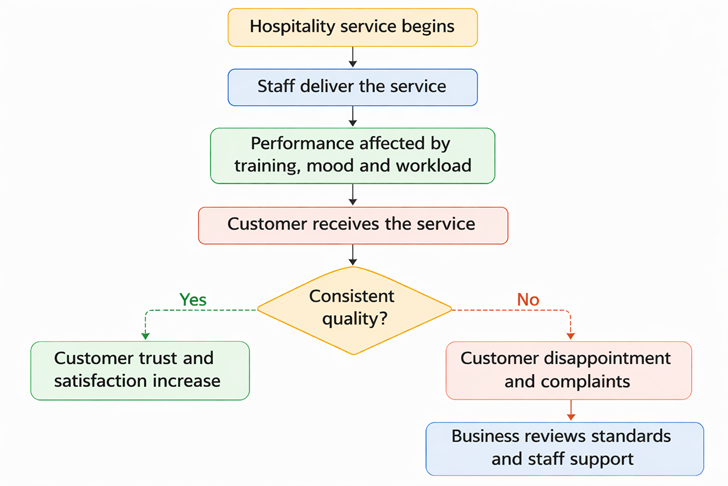
The most immediate source of variability is the employee. Hospitality employees differ in training, experience, personality, confidence, and emotional resilience. A highly experienced receptionist may manage guest interactions smoothly, anticipate problems, and communicate with reassurance and warmth. A less experienced colleague may follow the same procedural steps yet appear uncertain, abrupt, or less responsive. Both employees may technically complete the same task, but the perceived quality of service may differ considerably.
Employee performance is also affected by emotional and psychological factors. Hospitality work often involves emotional labour, meaning that staff are expected to regulate their emotions and present a professional, welcoming manner regardless of fatigue, stress, or personal circumstances. This expectation is difficult to sustain perfectly at all times. Mood, motivation, and energy levels can influence tone of voice, attentiveness, patience, and problem-solving ability. As a result, service delivery is shaped not only by formal skills but by the emotional condition of the person providing the service.
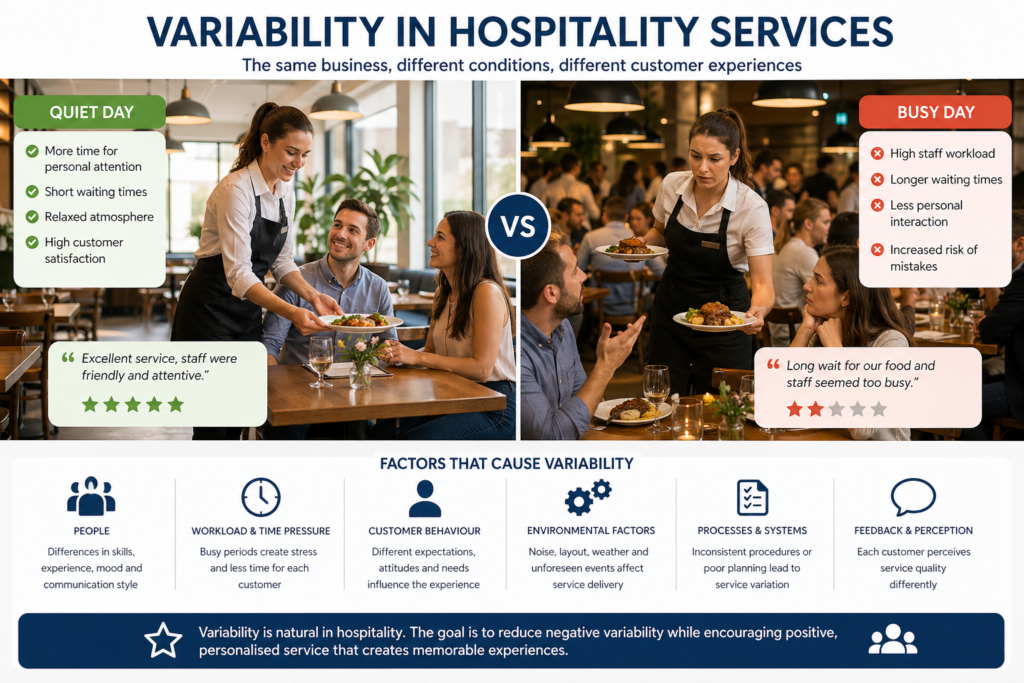
A second source of variability lies in operational conditions. Hospitality businesses rarely operate under stable and predictable circumstances. Demand fluctuates across days, seasons, and even hours. A quiet afternoon service allows staff more time to engage with customers, answer questions, and attend to detail. A crowded evening service, by contrast, creates time pressure, noise, queueing, and competing demands. Under such conditions, even capable employees may struggle to maintain the same level of attentiveness or personal interaction. Variability, then, is not solely a matter of individual performance; it is also the outcome of changing operational pressures.
A third source of variability is the customer. Hospitality services are unusual in that the customer plays an active role in the service encounter. Different customers arrive with different expectations, personalities, levels of patience, communication styles, and cultural norms. One guest may appreciate friendly conversation, while another may prefer a more formal and efficient interaction. One diner may be highly understanding of delays during a busy period, while another may interpret the same delay as poor service. This means that variability exists not only in what staff do, but also in how customers perceive and evaluate what has been done.
4. Variability Across the Customer Journey
Variability can appear at every stage of the customer journey, not merely during the core service encounter. Before a guest even arrives, differences in service quality may be evident in the handling of enquiries, booking confirmations, and pre-arrival communication. A prompt and informative response may create confidence and positive anticipation, whereas a delayed or vague response may create uncertainty and reduce trust before the service has formally begun.
At the point of arrival, variability often becomes more visible. In hotel reception, for instance, some staff may provide a warm welcome, explain procedures clearly, and make the guest feel valued from the outset. Others may be more transactional, focusing on administrative efficiency without creating the same sense of hospitality. The difference may appear small in operational terms, but it can be highly significant in shaping first impressions.
During the main period of service delivery, variability becomes even more pronounced. In restaurants, customers may be served by staff who differ in attentiveness, product knowledge, speed, and interpersonal skill. In hotels, housekeeping may maintain excellent room presentation on most days, yet a rushed shift may result in missed details, incomplete replenishment, or slower responses to special requests. These outcomes do not necessarily indicate systemic failure, but they reveal how fragile consistency can be when service depends on real-time human performance.
The post-service stage is equally important. Variability may be reflected in the way complaints are handled, how quickly problems are resolved, and whether follow-up communication is professional and reassuring. A service failure that is recovered with empathy and competence may leave a guest with a positive overall impression, while a minor issue handled poorly may create lasting dissatisfaction. In this sense, variability affects not only the delivery of service, but also the management of service recovery.
5. Implications for Customer Satisfaction, Reputation and Loyalty
The importance of variability in hospitality lies largely in its consequences. Customers generally expect a level of consistency from a hospitality brand. They may tolerate small differences in style or personality, but they usually expect the overall quality of service to remain reliable. When service delivery varies too widely, customers become uncertain about what to expect. This uncertainty can weaken trust, which is a critical component of customer satisfaction and loyalty.
Inconsistent service also affects the way customers interpret value. A guest who pays for a hotel stay or a restaurant meal does not only purchase the tangible elements of the experience; they also purchase the expectation of dependable service. When that expectation is not met consistently, the perceived value of the offering declines. A single poor experience may be especially damaging when it follows an earlier positive experience, because the contrast heightens disappointment.
The reputational consequences are even more significant in the digital era. Online review platforms have made individual service encounters highly visible. A business that delivers inconsistent service is likely to receive mixed reviews, and such inconsistency may be more damaging than a modest but dependable standard. Prospective customers often look not just for signs of excellence, but for signs of reliability. Repeated evidence that experiences are unpredictable can discourage bookings, reduce confidence, and weaken competitive position.
6. Managing Variability Through Service Management
Because variability cannot be eliminated entirely, hospitality management focuses on controlling and reducing its more damaging forms. One common strategy is standardisation. Standard operating procedures, service scripts, checklists, and quality controls are all designed to create a baseline level of consistency. These mechanisms are particularly important in areas such as housekeeping, food safety, reservation handling, and complaint resolution, where errors can have serious consequences for both guest satisfaction and operational efficiency.
Training is equally important. Effective hospitality training does more than teach staff how to complete tasks; it develops communication skills, emotional awareness, professional judgement, and customer orientation. Regular training helps reduce differences in performance by ensuring that employees share a common understanding of expectations and service standards. Recruitment also plays a major role. Businesses that select employees with strong interpersonal skills and an appropriate service mindset are better positioned to reduce negative variability.
Supervision and feedback provide an additional layer of control. Managers monitor performance, address inconsistencies, and use customer feedback to identify recurring problems. Staffing decisions are also central. When businesses fail to match staffing levels to demand, service quality often becomes unstable. Proper scheduling, workload planning, and managerial support are therefore essential in reducing the operational pressures that produce inconsistent service.
Even with these strategies in place, however, variability remains present. This should not be interpreted as managerial failure. Rather, it reflects the reality that hospitality is delivered through people in changing environments. The purpose of management is not to achieve mechanical uniformity, but to create sufficient consistency for customers to trust the service while preserving enough flexibility for staff to respond effectively to real situations.
7. Positive Variability and the Value of Personalisation
Although variability is often discussed as a problem, to treat all variability as undesirable would be conceptually misleading. Hospitality is valued precisely because it can feel personal, attentive, and responsive. Such qualities depend on a degree of flexibility. A rigidly standardised service may be consistent, but it may also feel impersonal or artificial. By contrast, employees who adapt their behaviour to suit the needs of different guests may create a stronger sense of care and professionalism.
This form of positive variability can be seen when staff remember a returning guest’s preferences, adjust their communication style to match the customer, or respond creatively to individual requests. In such cases, service differs from one encounter to another, but the difference is beneficial rather than harmful. It reflects professional judgement and genuine responsiveness rather than inconsistency or lack of control.
The challenge for hospitality organisations is therefore to distinguish between constructive flexibility and damaging inconsistency. The goal is not uniformity in every detail, but coherence of standards. Guests should feel that the service is reliably professional, even when it is adapted to their individual needs. This is one of the central tensions in hospitality management: the need to combine consistency with personalisation.
8. Illustrative Case: Restaurant Service on Busy and Quiet Days
The nature of variability can be illustrated through the example of a family restaurant that provides high levels of customer service during quiet weekday afternoons but struggles to maintain the same standard during busy weekend evenings. In the quieter period, staff have enough time to greet guests warmly, explain menu items, respond to questions, and serve meals efficiently. The pace of service supports personal interaction, and customers are likely to perceive the experience as attentive and well managed.
During busy weekend service, however, the conditions change dramatically. Increased customer numbers place pressure on waiting staff and kitchen operations. Employees must manage multiple tables simultaneously, respond to more frequent requests, and work within tighter time constraints. Under these circumstances, the quality of service may become uneven. Some customers may still receive prompt and friendly attention, while others may experience delays, reduced interaction, or order errors.
What makes this example particularly useful is that it shows the same business offering different service experiences without any change in its underlying identity. The restaurant remains the same in terms of concept, menu, and brand, yet the customer experience is altered by situational pressures. This demonstrates that variability in hospitality is often systemic rather than purely individual. It emerges from the interaction between staff capability, operational demand, and service conditions.
9. Final Thoughts
Variability is one of the defining characteristics of hospitality because hospitality service is inseparable from the human and situational conditions in which it is delivered. Unlike manufactured goods, hospitality experiences cannot be reproduced with complete consistency, since they depend on employees, customers, and operational contexts that are constantly changing. For this reason, variability should be understood as an inherent feature of the industry rather than as an exceptional problem.
At the same time, variability has serious implications for customer satisfaction, trust, loyalty, and reputation. Inconsistent service can undermine brand reliability and reduce the likelihood of repeat business, particularly in an environment where customer opinions are publicly shared through digital platforms. Hospitality organisations therefore invest heavily in training, supervision, staffing, and quality control in order to reduce undesirable fluctuations in service quality.
Yet variability is not wholly negative. It also makes personalisation possible, and personalisation is one of the distinctive strengths of hospitality. The real challenge for managers is to control inconsistency without suppressing the flexibility and attentiveness that guests value. When this balance is achieved, variability ceases to be merely a risk and becomes part of what makes hospitality both human and meaningful.
View Courses in Hospitality and Tourism…
Start your journey in hospitality and tourism with an accredited Click College course. Enrol today and build the skills, knowledge, and confidence to progress into a management role.







Recent Posts
Professional Diploma or Higher Qualification Pathway: Which Should You Choose?
Professional Diploma or Higher Qualification Pathway: Which Should You Choose? Choosing the right online qualification is not always simply a question of choosing the longest course or the highest level. For many learners, the better question is: what kind of study route fits my goals right now? Some learners want a focused qualification in one […]
Professional Diploma in Leadership and Management: Course Guide
Professional Diploma in Leadership and Management: Course Guide A Professional Diploma in Leadership and Management is designed for learners who want to develop advanced leadership, strategic thinking and organisational management skills without committing immediately to a full degree programme. Leadership and management are essential in almost every sector. Whether you work in business, education, hospitality, […]
Professional Diploma in Business Management: Who Is It For?
Professional Diploma in Business Management: Who Is It For? A Professional Diploma in Business Management is designed for learners who want to build practical business knowledge without committing immediately to a full degree or long higher education programme. It can be a useful option for people who want to understand how organisations work, how teams […]