What Is a Level 4 Hospitality and Tourism Qualification?
A Level 4 hospitality and tourism qualification is an introductory higher education qualification designed for learners who want to build knowledge of the hospitality, tourism and service industries. It is often suitable for people who are starting higher-level study for the first time, returning to education as adults, or looking for a flexible route into hospitality and tourism management.
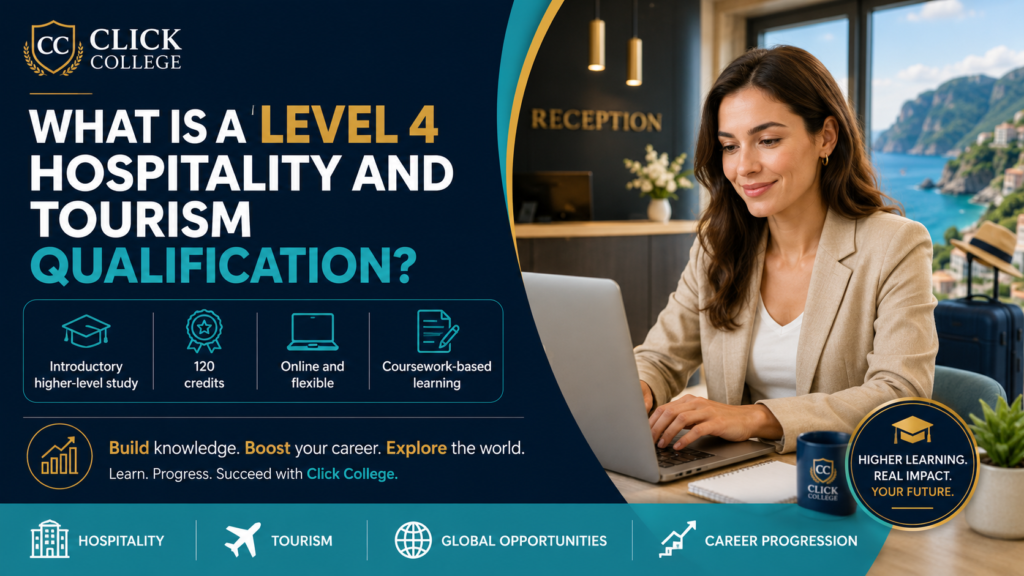
Level 4 sits above A Level or Level 3 study and is commonly compared with the first year of undergraduate study. It can provide a strong foundation before progressing to Level 5, Level 6 or more advanced professional development.
For learners interested in hotels, travel, tourism, resorts, events, customer service or service-based businesses, a Level 4 hospitality and tourism qualification can be a practical starting point. It introduces the core ideas needed to understand how hospitality and tourism organisations operate, how customers are served, and how managers support effective service delivery.
What does Level 4 mean?
In the UK qualification system, Level 4 represents the first stage of higher education study. It is above Level 3 qualifications such as A Levels and is often associated with qualifications such as a Certificate of Higher Education, Higher National Certificate and Level 4 diplomas.
This means Level 4 study is more advanced than school or college-level study, but it is still designed to introduce learners to higher education rather than assume they already have advanced subject knowledge.
At Level 4, learners are expected to move beyond simple description. They begin to explain concepts, apply ideas to realistic situations and develop more structured written responses. However, the level is still introductory compared with Level 5 and Level 6.
In hospitality and tourism, this means learners may begin by studying the structure of the industry, the importance of customer service, the role of hospitality operations, the basics of tourism systems, and the business principles that support successful service organisations.
What is a Level 4 hospitality and tourism qualification?
A Level 4 hospitality and tourism qualification introduces learners to the main principles of hospitality, tourism and management. It is usually designed to help learners understand the industry from both a practical and business perspective.
Hospitality includes areas such as hotels, restaurants, accommodation, events, food and beverage, guest services and front-of-house operations. Tourism includes travel, destinations, visitor attractions, tour operations, tourism services and the wider visitor economy.
A Level 4 qualification brings these areas together so learners can understand how hospitality and tourism organisations work, how they serve customers and how they operate in competitive markets.
It may cover topics such as:
- hospitality and service industries
- travel and tourism systems
- customer experience
- front-of-house operations
- business and management principles
- marketing fundamentals
- people and teamwork
- organisational behaviour
- service quality
- tourism destinations
- operational awareness
The aim is not simply to memorise facts about the industry. A good Level 4 hospitality and tourism course should help learners understand how the sector works in practice and how managers make decisions in service-based organisations.
Is Level 4 the same as the first year of a degree?
Level 4 is commonly understood as being academically comparable to the first year of undergraduate study. However, it is important to use this wording carefully.
A Level 4 diploma or certificate is not automatically the same award as a university degree. A degree is a specific qualification awarded by a university or another institution with degree-awarding powers. A Level 4 qualification sits at the first stage of higher education and may be used as part of a wider progression route.
A helpful way to understand it is this:
Level 4 is first-year undergraduate level. Level 5 is usually associated with second-year undergraduate level. Level 6 is associated with final-year undergraduate or bachelor’s degree-level study.
For this reason, many learners use Level 4 as a starting point before progressing to Level 5 and then Level 6.
This staged route can be useful for learners who want to build confidence gradually rather than begin with a full degree programme straight away.
Who is a Level 4 hospitality and tourism qualification for?
A Level 4 hospitality and tourism qualification can be suitable for many different types of learners.
It may suit school or college leavers who want to begin higher-level study in a career-focused subject. It may also suit adults who are returning to education after several years away and want a structured but accessible starting point.
It can also be useful for people already working in hospitality, tourism or customer service who want to improve their knowledge and prepare for future progression.
A Level 4 hospitality and tourism qualification may be suitable for learners who:
- want to begin higher-level study
- are interested in hotels, tourism, travel or events
- want a flexible alternative to traditional university study
- prefer coursework-based assessment
- are considering a career change
- already work in hospitality or tourism
- want to progress towards Level 5 or Level 6
- need online study around work or family commitments
- want to build confidence before advanced study
Because Level 4 introduces core ideas from the beginning, it can be especially helpful for learners who do not yet have formal experience in hospitality or tourism.
What will you learn at Level 4?
At Level 4, learners usually build a foundation in both industry knowledge and general management thinking.
In hospitality and tourism, this may include understanding how organisations are structured, how services are delivered, how customers make decisions, and how businesses respond to market conditions.
For example, learners may study the role of accommodation providers, restaurants, visitor attractions, travel businesses and destination services. They may also explore how customer expectations affect service quality, how staff contribute to customer experience, and how hospitality and tourism businesses promote themselves.
A Level 4 learner might be asked to explain how front-of-house operations support the guest experience, or how tourism organisations contribute to a destination’s economy. They may also explore how teamwork, communication and marketing influence service delivery.
This type of study helps learners connect theory with practice. Instead of only learning definitions, learners begin to think about real business situations.
Why study hospitality and tourism at Level 4?
Hospitality and tourism are global, people-focused industries. They involve customer service, cultural awareness, communication, organisation, commercial thinking and practical problem-solving.
A Level 4 hospitality and tourism qualification can help learners develop a stronger understanding of these industries and the skills needed to work within them.
There are several reasons why learners choose Level 4 study.
First, it provides a structured introduction to higher education. Learners can begin at an accessible level without jumping straight into final-year degree-level work.
Second, it offers a career-focused subject area. Hospitality and tourism are practical industries, so learners can connect their studies to real workplaces and future roles.
Third, it can support progression. A Level 4 qualification can provide a pathway to Level 5 and Level 6 study, helping learners build their academic profile step by step.
Fourth, it can build confidence. For learners who are nervous about returning to study, Level 4 can provide a manageable starting point.
What careers can Level 4 hospitality and tourism support?
A Level 4 qualification can help learners build knowledge for entry-level, junior supervisory or progression-focused roles. It can also provide a foundation for further study before moving into management.
Possible career areas may include:
- hotel operations
- front-of-house services
- guest relations
- food and beverage services
- travel and tourism support
- visitor attractions
- events support
- customer service
- reservations and bookings
- tourism administration
- hospitality supervision
Learners should be realistic about career progression. A Level 4 qualification alone may not immediately lead to senior management roles, especially without work experience. However, it can provide a valuable academic foundation and help learners prepare for higher-level study or professional development.
For learners already working in the sector, Level 4 study may help them understand their workplace more clearly and prepare for future supervisory responsibilities.
Is Level 4 suitable for beginners?
Yes, Level 4 can be suitable for beginners, especially when the course is designed as an open-access introduction to higher-level study.
A good Level 4 hospitality and tourism course should not assume that learners already understand the sector in detail. It should introduce important concepts clearly and build knowledge gradually.
This is important for adult learners and career changers. Someone may have strong customer service experience, travel experience or practical workplace skills, but no formal hospitality or tourism qualification. Level 4 can help turn that interest or experience into structured academic learning.
It is also suitable for learners who want to test their interest in the sector before committing to longer or more advanced study.
How is a Level 4 hospitality and tourism qualification assessed?
Assessment depends on the provider and awarding body, but many flexible online Level 4 hospitality and tourism qualifications are assessed through coursework rather than traditional timed exams.
Coursework-based assessment may include written assignments, case study responses, reports, applied tasks and reflective work. Learners are usually asked to show that they understand the topic and can apply ideas to realistic hospitality or tourism contexts.
For many learners, coursework is a more suitable form of assessment than exams. It gives them time to read, think, plan and write carefully. This can be particularly helpful for learners who are returning to education, studying around work or managing family commitments.
However, coursework still requires effort. Learners need to engage with the learning materials, answer the assignment questions properly and demonstrate understanding in a structured way.
No exams does not mean no standards. It means that knowledge is assessed differently.
Can you study Level 4 hospitality and tourism online?
Yes, Level 4 hospitality and tourism can be studied online through flexible distance learning.
Online study can be especially useful for learners who cannot attend a college or university campus. It allows learners to study from home, from work or from another country. This flexibility can make higher education more accessible for working adults, parents, international learners and people with changing schedules.
A fully online course may include digital learning materials, video lessons, workbooks, guided tasks and online assignment submission.
For hospitality and tourism learners, this flexibility can be particularly valuable because many people in the industry work shifts, evenings, weekends or seasonal hours. Online study allows learners to continue working while building their qualifications.
What is the difference between a 40-credit and 120-credit Level 4 qualification?
Not all Level 4 qualifications are the same size. This is why credit value matters.
A 40-credit Level 4 qualification is usually shorter and more focused. It may be suitable for continuing professional development, skills development or exploring a specific subject area.
A 120-credit Level 4 qualification is larger and usually represents a fuller year of undergraduate-level study. It provides a broader foundation and may support progression more effectively into Level 5 study.
For example, a short Level 4 Professional Diploma in Travel and Tourism may focus mainly on tourism systems, destinations and travel services. A 120-credit Higher International Certificate in Hospitality and Tourism Management may cover a wider range of business, hospitality, tourism and management topics.
When choosing a course, learners should look at both the level and the credit value. The level tells you the difficulty. The credits tell you the size of the qualification.
How does Level 4 lead to Level 5 and Level 6?
Level 4 is often the first stage in a longer higher education pathway.
After completing Level 4, learners may progress to Level 5, where they study more advanced management topics. In hospitality and tourism, this could include operations management, people management, quality management, digital transformation, destination management and more applied decision-making.
After Level 5, learners may progress to Level 6, which is degree-level study. At Level 6, learners are expected to analyse and evaluate more complex issues, such as strategic hospitality management, revenue management, tourism development, leadership and research.
This progression can be useful because it allows learners to build knowledge gradually:
Level 4 introduces the subject.
Level 5 develops management understanding.
Level 6 moves towards strategic and degree-level thinking.
For many learners, this staged approach feels more manageable than entering a traditional full degree programme immediately.
Study Level 4 Hospitality and Tourism with Click College
Click College offers the Higher International Certificate in Hospitality & Tourism Management at EduQual Level 4.
This is a 120-credit qualification designed to introduce learners to the core principles of hospitality, tourism and service-led organisations. It provides a foundation in business, management, customer experience and industry knowledge, helping learners prepare for further study or career development.
The course is delivered fully online, allowing learners to study from anywhere. It is designed for flexible, independent learning, with no fixed classroom schedule.
Assessment is completed through coursework, so there are no traditional timed exams. This can make the course especially suitable for learners who prefer written assignments and practical application over exam-based study.
The qualification is open access, meaning learners do not need previous hospitality, tourism or business qualifications to begin. This makes it a practical starting point for people from a wide range of educational and professional backgrounds.
Typical completion time is around 6 to 12 months, although flexible study allows learners to progress at a pace that suits their circumstances.
Why choose Click College for Level 4 hospitality and tourism?
Click College’s Level 4 hospitality and tourism route is designed for learners who want flexibility, accessibility and progression.
It may be suitable for learners who want to:
- study online from anywhere
- avoid traditional timed exams
- begin without formal entry requirements
- build a foundation in hospitality and tourism
- progress towards Level 5 and Level 6 study
- develop knowledge relevant to hotels, tourism and service industries
- study around work, family or other commitments
The course can also be useful for learners who are unsure whether hospitality and tourism management is the right long-term route. Starting at Level 4 allows learners to build confidence and explore the subject before moving into higher-level study.
Questions to ask before starting a Level 4 qualification
Before choosing a Level 4 hospitality and tourism qualification, it is helpful to ask a few practical questions.
What is the credit value of the course? A 120-credit qualification usually provides a fuller foundation than a short professional diploma.
Is the course fully online or does it require attendance? This matters if you need flexibility.
How is the course assessed? If you prefer coursework to exams, check that assessment is assignment-based.
Is there a progression route? If you want to continue to Level 5 or Level 6, make sure the course supports that pathway.
Does the subject content match your goals? Hospitality and tourism is broad, so consider whether you are more interested in hotels, travel, events, customer experience, destination management or general service management.
These questions can help you choose a course that fits your needs rather than simply choosing the first Level 4 option you find.
Final thoughts
A Level 4 hospitality and tourism qualification is a strong starting point for learners who want to begin higher-level study in a practical, people-focused industry.
It introduces the core ideas behind hospitality, tourism, customer service, business and management. It can help learners understand how service organisations operate and how managers support effective customer experiences.
Level 4 is especially useful because it provides an accessible first step. It is academically comparable to the first year of undergraduate study, but it can often be completed through flexible online learning and coursework-based assessment.
For learners who want to progress further, Level 4 can lead naturally into Level 5 and Level 6 study. This makes it a practical option for those who want to build towards higher-level hospitality and tourism management qualifications over time.
If you are interested in hotels, travel, tourism, events or customer-focused business, a Level 4 hospitality and tourism qualification can be a valuable first step towards your future career.
Explore Online Hospitality and Tourism Management Courses
Choosing the right hospitality and tourism management course depends on your current experience, career ambitions and preferred level of study.
Whether your goal is to enter the industry, move into management, specialise in hotel revenue, strengthen tourism expertise or build degree-level strategic capability, online study provides a flexible route towards your next step.
Explore the full Hospitality & Tourism Management course range here:
Ready to enrol?
Take Your Next Step Today
Ready to advance your professional management career with an accredited, flexible qualification? Visit Click College to explore their comprehensive online courses or discover detailed information about their range of qualifications.
For further enquiries or to enrol today, visit the Click College website and begin your journey toward professional excellence.





Recent Posts
Professional Diploma or Higher Qualification Pathway: Which Should You Choose?
Professional Diploma or Higher Qualification Pathway: Which Should You Choose? Choosing the right online qualification is not always simply a question of choosing the longest course or the highest level. For many learners, the better question is: what kind of study route fits my goals right now? Some learners want a focused qualification in one […]
Professional Diploma in Leadership and Management: Course Guide
Professional Diploma in Leadership and Management: Course Guide A Professional Diploma in Leadership and Management is designed for learners who want to develop advanced leadership, strategic thinking and organisational management skills without committing immediately to a full degree programme. Leadership and management are essential in almost every sector. Whether you work in business, education, hospitality, […]
Professional Diploma in Business Management: Who Is It For?
Professional Diploma in Business Management: Who Is It For? A Professional Diploma in Business Management is designed for learners who want to build practical business knowledge without committing immediately to a full degree or long higher education programme. It can be a useful option for people who want to understand how organisations work, how teams […]