What Is a Level 6 Hospitality and Tourism Qualification?
A Level 6 hospitality and tourism qualification is an advanced higher education qualification designed for learners who want to develop degree-level knowledge of hospitality, tourism and service management. It is usually suitable for learners who have already completed Level 4 and Level 5 study, or for those who want to complete a full degree-level pathway in hospitality and tourism management.
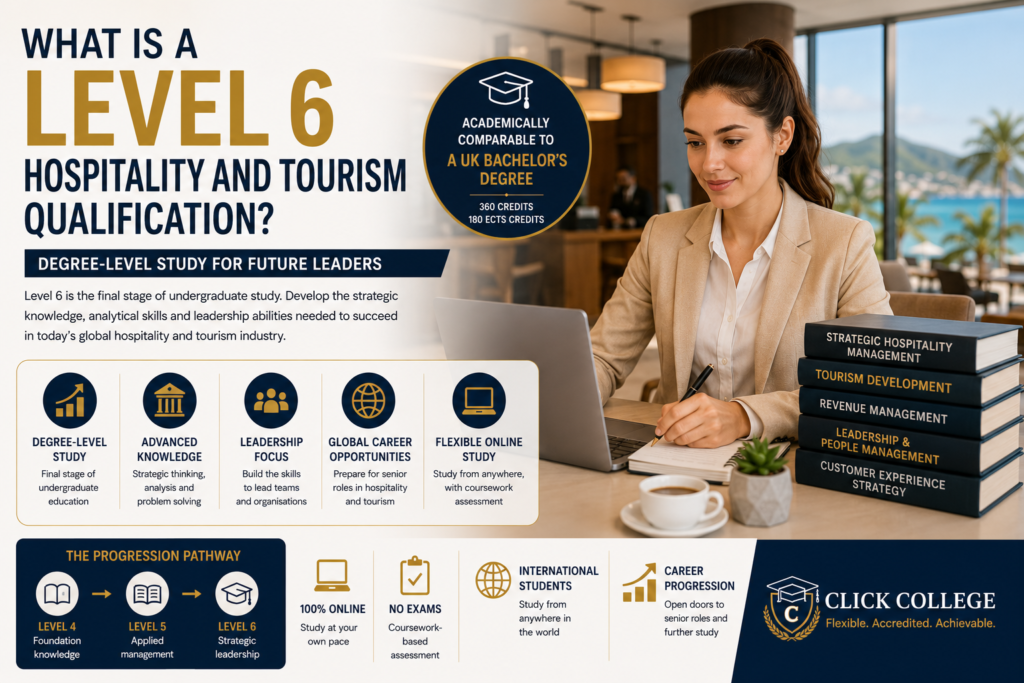
Level 6 is commonly associated with the final year of undergraduate study. This means it is the stage where learners are expected to think more strategically, analyse complex issues and apply management ideas to real hospitality and tourism organisations.
For learners interested in hotels, resorts, travel, tourism, events, destination management, visitor attractions or customer-focused business, a Level 6 hospitality and tourism qualification can be a valuable route into advanced management study.
It is especially relevant for learners who want to move beyond operational knowledge and develop a stronger understanding of leadership, strategy, finance, revenue management, customer experience and long-term business performance.
What does Level 6 mean?
In the UK qualification system, Level 6 represents advanced undergraduate study. It is the level commonly associated with bachelor’s degrees, graduate diplomas, graduate certificates, degree apprenticeships and Level 6 diplomas.
This means a Level 6 qualification is more advanced than Level 4 or Level 5. Learners are expected to demonstrate independent thinking, critical analysis, evaluation and the ability to apply knowledge to complex professional situations.
At Level 4, learners usually build a foundation. At Level 5, they develop more applied management understanding. At Level 6, they move into strategic and degree-level thinking.
In hospitality and tourism, this means learners are not simply studying how hotels, restaurants or tourism businesses operate. They are studying how organisations compete, how managers make strategic decisions, how customer expectations change, how revenue is managed, and how businesses respond to wider industry pressures.
A Level 6 learner may be asked to evaluate a hotel’s strategic position, analyse tourism development challenges, assess revenue management decisions, or make recommendations for improving organisational performance.
This is why Level 6 is often described as degree-level study.
What is a Level 6 hospitality and tourism qualification?
A Level 6 hospitality and tourism qualification focuses on advanced management within hospitality, tourism and related service industries. It is designed to help learners understand the sector from a strategic, commercial and leadership perspective.
the International Graduate Diploma in Hospitality and Tourism from Click College is an example of a Level 6 online hospitaity and tourism qualification
Hospitality includes areas such as hotels, resorts, restaurants, food and beverage, accommodation, guest services, events and customer experience. Tourism includes travel, destinations, visitor attractions, tour operations, destination marketing, cultural tourism and the wider visitor economy.
At Level 6, learners are expected to connect these areas with higher-level management issues. This may include strategy, finance, leadership, sustainability, revenue management, customer loyalty, competitive advantage and organisational performance.
A Level 6 hospitality and tourism course may include topics such as:
- strategic hospitality management
- tourism development
- hospitality revenue management
- hospitality finance
- customer experience and service quality
- leadership and people management
- destination management
- strategic marketing
- sustainability in tourism
- research and evidence-based decision-making
- competitive advantage in hospitality and tourism
- organisational change and innovation
The aim is to help learners develop the knowledge and confidence needed to understand hospitality and tourism organisations at a senior level.
Is Level 6 the same as a degree?
Level 6 is the same academic level as bachelor’s degree study, but it is important to understand the wording carefully.
A Level 6 diploma is degree-level. However, it is not automatically the same award as a university degree unless it is specifically awarded as a degree by a university or another institution with degree-awarding powers.
The difference is between level and award type.
A bachelor’s degree is a specific university award. A Level 6 diploma is a diploma qualification at Level 6. Both can sit at the same academic level, but they are not always identical qualifications.
A useful way to understand it is this:
Level 6 means the qualification is at bachelor’s degree level.
A degree means the qualification is awarded as a degree.
A Level 6 diploma may therefore be academically comparable to a degree in level, and sometimes in credit value, but it should not be described as a university degree unless it is formally awarded as one.
This distinction is important for learners, employers and universities. If you need a qualification for a specific purpose, such as postgraduate study, visa requirements, employment criteria or professional recognition, you should always check the requirements of the organisation receiving the qualification.
Why credit value matters at Level 6
When comparing Level 6 qualifications, credit value is very important.
The level tells you the academic difficulty of the qualification. The credit value tells you the size or volume of learning.
For example, a short Level 6 Professional Diploma may carry 40 credits. This can be useful for focused professional development, but it is not the same size as a full 360-credit qualification.
A 120-credit Level 6 top-up qualification is usually comparable to the final year of undergraduate study. It may be suitable for learners who already hold relevant Level 4 and Level 5 qualifications.
A 360-credit Level 6 qualification is much larger. It normally includes learning across Levels 4, 5 and 6 and is closer in size and structure to a full undergraduate pathway.
This is why learners should always ask two questions:
What level is the qualification?
How many credits does it carry?
A qualification can be Level 6 without being the same size as a full degree pathway. Equally, a 360-credit Level 6 qualification may be academically comparable to a bachelor’s degree in both level and credit value.
How is Level 6 different from Level 4 and Level 5?
Level 4, Level 5 and Level 6 each have a different purpose.
Level 4 is the introductory stage of higher education. It introduces learners to core ideas in hospitality, tourism, business, customer service and management.
Level 5 is the intermediate stage. It develops more advanced understanding of operations, people management, service quality, digital change, customer experience and applied decision-making.
Level 6 is the advanced stage. It focuses on strategic thinking, analysis, evaluation and senior-level management issues.
For example, at Level 4, a learner might explain the importance of customer service in a hotel.
At Level 5, the learner might analyse how service quality can be managed across hotel departments.
At Level 6, the learner might evaluate how customer experience strategy can create competitive advantage in a hotel group.
The subject area may be similar, but the depth of thinking becomes more advanced as the learner progresses.
Who is a Level 6 hospitality and tourism qualification for?
A Level 6 hospitality and tourism qualification may suit learners who want to complete degree-level study in a flexible and career-focused way.
It may be suitable for learners who:
- have completed Level 4 and Level 5 study
- want to progress to degree-level hospitality and tourism learning
- already work in hospitality, tourism, travel, events or service industries
- want to develop strategic management knowledge
- are preparing for leadership or senior supervisory roles
- prefer coursework-based assessment to traditional exams
- want to study online from anywhere
- are returning to higher education as adults
- want an alternative to a traditional campus-based degree
- are interested in hotels, resorts, destination management or tourism development
Level 6 is not usually the best starting point for complete beginners unless the qualification includes Level 4 and Level 5 content within a full pathway. Learners who are new to higher education may prefer to begin at Level 4 or enrol on a full integrated Level 6 route that builds knowledge step by step.
What will you learn at Level 6?
At Level 6, learners study hospitality and tourism from a more strategic and analytical perspective.
They may explore how organisations make decisions, respond to competition, manage revenue, improve service quality and adapt to industry changes.
For example, learners may examine how a hotel business can increase profitability without damaging guest satisfaction. They may analyse how a tourism destination can grow visitor numbers while protecting the local environment. They may evaluate how digital platforms, online reviews and customer data affect hospitality and tourism strategy.
Level 6 study may also involve research. Learners may be expected to investigate a topic, analyse information and present evidence-based recommendations.
This helps develop the type of thinking needed in management roles, where decisions are rarely simple. Hospitality and tourism managers often need to balance customer needs, staff performance, budgets, brand reputation, sustainability and commercial targets.
Why study hospitality and tourism at Level 6?
Hospitality and tourism are major global industries. They are also highly competitive and constantly changing.
Customer expectations, technology, global travel trends, sustainability concerns, online booking platforms, staffing pressures and economic conditions all affect the sector. Managers need to understand these changes and make informed decisions.
Level 6 study can help learners develop a deeper understanding of these issues.
There are several reasons why learners choose Level 6 hospitality and tourism.
First, it provides degree-level study in a career-focused subject. Learners can develop advanced knowledge that is relevant to hotels, resorts, tourism businesses, travel organisations and service-led companies.
Second, it supports career progression. For learners already working in the sector, Level 6 can help strengthen their management profile and prepare them for more responsible roles.
Third, it can support further academic progression, depending on the requirements of the receiving institution. Some learners may use Level 6 study as preparation for postgraduate or professional development routes.
Fourth, it can provide a flexible alternative to traditional university study, especially for learners who need online learning around work, family or international commitments.
What careers can Level 6 hospitality and tourism support?
A Level 6 hospitality and tourism qualification can support career development across a wide range of service industries. It may be particularly useful for learners who want to move towards management, leadership or specialist roles.
Possible career areas include:
- hotel management
- resort management
- hospitality operations management
- tourism management
- destination management
- visitor attraction management
- events management
- food and beverage management
- guest experience management
- revenue management
- travel and tourism operations
- customer experience management
- hospitality consultancy
- service quality management
Career outcomes depend on many factors, including previous experience, location, language skills, communication skills, professional attitude and employer requirements.
A qualification alone does not guarantee a particular job. However, Level 6 study can help learners develop the knowledge, confidence and academic profile needed for future progression.
Can Level 6 lead to postgraduate study?
A Level 6 qualification may support progression towards postgraduate study, but this depends on the university or institution receiving the application.
Some universities may consider a substantial Level 6 qualification as part of an application, especially if it is relevant, carries significant credit value and includes appropriate academic work. Other universities may specifically require a formal bachelor’s degree.
This is why learners should always check directly with the university or postgraduate provider if they have a specific master’s degree or further study route in mind.
Even where entry is not automatic, Level 6 study can still be useful preparation. It can help learners develop independent research, academic writing, critical analysis and evidence-based decision-making skills.
These skills are valuable for postgraduate study and for senior professional roles.
Can you study Level 6 hospitality and tourism online?
Yes, Level 6 hospitality and tourism can be studied online through flexible distance learning, from accredited providers such as Click College.
Online study is especially useful for learners who are working, living internationally, managing family commitments or unable to attend a campus-based course.
A fully online course may include digital learning materials, guided workbooks, video content, online assignment submission and tutor support.
For hospitality and tourism learners, flexibility is particularly important. Many people in the sector work shifts, weekends, evenings or seasonal hours. A fixed university timetable may not suit their lifestyle.
Online Level 6 study allows learners to build their qualifications while continuing with work and personal commitments.
Is Level 6 hospitality and tourism assessed by exams?
This depends on the provider, but many flexible online Level 6 hospitality and tourism qualifications are assessed through coursework rather than traditional timed exams.
Coursework-based assessment may include written assignments, reports, case studies, strategic analysis, applied scenarios and research projects.
This can be a suitable method for hospitality and tourism management because the subject is applied and professional. Learners can demonstrate understanding by analysing realistic business situations and making reasoned recommendations.
For example, a learner may complete an assignment on strategic hospitality management, revenue management, tourism development or customer experience.
Coursework gives learners time to research, plan and write carefully. This can be especially helpful for adult learners, working professionals and people who do not perform well in timed exam conditions.
However, coursework still requires serious academic effort. Learners need to read, analyse, structure their arguments and meet the assessment requirements.
No exams does not mean no standards. It means the qualification assesses knowledge in a different way.
What is the difference between a 40-credit, 120-credit and 360-credit Level 6 qualification?
Not all Level 6 qualifications are the same size.
A 40-credit Level 6 Professional Diploma is a shorter qualification. It may be useful for continuing professional development or focused study in one specialist area, such as strategic hospitality management.
A 120-credit Level 6 top-up qualification is larger. It may be suitable for learners who already hold relevant Level 4 and Level 5 qualifications and want to complete final-year degree-level study.
A 360-credit Level 6 qualification is a full pathway. It usually includes study across Level 4, Level 5 and Level 6, allowing learners to build from foundation knowledge through to advanced degree-level study.
This distinction matters because a short Level 6 course and a full 360-credit Level 6 pathway are both Level 6, but they are not the same size.
Learners should choose the route that fits their starting point and goals.
If you already hold Level 4 and Level 5 qualifications, a top-up route may be appropriate.
If you do not already hold Level 4 and Level 5 qualifications, a full 360-credit pathway may be more suitable.
If you only want focused professional development, a shorter Professional Diploma may be enough.
Study Level 6 Hospitality and Tourism with Click College
Click College offers the International Graduate Diploma in Hospitality & Tourism Management at Level 6.
This is a 360-credit qualification, equivalent to 180 ECTS credits, designed for learners who want to complete a full degree-level hospitality and tourism management pathway through flexible online study.
The qualification is academically comparable to a UK bachelor’s degree in Hospitality and Tourism Management in terms of level and credit value. It is designed to develop advanced strategic, operational and financial understanding of hospitality and tourism organisations.
The course is delivered fully online, allowing learners to study from anywhere. Assessment is completed through coursework, so there are no traditional timed exams.
This makes the course suitable for learners who want to study at degree level but need flexibility around work, family or other commitments.
Click College also offers a Level 6 top-up route in Hospitality and Tourism for learners who already hold relevant Level 4 and Level 5 qualifications. This allows eligible learners to complete the final stage of their degree-level pathway without repeating earlier levels.
What topics are included in Level 6 hospitality and tourism?
A Level 6 hospitality and tourism qualification usually includes more advanced and strategic topics than Level 4 or Level 5 study.
Learners may study areas such as strategic management, competitive advantage, hospitality revenue management, finance, tourism development, leadership, customer experience and research.
The focus is on helping learners understand how hospitality and tourism organisations make decisions, compete in the market and respond to changing conditions.
For example, strategic hospitality management may explore how hotels or hospitality groups position themselves against competitors. Revenue management may examine how pricing, demand and capacity affect profitability. Tourism development may consider how destinations grow responsibly while balancing visitor demand, sustainability and local impact.
These topics are relevant to learners who want to think like managers, not just employees.
Why choose Click College for Level 6 hospitality and tourism?
Click College’s Level 6 hospitality and tourism route is designed for learners who want flexibility, accessibility and degree-level study without the traditional campus model.
It may be suitable for learners who want to:
- study online from anywhere
- complete coursework instead of exams
- build a 360-credit degree-level qualification
- develop advanced hospitality and tourism management knowledge
- progress from Level 4 and Level 5 to Level 6
- study around work, family or international commitments
- focus on practical, career-related management topics
- prepare for future professional or academic progression
The course can be particularly useful for learners who want a flexible alternative to a traditional university degree while still studying at an advanced academic level.
Questions to ask before starting a Level 6 qualification
Before choosing a Level 6 hospitality and tourism qualification, it is useful to ask several questions.
What is the credit value? A 40-credit Level 6 course is very different from a 360-credit Level 6 pathway.
Is it a full qualification or a top-up? If it is a top-up, you may need Level 4 and Level 5 qualifications first.
How is the course assessed? If you prefer coursework to exams, check the assessment method carefully.
Is the course fully online? This matters if you need flexibility.
Does the qualification match your career goals? Hospitality and tourism is broad, so consider whether the content includes the areas you are most interested in, such as hotels, travel, destination management, revenue management or customer experience.
Do you need the qualification for a specific purpose? If you want to use it for postgraduate study, employment, immigration or professional recognition, check the requirements directly with the relevant organisation.
These questions can help you choose a qualification that fits your personal and professional aims.
Final thoughts
A Level 6 hospitality and tourism qualification is an advanced, degree-level route for learners who want to develop strategic management knowledge in a global and people-focused industry.
It builds on the foundations of Level 4 and Level 5, moving learners towards higher-level analysis, evaluation and decision-making. At this stage, learners study hospitality and tourism as complex business sectors, not just practical service environments.
Level 6 can be especially valuable for learners interested in management, leadership, revenue, customer experience, tourism development, hotel operations or service strategy.
The key is to understand exactly what type of Level 6 qualification you are choosing. Level 6 tells you the academic level, but credit value tells you the size of the qualification. A full 360-credit Level 6 pathway is very different from a short 40-credit Professional Diploma or a 120-credit top-up route.
For learners who want flexible online study, coursework-based assessment and a route into advanced hospitality and tourism management, a Level 6 qualification can be a strong step towards future career and academic progression.
Explore Online Hospitality and Tourism Management Courses
Choosing the right hospitality and tourism management course depends on your current experience, career ambitions and preferred level of study.
Whether your goal is to enter the industry, move into management, specialise in hotel revenue, strengthen tourism expertise or build degree-level strategic capability, online study provides a flexible route towards your next step.
Explore the full Hospitality & Tourism Management course range here:
Ready to enrol?
Take Your Next Step Today
Ready to advance your professional management career with an accredited, flexible qualification? Visit Click College to explore their comprehensive online courses or discover detailed information about their range of qualifications.
For further enquiries or to enrol today, visit the Click College website and begin your journey toward professional excellence.





Recent Posts
Professional Diploma or Higher Qualification Pathway: Which Should You Choose?
Professional Diploma or Higher Qualification Pathway: Which Should You Choose? Choosing the right online qualification is not always simply a question of choosing the longest course or the highest level. For many learners, the better question is: what kind of study route fits my goals right now? Some learners want a focused qualification in one […]
Professional Diploma in Leadership and Management: Course Guide
Professional Diploma in Leadership and Management: Course Guide A Professional Diploma in Leadership and Management is designed for learners who want to develop advanced leadership, strategic thinking and organisational management skills without committing immediately to a full degree programme. Leadership and management are essential in almost every sector. Whether you work in business, education, hospitality, […]
Professional Diploma in Business Management: Who Is It For?
Professional Diploma in Business Management: Who Is It For? A Professional Diploma in Business Management is designed for learners who want to build practical business knowledge without committing immediately to a full degree or long higher education programme. It can be a useful option for people who want to understand how organisations work, how teams […]