CATS and ECTS Credits Explained: What Do 40, 120, 240 and 360 Credits Mean?
Introduction
If you are comparing online courses, professional diplomas or higher education pathways, you will often see qualifications described using credits. A course may be worth 40 credits, 120 credits, 240 credits or 360 credits. You may also see references to CATS credits, ECTS credits or simply qualification credits.
At first, this can feel confusing. Credit systems sound technical, but the basic idea is simple: credits help show the amount of learning involved in a course or qualification. They do not tell you everything about a course, but they are an important way to understand its size, workload and how it may compare with other forms of study.
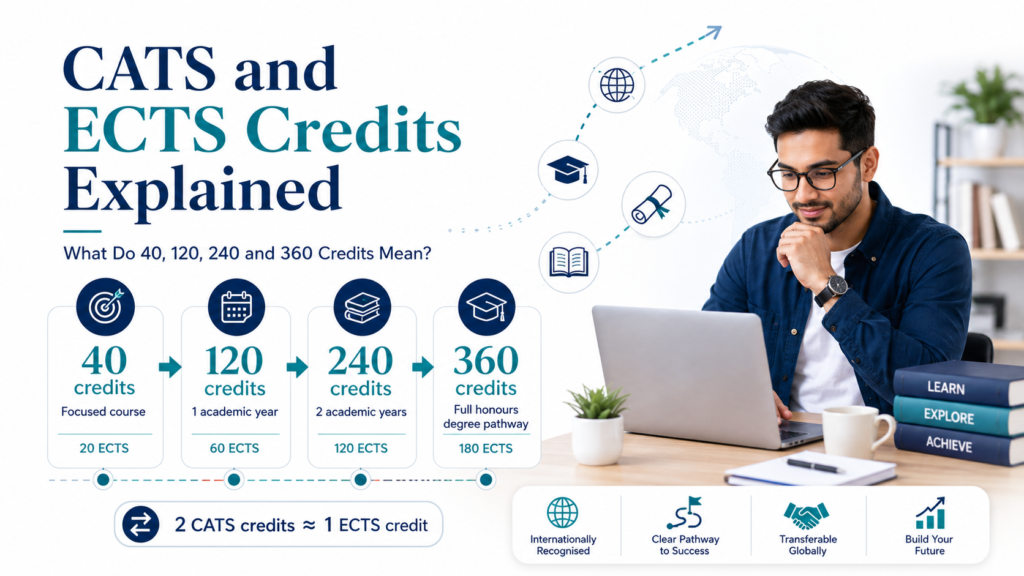
For Click College students, credits are especially useful because they help explain the difference between a focused 40-credit Professional Diploma, a 120-credit Level 4 course, a 240-credit Level 5 pathway and a 360-credit Level 6 International Graduate Diploma pathway.
What Are Qualification Credits?
Qualification credits are a way of measuring the amount of learning attached to a course or qualification. In UK higher education, credits normally reflect the estimated time an average learner is expected to spend completing the required learning outcomes.
This includes more than live teaching or online lessons. It may also include independent reading, research, coursework, assessment preparation, reflection and guided learning. In other words, credits are not just about how many hours you spend watching videos or attending classes. They reflect the total learning effort expected across the course.
A common principle in UK credit systems is that one credit represents approximately 10 hours of learning [1]. This is sometimes called notional learning time. It does not mean every learner will take exactly the same amount of time. Some students may move more quickly, while others may need longer. The credit value simply gives a standard way to estimate the size of the course.
This means a 40-credit course is typically associated with around 400 hours of total learning, while a 120-credit course is associated with around 1,200 hours of total learning.
What Are CATS Credits?
CATS stands for Credit Accumulation and Transfer System. CATS credits are commonly used in UK higher education to describe the size of learning and to support the accumulation and possible transfer of credit between courses or institutions.
The Quality Assurance Agency for Higher Education describes CATS as a system that enables learners to accumulate credit and facilitates the transfer of credit within and between education providers [2]. In simple terms, CATS credits help show how much learning has been completed and at what level.
CATS credits are often used alongside qualification levels. This is important because credits and levels tell you different things. Credits tell you about the volume of learning. Levels tell you about the academic difficulty of learning.
For example, 40 credits at Level 4 and 40 credits at Level 6 may involve a similar amount of learning time, but Level 6 study would normally be more academically demanding. This is why it is important to look at both the credit value and the level of a course.
What Are ECTS Credits?
ECTS stands for European Credit Transfer and Accumulation System. ECTS credits are widely used across European higher education to support comparison, recognition and student mobility.
Under the ECTS system, 60 ECTS credits are normally allocated to a full-time academic year [3]. This is broadly comparable to the UK convention where a full-time undergraduate academic year is typically associated with 120 UK credits [1].
Because of this, a common comparison is:
| UK CATS Credits | Approximate ECTS Credits |
|---|---|
| 40 CATS credits | 20 ECTS credits |
| 120 CATS credits | 60 ECTS credits |
| 240 CATS credits | 120 ECTS credits |
| 360 CATS credits | 180 ECTS credits |
This comparison is useful, but it should be treated as a broad guide rather than an automatic guarantee of recognition. Universities, colleges and professional bodies make their own decisions about credit transfer, recognition and entry requirements.
CATS Credits vs ECTS Credits
CATS and ECTS credits both help measure learning volume, but they come from different systems.
CATS credits are commonly associated with UK higher education credit structures. ECTS credits are used across the European Higher Education Area. The systems are different, but they are often compared because both are designed to help learners, institutions and employers understand the size of a course or qualification.
A simple way to understand the relationship is that 2 UK CATS credits are often treated as broadly comparable to 1 ECTS credit. This is because a full UK academic year is typically 120 credits, while a full ECTS academic year is typically 60 credits.
However, credits are only one part of the picture. A proper comparison also needs to consider the subject, level, learning outcomes, assessment method, awarding or accrediting body, and the requirements of the receiving institution.
What Does 40 Credits Mean?
A 40-credit course is a focused programme of study. Using the common UK credit convention, 40 credits usually represent around 400 hours of total learning.
At Click College, Professional Diplomas are 40-credit accredited courses. They are designed to provide targeted learning in specific management-focused areas such as business management, project management, marketing, human resources, hospitality and tourism, finance, leadership, logistics and operations.
A 40-credit Professional Diploma is not the same size as a full academic year. It is deliberately smaller and more focused. This can make it attractive for learners who want to build knowledge in a particular subject area without committing to a larger 120-credit programme.
For example, a 40-credit Professional Diploma may help you strengthen one part of your professional profile, explore a new career direction or develop structured knowledge in a management-related field. It can still carry academic value, particularly where it is accredited and assessed, but its purpose is different from a full-year qualification.
In ECTS terms, 40 UK credits are commonly compared with approximately 20 ECTS credits.
What Does 120 Credits Mean?
A 120-credit qualification is commonly associated with the learning volume of one full-time academic year in UK higher education [1]. Using the standard credit convention, 120 credits normally represent around 1,200 hours of total learning.
This is why 120 credits is such an important number. When people compare a Level 4 course with the first year of undergraduate study, or a Level 5 course with the second year, the credit value matters. A course may be at the same level, but it is only comparable in duration and learning volume to a full academic year where it carries the appropriate credit size.
At Click College, the Higher International Certificate at Level 4 is designed as a 120-credit stage. This makes it a substantial programme of study and helps distinguish it from shorter professional development courses.
In ECTS terms, 120 UK credits are commonly compared with approximately 60 ECTS credits.
What Does 240 Credits Mean?
A 240-credit pathway usually represents a much larger programme of study than a single-year course. In UK higher education terms, 240 credits are commonly associated with two full-time academic years of learning volume.
This does not automatically mean that every 240-credit pathway is the same as completing two years of a university degree. Level, subject content, assessment, awarding arrangements and institutional recognition still matter. However, from a credit-volume perspective, 240 credits normally represents a substantial body of learning.
At Click College, the Higher International Diploma at Level 5 can form part of a 240-credit pathway by building on Level 4 study and progressing into Level 5. This allows learners to develop their academic knowledge gradually, moving from introductory higher education-level learning into more advanced application and analysis.
In ECTS terms, 240 UK credits are commonly compared with approximately 120 ECTS credits.
What Does 360 Credits Mean?
A 360-credit pathway is commonly associated with the total credit volume of a standard three-year undergraduate honours degree in many UK higher education contexts [1]. This is because undergraduate degree study is often structured across three academic stages: Level 4, Level 5 and Level 6.
A 360-credit structure usually reflects a full pathway of learning rather than a short course. It may include 120 credits at Level 4, 120 credits at Level 5 and 120 credits at Level 6. This staged structure allows learners to build knowledge progressively, moving from foundation-level higher education study through to graduate-level learning.
At Click College, the International Graduate Diploma pathway at Level 6 is designed as part of a 360-credit progression route. Learners may begin with the 120-credit Higher International Certificate at Level 4, continue through Level 5, and then complete the Level 6 International Graduate Diploma stage.
In ECTS terms, 360 UK credits are commonly compared with approximately 180 ECTS credits.
Why Credits and Levels Must Be Read Together
One of the most common mistakes learners make is looking only at credits or only at levels. Both matter.
Credits tell you how much learning is involved. Levels tell you how demanding that learning is. A 40-credit course and a 120-credit course may sit at the same level, but the 120-credit course is larger in learning volume. Equally, a 40-credit Level 6 course may be smaller than a 120-credit Level 4 course, but the Level 6 course is normally more academically advanced.
This is why a course description should always make clear both the level and the credit value. A phrase such as “Level 6” tells you the academic standard. A phrase such as “40 credits” tells you the size of the course. Together, they give a much clearer picture.
For Click College students, this distinction helps explain the difference between Professional Diplomas and larger staged qualifications. A 40-credit Professional Diploma is focused and career-relevant. A 120-credit Level 4 course is a larger academic stage. A 240-credit pathway reflects more extended learning across Levels 4 and 5. A 360-credit pathway represents a much broader progression route across Levels 4, 5 and 6.
How Credits Support Progression
Credits can support progression because they provide a structured way to show learning volume. If you complete a credit-bearing course, you have evidence of study at a particular level and size.
However, credit does not automatically guarantee entry to another course or university. Education providers make their own decisions about admissions, recognition and credit transfer. They may consider the level, credit value, subject area, grades, learning outcomes, assessment method and the overall fit with the course being applied for.
This means credits are useful, but they are not a universal passport. A course with 120 credits may be more substantial than a 40-credit course, but the receiving provider still decides whether and how that credit can be recognised.
For learners, the practical message is simple: credits help you understand and explain what you have studied, but progression decisions remain subject to the requirements of the receiving institution or organisation.
Why Credits Matter for Online Learners
Credits are especially important for online learners because online courses can vary widely in size and purpose. Some online courses are short introductions. Others are structured academic programmes with assessment, credit and progression potential.
Without credits, it can be difficult to compare courses fairly. A course title may sound impressive, but the credit value helps show whether it is a short professional development course, a substantial diploma or a larger academic pathway.
This is why Click College clearly positions its courses by credit value. A 40-credit Professional Diploma gives focused subject-specific development. A 120-credit Level 4 course provides a full academic stage. A 240-credit pathway allows learners to continue into more advanced study. A 360-credit route supports a broader progression pathway towards graduate-level learning.
For students balancing study with work, family or other responsibilities, this clarity matters. It helps you choose a course that fits your goals, time commitment and progression plans.
Frequently Asked Questions
What are CATS credits?
CATS credits are UK-style academic credits used to show the amount of learning in a course or qualification. CATS stands for Credit Accumulation and Transfer System. Credits can help learners build up learning over time and may support transfer or progression, depending on the receiving institution.
What are ECTS credits?
ECTS credits are European credits used across the European Higher Education Area. ECTS stands for European Credit Transfer and Accumulation System. Under ECTS, 60 credits normally represent one full-time academic year.
How many CATS credits are in one academic year?
In UK higher education, one full-time undergraduate academic year is typically associated with 120 credits. This is often used as a benchmark when comparing course size and learning volume.
How many ECTS credits are in one academic year?
In the ECTS system, one full-time academic year is normally associated with 60 ECTS credits.
How do CATS credits convert to ECTS credits?
A common comparison is that 2 UK CATS credits are broadly comparable to 1 ECTS credit. This means 40 UK credits are approximately 20 ECTS credits, 120 UK credits are approximately 60 ECTS credits, 240 UK credits are approximately 120 ECTS credits, and 360 UK credits are approximately 180 ECTS credits.
What does 40 credits mean?
A 40-credit course is a focused programme of study, normally associated with around 400 hours of total learning. At Click College, Professional Diplomas are 40-credit accredited courses designed for targeted professional development.
What does 120 credits mean?
A 120-credit course is commonly associated with one full-time academic year of study in UK higher education. It is typically equivalent in credit volume to around 60 ECTS credits.
What does 240 credits mean?
A 240-credit pathway is commonly associated with the learning volume of two full-time academic years. It is typically equivalent in credit volume to around 120 ECTS credits.
What does 360 credits mean?
A 360-credit pathway is commonly associated with the total credit volume of a standard three-year undergraduate honours degree in many UK higher education contexts. It is typically equivalent in credit volume to around 180 ECTS credits.
Are credits the same as qualification levels?
No. Credits and levels are different. Credits measure the amount of learning, while levels indicate the academic difficulty of the learning. A course should be understood by looking at both its credit value and its level.
References
- Quality Assurance Agency for Higher Education. Higher Education Credit Framework for England. Available at: https://www.qaa.ac.uk/the-quality-code/higher-education-credit-framework-for-england
- Quality Assurance Agency for Higher Education. Higher Education Credit Framework for England: Advice on Academic Credit Arrangements. Available at: https://www.qaa.ac.uk/docs/qaa/quality-code/higher-education-credit-framework-for-england.pdf
- European Commission. ECTS Users’ Guide 2015. Available at: https://education.ec.europa.eu/sites/default/files/document-library-docs/ects-users-guide_en.pdf
- ENIC-NARIC. European Credit Transfer and Accumulation System. Available at: https://www.enic-naric.net/ects—european-credit-transfer-and-accumulation-system.aspx
The key sources behind the credit definitions are QAA’s Higher Education Credit Framework and the European Commission’s ECTS Users’ Guide, which set out the UK credit framework and the 60-ECTS academic-year convention. (qaa.ac.uk)
Take Your Next Step Today
Ready to advance your professional management career with an accredited, flexible qualification? Visit Click College to explore their comprehensive online courses or discover detailed information about their range of qualifications.
For further enquiries or to enrol today, visit the Click College website and begin your journey toward professional excellence.






Recent Posts
Professional Diploma or Higher Qualification Pathway: Which Should You Choose?
Professional Diploma or Higher Qualification Pathway: Which Should You Choose? Choosing the right online qualification is not always simply a question of choosing the longest course or the highest level. For many learners, the better question is: what kind of study route fits my goals right now? Some learners want a focused qualification in one […]
Professional Diploma in Leadership and Management: Course Guide
Professional Diploma in Leadership and Management: Course Guide A Professional Diploma in Leadership and Management is designed for learners who want to develop advanced leadership, strategic thinking and organisational management skills without committing immediately to a full degree programme. Leadership and management are essential in almost every sector. Whether you work in business, education, hospitality, […]
Professional Diploma in Business Management: Who Is It For?
Professional Diploma in Business Management: Who Is It For? A Professional Diploma in Business Management is designed for learners who want to build practical business knowledge without committing immediately to a full degree or long higher education programme. It can be a useful option for people who want to understand how organisations work, how teams […]