Level 6 Equivalent: What Does It Mean?
Introduction
If you are considering a Level 6 course, one of the first questions you may have is: what is Level 6 equivalent to? This is an important question if you are comparing alternatives to traditional university study, planning your next academic step, or looking for a flexible route towards degree-level learning.
In broad academic terms, Level 6 is commonly associated with the final stage of undergraduate study. In the UK, Level 6 qualifications include honours degrees, ordinary degrees, graduate diplomas, Level 6 certificates and Level 6 diplomas [1]. This means Level 6 sits above Level 5 and below Level 7, which is normally associated with master’s-level study.
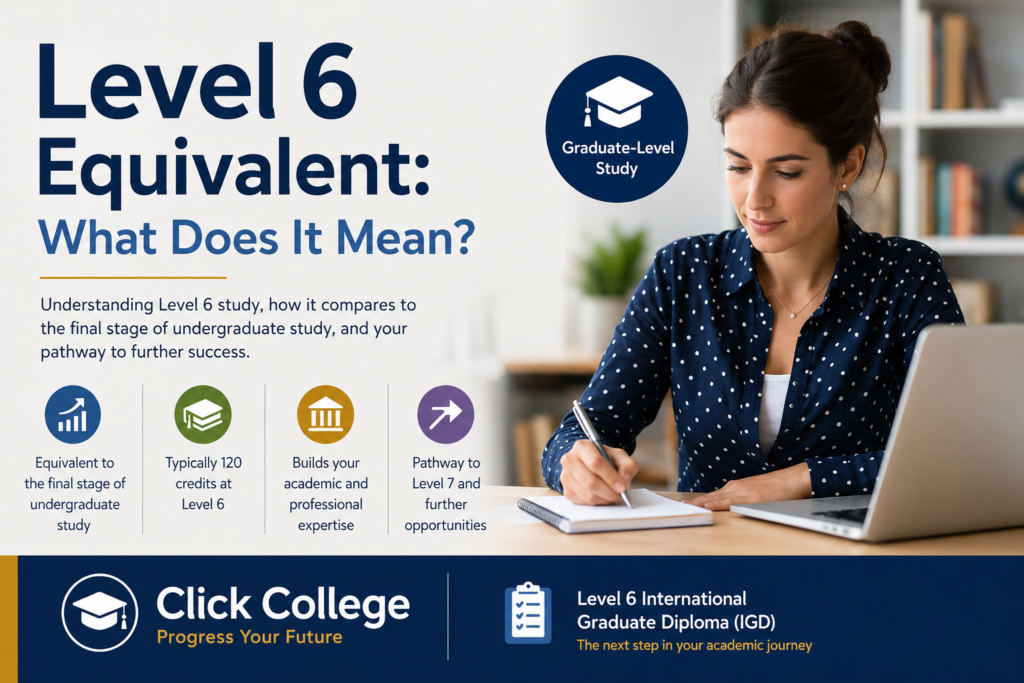
At Click College, Level 6 study is offered through the International Graduate Diploma (IGD) pathway. It sits as the graduate-level stage after Level 4 and Level 5 study, giving learners a structured route to develop advanced academic, professional and strategic knowledge.
Understanding Level 6
Level 6 represents advanced undergraduate-level study. At this stage, students are expected to work with greater independence, apply knowledge to more complex situations, evaluate evidence critically and develop well-reasoned conclusions. The learning is usually more specialised than at Level 4 or Level 5 and requires a higher level of academic confidence.
At Level 4, students are introduced to higher education-level learning. At Level 5, they begin to develop more advanced analysis and application. At Level 6, the focus moves towards independent judgement, strategic thinking and the ability to deal with more complex academic and professional issues.
This makes Level 6 especially important for learners who want to strengthen their graduate-level profile. It can support career development, professional progression and preparation for further study, depending on the learner’s goals and the requirements of any receiving institution.
What Is Level 6 Equivalent To?
In broad academic terms, Level 6 is comparable to the level of study normally associated with the final stage of a UK undergraduate degree. GOV.UK lists Level 6 qualifications as including a degree with honours, an ordinary degree without honours, a graduate diploma, a Level 6 award, a Level 6 certificate and a Level 6 diploma [1].
This helps explain why Level 6 is often described as degree-level study. It reflects a level of academic demand where students are expected to demonstrate advanced subject knowledge, independent thinking and the ability to apply ideas to complex contexts.
However, it is important to distinguish between the level of study and the volume (described by the credits) of study. A course may be set at Level 6, but that does not automatically mean it is equivalent in size or duration to a full undergraduate degree. In UK higher education, one full-time undergraduate academic year is typically associated with 120 credits [2]. Therefore, for a Level 6 course to be comparable to the duration and learning volume of the final year of an undergraduate degree, it would normally need to carry 120 credits at Level 6.
A full bachelor’s degree is normally larger than a single Level 6 course because it usually includes study across Levels 4, 5 and 6. In many UK higher education contexts, a full honours degree is commonly associated with 360 credits in total, with learning built across three academic stages [2]. This means that a Level 6 qualification can be degree-level in academic demand, while still needing to be understood in relation to its credit value and total learning volume.
Level 6, 120 Credits and the Final Year of Undergraduate Study
The 120-credit distinction is especially important at Level 6. A short Level 6 course may still be academically valuable, but it should not be described as equivalent in duration to the final year of an undergraduate degree unless it carries the appropriate learning volume.
For example, a 120-credit Level 6 programme may be comparable in volume to one full-time academic year of Level 6 undergraduate study. If a learner has already completed suitable Level 4 and Level 5 study, a 120-credit Level 6 programme may form part of a wider academic pathway that is comparable in staged learning volume to undergraduate study.
This is why Level 6 is often associated with “top-up” or final-stage learning. It may provide the final academic stage after earlier Level 4 and Level 5 study. However, recognition, credit transfer and progression are always subject to the requirements of the receiving institution or organisation.
Why Level 6 Study Matters
Level 6 study matters because it helps learners move into a more advanced stage of academic and professional development. It is not simply about learning more content. It is about learning to think, analyse and communicate at a higher level.
At this stage, students are often expected to evaluate different perspectives, apply theory to complex problems, produce more sophisticated written work and demonstrate a stronger ability to work independently. In professional subject areas, this may include strategic thinking, leadership analysis, decision-making, research-informed problem solving and a more mature understanding of organisational practice.
For working adults, Level 6 study can be particularly valuable. It allows you to connect professional experience with graduate-level academic learning. If you already have workplace knowledge, a Level 6 programme can help you frame that experience through a more advanced academic and strategic lens.
Is Level 6 the Same as a Bachelor’s Degree?
Level 6 is commonly associated with bachelor’s degree-level study, but it is not automatically the same as a full bachelor’s degree.
A bachelor’s degree is not defined by level alone. It is also defined by credit volume, programme structure, institutional rules, assessment requirements, awarding arrangements and progression decisions. A qualification or course may sit at Level 6, but still differ from a full bachelor’s degree in size, purpose and awarding status.
This is why accurate language matters. A Level 6 course can be described as being at degree level in terms of academic demand. It should not automatically be described as a full degree unless it is awarded as a degree by an institution with the appropriate degree-awarding authority.
For learners, the key distinction is simple: Level 6 tells you the academic standard of the learning; credits tell you the amount of learning; the qualification title tells you what award is being made.
Can Level 6 Lead to Further Study?
Yes. Level 6 study can support progression to further study, including Level 7 programmes such as postgraduate certificates, postgraduate diplomas and master’s degrees, depending on the course completed and the entry requirements of the receiving institution.
In the UK framework, Level 7 is associated with master’s-level qualifications, including master’s degrees, postgraduate certificates and postgraduate diplomas [1]. This means Level 6 can provide an important academic platform for learners who may wish to move towards postgraduate-level study in the future.
However, progression is not automatic in every case. Universities and education providers set their own entry requirements. They may consider the subject studied, qualification size, credit value, grades, English language ability, professional experience and the learner’s wider academic profile. A Level 6 qualification can strengthen your profile, but it should not be treated as a universal guarantee of admission to postgraduate study.
Click College Level 6 International Graduate Diploma Pathway
At Click College, Level 6 study is offered through the International Graduate Diploma (IGD) pathway. This is the next stage after Level 4 and Level 5 study and is designed for learners who want to continue towards graduate-level academic and professional development.
The Click College pathway allows students to build their learning progressively. Students may begin with the Higher International Certificate at Level 4, move on to the Higher International Diploma at Level 5, and then progress to the International Graduate Diploma at Level 6.
This staged structure is useful because it allows learners to develop confidence and capability over time. Level 4 introduces higher education-level learning, Level 5 develops more advanced subject knowledge and applied analysis, and Level 6 focuses on graduate-level understanding, independent judgement and strategic thinking.
Click College’s Level 6 IGD pathway is designed to be flexible, fully online and accessible to learners who want to study around work, family or other commitments. It provides a structured route for students who want degree-level learning without following a traditional campus-based undergraduate model.
Why Students Choose Level 6 Study at Click College
Students choose Level 6 study at Click College because it offers a flexible way to continue their academic journey after completing Level 4 and Level 5 study or equivalent prior learning. It is particularly suitable if you want to strengthen your graduate-level profile in areas such as business, management, hospitality, tourism, marketing, project management, finance or human resources.
The focus is not simply on completing another course. Level 6 study helps you develop higher-level academic and professional habits. These include reading more critically, evaluating evidence more confidently, applying theory to complex situations, writing with greater sophistication and forming more independent judgements.
For working professionals, this can be especially useful. Level 6 study can help you connect your professional experience with higher-level academic knowledge. It can also support your ability to think more strategically about organisational challenges, management decisions and professional development.
For learners who have already completed Level 4 and Level 5, the Level 6 IGD can provide the next stage of a structured progression pathway. It helps bring earlier learning together and moves the focus towards graduate-level application and analysis.
Frequently Asked Questions
What is Level 6 equivalent to?
Level 6 is broadly comparable in academic level to the final stage of undergraduate study. In the UK, Level 6 includes qualifications such as honours degrees, ordinary degrees, graduate diplomas, Level 6 certificates and Level 6 diplomas.
Is Level 6 equivalent to a degree?
Level 6 is commonly associated with degree-level study, but it is not automatically the same as a full bachelor’s degree. A full degree is shaped by level, credit volume, course structure and awarding arrangements. A Level 6 course may be degree-level in academic demand, but it should only be described as a degree if it is awarded as a degree by an appropriate institution.
What is Click College’s Level 6 IGD?
Click College’s Level 6 International Graduate Diploma (IGD) is a graduate-level pathway designed for learners who want to continue their academic and professional development after Level 4 and Level 5 study. It focuses on advanced subject knowledge, independent judgement and higher-level professional understanding.
How many credits should a Level 6 course have?
The credit value depends on the size and purpose of the course. A full undergraduate academic year is typically associated with 120 credits. This means a Level 6 course would normally need to carry 120 credits at Level 6 to be comparable in learning volume to the final year of a bachelor’s degree.
Is Level 6 higher than Level 5?
Yes. Level 6 is higher than Level 5 and represents a more advanced stage of academic study. Level 5 develops applied analysis and deeper subject knowledge, while Level 6 focuses more strongly on independent judgement, advanced application and graduate-level thinking.
Can I progress from Level 6 to a master’s degree?
Level 6 study may support progression to Level 7 or postgraduate study, depending on the course completed and the requirements of the receiving institution. Universities and education providers make their own decisions about entry, and may consider credit value, subject area, grades, English language ability and professional experience.
Who is a Level 6 IGD suitable for?
A Level 6 International Graduate Diploma may be suitable if you have completed Level 4 and Level 5 study, or if you have relevant prior learning or professional experience. It can be especially useful if you want to strengthen your graduate-level profile, develop strategic knowledge or prepare for further academic or professional progression.
Is a Level 6 IGD the same as the final year of university?
A Level 6 IGD may be comparable in academic level to final-year undergraduate study. However, it should only be compared to the duration and learning volume of a full final university year where it carries the appropriate credit volume, typically 120 credits at Level 6. Recognition and progression decisions remain subject to the requirements of receiving institutions.
Final Thoughts
So, what does Level 6 equivalent mean?
It means the course is designed at Level 6, a level commonly associated with the final stage of undergraduate study. Level 6 study is comparable in academic demand to qualifications such as honours degrees, ordinary degrees, graduate diplomas and Level 6 diplomas. It can help you develop advanced subject knowledge, stronger academic confidence and graduate-level professional understanding.
At the same time, equivalence should be understood accurately. A Level 6 course is comparable by level, but it is only comparable to the duration and learning volume of a full final year of undergraduate study where it carries an appropriate volume of credit, typically 120 credits at Level 6. A full bachelor’s degree normally involves a larger programme of study across Levels 4, 5 and 6.
For learners seeking a flexible, accessible and structured route into graduate-level study, the Click College Level 6 International Graduate Diploma pathway can provide a valuable next step. It offers a bridge between earlier higher education study and advanced academic or professional progression, helping you continue your journey with greater clarity, confidence and direction.
References
- GOV.UK. What qualification levels mean: list of qualification levels. Available at: https://www.gov.uk/what-different-qualification-levels-mean/list-of-qualification-levels
- Quality Assurance Agency for Higher Education. Higher Education Credit Framework for England. Available at: https://www.qaa.ac.uk/the-quality-code/higher-education-credit-framework-for-england
- Quality Assurance Agency for Higher Education. Qualifications Frameworks. Available at: https://www.qaa.ac.uk/the-quality-code/qualifications-frameworks
Take Your Next Step Today
Ready to advance your professional management career with an accredited, flexible qualification? Visit Click College to explore their comprehensive online courses or discover detailed information about their range of qualifications.
For further enquiries or to enrol today, visit the Click College website and begin your journey toward professional excellence.



Recent Posts
Professional Diploma or Higher Qualification Pathway: Which Should You Choose?
Professional Diploma or Higher Qualification Pathway: Which Should You Choose? Choosing the right online qualification is not always simply a question of choosing the longest course or the highest level. For many learners, the better question is: what kind of study route fits my goals right now? Some learners want a focused qualification in one […]
Professional Diploma in Leadership and Management: Course Guide
Professional Diploma in Leadership and Management: Course Guide A Professional Diploma in Leadership and Management is designed for learners who want to develop advanced leadership, strategic thinking and organisational management skills without committing immediately to a full degree programme. Leadership and management are essential in almost every sector. Whether you work in business, education, hospitality, […]
Professional Diploma in Business Management: Who Is It For?
Professional Diploma in Business Management: Who Is It For? A Professional Diploma in Business Management is designed for learners who want to build practical business knowledge without committing immediately to a full degree or long higher education programme. It can be a useful option for people who want to understand how organisations work, how teams […]