Professional Diploma vs Degree: Which Is Right for Your Career?
Choosing between a professional diploma and a degree can feel confusing, especially if you are trying to improve your career prospects, change direction, or gain a recognised qualification without committing to several years of university study.
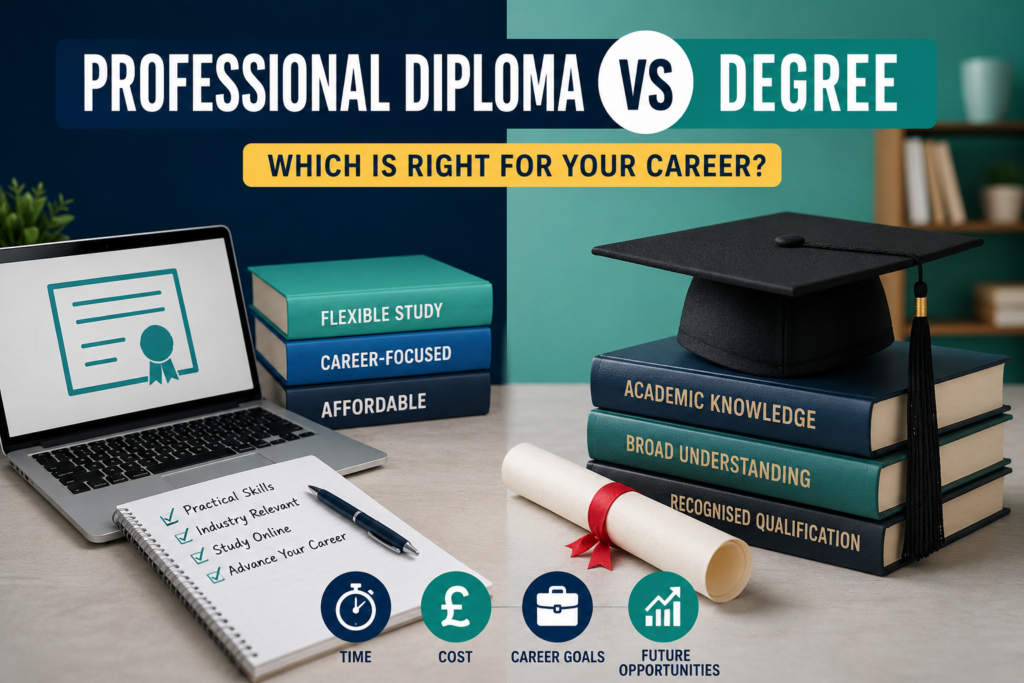
Both routes can be valuable. A degree is often seen as the traditional academic pathway, while a professional diploma is usually more focused, flexible and career-related. The best option depends on your goals, current experience, budget, available study time and the type of career you want to build.
This guide explains the key differences between a professional diploma and a degree, how each route can support career development, and when a professional diploma may be the more practical choice.
What is the difference between a professional diploma and a degree?
The main difference between a professional diploma and a degree is usually the structure, purpose and length of study.
A degree is a broad academic qualification normally delivered by a university or higher education institution. It usually involves several years of study and covers a subject in depth, often combining theory, research, academic writing and wider subject knowledge.
A professional diploma is usually more focused on a specific career area, industry or skill set. It is often designed for learners who want to develop practical knowledge that can be applied in the workplace. Professional diplomas may be shorter than degrees, more flexible to study, and more directly linked to professional development.
In simple terms, a degree is often broader and more academic, while a professional diploma is usually more targeted and career-focused.
Professional diploma vs degree: a simple comparison
A degree is often suitable for learners who want a full academic qualification, a traditional university experience or access to careers where a degree is specifically required.
A professional diploma may be more suitable for learners who want a flexible, affordable and practical route into a new field or who already have work experience and want to build recognised knowledge without starting a full degree programme.
For example, someone who wants to become a doctor, solicitor, architect or teacher may need a specific degree or regulated professional pathway. However, someone who wants to move into business management, hospitality and tourism, project management, marketing, finance, human resources or leadership may find that a professional diploma provides a more direct and flexible route to relevant knowledge.
What is a degree?
A degree is an academic qualification awarded by a university or recognised higher education provider. Undergraduate degrees usually include bachelor’s degrees such as BA, BSc or BBA qualifications. In the UK, an honours degree is normally associated with Level 6 study.
Degrees are often highly respected because they provide broad subject knowledge and develop academic skills such as research, analysis, critical thinking, written communication and independent study.
A degree may be the right choice if you want:
- a traditional university qualification
- a broad academic education
- access to a career that requires a degree
- a pathway to postgraduate study
- the experience of university life
- a qualification that is widely recognised by employers and institutions
However, degrees can also require a significant commitment of time and money. Many undergraduate degrees take three years of full-time study, and longer if studied part-time. For adult learners, working professionals or international students, this can be difficult to manage alongside employment, family responsibilities or financial commitments.
What is a professional diploma?
A professional diploma is a qualification designed to develop knowledge and skills in a particular professional area. Unlike a degree, which may cover a broad academic discipline, a professional diploma is usually more focused on practical understanding and workplace relevance.
Professional diplomas can be available at different academic levels. This means that not all professional diplomas are the same. Some may introduce a subject at an early stage, while others may be at higher education level and suitable for learners who want more advanced knowledge.
At Click College, professional diplomas are designed for flexible online study. They are particularly suitable for learners who want to gain recognised knowledge in areas such as business, marketing, finance, human resources, project management, hospitality and tourism.
A professional diploma may be the right choice if you want:
- a shorter and more focused qualification
- flexible online study
- career-related knowledge
- a route into a new sector
- professional development without attending university
- a qualification that can fit around work or family life
- a lower-cost alternative to a full degree pathway
Professional diplomas can be especially useful for learners who do not need a full degree immediately but still want structured, credible and relevant learning.
Is a professional diploma equivalent to a degree?
This depends on the level, credit value and awarding structure of the qualification.
A professional diploma is not automatically the same as a degree. The word “diploma” can be used for qualifications at different levels, so it is important to check the academic level and credit value before making a decision.
For example, a Level 4 qualification is broadly comparable to the first year of higher education study. A Level 5 qualification is broadly comparable to the second year of higher education study. A Level 6 qualification sits at degree level in terms of academic difficulty, although it is not necessarily the same as a full university degree.
This is an important distinction. A Level 6 professional diploma may be degree-level, but that does not always mean it is a full bachelor’s degree. A degree normally has its own award title, structure and institutional requirements.
The safest way to understand the comparison is this:
A professional diploma can sit at the same academic level as part of a degree pathway, but it is not automatically the same award as a degree.
Why do some learners choose a professional diploma instead of a degree?
Many learners choose a professional diploma because they want a more flexible and career-focused route.
A full degree can be valuable, but it may not be realistic for everyone. Some learners are already working full time. Others may be changing career and do not want to spend three years studying before they can move forward. Some may already have experience but need a recognised qualification to support promotion, confidence or professional credibility.
A professional diploma can be attractive because it allows learners to study a specific area without committing to a full university degree from the beginning.
For example, someone interested in hospitality and tourism management may not want to start a three-year university degree immediately. Instead, they may prefer to study a professional diploma in tourism, hospitality, hotel management or hospitality revenue management to build knowledge, test the subject and strengthen their CV.
This can be a practical first step, especially for learners who want to move into a new sector but are not yet ready for a full academic programme.
When is a degree the better option?
A degree may be the better option if your chosen career specifically requires one.
Some professions have strict entry requirements. If you want to enter a regulated profession, you should always check the exact requirements before choosing a qualification. In some sectors, a professional diploma may support your development but will not replace a required degree.
A degree may also be a better option if you want a broad academic education, a traditional university experience, access to certain graduate schemes, or a direct route into postgraduate study where a degree is required.
For younger learners leaving school, a university degree may also provide a structured transition into higher education, independent study and wider academic development.
In short, a degree may be the stronger option where the qualification itself is a formal requirement.
When is a professional diploma the better option?
A professional diploma may be the better option if you want flexibility, speed and career relevance.
This is particularly true if you are already working, changing career, returning to study after a break, or looking for a qualification that can be completed online.
A professional diploma can help you build confidence in a subject without the pressure of committing to a full degree. It can also be useful if you want to demonstrate professional interest in a field, strengthen your CV, or gain knowledge that can be applied directly in your current role.
For example, a learner working in a hotel, restaurant, travel company or customer service role may choose a professional diploma in hospitality or tourism to develop management knowledge. A learner working in administration may choose a professional diploma in business, marketing or human resources to support career progression.
In these situations, the learner may not need a full degree straight away. What they need is relevant, structured and flexible study that helps them move forward.
Professional diploma vs degree for career change
For career changers, a professional diploma can be particularly useful.
Changing career often involves uncertainty. You may be interested in a new field but unsure whether you want to commit to a full degree. You may also need to keep working while you study, especially if you are supporting yourself or your family.
A professional diploma allows you to explore a new subject in a focused way. It can help you understand the language, concepts and expectations of a new industry. It can also show employers that you are serious about your career change and have taken active steps to develop relevant knowledge.
For example, someone with experience in retail, customer service, law, administration or education may decide to move into hospitality, tourism, business management or project management. A professional diploma can provide a bridge between their existing experience and their new career direction.
This is one of the main reasons professional diplomas are attractive to adult learners. They do not require learners to put their lives on hold in the same way that full-time university study sometimes can.
Professional diploma vs degree for promotion
A professional diploma can also be valuable for people who are already employed and want to progress.
Many employees reach a stage where experience alone is not enough. They may be capable, motivated and trusted at work, but they may need formal study to support the next step into supervision, management or specialist responsibility.
A professional diploma can help by providing structured knowledge in areas such as leadership, operations, marketing, finance, human resources or project management. This can make the learner more confident and better prepared for new responsibilities.
For example, someone working in hospitality may already understand customer service and daily operations. However, if they want to move into management, they may need a stronger understanding of revenue, staffing, strategy, service quality and organisational decision-making.
A professional diploma can help connect practical experience with management theory.
Professional diploma vs degree for international learners
For international learners, flexibility is often one of the most important factors.
Studying a traditional degree may involve relocation, visa requirements, fixed timetables and high costs. For many learners, this is not realistic. Online professional diplomas can offer an alternative route for learners who want to gain a recognised qualification while continuing to live and work in their own country.
This can be especially helpful for learners who want UK-style higher education but need a more accessible format. With online study, learners can work through materials at their own pace and complete assignments without attending scheduled classes.
This does not mean that a professional diploma is always better than a degree. It means that, for many international learners, a professional diploma may be a more practical route into higher-level study and professional development.
Cost and time: an important difference
Cost and time are two of the biggest differences between a professional diploma and a degree.
A degree normally requires a longer commitment. It may involve tuition fees, accommodation costs, travel costs and the opportunity cost of taking time away from work.
A professional diploma is often shorter and more affordable. Because it is usually more focused, learners can gain relevant knowledge without paying for a full degree programme. Online study can also reduce additional costs because learners do not need to relocate or travel to classes.
For many learners, this makes a professional diploma a lower-risk option. It allows them to start developing their knowledge now, rather than waiting until they can afford or commit to a full university degree.
Assessment: exams or coursework?
Assessment methods vary between providers, so learners should always check the details of the qualification before enrolling.
Traditional degrees may include essays, reports, presentations, projects, exams, practical assessments or dissertations. Professional diplomas may also include written assignments, projects or case-study-based assessments.
At Click College, courses are designed for flexible online study and are assessed through coursework rather than traditional exams. This can be helpful for learners who prefer to demonstrate understanding through written assignments rather than timed exam conditions.
Coursework-based assessment can be particularly suitable for adult learners because it allows them to research, reflect and apply ideas to professional situations.
Which qualification do employers prefer?
There is no single answer because employers value different things.
Some employers require a degree because the role demands it or because it is part of a formal graduate recruitment process. In those cases, a professional diploma may not replace the degree requirement.
However, many employers are also interested in relevant skills, experience, motivation and evidence of continuous learning. In these situations, a professional diploma can be valuable because it shows that the learner has taken active steps to develop career-related knowledge.
A professional diploma may be especially useful when combined with existing work experience. For example, a learner who already works in hospitality and completes a professional diploma in hospitality management may be able to show both practical experience and structured academic development.
Employers often want evidence that a candidate can learn, adapt and apply knowledge. A professional diploma can help demonstrate these qualities.
Can a professional diploma lead to further study?
In many cases, yes, but progression depends on the qualification, level, credits, awarding body and the entry requirements of the institution you want to progress to.
A professional diploma can sometimes support progression into higher-level study. For example, a Level 4 qualification may support progression to Level 5 study, while a Level 5 qualification may support progression towards Level 6 study. A Level 6 qualification may support further professional development or, in some cases, postgraduate pathways, depending on the provider and the receiving institution.
However, learners should not assume automatic progression. Universities and institutions set their own entry requirements, so it is always important to check before enrolling if your main goal is academic progression.
Professional diploma vs degree: which is right for your career?
The right choice depends on your career goal.
Choose a degree if you need a full university qualification, want a traditional academic route, or plan to enter a profession where a degree is required.
Choose a professional diploma if you want a flexible, focused and career-relevant qualification that can help you build knowledge without committing to a full degree.
For many learners, the decision is not simply “professional diploma or degree”. A professional diploma can be the first step towards higher study, career progression or a future degree pathway. It can help learners build confidence, gain subject knowledge and make a more informed decision about their next move.
How Click College supports flexible professional study
Click College offers flexible online qualifications for learners who want to develop career-focused knowledge without attending traditional classes.
Our courses are designed for independent online study, with no fixed class timetable and no traditional exams. Learners can study at their own pace and complete written assignments when they are ready.
This model is particularly suitable for working adults, career changers and international learners who want a more accessible route into higher-level professional education.
Click College offers qualifications in areas including business, marketing, finance, human resources, project management, hospitality and tourism. These subject areas are closely linked to real career pathways and are suitable for learners who want to develop practical knowledge for professional growth.
Final thoughts
A degree remains an important and respected qualification, especially for careers where a university degree is required. However, it is not the only route to career development.
A professional diploma can offer a flexible, focused and practical alternative for learners who want to build knowledge, change direction or progress professionally without committing to a full degree from the start.
When comparing a professional diploma vs degree, the best choice depends on your personal situation. Consider your career goal, the qualification requirements of your chosen sector, your available time, your budget and how you prefer to study.
For many learners, a professional diploma is not a second-best option. It is a practical, modern and accessible route into professional learning.
Frequently asked questions
Is a professional diploma the same as a degree?
No. A professional diploma is not automatically the same as a degree. Some professional diplomas may be at degree level, especially at Level 6, but a degree is a specific academic award. Always check the level, credit value and awarding body before comparing qualifications.
Is a professional diploma worth it?
A professional diploma can be worth it if it helps you gain relevant knowledge, improve your CV, support career progression or move into a new field. It is especially useful for learners who want flexible, career-focused study.
Is a degree better than a professional diploma?
A degree is better if your chosen career specifically requires one. However, a professional diploma may be better if you want a shorter, more flexible and more practical route to professional development.
Can I get a job with a professional diploma?
A professional diploma can support your job search by showing that you have studied a relevant subject and developed professional knowledge. However, employment outcomes depend on your experience, skills, sector, location and the requirements of individual employers.
Can a professional diploma help me change career?
Yes. A professional diploma can be a useful way to explore a new field, gain subject knowledge and show employers that you are serious about changing direction.
Is a professional diploma good for adult learners?
Yes. Professional diplomas are often well suited to adult learners because they can be more flexible than traditional university study. Online professional diplomas can be especially helpful for learners balancing study with work or family commitments.
Should I choose a professional diploma or a degree?
Choose a degree if you need a full university qualification for your career. Choose a professional diploma if you want focused, flexible and career-related study that can help you build knowledge and progress professionally..
Explore Online Management Courses
Take Your Next Step Today
Ready to advance your professional management career with an accredited, flexible qualification? Visit Click College to explore their comprehensive online courses or discover detailed information about their range of qualifications.
For further enquiries or to enrol today, visit the Click College website and begin your journey toward professional excellence.:
Ready to enrol?


Recent Posts
Professional Diploma or Higher Qualification Pathway: Which Should You Choose?
Professional Diploma or Higher Qualification Pathway: Which Should You Choose? Choosing the right online qualification is not always simply a question of choosing the longest course or the highest level. For many learners, the better question is: what kind of study route fits my goals right now? Some learners want a focused qualification in one […]
Professional Diploma in Leadership and Management: Course Guide
Professional Diploma in Leadership and Management: Course Guide A Professional Diploma in Leadership and Management is designed for learners who want to develop advanced leadership, strategic thinking and organisational management skills without committing immediately to a full degree programme. Leadership and management are essential in almost every sector. Whether you work in business, education, hospitality, […]
Professional Diploma in Business Management: Who Is It For?
Professional Diploma in Business Management: Who Is It For? A Professional Diploma in Business Management is designed for learners who want to build practical business knowledge without committing immediately to a full degree or long higher education programme. It can be a useful option for people who want to understand how organisations work, how teams […]