What Is a Level 6 Qualification Equivalent To?
Introduction
If you are researching higher education qualifications in the UK, you may have come across the term Level 6 qualification.
Understanding what Level 6 means can help you compare qualifications more clearly and understand how different study routes fit within undergraduate-level higher education.
A Level 6 qualification is commonly associated with:
- bachelor’s degree-level study
- the final stage of undergraduate study
- graduate diplomas
- professional higher education qualifications
- International Graduate Diplomas (IGDs)
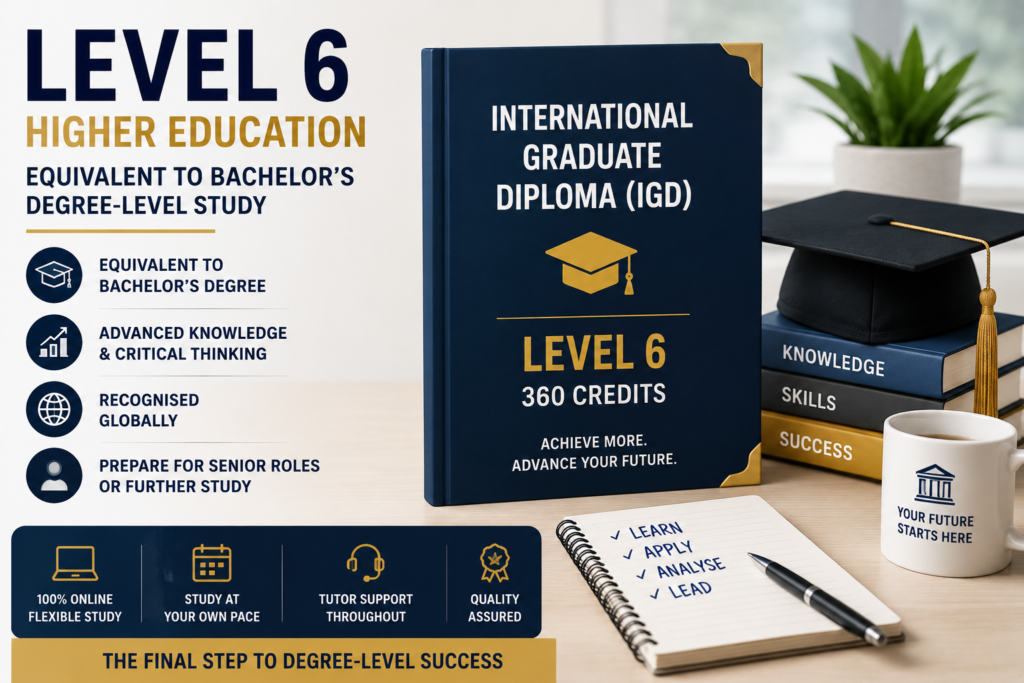
At Click College, the International Graduate Diploma (IGD) is a Level 6 qualification with 360 credits designed for learners who want flexible online higher education study.
You can read more about the International Graduate Diploma here.
What is a Level 6 qualification?
A Level 6 qualification is an advanced stage of undergraduate higher education in England, Wales and Northern Ireland.
Gov.UK explains that Level 6 qualifications include examples such as:
- bachelor’s degrees with honours
- graduate diplomas
- Level 6 Awards
- Level 6 Certificates
- Level 6 Diplomas [1]
Level 6 is commonly associated with the final year of undergraduate study.
This means Level 6 qualifications sit above Level 5 qualifications such as HNDs, Foundation Degrees and Higher International Diplomas, but below Level 7 postgraduate qualifications such as master’s degrees.
What is a Level 6 qualification equivalent to?
A Level 6 qualification is commonly associated with bachelor’s degree-level study.
Examples of Level 6 qualifications include:
| Qualification | Level | Typical credit value |
|---|---|---|
| Bachelor’s Degree with Honours | Level 6 | 360 credits |
| Graduate Diploma | Level 6 | 360 credits |
| International Graduate Diploma (IGD) | Level 6 | 360 credits |
| Final year of undergraduate study | Level 6 | 360 credits |
Although qualifications may differ in structure, awarding arrangements and assessment methods, they are all commonly understood as Level 6 higher education study.
At Click College, the International Graduate Diploma is a Level 6 qualification with 360 credits designed for learners that wish to progress through undergraduate-level study, but are looking for an alternative to the traditional university pathway..
Is a Level 6 qualification higher education?
Yes. A Level 6 qualification is part of higher education.
The Framework for Higher Education Qualifications (FHEQ) places Level 6 within undergraduate higher education study [2].
At Level 6, learners are expected to demonstrate:
- advanced subject knowledge
- independent analytical ability
- critical evaluation skills
- strategic thinking
- evidence-based decision-making
- the ability to apply theory to complex professional situations
Level 6 study builds on the knowledge and skills developed at Levels 4 and 5.
Is Level 6 equivalent to a bachelor’s degree?
Level 6 is commonly associated with bachelor’s degree-level study [1][2].
This is one of the most useful ways to understand Level 6 qualifications.
For example:
| Academic stage | Typical level |
|---|---|
| First year undergraduate study | Level 4 |
| Second year undergraduate study | Level 5 |
| Final year undergraduate study | Level 6 |
At Click College, learners can progress through a structured undergraduate-level pathway:
| Qualification | Level | Typical credit value |
|---|---|---|
| Higher International Certificate (HIC) | Level 4 | 120 credits |
| Higher International Diploma (HID) | Level 5 (including Level 4) | 240 credits |
| International Graduate Diploma (IGD) | Level 6 (including Level 4 and Level 5) | 360 credits |
The International Graduate Diploma is designed as a Level 6 qualification with 360 credits representing undergraduate degree-level study that is available fully online and is open-access so anyone can study from anywhere in the word.
Is a Level 6 qualification the same as a degree?
Level 6 qualifications are commonly associated with degree-level study, but qualification titles and structures can vary.
For example:
- some Level 6 qualifications are bachelor’s degrees
- some are graduate diplomas
- some are professional qualifications
- some are International Graduate Diplomas
The important point is that they sit at the same academic level within the UK qualification framework.
Different Level 6 qualifications may vary in:
- qualification title
- awarding arrangements
- assessment methods
- subject focus
- progression pathways
At Click College, the International Graduate Diploma provides a flexible online Level 6 route for learners seeking undergraduate degree-level study.
How many credits is a Level 6 qualification?
Level 6 qualifications can vary in size, but full undergraduate-level qualifications commonly involve 360 credits.
The QAA explains that academic credit represents the amount of learning achieved and supports progression and transparency within higher education [3].
A common UK higher education principle is:
1 credit = approximately 10 hours of learning [3]
This means:
| Credits | Click College Approximate learning time |
|---|---|
| 120 credits | Around 6-12 months |
| 240 credits | Around 12-24 months |
| 360 credits | Around 24-36 months |
At Click College, the International Graduate Diploma is a 360-credit Level 6 qualification.
You can learn more about qualification credits here.
What do learners study at Level 6?
Level 6 study focuses on advanced analysis, evaluation and professional application of knowledge.
Depending on the subject area, learners may develop:
- strategic thinking
- advanced analytical ability
- independent research skills
- professional judgement
- critical evaluation
- evidence-based decision-making
At Click College, Level 6 qualifications are available in areas such as:
- business management
- marketing management
- finance management
- human resource management
- hospitality and tourism management
- project management
>> Explore all available online undergraduate courses at Click College.
Who is a Level 6 qualification suitable for?
Level 6 qualifications are often suitable for learners who:
- already have Level 5 study
- have substantial professional experience
- want degree-level higher education study
- want flexible online learning
- are aiming for advanced professional or management roles
- want progression towards postgraduate study
For many learners, Level 6 represents the stage where they demonstrate independent professional and academic capability.
What comes after Level 6?
After completing Level 6 study, learners may progress to Level 7 postgraduate qualifications.
Level 7 qualifications are commonly associated with:
- master’s degrees
- postgraduate diplomas
- postgraduate certificates [1]
Some learners also use Level 6 qualifications for:
- career progression
- professional development
- management advancement
- university progression opportunities
What is the difference between Level 5 and Level 6?
The main difference is the level of independence, critical evaluation and advanced application expected from learners.
Level 5
Learners apply concepts independently and evaluate information critically.
Level 6
Learners demonstrate advanced analysis, strategic thinking and independent judgement.
A simple comparison looks like this:
| Level | Common examples | Typical credit value | Main focus |
|---|---|---|---|
| Level 5 | HND, Foundation Degree, HID | 240 credits | Apply and evaluate knowledge |
| Level 6 | Bachelor’s Degree, Graduate Diploma, IGD | 360 credits | Advanced analysis and independent judgement |
Is a Level 6 qualification recognised internationally?
UK qualification frameworks help support international comparison of qualifications.
UK ENIC explains that UK qualification frameworks are used to describe qualification levels and support comparison across education systems [4].
However, recognition decisions are always made by individual employers, universities, professional bodies or government authorities.
If you need a qualification for a specific purpose, you should always check directly with the relevant organisation.
Level 6 qualifications explained simply
Here is the simplest way to understand a Level 6 qualification:
- it is an advanced stage of undergraduate higher education
- it is commonly associated with bachelor’s degree-level study
- it is commonly associated with the final year of undergraduate study
- full undergraduate-level qualifications commonly involve 360 credits
- it develops advanced analytical and professional skills
- it can lead to postgraduate progression
At Click College, the International Graduate Diploma provides a flexible online Level 6 pathway with 360 credits.
Study a Level 6 qualification online with Click College
If you are looking for flexible online undergraduate degree-level study, a Level 6 qualification can be an excellent progression route.
Click College offers Level 6 International Graduate Diplomas across a range of career-focused subject areas designed for modern learners and working adults.
To explore the International Graduate Diploma route, visit:
FAQs
What is a Level 6 qualification equivalent to?
A Level 6 qualification is commonly associated with bachelor’s degree-level study and the final year of undergraduate study [1][2].
Is Level 6 higher education?
Yes. Level 6 is part of undergraduate higher education study [2].
Is a bachelor’s degree Level 6?
Yes. GOV.UK lists bachelor’s degrees with honours as Level 6 qualifications [1].
Is an International Graduate Diploma a Level 6 qualification?
Yes. At Click College, the International Graduate Diploma (IGD) is a Level 6 qualification with 360 credits.
Is Level 6 equivalent to a degree?
Level 6 is commonly associated with bachelor’s degree-level study [1][2].
How many credits is a Level 6 qualification?
Full undergraduate-level qualifications commonly involve 360 credits [3].
What comes after Level 6?
Learners commonly progress to Level 7 postgraduate qualifications such as master’s degrees [1].
Can I study Level 6 qualifications online?
Yes. Click College offers flexible online Level 6 qualifications across multiple subject areas.
Explore available courses here.
References
[1] GOV.UK
What qualification levels mean: England, Wales and Northern Ireland
Used to explain Level 6 qualification examples and their relationship to higher education study.
https://www.gov.uk/what-different-qualification-levels-mean/list-of-qualification-levels
[2] The Quality Assurance Agency for Higher Education (QAA)
Qualifications Frameworks
Used to explain the position of Level 6 within higher education qualifications frameworks.
https://www.qaa.ac.uk/the-quality-code/qualifications-frameworks
[3] The Quality Assurance Agency for Higher Education (QAA)
Higher Education Credit Framework for England: Advice on Academic Credit Arrangements
Used to explain qualification credits and learning volume.
https://www.qaa.ac.uk/docs/qaa/quality-code/higher-education-credit-framework-for-england.pdf
[4] UK ENIC
Guide to the Education Systems of the UK
Used to support explanation of UK qualification frameworks and international comparison.
https://www.enic.org.uk/Documents/Guide%20to%20the%20UK%20education%20systems_final.pdf
Take Your Next Step Today
Ready to advance your professional management career with an accredited, flexible qualification? Visit Click College to explore their comprehensive online courses or discover detailed information about their range of qualifications.
For further enquiries or to enrol today, visit the Click College website and begin your journey toward professional excellence.



Recent Posts
Professional Diploma or Higher Qualification Pathway: Which Should You Choose?
Professional Diploma or Higher Qualification Pathway: Which Should You Choose? Choosing the right online qualification is not always simply a question of choosing the longest course or the highest level. For many learners, the better question is: what kind of study route fits my goals right now? Some learners want a focused qualification in one […]
Professional Diploma in Leadership and Management: Course Guide
Professional Diploma in Leadership and Management: Course Guide A Professional Diploma in Leadership and Management is designed for learners who want to develop advanced leadership, strategic thinking and organisational management skills without committing immediately to a full degree programme. Leadership and management are essential in almost every sector. Whether you work in business, education, hospitality, […]
Professional Diploma in Business Management: Who Is It For?
Professional Diploma in Business Management: Who Is It For? A Professional Diploma in Business Management is designed for learners who want to build practical business knowledge without committing immediately to a full degree or long higher education programme. It can be a useful option for people who want to understand how organisations work, how teams […]