Does Structure Matter? How It Affects Collaboration and Efficiency
Introduction
The structure of an organisation has a powerful influence on how people work together and on how efficiently work is completed. Structure can be thought of as the backbone of the organisation, providing shape, direction and boundaries for the way activities are arranged. It determines who makes decisions, how communication flows and how responsibilities are distributed. Because of this, structure affects both the everyday working experiences of employees and the organisation’s ability to deliver results. When analysing structure, it is useful to consider how different designs either support or hinder collaboration and efficiency, and how the balance between these two elements shifts depending on the organisation’s needs and environment.
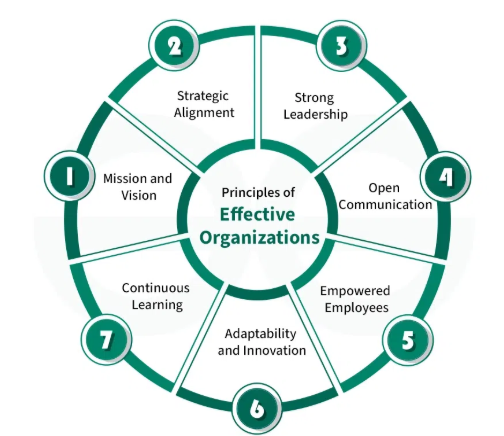
Structure provides a framework for collaboration by defining the connections between departments and teams. When the structure is clear and appropriate for the organisation’s tasks, collaboration is supported because people have a shared understanding of roles and reporting lines. When the structure is poorly designed or misaligned with organisational goals, collaboration becomes harder. Departments may not know how to work with each other, delays may occur and the organisation may find it difficult to respond to challenges. Structure also affects efficiency. A structure that reduces duplication, promotes clarity and enables quick decision-making can support efficient operations. In contrast, a structure that creates bottlenecks or confusion may slow work down and reduce overall productivity.
Functional Structure
A functional structure groups people according to their area of specialism, such as marketing, finance or operations.
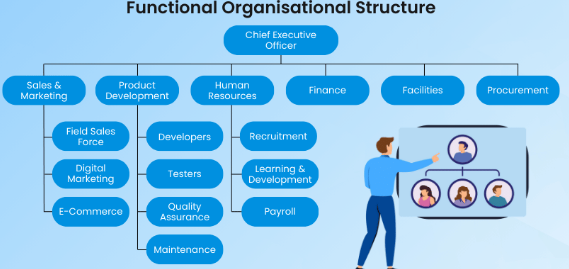
This structure is effective for building deep expertise. Because people with similar skills work together, they can develop consistent procedures and focus on tasks that match their strengths. This can support high levels of efficiency within departments.
However, functional structures can create barriers to collaboration. Departments may become isolated and focus on their own priorities rather than those of the organisation as a whole. When work requires contributions from different departments, communication may be slow and coordination may rely on several layers of management. This can reduce efficiency, particularly when fast responses are needed. The strength of specialisation in functional structures can therefore become a limitation when cross-functional collaboration is essential for success.
Divisional Structure
In contrast, a divisional structure groups employees according to the product line, service area or geographical region they support.
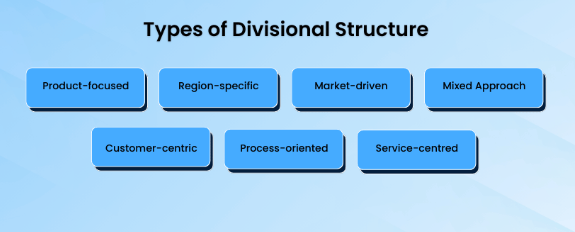
This structure brings together people who share a common commercial focus, making collaboration within divisions more natural. Divisions often experience a strong sense of ownership over their work because they are responsible for the performance of their entire product or region. This can lead to quicker and more flexible decision-making. However, divisional structures may introduce duplication of effort. For example, each division may require its own marketing or finance teams, which can increase costs and reduce overall organisational efficiency. Divisions may also become competitive with each other, sometimes prioritising their own interests over the interests of the organisation. Although collaboration within divisions is often strong, collaboration between divisions can become more challenging, limiting knowledge sharing and creating potential for inconsistency.
Matrix Structure
A matrix structure is an attempt to combine the advantages of both functional and divisional arrangements.
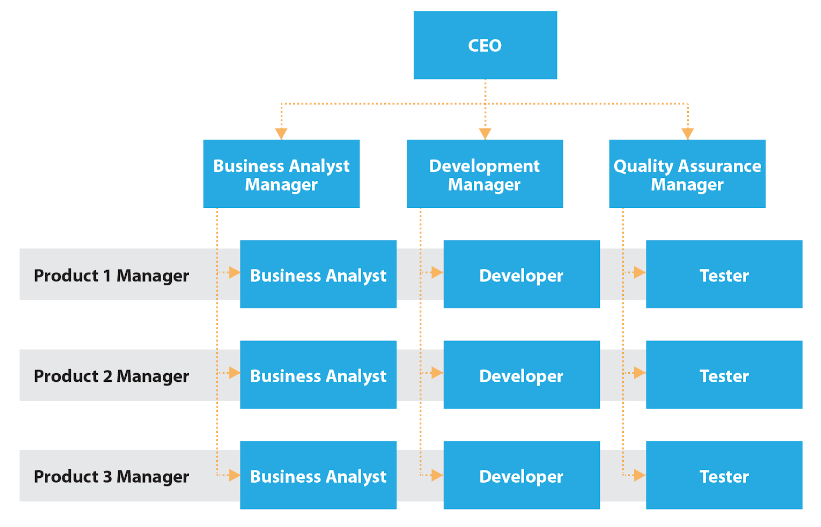
Employees in a matrix belong to a functional department but also work on cross-functional teams focused on projects or products. This can support collaboration because it brings together different expertise and encourages communication across functional boundaries. Matrix structures are often used in organisations with complex or innovative work where flexibility and responsiveness are important. However, a matrix structure requires careful management. Employees may report to more than one manager, which can create uncertainty about priorities or workload. Conflicting instructions can reduce efficiency if not managed effectively. Coordination demands are much higher in a matrix, and without clear communication processes, confusion and duplicated effort may occur. In environments where leadership and communication are strong, a matrix can enhance collaboration and efficiency. In organisations without these capabilities, the structure may become difficult to manage.
Flat Organisational Structure
Some organisations adopt flatter or decentralised structures. These structures reduce layers of management and give teams more autonomy.
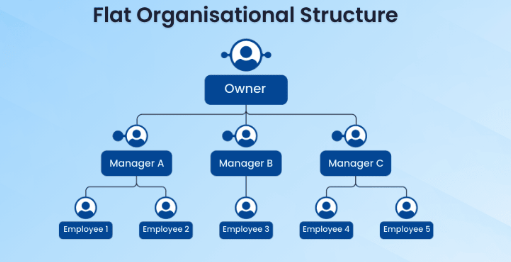
Flatter structures can support collaboration because decisions are made closer to where the work happens, allowing teams to respond quickly and share ideas freely. This can also improve efficiency because communication becomes more direct and less time is spent seeking managerial approval. However, decentralisation places greater responsibility on staff and managers, who must coordinate their work without extensive guidance. If coordination mechanisms are weak, different teams may move in different directions or fail to align their work. This can lead to reduced efficiency and confusion about priorities.
Flexible Structures
Structure also affects how organisations respond to change. More flexible structures, such as matrix or decentralised designs, can help organisations adapt quickly to shifting markets or technological developments.
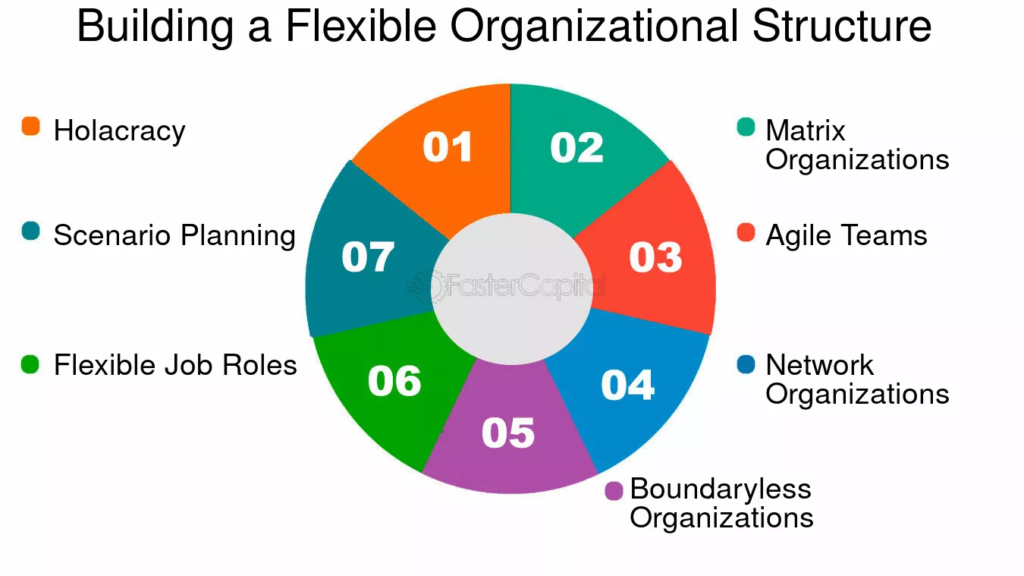
These structures encourage collaboration by forming temporary project teams and allowing resources to move where they are needed most. However, flexibility can also become a limitation if roles and responsibilities become unclear. More rigid structures, such as traditional functional arrangements, provide clarity and control but may not adapt well when rapid change is required. Efficiency in a stable environment does not always translate into efficiency in a dynamic one.
When analysing how structure influences collaboration and efficiency, it is important to consider the organisation’s goals, culture and environment. A structure that enhances collaboration in one organisation may hinder it in another. A structure that supports efficiency in a predictable market may fail in a rapidly changing one. No structure is universally effective. The key is how well the structure aligns with what the organisation is trying to achieve. Understanding these relationships helps explain why organisations choose different structural designs and why they sometimes reorganise as they grow or encounter new challenges.
Case Study
Consider a technology company called NovaTech, which originally used a functional structure. Software engineers worked together in one department, marketing in another, and customer support in a third. Within each function, efficiency was strong because staff were able to specialise deeply in their tasks. However, as the company developed more complex products that required input from multiple departments, communication barriers began to appear. Engineers created features without understanding customer needs, marketing created campaigns without accurate technical information, and customer support struggled to resolve issues quickly because information moved slowly between teams.
To address these problems, NovaTech adopted a matrix structure. Cross-functional teams were created for each major product, bringing together engineers, designers, marketers and support specialists. Collaboration within these teams increased significantly because the people involved in the same product worked together daily. Product development became more efficient because potential issues were identified earlier, and customer needs were communicated directly to the teams building the product. However, tensions sometimes arose because employees now had two reporting lines, and managers had to spend more time coordinating responsibilities. NovaTech found that the matrix improved collaboration and innovation, but required strong communication systems and clear priorities to avoid confusion.
This example illustrates that structure can increase or hinder both collaboration and efficiency, and that organisations must find a structure that balances clarity, control and flexibility.
Interested in our Business Courses?
Click College offers a wide range of fully online accredited business management courses and qualifications to suit different academic backgrounds and career goals. Our programmes range from short 40 credit Professional Diplomasthrough to the 360 credit International Graduate Diploma, which is academically comparable to a bachelor’s degree. All courses are open access and available to learners worldwide.
With courses available in business management, marketing, finance, HR, hospitality & tourism and project management, Click College provides flexible learning pathways to support professional development, career progression or further study.
All Courses
Explore our courses and find a qualification that fits your goals and your schedule.
First Year of Undergraduate (Level 4 – 120 Credits)
The Higher International Certificate courses are accredited and delivered at Level 4 of the UK FHEQ framework, making them academically comparable to the first year of undergraduate study.
Years One and Two of Undergraduate (Level 5 – 240 Credits)
The Higher International Diploma courses are accredited and available with 240 Credits at Level 5 of the UK FHEQ framework, making it academically comparable to a Foundation Degree (UK) or an Associate Degree (US).
Degree-Comparable International Graduate Diploma (Level 6 – 360 Credits)
The International Graduate Diploma is accredited and delivered at Level 6 of the UK FHEQ framework. With 360 credits, it is academically comparable to a UK bachelor’s degree in terms of level and credits.







Recent Posts
Professional Diploma or Higher Qualification Pathway: Which Should You Choose?
Professional Diploma or Higher Qualification Pathway: Which Should You Choose? Choosing the right online qualification is not always simply a question of choosing the longest course or the highest level. For many learners, the better question is: what kind of study route fits my goals right now? Some learners want a focused qualification in one […]
Professional Diploma in Leadership and Management: Course Guide
Professional Diploma in Leadership and Management: Course Guide A Professional Diploma in Leadership and Management is designed for learners who want to develop advanced leadership, strategic thinking and organisational management skills without committing immediately to a full degree programme. Leadership and management are essential in almost every sector. Whether you work in business, education, hospitality, […]
Professional Diploma in Business Management: Who Is It For?
Professional Diploma in Business Management: Who Is It For? A Professional Diploma in Business Management is designed for learners who want to build practical business knowledge without committing immediately to a full degree or long higher education programme. It can be a useful option for people who want to understand how organisations work, how teams […]