Why Sustainability Is Now Central to Business Strategy
How environmental, social and governance responsibilities shape modern organisations
Sustainability has become one of the most important forces shaping modern organisations. Once considered a secondary concern or a marketing initiative, sustainability is now a core strategic issue influencing how businesses operate, make decisions and plan for the future.
Customers, investors, governments and employees increasingly expect organisations to demonstrate responsible behaviour. As a result, businesses are being evaluated not only on financial performance but also on how they manage their environmental impact, social responsibilities and governance practices.
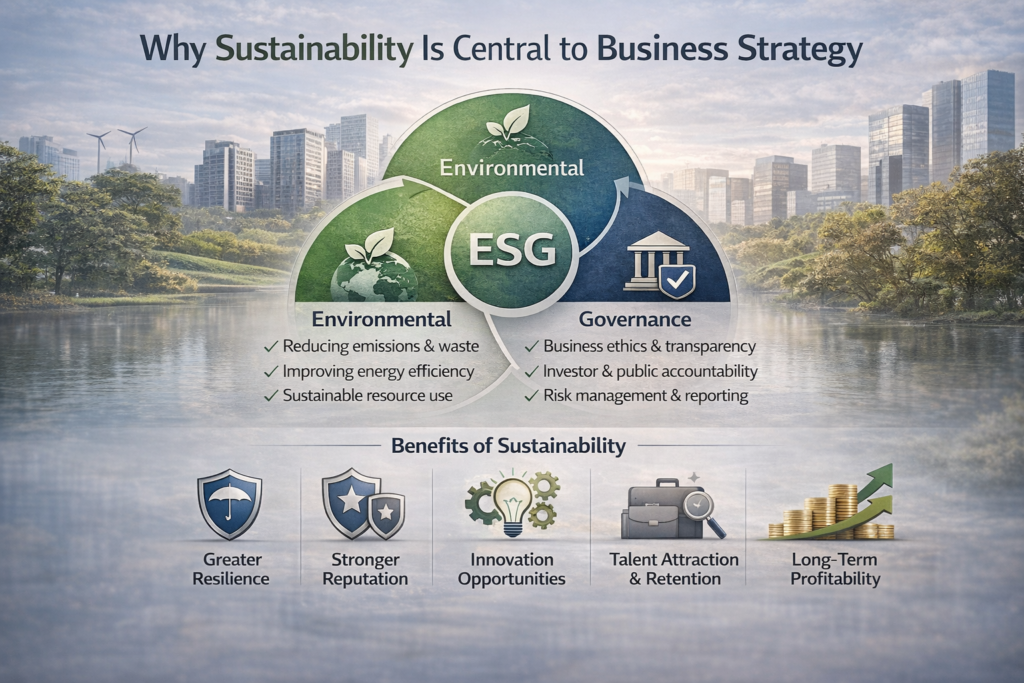
Together, these three areas are often referred to as ESG: Environmental, Social and Governance.
Understanding sustainability is essential for anyone studying business today because it affects everything from supply chains and product design to organisational reputation and long-term competitiveness.
What Sustainability Means in Business
In a business context, sustainability refers to operating in a way that supports long-term economic success while protecting the environment and contributing positively to society.
Although many people associate sustainability primarily with environmental protection, the concept is broader. It involves balancing three interconnected responsibilities:
- Environmental responsibility – managing the organisation’s impact on the natural environment
- Social responsibility – treating people fairly and supporting communities
- Governance responsibility – ensuring organisations are managed ethically and transparently
Together, these elements help organisations operate responsibly while maintaining long-term viability.
Organisations that ignore sustainability risks may face regulatory penalties, reputational damage or rising operational costs. In contrast, those that integrate sustainability into their strategy often become more resilient and adaptable in changing environments.
Environmental Sustainability and Business Operations
Environmental sustainability focuses on reducing the negative impact organisations have on the natural environment.
Businesses rely heavily on natural resources such as energy, water, raw materials and land. As these resources become more scarce or expensive, organisations face increasing operational and financial risks.
Many organisations are responding by introducing environmentally responsible practices such as:
- improving energy efficiency in buildings and manufacturing processes
- investing in renewable energy sources such as solar or wind power
- reducing waste through recycling and circular economy initiatives
- redesigning products to use fewer materials or to be recyclable
- improving logistics to reduce fuel consumption and emissions
These actions often reduce long-term costs while also improving environmental performance.
Environmental sustainability also influences brand reputation. Consumers are increasingly choosing organisations that demonstrate environmental responsibility, while businesses associated with pollution or wasteful practices can face significant criticism.
Social Sustainability and Responsibility to People
Social sustainability focuses on how organisations treat people and contribute to society.
This includes responsibilities toward:
- employees
- customers
- suppliers
- local communities
A socially sustainable organisation aims to create safe working environments, fair pay structures, inclusive workplaces and ethical supply chains.
For employees, social sustainability means organisations invest in wellbeing, training and development opportunities. Companies that support their workforce tend to experience higher morale, stronger retention and greater productivity.
Customers also expect socially responsible behaviour. Providing safe products, honest information and fair pricing helps build long-term relationships.
Supply chains have become an especially important area. Many organisations operate globally, and poor working conditions among suppliers can quickly damage brand reputation. Responsible organisations therefore monitor their supply chains and work to ensure fair labour practices.
Social sustainability also involves community engagement. Many organisations support local communities through employment opportunities, charitable initiatives or partnership projects that contribute to economic and social development.
Governance: The Foundation of Responsible Organisations
Governance refers to the systems and structures that ensure organisations are managed responsibly.
Strong governance provides the framework that allows environmental and social goals to be implemented effectively. Without clear governance systems, sustainability commitments may remain superficial.
Key elements of governance include:
- transparent decision-making processes
- accurate financial reporting
- ethical leadership and anti-corruption measures
- effective risk management
- accountability to stakeholders
Many organisations now publish sustainability or ESG reports to demonstrate their progress and provide transparency to investors and the public.
Good governance ensures that sustainability is embedded in strategy rather than treated as a public relations exercise.
Why Sustainability Matters for Long-Term Success
Sustainability is increasingly recognised as a driver of long-term organisational success.
Organisations that integrate sustainability into their strategy benefit in several ways.
Greater resilience
Sustainable organisations are better prepared for regulatory changes, resource shortages and environmental risks.
Stronger reputation
Customers, investors and employees are more likely to support organisations that demonstrate responsible behaviour.
Innovation opportunities
Sustainability challenges often encourage organisations to develop new products, technologies and business models.
Employee attraction and retention
Many employees prefer to work for organisations with clear social purpose and responsible practices.
Long-term profitability
Although sustainability initiatives may require investment, they often reduce operational costs and risk over time.
Sustainability as a Strategic Priority
In the past, sustainability was often viewed as an optional activity or corporate social responsibility initiative. Today, it has become a central element of organisational strategy.
Businesses must respond to climate change, evolving regulations, stakeholder expectations and resource constraints. Sustainability provides a framework for managing these challenges while creating opportunities for innovation and growth.
Organisations that integrate sustainability effectively are more likely to build trust with stakeholders, strengthen their reputation and remain competitive in rapidly changing markets.
For students studying business and management, understanding sustainability is therefore essential. It shapes how organisations operate today and how they will succeed in the future.
.
Want to understand how modern organisations manage sustainability, ethics and strategy?
Explore Click College’s online business courses designed to help you develop the knowledge and skills needed for today’s evolving business environment
Click College offers a wide range of fully online accredited business management courses and qualifications to suit different academic backgrounds and career goals. Our programmes range from short 40 credit Professional Diplomas through to the 360 credit International Graduate Diploma, which is academically comparable to a bachelor’s degree. All courses are open access and available to learners worldwide.
With courses available in business management, marketing, finance, HR, hospitality & tourism and project management, Click College provides flexible learning pathways to support professional development, career progression or further study.
All Courses
Explore our courses and find a qualification that fits your goals and your schedule.
First Year of Undergraduate (Level 4 – 120 Credits)
The Higher International Certificate courses are accredited and delivered at Level 4 of the UK FHEQ framework, making them academically comparable to the first year of undergraduate study.
Years One and Two of Undergraduate (Level 5 – 240 Credits)
The Higher International Diploma courses are accredited and available with 240 Credits at Level 5 of the UK FHEQ framework, making it academically comparable to a Foundation Degree (UK) or an Associate Degree (US).
Degree-Comparable International Graduate Diploma (Level 6 – 360 Credits)
The International Graduate Diploma is accredited and delivered at Level 6 of the UK FHEQ framework. With 360 credits, it is academically comparable to a UK bachelor’s degree in terms of level and credits.






Recent Posts
Professional Diploma or Higher Qualification Pathway: Which Should You Choose?
Professional Diploma or Higher Qualification Pathway: Which Should You Choose? Choosing the right online qualification is not always simply a question of choosing the longest course or the highest level. For many learners, the better question is: what kind of study route fits my goals right now? Some learners want a focused qualification in one […]
Professional Diploma in Leadership and Management: Course Guide
Professional Diploma in Leadership and Management: Course Guide A Professional Diploma in Leadership and Management is designed for learners who want to develop advanced leadership, strategic thinking and organisational management skills without committing immediately to a full degree programme. Leadership and management are essential in almost every sector. Whether you work in business, education, hospitality, […]
Professional Diploma in Business Management: Who Is It For?
Professional Diploma in Business Management: Who Is It For? A Professional Diploma in Business Management is designed for learners who want to build practical business knowledge without committing immediately to a full degree or long higher education programme. It can be a useful option for people who want to understand how organisations work, how teams […]