Travel in Hospitality: The Sector That Connects the Customer Journey
Abstract
The travel sector is one of the main sectors within the hospitality and service industries because it enables the movement of people between locations in a way that supports tourism, accommodation, leisure, and wider customer experience. Although travel is often understood primarily as transport, its role in hospitality is much broader. The journey itself forms an important part of the customer experience and can influence satisfaction before the destination is even reached. This article examines the travel sector as a core component of hospitality, outlining its main functions, the types of businesses it includes, and its relationship with other sectors such as accommodation and tourism. It also considers the importance of reliability, safety, communication, customer service, and technology in shaping travel experiences. The discussion shows that travel is not simply a background support service, but a key part of how hospitality operates in practice. By connecting people to destinations, attractions, hotels, and other services, the travel sector plays a central role in both customer satisfaction and the wider success of the hospitality industry.
1. Introduction
The travel sector is one of the main sectors within the hospitality and service industries because it focuses on moving people from one place to another safely, efficiently, and comfortably. While travel is sometimes viewed only as transport, within hospitality it has a much wider significance. It often shapes the beginning and end of a customer’s overall experience, meaning it plays a direct role in how a journey is perceived and remembered. Whether a person is going on holiday, attending a business meeting, visiting family, or travelling for education, the quality of the travel experience can influence their satisfaction long before they reach their final destination.
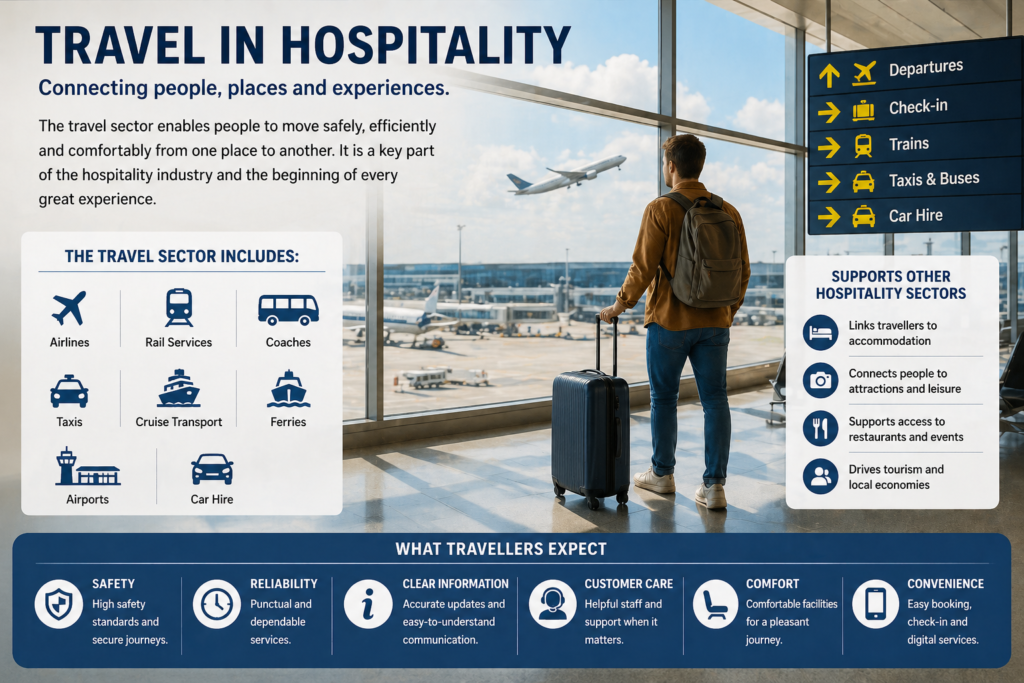
The sector includes a wide range of services and businesses, such as airlines, rail services, coaches, taxis, cruise transport, ferries, airports, and car hire companies. These services differ in scale, purpose, and market, but they all share a central function: enabling movement. In hospitality, that movement is essential because access to destinations, accommodation, restaurants, attractions, and leisure facilities depends heavily on reliable transport. Without the travel sector, many parts of hospitality and tourism would struggle to operate effectively.
Understanding the travel sector is therefore important because it reveals how deeply connected transport is to hospitality. It shows that travel is not separate from customer experience, but a core part of it. The journey itself can create comfort, stress, confidence, frustration, efficiency, or delay, all of which shape how the wider hospitality experience is judged.
2. What the Travel Sector Includes
The travel sector covers the businesses and services that support the movement of people between locations. This includes long-distance international transport, domestic travel, and local movement within destinations. Airlines connect countries and cities across the world. Rail services provide national and regional links. Coaches and buses support both scheduled transport and tourism-related movement. Taxis and private hire vehicles often provide flexible short-distance transport. Ferries and cruise transport support sea travel, while airports and stations act as major service environments in their own right. Car hire businesses offer customers independence and flexibility, especially in destinations where public transport may be limited.
Although each of these services operates differently, they are linked by their role in enabling customer access. Hospitality experiences usually depend on the ability of the customer to arrive where they need to be, at the right time, and in reasonable comfort. A hotel stay, restaurant booking, conference visit, or leisure trip often cannot take place without some form of travel service. In this sense, the travel sector is not merely supportive of hospitality; it is fundamental to it.
The diversity of the sector also reflects the diversity of customer needs. Some travellers want speed and convenience, others prioritise affordability, flexibility, comfort, or accessibility. The sector must therefore cater for a wide range of travel purposes and expectations while maintaining reliability and operational control.
3. Why Travel Is Central to Hospitality
Travel is central to hospitality because it provides access. A destination may have excellent hotels, attractive tourism sites, high-quality restaurants, and memorable leisure experiences, but without reliable ways for customers to reach them, those services become much less effective. The travel sector allows hospitality to function in practical terms by connecting people to places.
This is particularly visible in tourism. International tourists often rely on airlines to reach a country or city, then use trains, taxis, coaches, or car hire services to continue their journey locally. Business travellers may depend on efficient air and rail services to attend meetings or conferences. Families on holiday may need flexible travel arrangements that allow them to move comfortably with luggage and children. In each case, travel is not a separate stage that can be ignored once the destination is reached. It is part of the total experience and often one of the first aspects of the trip that the customer encounters.
Because of this, good travel services can improve the overall perception of hospitality. A smooth, well-organised journey helps customers arrive relaxed, confident, and ready to enjoy the next stage of their trip. By contrast, delays, poor communication, lost luggage, or uncomfortable travel conditions can create frustration before the main hospitality experience has properly begun. Travel therefore has a direct impact on customer mood, expectations, and satisfaction.
4. Travel as Part of the Customer Experience
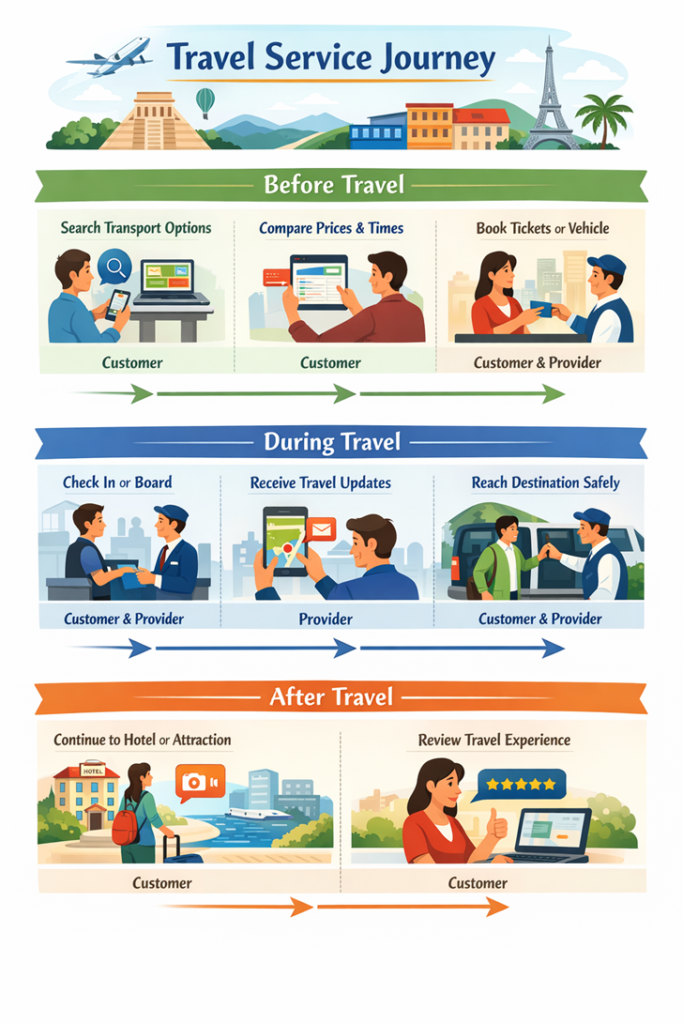
One of the most important ideas in hospitality is that customer experience is shaped by the full journey, not just the final destination. The travel sector illustrates this clearly. A customer often begins forming opinions about a trip as soon as they search for tickets, make a booking, receive confirmation messages, and prepare for departure. Their view of the experience continues through check-in, boarding, luggage handling, seating comfort, information updates, staff interaction, and arrival procedures.
This means that the travel sector contributes far more than physical movement. It also contributes to emotional and psychological aspects of the journey, including reassurance, convenience, stress reduction, and trust. A customer who receives accurate updates, clear instructions, and helpful service is more likely to feel in control and well supported. A customer who faces confusion, poor communication, or unhelpful staff may feel anxious or dissatisfied, even if the journey is completed successfully in technical terms.
In hospitality, these feelings matter because they influence how customers experience everything that follows. A traveller who arrives tired and frustrated may view the hotel, restaurant, or destination less positively at first. A traveller who arrives smoothly and comfortably may be more receptive to enjoying the wider experience. The travel sector therefore plays a significant role in shaping the overall tone of a customer’s journey.
5. Customer Expectations in the Travel Sector
The travel sector is highly customer-focused because customers place strong expectations on transport services. Among the most important of these expectations are reliability, punctuality, safety, comfort, and clear communication. Travellers generally expect services to run according to schedule, information to be accurate, boarding or check-in processes to be organised, and support to be available when problems occur.
These expectations are especially important because travel often involves time pressure and uncertainty. Missing a flight, experiencing a delayed train, or receiving unclear instructions can disrupt not only the journey itself but also hotel bookings, meeting schedules, event attendance, and wider plans. As a result, customers often judge travel services not just by whether they arrive eventually, but by how smoothly and confidently the journey is managed.
Customer expectations also differ depending on travel purpose. Business travellers may prioritise speed, punctuality, digital convenience, and efficient scheduling. Families may need flexibility, accessible support, and practical help with luggage or seating arrangements. Tourists may focus on affordability, ease of navigation, and guidance in unfamiliar environments. This means travel businesses must deliver standard operational reliability while also responding to varied customer needs and preferences.
6. Service Quality in Travel
Service quality in the travel sector depends on both operational performance and human interaction. Operationally, travel businesses must manage timetables, routes, safety procedures, baggage systems, boarding processes, maintenance, and customer flow. From a customer perspective, however, quality is also shaped by how well these systems are communicated and supported by staff.
For example, a passenger using an airline or rail service expects the practical side of the journey to function properly, but also expects staff to be helpful, professional, and responsive. Clear signage, accessible booking systems, accurate digital updates, organised boarding, and prompt assistance all contribute to the perceived quality of the service. When problems arise, service quality becomes even more visible. A delay handled with clear information, calm communication, and effective support may still leave the customer feeling respected and informed. The same delay, if poorly explained or badly managed, can lead to anger, confusion, and negative reviews.
This shows that travel is both operationally complex and service-driven. The technical side of transport must work effectively, but the customer experience depends heavily on how that technical operation is presented and managed from the traveller’s point of view.
7. The Relationship Between Travel and Other Hospitality Sectors
The travel sector does not operate alone. It is closely connected to accommodation, tourism, food and beverage, and leisure services. In many cases, these sectors depend on one another to create a complete customer experience. Hotels need guests to be able to reach them. Attractions rely on visitor access. Restaurants benefit from local and visiting customers being able to move around conveniently. Tour operators build packages that combine transport, accommodation, and activities into one coordinated experience.
Travel therefore acts as a connecting sector within hospitality. It links customers to the places and services they have chosen, and it often determines how easily those services can be enjoyed. A well-connected destination is usually more attractive to tourists and business visitors because it is easier to access and navigate. Conversely, poor transport links or unreliable services may reduce the appeal of a destination, no matter how good its hotels or attractions may be.
This connecting role is one of the reasons the travel sector is so significant. It does not simply deliver customers to hospitality services; it helps make those services commercially and practically viable.
8. Flexibility, Technology, and Modern Travel Services
Modern travel services are increasingly shaped by technology and the expectation of convenience. Customers now often expect online booking systems, digital boarding passes, mobile updates, real-time notifications, and easy access to customer support. These tools are important because they help reduce uncertainty and improve the efficiency of the journey.
Travel companies invest heavily in such systems because information is a major part of the customer experience. A customer who knows exactly when to arrive, where to check in, what to expect, and how delays are being managed is more likely to remain satisfied. In this way, digital systems are not just operational tools; they are part of hospitality service quality.
At the same time, flexibility remains important. Travel services must respond to different customer needs, changing travel flows, and disruptions that may affect routes and schedules. This makes the sector both dynamic and demanding. Businesses must combine structured planning with the ability to respond quickly and effectively when circumstances change.
9. The Economic Importance of the Travel Sector
The travel sector makes a major contribution to employment and economic activity. It creates jobs for pilots, cabin crew, drivers, station staff, airport teams, customer service assistants, transport planners, engineers, travel consultants, baggage handlers, and many others. These roles are essential not only to transport itself but to the wider hospitality and tourism economy.
The sector also supports destinations by making them accessible to visitors. When transport links are strong, destinations are better able to attract tourists, business travellers, conference visitors, and students. This generates income not only for transport businesses, but also for hotels, restaurants, attractions, retail outlets, and local service providers. In this sense, the travel sector helps stimulate wider economic activity beyond its own direct services.
It is also important because changing travel patterns can reshape the hospitality industry more broadly. Domestic travel growth, changes in international traveller flows, and increasing expectations for tailored travel experiences all affect how destinations and hospitality businesses operate. Understanding travel therefore helps learners understand larger patterns of change across hospitality and tourism.
10. Case Study: Airline and Airport Service Supporting Tourism
The importance of the travel sector can be seen clearly in the example of a family booking an international holiday. Their experience begins well before they reach the hotel. They use an online booking system, receive travel updates by email, check in at the airport, drop off luggage, board the aircraft, and rely on airline and airport staff for guidance and assistance throughout the process. Because the journey is smooth and well organised, the family arrives relaxed and ready to enjoy the rest of their holiday.
This example is important because it shows that travel is not simply a practical necessity. It is a hospitality experience in its own right. The airline and airport services shape the family’s impression of the entire trip, influencing how comfortable, confident, and satisfied they feel before the holiday has fully begun. The case also highlights the importance of reliability, communication, and customer care. The journey works well not only because the transport takes place, but because the supporting systems and service interactions are handled effectively.
This demonstrates why the travel sector is such a key part of hospitality. When it performs well, it strengthens tourism, supports accommodation and destination services, and contributes positively to customer satisfaction across the whole travel experience.
11. Why Understanding Travel Matters
Understanding the travel sector is important because it helps explain how hospitality depends on movement, access, and connection. It shows that customer satisfaction is influenced not only by destinations and services at the destination, but also by how people get there. It also highlights the complexity of a sector that must balance safety, punctuality, customer care, technology, and operational efficiency.
More broadly, the travel sector illustrates the way hospitality is built through linked services rather than isolated experiences. Hotels, tourism providers, restaurants, attractions, and event businesses all depend to some degree on reliable transport. To understand travel is therefore to understand one of the main systems that allows the wider hospitality industry to function.
12. Concluding Comments
The travel sector is one of the main sectors within the hospitality and service industries because it focuses on moving people safely, efficiently, and comfortably between places. It includes airlines, rail services, taxis, coaches, ferries, cruise transport, airports, and car hire companies, all of which help connect customers to destinations, accommodation, attractions, and other hospitality services.
Its importance lies not only in transport itself, but in its contribution to the customer experience. Travel often forms the beginning and end of a journey, meaning it can strongly influence satisfaction, mood, and the overall impression of a trip. Good travel services support tourism and hospitality by improving access, communication, and convenience, while poor travel experiences can damage customer perceptions before other services have even begun.
The sector also plays a major economic role by creating employment, supporting destination growth, and helping the wider hospitality industry operate successfully. For all of these reasons, the travel sector is not simply a supporting service within hospitality. It is one of the essential foundations on which the wider customer experience depends.
View Courses in Hospitality and Tourism…
Start your journey in hospitality and tourism with an accredited Click College course. Enrol today and build the skills, knowledge, and confidence to progress into a management role.







Recent Posts
Professional Diploma or Higher Qualification Pathway: Which Should You Choose?
Professional Diploma or Higher Qualification Pathway: Which Should You Choose? Choosing the right online qualification is not always simply a question of choosing the longest course or the highest level. For many learners, the better question is: what kind of study route fits my goals right now? Some learners want a focused qualification in one […]
Professional Diploma in Leadership and Management: Course Guide
Professional Diploma in Leadership and Management: Course Guide A Professional Diploma in Leadership and Management is designed for learners who want to develop advanced leadership, strategic thinking and organisational management skills without committing immediately to a full degree programme. Leadership and management are essential in almost every sector. Whether you work in business, education, hospitality, […]
Professional Diploma in Business Management: Who Is It For?
Professional Diploma in Business Management: Who Is It For? A Professional Diploma in Business Management is designed for learners who want to build practical business knowledge without committing immediately to a full degree or long higher education programme. It can be a useful option for people who want to understand how organisations work, how teams […]