The Leisure Sector in Hospitality and Service Industries: Experience, Value and Customer Engagement
Abstract
The leisure sector is a major component of the hospitality and service industries because it focuses on activities that people choose to undertake in their free time for enjoyment, relaxation, wellbeing, entertainment, and personal interest. Unlike sectors such as accommodation or travel, which often meet practical and functional needs, leisure is more strongly shaped by choice, preference, and experience. This article examines the leisure sector as a significant part of the wider hospitality environment, exploring its main functions, its contribution to customer satisfaction, and its relationship with tourism, accommodation, and food and beverage services. It argues that leisure is not simply an additional or optional element within hospitality, but a sector that plays a central role in destination appeal, customer spending, and overall experience quality. The discussion also considers the importance of service quality, safety, convenience, and adaptability in leisure businesses, as well as the sector’s wider contribution to employment and the economy. The article concludes that leisure should be understood as a core hospitality sector because it enhances customer experience, supports business competitiveness, and contributes to the broader attractiveness of places and hospitality services.
1. Introduction
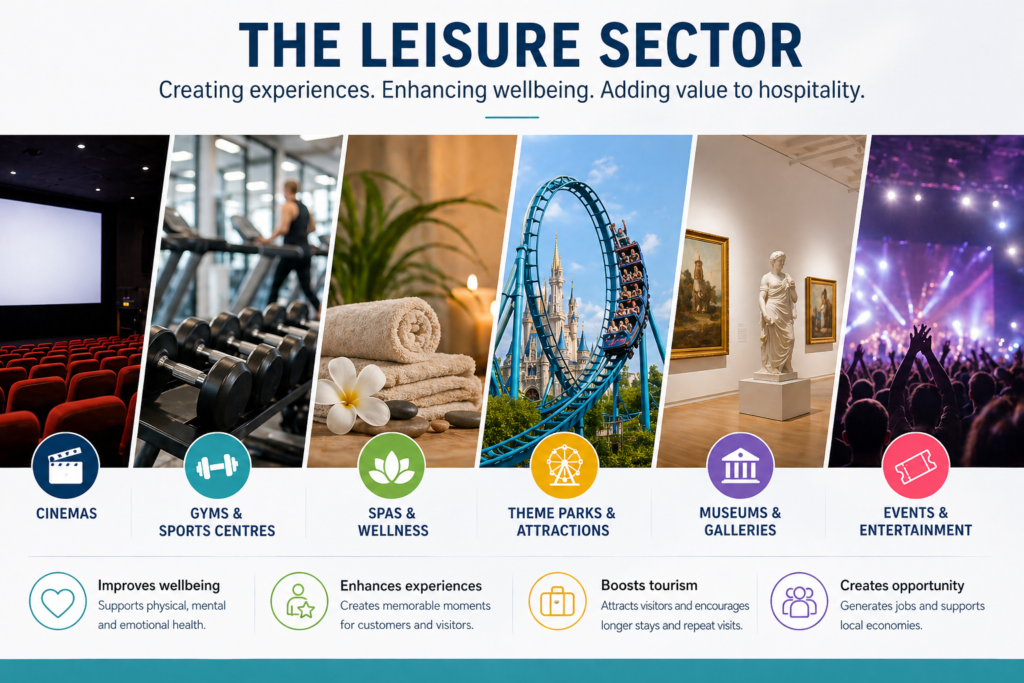
The leisure sector is one of the principal sectors within the hospitality and service industries and is concerned with the provision of activities and environments that people use in their free time. These activities are usually chosen voluntarily and are linked to enjoyment, relaxation, health, entertainment, and personal fulfilment. The sector includes a wide range of businesses and facilities, such as cinemas, sports centres, gyms, spas, theme parks, museums, galleries, entertainment venues, event spaces, and other recreational services. Although these businesses differ in purpose and format, they share a common focus on creating experiences that customers actively choose because they find them enjoyable, worthwhile, or beneficial.
This makes the leisure sector distinct from other sectors that are often tied more directly to practical necessity. Customers may require transport in order to reach a destination or accommodation in order to stay overnight, but leisure activities are usually associated more closely with discretionary time and personal preference. People engage with leisure because they want to do so, not simply because they must. This gives the sector a particularly strong relationship with experience, emotion, and perceived value.
Within hospitality, leisure is important because customer satisfaction is often influenced not only by where people stay or how they travel, but also by what they are able to do and enjoy during their time away from home or during their free time locally. Understanding the leisure sector is therefore essential to understanding hospitality more broadly, as it shows how recreation, entertainment, and wellbeing contribute to the overall service experience.
2. Defining the Leisure Sector
The leisure sector can be defined as the part of the hospitality and service industries that provides recreational, cultural, entertainment, and wellbeing-related activities for customers. Its focus is on the use of free time. Customers do not usually engage with leisure services in order to meet immediate physical necessity, but rather to improve quality of life, seek enjoyment, reduce stress, pursue personal interests, or spend time with others in meaningful ways.
This broad definition explains why the leisure sector includes such a wide range of services. A cinema provides entertainment through film and shared audience experience. A gym or sports centre supports health, exercise, and personal wellbeing. A spa offers relaxation and wellness treatments. A museum or gallery provides cultural enrichment and education. A theme park combines excitement, attractions, and family-oriented recreation. Event venues and entertainment complexes create opportunities for social participation and memorable experiences. Although these activities differ, they all reflect the same central principle: they are chosen by customers as a way of using time in pleasurable, engaging, or personally valuable ways.
Because leisure is closely linked to experience, its value cannot be understood only in functional terms. Customers are not simply paying for access to a building or activity; they are paying for the quality of the experience they expect to have while using it. This makes the sector strongly aligned with the wider principles of hospitality, where customer perception and service quality are central.
3. The Leisure Sector as an Experience-Based Industry
A defining feature of the leisure sector is that it is highly experience-based. Customers judge leisure businesses not only by what is offered, but by how the experience feels while it is taking place. This means that the atmosphere, service delivery, cleanliness, safety, convenience, and emotional impact of the experience all matter significantly.
For example, a customer visiting a cinema may expect comfortable seating, good sound and visual quality, efficient ticketing, and a pleasant environment. A visitor using a spa is likely to expect calm surroundings, cleanliness, professionalism, and a sense of relaxation. A family visiting a theme park expects excitement and enjoyment, but also safe operations, clear information, efficient queue management, and helpful staff. In each case, the customer’s judgement is based on the totality of the experience rather than on one isolated feature.
This experience-based nature means that leisure businesses must pay close attention to the emotional and practical dimensions of service. A facility may offer attractive activities, but if the environment feels disorganised, unsafe, or poorly managed, the overall experience can be damaged. Conversely, a leisure business that provides strong service quality and creates a positive atmosphere may achieve high levels of customer satisfaction even if its offering is relatively simple. This is one of the reasons the leisure sector fits so strongly within hospitality: it depends heavily on the ability to design and deliver customer experiences rather than merely providing access to facilities.
4. The Relationship Between Leisure and Hospitality
The leisure sector adds significant value to the hospitality and service industries because it extends the customer experience beyond basic service provision. Hospitality is not only about giving customers somewhere to stay, somewhere to eat, or a way to travel. It is also about creating enjoyable and memorable experiences. Leisure is central to this broader purpose.
Many hospitality businesses rely on leisure in order to strengthen their overall offer. A hotel with a spa, swimming pool, gym, or entertainment programme can often attract more customers than one offering accommodation alone. Restaurants located near theatres, cinemas, or event venues may benefit from increased visitor flow. Tourist destinations often become more attractive because of their leisure opportunities, such as beaches, sports events, theme parks, museums, galleries, or wellness facilities. In this way, leisure works in close partnership with tourism, accommodation, and food and beverage services.
This interconnectedness demonstrates that leisure should not be viewed as an isolated sector. It often enhances and supports other hospitality activities by increasing customer spending, extending length of stay, and making destinations or businesses more competitive. A customer may book a particular hotel because of its leisure facilities, choose a destination because of its cultural attractions, or spend more during a trip because of the range of recreational options available. Leisure therefore helps transform hospitality from a functional service into a richer and more attractive experience.
5. Leisure, Destination Appeal and Customer Choice
The leisure sector is particularly important in shaping destination appeal. Many customers choose where to visit not only on the basis of accommodation or transport convenience, but also according to the leisure opportunities available in that location. A seaside destination may attract visitors because of beaches and recreational activities. A city may appeal because of museums, cinemas, galleries, shopping, entertainment venues, or sports events. A resort may attract guests because of wellness facilities, pools, and family recreation.
This means that leisure is often a deciding factor in customer choice. Where customers believe that a destination offers enjoyable, varied, or distinctive leisure experiences, they may be more willing to travel there, spend money there, and return in the future. Leisure can therefore enhance both competitiveness and differentiation. In an increasingly crowded market, destinations and businesses often need more than basic hospitality infrastructure; they need compelling experiences that give customers a reason to choose them.
The effect of leisure on destination appeal also has important economic implications. When customers stay longer or spend more because of the availability of leisure options, local businesses benefit. Hotels, restaurants, shops, transport providers, and attractions may all gain from the increased demand created by appealing leisure services. The sector therefore contributes not only to customer enjoyment, but also to wider destination development and economic vitality.
6. Customer Expectations in the Leisure Sector
Because the leisure sector is based so heavily on experience and choice, customer expectations are particularly important. Customers usually enter leisure environments with a clear idea of what they want from the experience, whether that is relaxation, entertainment, health improvement, social interaction, or cultural enrichment. Their level of satisfaction depends on how well the business delivers against those expectations.
Customers in this sector commonly expect quality, safety, convenience, comfort, and professionalism. A health club user expects clean and well-maintained equipment, a safe environment, and knowledgeable staff. A museum visitor may expect accessible information, attractive displays, and a pleasant visitor environment. A family using a recreational attraction expects safe operations, clear guidance, and service that supports enjoyment rather than frustration. Because leisure often involves time that customers highly value, disappointment can be especially significant when expectations are not met.
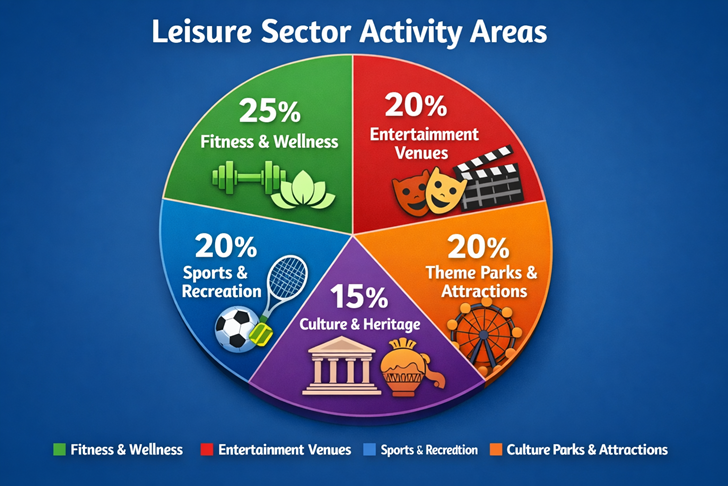
The sector must also respond to changing consumer interests. Patterns of leisure spending may shift over time depending on lifestyle changes, economic pressures, and social trends. Some categories, such as gym use and experience-led activities, may show strong interest, while customers may remain more selective in others. This makes the leisure sector particularly sensitive to customer preference and market change. Businesses must therefore remain relevant, attractive, and responsive in order to sustain demand.
7. Service Quality, Safety and Convenience in Leisure
As with other hospitality sectors, service quality is a major determinant of success in leisure. Customers may be drawn initially by the activity itself, but their longer-term satisfaction often depends on how effectively that activity is managed and delivered. This includes the quality of facilities, the cleanliness of the environment, the professionalism of staff, the ease of access, and the overall sense of care shown toward the customer.
Safety is especially important in the leisure sector because many activities involve physical participation, specialist equipment, or environments where customers may be vulnerable. Sports centres, swimming pools, theme parks, and spas all require careful operational control in order to protect customers and maintain trust. A leisure experience cannot be considered successful if customers feel unsafe or poorly supervised. Safety, therefore, is not separate from customer enjoyment; it is a condition that supports it.
Convenience is also a key factor. Customers value booking systems that are easy to use, clear information, accessible layouts, efficient entry processes, and helpful staff assistance when needed. Because leisure is often undertaken during limited free time, poor organisation or unnecessary inconvenience can reduce the quality of the overall experience. Businesses in the sector must therefore balance attractive offerings with smooth operational design.
8. Economic and Employment Contribution of the Leisure Sector
The leisure sector contributes significantly to employment and the wider economy. It creates jobs for fitness instructors, spa therapists, event workers, technicians, lifeguards, entertainers, managers, cleaners, supervisors, and customer service teams. In addition, many leisure businesses purchase goods and services from suppliers, contractors, maintenance providers, and local partners, creating wider economic activity beyond their own operations.
The sector also supports tourism and local economies by encouraging customer spending and repeat visits. A positive leisure experience can increase the attractiveness of a destination and make it more likely that visitors will return or recommend it to others. This can generate benefits for accommodation providers, restaurants, retailers, and transport services. In this sense, the economic value of leisure extends beyond direct ticket sales or membership fees; it influences the broader commercial performance of places and hospitality systems.
Because leisure is closely linked to enjoyment and personal choice, businesses in this sector often operate in highly competitive markets. They must continue investing in service quality, relevance, and attractiveness in order to maintain demand. This competitive dynamic itself can stimulate innovation, improvement, and diversification within the wider hospitality industry.
9. Case Study: Hotel Spa and Gym Improving Guest Experience
The importance of the leisure sector can be illustrated through the example of a four-star hotel that includes a gym, swimming pool, and spa as part of its facilities. Some guests choose the hotel specifically because they want opportunities to relax after work meetings or enjoy wellness activities during a short break. The hotel promotes these services alongside its rooms and restaurant, making the overall offer more appealing than accommodation alone. Guests who use the spa and gym often spend more time within the hotel and report higher satisfaction with their stay.
This example is significant because it shows that leisure services are not merely optional extras. They can play an active role in booking decisions, customer satisfaction, and the perceived value of the overall hospitality experience. The spa and gym enhance the hotel’s attractiveness by adding opportunities for relaxation, health, and enjoyment. They also strengthen the hotel’s position in the market by differentiating it from competitors that offer fewer facilities.
The case study further demonstrates how leisure supports the wider hospitality industry. The customer experience is improved not through accommodation alone, but through the combination of accommodation, food and beverage, and leisure services. This reinforces the idea that hospitality sectors operate most effectively when they are integrated and customer-focused.
10. Wrapping up
The leisure sector is a major part of the hospitality and service industries because it provides the experiences, activities, and environments that people choose for enjoyment, relaxation, health, entertainment, and personal interest. Its importance lies in its ability to add value beyond basic service provision, making hospitality more attractive, engaging, and memorable for both local customers and visitors.
As an experience-based sector, leisure depends heavily on service quality, safety, convenience, and the ability to meet changing customer expectations. It works closely with accommodation, tourism, and food and beverage services, often enhancing destination appeal and increasing customer satisfaction. It also contributes significantly to employment, local economies, and the wider competitiveness of hospitality businesses and places.
For these reasons, the leisure sector should be understood not as a secondary addition to hospitality, but as one of its core components. It reflects the broader purpose of hospitality itself: not only to serve customers, but to enrich their time, improve their wellbeing, and create experiences they value and remember.
View Courses in Hospitality and Tourism…
Start your journey in hospitality and tourism with an accredited Click College course. Enrol today and build the skills, knowledge, and confidence to progress into a management role.







Recent Posts
How to Build Trust Before a Customer Buys
How to Build Trust Before a Customer Buys Before a customer buys from an unfamiliar business, they are making more than a price comparison. They are deciding whether the offer is genuine, whether the organisation will deliver what it promises and whether help will be available if something goes wrong. That is why trust is […]
Why Customers Switch: The Trust and Value Signals That Drive Churn
Why Customers Switch: The Trust and Value Signals That Drive Churn Customers rarely switch simply because a competitor is cheaper. They switch when the relationship no longer feels safe, fair or worth the effort. A price rise may trigger the search, but unclear charges, poor support, weak proof and uncertainty about what happens next are […]
How to Find and Fix Friction in the Buying Journey
How to Find and Fix Friction in the Buying Journey Customers rarely decide not to buy for one dramatic reason. More often, small difficulties build up: a confusing product page, unclear pricing, a slow reply, an awkward form, conflicting information or a delivery promise that feels uncertain. Each issue may appear minor in isolation. Together, […]