Tourism Services in Hospitality: The Sector That Connects the Entire Customer Journey
Abstract
The tourism services sector is a central component of the hospitality and service industries because it supports customers before, during, and after their travel experiences. Unlike sectors such as accommodation or travel, which focus on specific parts of the journey, tourism services provide coordination, planning, information, and customer support across the entire experience. This article examines the role of tourism services in connecting the different sectors of hospitality, including accommodation, travel, food and beverage, and leisure. It explores the importance of customer care, communication, organisation, and service quality, as well as the sector’s contribution to economic activity and employment. The discussion highlights how tourism services enhance accessibility, reduce complexity, and improve overall customer satisfaction. The article concludes that tourism services are not simply an additional support function, but a core sector that enables the hospitality experience to operate effectively and cohesively.
1. Introduction
The tourism services sector is one of the main sectors within the hospitality and service industries because it focuses on supporting customers throughout the entire travel experience. While other sectors provide specific elements such as transport, accommodation, or dining, tourism services bring these elements together into a coordinated and manageable experience for the customer.
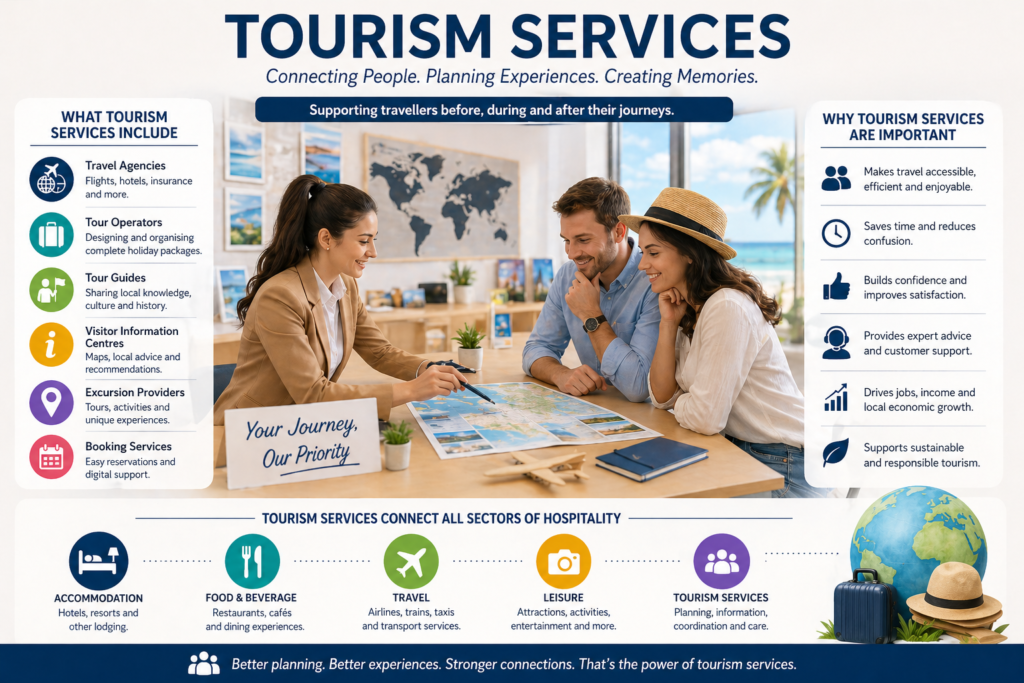
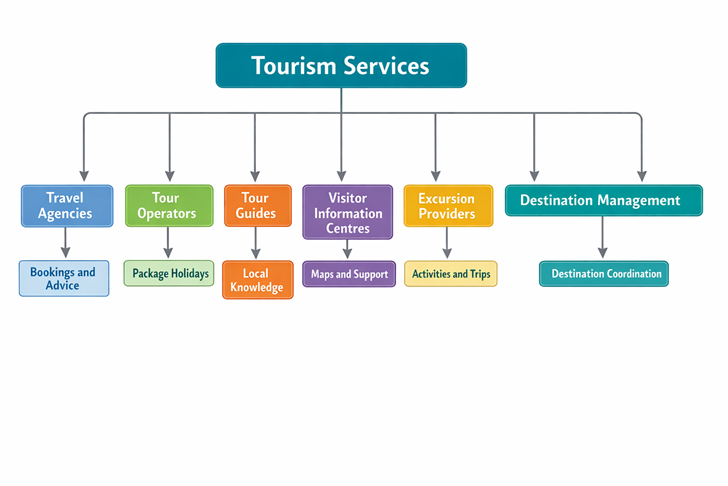
This sector includes travel agencies, tour operators, tour guides, destination management companies, visitor information centres, excursion providers, and booking services. Each of these plays a role in helping customers plan, organise, and enjoy their journeys more effectively. Rather than delivering a single service, tourism services focus on coordination, advice, information, convenience, and experience design.
Tourism can be understood as time spent away from home for recreation, relaxation, and enjoyment, typically involving the use of commercially provided services. This highlights why tourism services are so important. Travellers often rely on multiple services across different sectors, and without coordination, the process can become complex and difficult to manage. Tourism services simplify this process, making travel more accessible, efficient, and enjoyable.
2. What the Tourism Services Sector Includes
The tourism services sector consists of organisations and professionals who support travel planning and customer experience. Travel agencies assist customers in booking flights, accommodation, insurance, and activities, often combining these into convenient packages. Tour operators design and organise complete travel experiences, including transport, lodging, meals, and excursions.
Tour guides provide local knowledge and interpretation, helping visitors understand the cultural, historical, and social context of a destination. Destination management companies coordinate services at a local level, ensuring that logistics, events, and visitor experiences run smoothly. Visitor information centres offer maps, recommendations, and practical advice, while excursion providers organise activities such as guided tours, day trips, and experiences.
These services are not isolated; they form a network that supports the traveller from initial planning through to the completion of the journey. Their shared purpose is to reduce complexity, improve organisation, and enhance the quality of the overall experience.
3. The Role of Tourism Services in the Customer Journey
Tourism services play a crucial role across all stages of the customer journey. Before travel begins, they help customers research destinations, compare options, and make informed decisions. During the planning stage, they assist with booking arrangements, scheduling, and preparation, ensuring that different elements of the trip are coordinated effectively.
During the journey itself, tourism services may provide guidance, support, and information. Tour guides, for example, enhance understanding and enjoyment by explaining local attractions and culture. Visitor centres offer assistance when customers arrive in unfamiliar locations. Excursion providers create structured experiences that allow travellers to make the most of their time.
After the trip, tourism services may continue to play a role through feedback, follow-up communication, or support in resolving any issues that may have occurred. This continuous involvement shows that tourism services are not limited to one stage of travel, but operate across the entire experience.
4. Improving Accessibility, Efficiency and Confidence
One of the most important functions of tourism services is to make travel more accessible and manageable. Travelling often involves multiple decisions, bookings, and logistical arrangements. For many customers, especially those visiting unfamiliar destinations, this complexity can create uncertainty and stress.
Tourism services address this challenge by simplifying the process. A travel agency can combine flights, accommodation, insurance, and excursions into a single package, reducing the need for customers to organise each element separately. Tour operators can design structured itineraries that ensure time is used effectively. Visitor information centres provide local knowledge that helps customers navigate new environments with confidence.
By reducing confusion and saving time, tourism services improve both efficiency and customer confidence. Travellers are more likely to feel prepared, informed, and comfortable when their journey is well organised. This contributes directly to overall satisfaction and the likelihood of repeat travel.
5. Customer Care and Communication in Tourism Services
Customer care and communication are central to the tourism services sector because customers depend heavily on accurate information and professional support. Travel decisions often involve financial commitment, time planning, and personal expectations, meaning that mistakes or misunderstandings can have significant consequences.
For example, an error in booking details, unclear travel instructions, or poor advice can disrupt the entire trip. As a result, tourism service providers must maintain high standards of accuracy, organisation, and reliability. They must communicate clearly, respond promptly to customer enquiries, and provide guidance that is both helpful and trustworthy.
The importance of communication extends throughout the travel experience. Customers need updates, confirmations, and reassurance at different stages of their journey. Effective communication helps build trust and ensures that customers feel supported, particularly when dealing with unfamiliar destinations or unexpected situations.
6. Responding to Changing Customer Expectations
The tourism services sector must continually adapt to changing customer expectations. Modern travellers increasingly expect flexibility, convenience, and personalisation. Many customers prefer digital booking systems, mobile updates, and real-time communication. They also expect services to be tailored to their individual preferences, whether in terms of itinerary design, accommodation choices, or activity selection.
Sustainability has also become an important consideration. Customers are increasingly aware of environmental and social impacts, and many expect tourism providers to offer responsible and sustainable travel options. This adds another layer of complexity to service provision, as businesses must balance customer expectations with operational and environmental considerations.
These changes highlight the dynamic nature of tourism services. Businesses must remain responsive, innovative, and customer-focused in order to remain competitive and relevant in a rapidly evolving market.
7. The Economic and Industry Contribution of Tourism Services
The tourism services sector makes a significant contribution to the wider hospitality and service industries. By connecting customers with accommodation, travel, food and beverage, and leisure services, it helps generate demand across multiple sectors. Well-organised tourism services can increase bookings, encourage longer stays, and enhance visitor satisfaction.
The sector also creates employment opportunities in roles such as travel consultants, tour guides, booking agents, destination managers, tourism officers, and event planners. These roles require a combination of organisational skill, customer service ability, and industry knowledge.
Tourism services also contribute to economic growth by supporting destinations and local businesses. As global tourism continues to recover and grow, the importance of effective tourism services remains high. They play a key role in managing visitor flows, supporting local economies, and ensuring that tourism benefits both customers and communities.
8. Case Study: Travel Agency Creating a Complete Holiday Package
The importance of tourism services can be seen clearly in the example of a travel agency organising a family holiday. The agency arranges flights, hotel accommodation, airport transfers, travel insurance, and a guided city tour, combining all elements into a single package. Instead of managing each component separately, the family relies on the agency to coordinate the entire trip.
In addition to bookings, the agency provides destination advice, local travel tips, and emergency contact information. As a result, the family feels more confident and prepared before departure, and the trip runs smoothly.
This case study demonstrates how tourism services connect different sectors into a single, organised experience. The agency does not directly provide the flight or accommodation, but it plays a crucial role in planning, coordination, and customer support. This highlights the value of tourism services in simplifying travel and improving overall satisfaction.
9. Tourism Services as a Connecting Sector
One of the defining features of tourism services is their role as a connecting sector within hospitality. While accommodation provides lodging, travel provides movement, and leisure provides activities, tourism services bring all of these elements together. They act as a bridge between different sectors, ensuring that the overall experience is coherent and well organised.
This connecting role is essential because customers do not experience hospitality as separate services. They experience it as a complete journey. Tourism services help ensure that this journey is smooth, coordinated, and aligned with customer expectations.
Without effective tourism services, customers may struggle to navigate the complexity of travel arrangements, leading to confusion, inefficiency, and reduced satisfaction. By contrast, well-managed tourism services create a seamless experience that enhances the value of all other hospitality sectors.
10. Concluding Comments
The tourism services sector is a key part of the hospitality and service industries because it supports customers throughout the entire travel experience. By providing planning, coordination, information, and customer support, it makes travel more accessible, efficient, and enjoyable.
Its importance lies in its ability to connect different sectors, including accommodation, travel, food and beverage, and leisure, into a single, organised experience. It also plays a vital role in customer satisfaction, economic activity, and destination development.
As customer expectations continue to evolve, tourism services must remain adaptable, customer-focused, and responsive. For all of these reasons, the sector should be understood not as a secondary support function, but as a central component of hospitality that enables the full customer experience to take place successfully.
View Courses in Hospitality and Tourism…
Start your journey in hospitality and tourism with an accredited Click College course. Enrol today and build the skills, knowledge, and confidence to progress into a management role.







Recent Posts
How to Build Trust Before a Customer Buys
How to Build Trust Before a Customer Buys Before a customer buys from an unfamiliar business, they are making more than a price comparison. They are deciding whether the offer is genuine, whether the organisation will deliver what it promises and whether help will be available if something goes wrong. That is why trust is […]
Why Customers Switch: The Trust and Value Signals That Drive Churn
Why Customers Switch: The Trust and Value Signals That Drive Churn Customers rarely switch simply because a competitor is cheaper. They switch when the relationship no longer feels safe, fair or worth the effort. A price rise may trigger the search, but unclear charges, poor support, weak proof and uncertainty about what happens next are […]
How to Find and Fix Friction in the Buying Journey
How to Find and Fix Friction in the Buying Journey Customers rarely decide not to buy for one dramatic reason. More often, small difficulties build up: a confusing product page, unclear pricing, a slow reply, an awkward form, conflicting information or a delivery promise that feels uncertain. Each issue may appear minor in isolation. Together, […]