The Importance of Hospitality and Service Industries to the Global Economy
Introduction
The hospitality and service industries are among the most important sectors in the global economy. From hotels and restaurants to tourism, transport, and leisure businesses, these industries support millions of people and contribute significantly to economic growth worldwide. As demand for travel and customer experiences continues to increase, many students are now exploring hospitality courses to gain the skills needed for careers in this fast-growing sector.
Hospitality is not only about customer service and guest experiences. It also plays a major role in generating income, supporting businesses, creating investment opportunities, and driving national and international economic development.
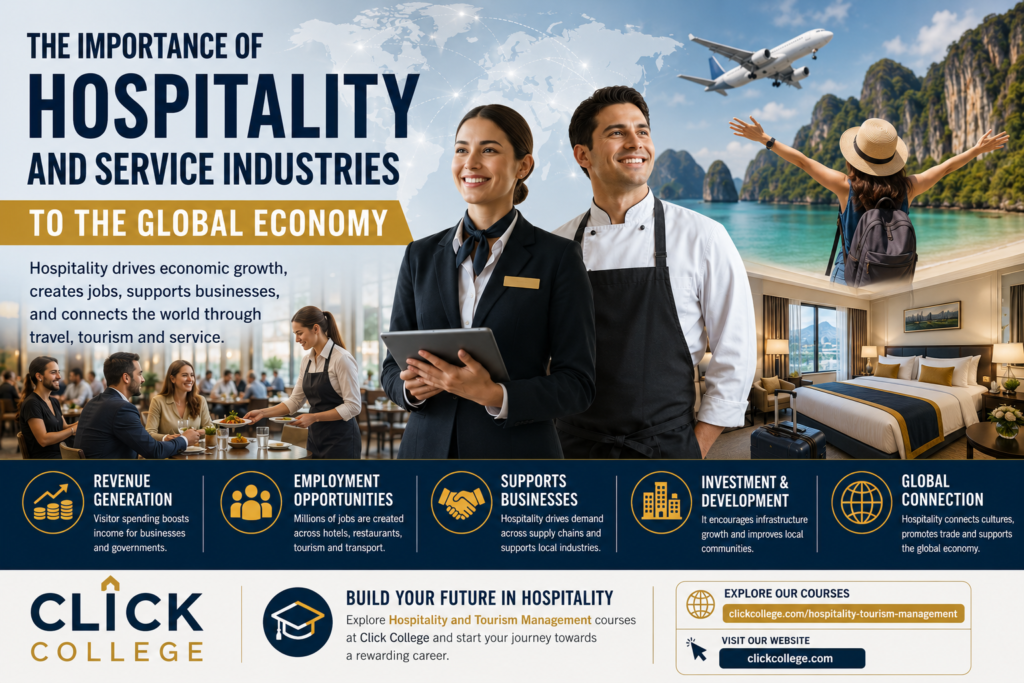
Economic Contribution of the Hospitality Industry
One of the main reasons the hospitality industry is so important is because it generates large amounts of revenue through customer spending. Every day, people spend money on accommodation, food, transport, entertainment, and tourism activities. This spending supports businesses directly and contributes to wider economic activity.
For example, when tourists visit a destination, they may pay for:
- Flights and transport – Airlines, taxis, trains, buses, airport transfers, and car hire services all benefit from visitor spending, helping transport industries generate income and expand services.
- Hotel accommodation – Hotels, resorts, guest houses, and serviced apartments earn revenue from overnight stays, conference bookings, and holiday packages.
- Restaurant meals – Cafés, restaurants, bars, and catering businesses gain significant income from tourists and travellers looking for dining experiences and local cuisine.
- Attractions and entertainment – Museums, theme parks, cultural attractions, theatres, sporting events, and guided tours all depend heavily on visitor spending.
- Shopping and leisure experiences – Retail shops, local markets, spas, and leisure facilities benefit when tourists purchase souvenirs, clothing, gifts, and recreational services.
This shows that hospitality businesses do not operate alone. A single visitor can support many different industries during one trip. The combined effect of this spending contributes to local economies, national income, and global trade.
Because of the economic importance of this sector, many colleges and universities now offer specialised hospitality courses that help learners understand tourism management, customer service, operations, and business development within the industry.
Hospitality Supports Supply Chains
Another major economic benefit of the hospitality and service industries is their connection to supply chains. Hospitality businesses rely on many other industries in order to operate successfully.
Hotels depend on:
- Food and beverage suppliers – Hotels require regular deliveries of fresh produce, drinks, and catering supplies to meet guest expectations and maintain restaurant operations.
- Laundry services – External laundry companies support hotels by cleaning bedding, towels, uniforms, and linens to maintain hygiene and service standards.
- Furniture manufacturers – Hospitality venues rely on furniture companies to provide beds, seating, tables, décor, and interior design products.
- Cleaning and maintenance companies – Specialist contractors help maintain cleanliness, safety, and building repairs to ensure quality guest experiences.
- Technology providers – Hotels and tourism businesses use booking systems, payment platforms, security systems, and digital customer service tools to improve operations.
- Energy and utility services – Hospitality businesses consume large amounts of electricity, water, heating, and internet services to operate efficiently and comfortably for guests.
Restaurants rely on farmers, wholesalers, kitchen equipment suppliers, and delivery services. Tourism businesses depend on transport companies, booking systems, and marketing agencies.
This means that hospitality creates a chain of economic activity that supports thousands of businesses beyond the sector itself. The industry encourages money to flow throughout the economy and creates opportunities for both small and large businesses.
Students studying hospitality courses often learn how supply chains work and how businesses within hospitality depend on effective partnerships and operational management.
Encouraging Regional and Local Development
The hospitality industry also plays a key role in developing towns, cities, and tourist destinations. Areas that attract visitors often experience increased investment in infrastructure and public facilities.
For example, tourism growth may lead to improvements in:
- Roads and transport systems – Governments often invest in better roads, public transport, and travel infrastructure to support increasing visitor numbers.
- Airports and travel hubs – Expanding tourism can encourage airport development, improved international connections, and better passenger facilities.
- Hotels and restaurants – Growing demand for accommodation and dining encourages businesses to open new venues and expand existing services.
- Shopping centres – Retail developments often increase in tourist areas as businesses aim to meet the needs of both visitors and residents.
- Entertainment venues – Cinemas, theatres, music venues, and leisure centres may expand to provide more experiences for tourists and local communities.
- Public spaces and attractions – Parks, beaches, historical sites, and cultural attractions may receive investment to improve visitor experiences and community value.
These developments benefit both tourists and local communities. As a result, hospitality can stimulate long-term economic growth and improve living standards in many regions.
This is one reason why governments and businesses invest heavily in tourism and hospitality projects. It is also why hospitality courses are becoming increasingly popular among students interested in business, tourism, and international career opportunities.
Foreign Exchange and International Trade
Hospitality and tourism also help countries earn foreign exchange income. When international tourists spend money abroad, they bring valuable revenue into that country’s economy.
This can:
- Strengthen local businesses – Increased tourist spending helps businesses grow, expand operations, and improve profitability.
- Increase employment opportunities – More visitors create demand for workers in hotels, restaurants, travel services, entertainment, and retail.
- Improve tax revenues – Governments receive additional income through tourism taxes, VAT, and business taxation linked to hospitality activity.
- Support economic stability – Tourism income can help countries diversify their economies and reduce dependence on a single industry.
- Encourage future investment – Successful tourism destinations often attract investors looking to develop hotels, resorts, attractions, and infrastructure projects.
Countries that attract high numbers of visitors often treat hospitality and tourism as strategic industries because they contribute to international trade and global economic connections.
Hospitality therefore plays an important role not only at a local level but also within the wider global economy.
Tax Revenue and Public Services
Another important contribution made by hospitality businesses is tax generation. Governments receive income from:
- Business taxes – Hospitality companies contribute corporation taxes and operating fees that support public finances.
- Employee taxes – Workers employed in hospitality pay income taxes and national insurance contributions through their employment.
- VAT and sales taxes – Customer spending on hotels, food, transport, and tourism activities generates significant indirect tax revenue.
- Tourism-related charges – Some destinations collect visitor levies, accommodation taxes, or airport charges linked directly to tourism activity.
This tax revenue can then be used to fund important public services such as education, healthcare, transport, and community development.
As hospitality businesses grow, governments often benefit from stronger public income, showing that the industry supports both private enterprise and public sector development.
Case Study: Coastal Resort Supporting the Local Economy
A coastal resort town attracts thousands of visitors during holiday seasons. Tourists stay in hotels, eat in local restaurants, visit attractions, use taxis, and shop in nearby stores.
This creates economic benefits for many businesses across the area, not just hotels. Restaurants increase sales, transport services gain more customers, and local shops benefit from tourist spending.
The resort also experiences improvements in infrastructure, entertainment facilities, and public services because of increased tourism demand.
This example clearly demonstrates how hospitality contributes to economic activity through:
- Revenue generation – Visitor spending creates direct income for hotels, restaurants, transport providers, and local attractions.
- Business growth – Increased demand encourages companies to expand services, hire staff, and invest in new facilities.
- Supply chain support – Local suppliers, food producers, maintenance firms, and retail businesses benefit indirectly from tourism activity.
- Local development – The area may receive investment in roads, public spaces, transport links, and tourism infrastructure.
- Employment opportunities – Hotels, restaurants, and leisure venues create jobs for local residents during both peak and off-peak seasons.
It highlights why hospitality remains one of the world’s most economically important industries.
Hospitality Courses focussed on Career Porgression
As the hospitality sector continues to grow globally, employers increasingly require skilled professionals who understand customer service, tourism management, business operations, and international hospitality trends.
Modern hospitality courses help students develop practical and managerial skills needed for careers in:
- Hotel management – Learning how to manage accommodation operations, guest services, staffing, and hotel performance.
- Tourism operations – Understanding travel planning, destination management, tour coordination, and tourism business strategy.
- Event management – Developing skills in organising conferences, weddings, festivals, exhibitions, and corporate events.
- Restaurant and catering services – Gaining knowledge of food service operations, menu planning, kitchen management, and customer satisfaction.
- Travel and leisure industries – Exploring careers within airlines, cruise companies, holiday providers, and leisure organisations.
- Customer experience management – Learning how to improve guest satisfaction, communication, service quality, and brand reputation.
These courses also help learners understand the wider economic importance of hospitality and how the industry contributes to business growth and global development.
For students looking to build careers in this exciting industry, Click College offers specialised Hospitality and Tourism Management programmes designed to develop industry knowledge and practical business skills. You can explore the courses here:
👉 https://clickcollege.com/hospitality-tourism-management
Students can also learn more about the college and its wider range of career-focused programmes by visiting the official website:
👉 https://clickcollege.com/
With the continued expansion of tourism and global travel, studying hospitality can open doors to international career opportunities across hotels, resorts, airlines, events, and tourism organisations worldwide.
Conclusion
The hospitality and service industries are essential to the global economy because they generate revenue, support supply chains, encourage investment, create tax income, and stimulate local and international development.
From tourism spending to infrastructure growth, hospitality affects many areas of economic life. Its contribution goes far beyond hotels and restaurants, supporting businesses, communities, and governments around the world.
As the industry continues to expand, studying hospitality courses can provide valuable knowledge and career opportunities in one of the world’s most dynamic and economically important sectors.
Explore Hospitality Courses
Start your journey in hospitality and tourism with an accredited Click College course. Enrol today and build the skills, knowledge, and confidence to progress into a management role.







Recent Posts
Which Online Management Course Should I Choose? Business, Marketing, Finance, HR, Hospitality or Project Management
Which Online Management Course Should I Choose? Business, Marketing, Finance, HR, Hospitality or Project Management Choosing an online management course can be difficult because Business Management, Marketing, Finance, Human Resources, Hospitality and Project Management all overlap. Every organisation needs to attract customers, manage money, support its staff and deliver work effectively. The best choice depends […]
How Consumers Evaluate Alternatives: Shortlists, Decision Rules and Choice Overload
How Consumers Evaluate Alternatives: Shortlists, Decision Rules and Choice Overload Why can two customers examine the same products and reach completely different conclusions? One may choose the least expensive option, another may pay more for reassurance, and a third may postpone the decision altogether. Consumers evaluate alternatives by reducing a broad market to a manageable […]
How Social Influences Shape Consumer Buying Behaviour
How Social Influences Shape Consumer Buying Behaviour Why do people ask friends for recommendations, check reviews before buying or choose products that appear popular within their professional or social group? Social influences shape consumer buying behaviour by providing information, establishing expectations and signalling which choices appear credible, accepted or appropriate. The main social influences include […]