What Is a Professional Diploma? Meaning, Level and Career Value Explained
Introduction
If you are comparing flexible online courses, career development options or alternatives to traditional university study, you may have seen the term professional diploma. It sounds impressive, but it is also a term that can mean different things depending on the provider, subject area, qualification level and awarding or accrediting body.
So, what is a professional diploma? In simple terms, a professional diploma is a focused course designed to develop practical, career-relevant knowledge in a particular subject or professional field. Unlike a broad academic degree, a professional diploma usually concentrates on the knowledge, skills and applied understanding needed for work, progression or specialist development.
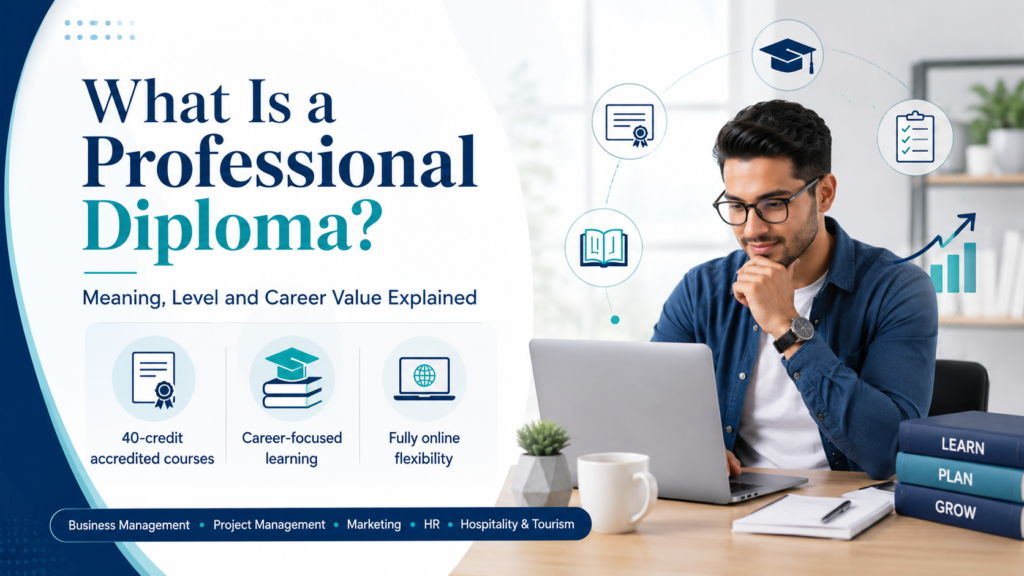
The professional diploma meaning is therefore best understood as a combination of three ideas: professional relevance, structured learning and clear subject focus. A professional diploma is not just a short informal course, but it is also not always the same as a degree. Its value depends on the level, credit size, subject content, assessment method, provider and progression opportunities attached to it.
At Click College, Professional Diplomas are 40-credit accredited courses designed for learners who want focused, flexible and career-relevant study. They are available in a range of management-focused areas, including business management, project management, marketing, human resources, hospitality and tourism and finance. Each Professional Diploma is accredited to confirm its academic rigour and provide learners with confidence that the course has been externally reviewed against defined academic expectations.
Professional Diploma Meaning
A professional diploma is a course that focuses on applied knowledge within a professional or vocational area. This may include fields such as business, management, project management, marketing, finance, human resources, hospitality, tourism, leadership, logistics or operations.
The word professional is important because it signals that the course is connected to workplace knowledge and practical application. The word diploma usually indicates a structured programme of study that is more substantial than a very short course or certificate, although diploma size can vary significantly.
This is why it is important not to judge a professional diploma by its title alone. One professional diploma may be a short continuing professional development course, while another may sit at a higher education level and carry academic credit. At Click College, the Professional Diploma format is deliberately focused: each course carries 40 credits, allowing learners to study a clearly defined area of management or professional practice in depth, without taking on the volume of a full 120-credit academic year.
The title tells you the general type of course, but the level and credit value tell you much more about its academic demand and learning volume.
What Level Is a Professional Diploma?
A professional diploma does not have one single fixed level. It can be offered at different levels depending on the course and awarding or accrediting arrangements.
In the UK system, qualification levels are used to indicate the academic demand of study. GOV.UK explains that different qualification levels help show how qualifications compare in difficulty. For example, Level 4 includes qualifications such as a Certificate of Higher Education, Higher National Certificate and Level 4 diploma; Level 5 includes qualifications such as a Diploma of Higher Education, foundation degree, Higher National Diploma and Level 5 diploma; and Level 6 includes honours degrees, graduate diplomas and Level 6 diplomas [1].
This means a professional diploma could sit at Level 4, Level 5, Level 6 or another level, depending on how the course is designed. A Level 4 professional diploma would normally represent an entry point into higher education-level learning. A Level 5 professional diploma would usually involve more advanced application and analysis. A Level 6 professional diploma would normally sit at degree-level academic demand.
For learners, the key point is that the word professional diploma does not automatically tell you the level. You should always check the stated qualification level before deciding whether the course is suitable for your goals. At Click College, Professional Diplomas are designed to provide short, focused management-related study at the relevant academic level, helping learners choose a course that matches both their current experience and future ambitions.
Professional Diploma vs Degree
A professional diploma and a degree can both be valuable, but they are not the same type of study.
A degree is usually a broad academic qualification delivered across several years or stages of higher education. In the UK, undergraduate study is commonly structured across Levels 4, 5 and 6. A full honours degree is often associated with a larger programme of study across these levels.
A professional diploma is usually more focused. It is often designed around a specific subject area, career pathway or professional skill set. Instead of covering a wide academic programme, it may concentrate on applied knowledge that can be used in work or further study.
This is one of the key reasons Click College offers 40-credit Professional Diplomas. They are designed for learners who want meaningful, structured study in a specific management-focused subject, such as business management, project management, marketing, human resources, hospitality and tourism, finance, leadership or logistics, without enrolling on a full degree-length course.
This does not mean a professional diploma is less useful. For many learners, it may be more practical than a traditional degree route, especially if they want to develop targeted knowledge in a shorter or more flexible format. However, it should not automatically be described as a full degree unless it is formally awarded as one by an institution with the relevant authority.
The best way to compare a professional diploma with a degree is to look at three things: the level of study, the number of credits and the intended outcome.
Professional Diploma vs Certificate
A professional diploma is usually more substantial than a certificate, although this depends on the exact course.
In general, certificates are often shorter and may focus on a narrower set of topics or skills. Diplomas are typically broader or deeper, giving learners more time to develop subject knowledge and apply ideas across a wider range of contexts.
However, the title alone is not enough. Some certificates can sit at a high academic level, while some diplomas may be shorter professional development courses. Again, the most important details are the course level, credit value, learning outcomes and assessment requirements.
For example, a Level 6 certificate may be academically more advanced than a Level 4 diploma, even if the diploma sounds larger by title. This is why learners should look beyond the name and check both the level and the volume of study.
A 40-credit Professional Diploma, such as those offered by Click College, provides more structured learning than a brief introductory course, while still remaining shorter and more focused than a full 120-credit academic year.
Why Credit Value Matters
Credit value is important because it tells you about the amount of learning involved. Level tells you how demanding the study is, while credit tells you how large the course is.
In UK higher education, one full-time undergraduate academic year is typically associated with 120 credits [2]. This does not mean every professional diploma must carry 120 credits. Many professional diplomas are deliberately shorter and more focused. However, credit value helps you understand how the course compares in size to other forms of study.
At Click College, Professional Diplomas are 40-credit courses. This means they are designed to provide focused study in a specific subject area, rather than the same learning volume as a full undergraduate academic year. This can be an advantage for learners who want to build professional knowledge in a targeted way, without taking on the time, cost or breadth of a larger programme.
A 40-credit professional diploma may be particularly suitable if you want to strengthen one part of your professional profile, explore a new subject area, or gain structured learning that can support career development or future progression. A 120-credit diploma at the same level would normally represent a much larger volume of learning. Both may be useful, but they serve different purposes.
This distinction matters when comparing courses. A professional diploma may be at Level 6, for example, but if it carries fewer than 120 credits it should not be described as equivalent in duration to a full final year of undergraduate study. It may still be degree-level in academic demand, but it is smaller in learning volume.
What Is the Career Value of a Professional Diploma?
The career value of a professional diploma lies in its focus. It is designed to help you build knowledge that can be connected to work, professional practice or career progression.
A professional diploma may help you develop confidence in a new subject area, strengthen your CV, prepare for a change of role or support progression into further study. It can also help you show employers that you are committed to continuing professional development and willing to invest in your skills.
The National Careers Service provides careers information, advice and guidance to help people make decisions at different stages of their career [3]. In practice, career progression often depends on a combination of qualifications, experience, skills, confidence and the ability to apply knowledge effectively. A professional diploma can support this by giving you structured learning that is relevant to your chosen field.
For working adults, this can be particularly useful. A 40-credit Professional Diploma in a management-focused area can help connect existing experience with formal learning. If you already work in a sector, it may help you understand the theories, frameworks and management ideas behind your day-to-day practice. If you are changing career, it may provide a practical foundation for entering a new area.
For example, a professional diploma in project management may help you understand planning, risk and delivery more clearly. A professional diploma in marketing may help you build confidence in customer insight, branding or campaign planning. A professional diploma in human resources may support understanding of people management and organisational development. In hospitality and tourism, a professional diploma may help you connect service, operations and customer experience with wider management practice.
Who Is a Professional Diploma Suitable For?
A professional diploma may be suitable if you want focused learning without committing immediately to a full degree. It can be especially useful if you are already working, returning to education after a break, changing career or looking to strengthen your professional profile.
It may also suit learners who prefer applied assessment rather than traditional exams. Many professional diploma courses are designed around coursework, projects, case studies or work-related tasks. This can make the learning feel more relevant and practical, particularly for adult learners who want to connect study with real professional situations.
At Click College, 40-credit Professional Diplomas are fully online and designed to be flexible. This means you can study from anywhere and fit your learning around your existing commitments. For many students, this flexibility is what makes professional development possible.
Professional Diplomas at Click College
Click College offers 40-credit Professional Diplomas for learners who want focused, career-relevant study in a flexible online format. These courses are available in a range of management-focused areas, including business management, project management, marketing, human resources, hospitality and tourism and finance, leadership, logistics and operations.
All Click College Professional Diplomas are accredited, helping to confirm their academic rigour and give learners confidence in the structure, level and quality of the course. Accreditation provides an important external reference point, showing that the course has been reviewed against academic expectations rather than being simply an informal short course.
The aim is to provide accessible professional learning that supports both career development and academic progression. Because each Professional Diploma is focused rather than broad, learners can select a subject that closely matches their goals. This may be useful if you want to develop a specific area of expertise, strengthen your CV, prepare for future study or gain confidence in a new professional field.
Click College’s approach is particularly suited to learners who want structured academic content without the restrictions of campus-based study. Courses are delivered online, allowing students to study from anywhere, at any time, while continuing to manage work, family or personal commitments.
Professional Diploma and Further Study
A professional diploma can sometimes support progression to further study, but this depends on the level, credit value, subject area and entry requirements of the receiving provider.
If a professional diploma sits at Level 4, it may support progression towards Level 5 study. If it sits at Level 5, it may support progression towards Level 6. If it sits at Level 6, it may strengthen a learner’s profile for higher-level academic or professional pathways.
However, progression should always be checked carefully. Universities, colleges and education providers make their own decisions about entry. They may consider the subject studied, qualification level, credit value, grades, English language ability, professional experience and overall academic profile.
A professional diploma can therefore be a valuable part of your learning journey, but it should not be treated as an automatic guarantee of university admission or professional recognition.
Frequently Asked Questions
What is a professional diploma?
A professional diploma is a structured course designed to develop career-relevant knowledge and skills in a specific professional area. It is usually more focused than a broad degree and may support career development, further study or specialist professional learning.
What does professional diploma mean?
The professional diploma meaning depends on the course, level and provider. In general, it means a diploma-style course focused on applied professional knowledge rather than purely academic study.
Is a professional diploma a degree?
No, a professional diploma is not automatically a degree. It may sit at a higher education level and may be academically valuable, but it should only be described as a degree if it is formally awarded as one by an appropriate institution.
What level is a professional diploma?
A professional diploma can be offered at different levels. It may be Level 4, Level 5, Level 6 or another level depending on the course. You should always check the stated level before enrolling.
How many credits is a Click College Professional Diploma?
Click College Professional Diplomas are 40-credit courses. They are designed to provide focused, career-relevant learning in a specific management-related subject area.
Are Click College Professional Diplomas accredited?
Yes. Click College Professional Diplomas are accredited, helping to confirm their academic rigour and provide learners with confidence in the structure, level and quality of the course. They are also 40-credit courses, which means they provide focused professional learning rather than the same learning volume as a full 120-credit academic year.
Is a 40-credit Professional Diploma the same as a full academic year?
No. In UK higher education, a full undergraduate academic year is typically associated with 120 credits. A 40-credit Professional Diploma is therefore a focused course rather than a full-year programme. It may still provide valuable structured learning, but it should not be described as equivalent in duration to a full academic year.
Is a professional diploma higher than a certificate?
Often, a diploma is larger or broader than a certificate, but this is not always the case. The level and credit value are more important than the title alone. A higher-level certificate may be more academically advanced than a lower-level diploma.
Is a professional diploma useful for my career?
A professional diploma can be useful if it develops knowledge relevant to your career goals. It may help strengthen your CV, support professional development, prepare you for further study or build confidence in a new subject area.
Can a professional diploma help me get a job?
A professional diploma may support your employability by helping you develop relevant knowledge and demonstrate commitment to learning. However, employment outcomes also depend on experience, skills, sector requirements, interview performance and employer expectations.
Can I study a professional diploma online?
Yes. Many professional diplomas, including those offered by Click College, are available online. This allows students to study flexibly from anywhere while balancing learning with work, family or other commitments.
Final Thoughts
So, what is a professional diploma?
A professional diploma is a focused course designed to develop applied knowledge in a professional subject area. Its value depends on its level, credit value, subject content, assessment method and how well it supports your personal career or study goals.
At Click College, Professional Diplomas are 40-credit accredited courses in management-focused areas such as business management, project management, marketing, human resources, hospitality and tourism, finance, leadership, logistics and operations. They are designed for learners who want targeted professional development in a flexible online format, with accreditation helping to confirm the academic rigour of each course.
The most important thing is to understand the course clearly. A professional diploma can be a valuable route into career development, further study or specialist knowledge, but it should be judged by its level, learning volume and relevance rather than by the title alone.
For learners who want flexible, career-relevant study, a Professional Diploma at Click College can provide a practical and accessible way to build knowledge, confidence and progression potential without following a traditional campus-based route.
References
- GOV.UK. What qualification levels mean: list of qualification levels. Available at: https://www.gov.uk/what-different-qualification-levels-mean/list-of-qualification-levels
- Quality Assurance Agency for Higher Education. Higher Education Credit Framework for England. Available at: https://www.qaa.ac.uk/the-quality-code/higher-education-credit-framework-for-england
- National Careers Service. Careers advice, job profiles, information and resources. Available at: https://nationalcareers.service.gov.uk/
Take Your Next Step Today
Ready to advance your professional management career with an accredited, flexible qualification? Visit Click College to explore their comprehensive online courses or discover detailed information about their range of qualifications.
For further enquiries or to enrol today, visit the Click College website and begin your journey toward professional excellence.




Recent Posts
Professional Diploma or Higher Qualification Pathway: Which Should You Choose?
Professional Diploma or Higher Qualification Pathway: Which Should You Choose? Choosing the right online qualification is not always simply a question of choosing the longest course or the highest level. For many learners, the better question is: what kind of study route fits my goals right now? Some learners want a focused qualification in one […]
Professional Diploma in Leadership and Management: Course Guide
Professional Diploma in Leadership and Management: Course Guide A Professional Diploma in Leadership and Management is designed for learners who want to develop advanced leadership, strategic thinking and organisational management skills without committing immediately to a full degree programme. Leadership and management are essential in almost every sector. Whether you work in business, education, hospitality, […]
Professional Diploma in Business Management: Who Is It For?
Professional Diploma in Business Management: Who Is It For? A Professional Diploma in Business Management is designed for learners who want to build practical business knowledge without committing immediately to a full degree or long higher education programme. It can be a useful option for people who want to understand how organisations work, how teams […]