The Consumer Decision-Making Process: Five Stages Explained
Why does a customer move from vaguely wanting something to choosing one particular product—and what happens after the sale?
The consumer decision-making process explains this journey through five stages: problem recognition, information search, evaluation of alternatives, purchase decision and post-purchase evaluation. It helps organisations understand what customers are trying to achieve, what may prevent them from proceeding and what support they need at each point.
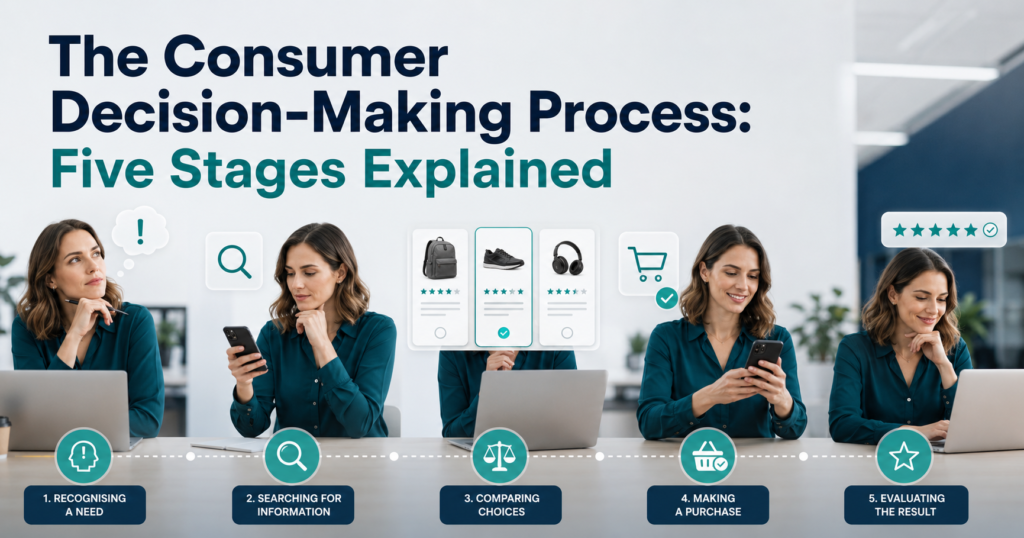
The model should not be mistaken for a rigid sequence. A customer buying a familiar, inexpensive item may pass through several stages almost instantly. Someone choosing a car, professional service or family holiday may spend weeks researching, comparing and seeking reassurance. Digital customers can also move backwards and forwards as new information, reviews or prices change their judgement.
What Is the Consumer Decision-Making Process?
The consumer decision-making process is a model of how people recognise a need, investigate possible solutions, compare them, choose an offer and judge the result. The Open University presents the stage model as problem recognition, information search, evaluation of alternatives, product choice and post-purchase evaluation.[1]
The model matters because a purchase is rarely created by one advertisement or one visit to a checkout page. Different questions dominate at different stages:
| Stage | The customer’s main question | The marketer’s task |
|---|---|---|
| Problem recognition | Do I need to act? | Make the need relevant and recognisable |
| Information search | What could solve it? | Make useful, credible information easy to find |
| Evaluation of alternatives | Which option fits me best? | Clarify value and reduce uncertainty |
| Purchase decision | Am I ready and able to buy? | Remove friction without creating pressure or confusion |
| Post-purchase evaluation | Was this the right choice? | Deliver the promise and reinforce confidence |
These stages give marketers a practical way to connect communication with product design, pricing, distribution, service and customer experience.
Stage 1: Problem Recognition
Problem recognition occurs when a consumer notices a gap between their current situation and a preferred one. Something is missing, inconvenient, no longer suitable or capable of being improved.
The trigger may be internal. Hunger, discomfort, boredom or a desire for confidence can create the motivation to act. It may also be external, such as seeing a colleague use a better device, receiving a contract-renewal reminder or encountering an advertisement that reveals an unfamiliar solution.
Not every recognised problem becomes an active purchase. The gap must feel important enough to justify the money, effort and risk involved. A slow laptop may be irritating, but the customer could postpone replacing it until it begins interrupting important work.
Marketers therefore need to connect the problem to a meaningful consequence. Effective marketing helps customers recognise a genuine need and understand why addressing it may be worthwhile. It should not manufacture misleading fears or exaggerate the likely outcome.
Example: Recognising the Need for a New Laptop
A freelance designer notices that an ageing laptop repeatedly freezes during client work. The immediate problem is poor performance, but the deeper concern is lost time and the risk of missing deadlines. A message based only on technical specifications may be less relevant than one explaining reliable performance during demanding creative work.
Stage 2: Information Search
Once the need becomes important, the consumer begins searching for possible solutions. The amount of searching usually depends on the purchase’s cost, familiarity, complexity and perceived risk.
An internal search draws on memory and past experience. The customer may recall a brand they have used successfully or reject one associated with a previous problem.
An external search uses sources beyond memory, including:
- Search engines
- Retailer websites
- Comparison tools
- Online reviews
- Product demonstrations
- Social media
- Professional advice
- Recommendations from friends or colleagues
The customer is not necessarily looking for every available option. They are trying to build a manageable set of credible possibilities. Clear product pages, useful guides, accurate specifications, transparent pricing and accessible frequently asked questions can help an organisation enter that consideration set.
Reviews can be especially influential because they appear to provide evidence from other customers. They must also be handled responsibly. The UK Competition and Markets Authority provides guidance for businesses that publish reviews and has continued enforcement work concerning potentially fake or misleading review practices.[2]
For marketers, visibility is only the beginning. Information must be understandable, relevant and trustworthy. A page that ranks well but leaves important costs or conditions unclear may attract attention while weakening confidence.
Stage 3: Evaluation of Alternatives
At this stage, the consumer compares the options that survived the initial search. They judge how well each offer meets the criteria that matter to them.
Possible criteria include:
- Price and total cost
- Quality and performance
- Convenience and availability
- Brand reputation
- Reviews and recommendations
- Delivery, returns or cancellation terms
- Compatibility with existing products
- Service and after-sales support
- Ethical, accessibility or sustainability considerations
These criteria do not carry equal weight. One customer may prioritise the lowest price, while another is prepared to pay more for reliability or specialist support. Even the same person may apply different priorities in different situations.
Evaluation includes both rational and emotional judgement. Features, price and evidence matter, but so do trust, familiarity, identity and the feeling that one option is safer or more suitable.
The psychological, social, cultural and personal influences explored in our guide to consumer buying behaviour can affect what the customer notices and how each criterion is weighted.
Marketers should make meaningful comparison easier. This can involve clear plans, honest feature tables, relevant demonstrations, case evidence and explanations of who an offer is—and is not—designed for. A long list of features is less useful when it does not show how those features solve the customer’s problem.
A Simple Weighted Comparison
Suppose the designer compares three laptops using four criteria:
| Criterion | Importance | Laptop A | Laptop B | Laptop C |
|---|---|---|---|---|
| Performance | 40% | 5/5 | 4/5 | 3/5 |
| Reliability and support | 25% | 4/5 | 3/5 | 4/5 |
| Price | 20% | 2/5 | 4/5 | 5/5 |
| Portability | 15% | 3/5 | 5/5 | 4/5 |
| Weighted score | 100% | 3.85/5 | 3.85/5 | 3.80/5 |
This illustrative framework shows why a decision may remain difficult even after extensive research. Laptop A and Laptop B receive the same weighted score for different reasons. The customer must then decide whether stronger performance or greater portability and affordability matters more in practice.
Stage 4: Purchase Decision
The evaluation stage produces a preference, but preference does not guarantee a purchase. The customer must still convert intention into action.
Several factors can interrupt the decision:
- The preferred item becomes unavailable
- The final price includes unexpected charges
- Delivery takes too long
- The payment method is unsuitable
- The checkout process appears difficult or insecure
- A negative review creates new doubt
- Another person questions the choice
- The customer’s financial or personal circumstances change
The marketing mix is particularly visible here. Product availability, pricing, distribution, communication, people, process and physical evidence must support the same promise. The 4Ps and 7Ps of marketing provide a useful framework for examining this alignment.
Organisations can support purchase by making costs, terms, stock, delivery and next steps clear. Checkout should be simple and accessible, but ethical practice matters: urgency, scarcity or social-proof claims should be genuine rather than designed to mislead.
Stage 5: Post-Purchase Evaluation
The decision-making process continues after payment. The customer compares the experience with their expectations and asks whether the choice was worthwhile.
When performance meets or exceeds expectations, satisfaction becomes more likely. The customer may buy again, recommend the organisation or become less likely to search widely next time.
When performance falls short, dissatisfaction may lead to complaints, returns, negative reviews or switching.
A customer can also experience post-purchase dissonance: doubt or discomfort about whether they made the right choice. This is particularly common when the purchase is expensive, difficult to reverse or involves several attractive alternatives.
Organisations can reduce uncertainty through:
- Clear confirmations and realistic delivery updates
- Straightforward onboarding or setup guidance
- Accessible support and complaint handling
- Fair returns or cancellation processes
- Helpful follow-up information
- Honest requests for feedback
Post-purchase communication should provide genuine value and respect the customer’s preferences. The Information Commissioner’s Office states that organisations conducting direct marketing should plan for responsible use of personal information, explain its use fairly and respect people’s right to object or opt out.[3]
This stage is commercially important because it feeds the next decision. A good experience becomes part of the customer’s internal information search, while a poor experience can remove the brand from future consideration.
Do Consumers Always Follow All Five Stages?
No. The model is a useful guide, not a rule describing every purchase exactly.
With a low-involvement purchase, habit may compress the process. A customer buying their usual toothpaste could recognise the need, select the familiar brand and complete the purchase in seconds. Information search and evaluation are minimal because the perceived risk is low.
High-involvement decisions usually involve more extensive searching and comparison. A customer choosing a mortgage, vehicle, degree pathway or expensive piece of equipment may revisit earlier stages repeatedly as new information appears.
Journeys can also be interrupted or reversed. A product discovered during information search can create a new understanding of the original problem. A poor checkout experience can send the customer back to evaluate alternatives. An unsatisfactory purchase can trigger an immediate search for a replacement.
The practical lesson is to support the customer wherever they are rather than assuming everyone follows a perfectly linear funnel.
How Marketers Can Apply the Five-Stage Model
The model becomes useful when it changes decisions rather than remaining a diagram. A marketer can apply it by auditing the evidence and friction at every stage:
- Define the customer and problem clearly. What situation triggers the need, and why would the customer act now?
- Map information sources. Where does the customer search, and which sources do they trust?
- Identify evaluation criteria. Which benefits, costs and risks determine the shortlist?
- Inspect purchase barriers. What prevents a willing customer from completing the transaction?
- Measure the experience after purchase. What drives satisfaction, complaints, recommendations or repeat behaviour?
This approach connects consumer insight with practical marketing action. It also prevents an organisation from concentrating all its effort on promotion while ignoring product suitability, confusing processes or weak after-sales service.
Develop Your Understanding of Marketing and Consumer Behaviour
Understanding how customers recognise needs, compare alternatives and evaluate outcomes supports better decisions in marketing, sales, customer experience and business development.
Click College offers flexible online routes for different learning goals:
- The Professional Diploma in Marketing is a focused 40-credit route covering essential marketing knowledge and practice.
- The Higher International Certificate in Marketing Management provides a broader Level 4 programme worth 120 credits.
- The Higher International Diploma in Marketing Management incorporates Level 4 and develops study through Level 5, totalling 240 credits.
- The International Graduate Diploma in Marketing Management incorporates Levels 4, 5 and 6 in a 360-credit programme.
Compare these options on the Marketing Management courses page and select the route that best matches the depth and level of study you want to undertake.
Frequently Asked Questions
What Are the Five Stages of the Consumer Decision-Making Process?
The five stages are problem recognition, information search, evaluation of alternatives, purchase decision and post-purchase evaluation. They describe how a customer moves from recognising a need to judging whether the eventual purchase was successful.
Why Is the Consumer Decision-Making Process Important?
It helps organisations understand what information, reassurance and experience customers need at different points. This supports more relevant communication, clearer offers, lower purchase friction and better post-purchase service.
What Is the Difference Between Information Search and Evaluation of Alternatives?
Information search is the process of finding possible solutions and learning about them. Evaluation of alternatives involves comparing the shortlisted options against criteria such as price, quality, convenience and risk.
What Factors Affect Consumer Decisions?
Consumer decisions are influenced by psychological, social, cultural and personal factors. Their importance changes according to the customer, context and level of involvement in the purchase.
What Is Post-Purchase Evaluation?
Post-purchase evaluation is the customer’s judgement of whether the product or service met expectations. It can influence satisfaction, complaints, reviews, recommendations, loyalty and future purchase behaviour.
Key Takeaways
The consumer decision-making process consists of five connected stages: recognising a problem, searching for information, evaluating alternatives, making the purchase and evaluating the outcome.
The model is most valuable when organisations use it to understand the customer’s changing questions. Early stages require relevance and useful information. Evaluation requires clear value and credible evidence. Purchase requires low friction and transparent conditions. Post-purchase evaluation requires consistent delivery, support and reassurance.
Consumers do not always move through the stages in a straight line, but the framework helps marketers identify where confidence is built, where uncertainty develops and where the customer experience can be improved.
Ready to develop a deeper understanding of customers and marketing decisions? Explore Click College’s Marketing Management courses and choose the qualification route suited to your goals.
References
- You as a Customer: Stage Model of Buyer Behaviour — The Open University, OpenLearn
- Online Consumer Reviews — Competition and Markets Authority
- Direct Marketing Guidance — Information Commissioner’s Office
Develop Your Marketing and ManagementSkills
Want to develop your understanding of marketing and business management? Explore Click College’s Marketing Management courses and choose the flexible online qualification that best supports your next step.
Alternatively, view our Business Management courses and start studying online today.







Recent Posts
How to Build Trust Before a Customer Buys
How to Build Trust Before a Customer Buys Before a customer buys from an unfamiliar business, they are making more than a price comparison. They are deciding whether the offer is genuine, whether the organisation will deliver what it promises and whether help will be available if something goes wrong. That is why trust is […]
Why Customers Switch: The Trust and Value Signals That Drive Churn
Why Customers Switch: The Trust and Value Signals That Drive Churn Customers rarely switch simply because a competitor is cheaper. They switch when the relationship no longer feels safe, fair or worth the effort. A price rise may trigger the search, but unclear charges, poor support, weak proof and uncertainty about what happens next are […]
How to Find and Fix Friction in the Buying Journey
How to Find and Fix Friction in the Buying Journey Customers rarely decide not to buy for one dramatic reason. More often, small difficulties build up: a confusing product page, unclear pricing, a slow reply, an awkward form, conflicting information or a delivery promise that feels uncertain. Each issue may appear minor in isolation. Together, […]