The Marketing Mix Explained: A Guide to the 4Ps and 7Ps
The marketing mix is one of the best-known frameworks in business. It helps organisations turn broad marketing goals into practical decisions about what they offer, what customers pay, how the offer is made available and how it is promoted.
The original model is built around the 4Ps of marketing: product, price, place and promotion. For services and experience-led organisations, the model is commonly extended to the 7Ps of marketing by adding people, process and physical evidence.
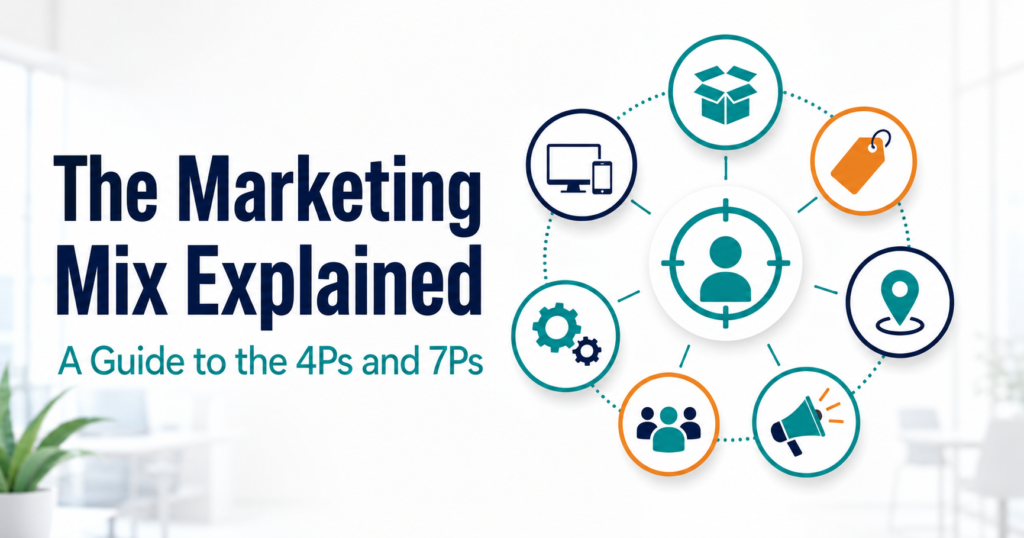
Understanding these elements helps marketers create a consistent customer experience. A strong advertising campaign cannot compensate for an unsuitable product, confusing price, inconvenient distribution or unreliable service. Every part of the mix must support the same value proposition.
This guide explains each element of the marketing mix, shows why the 4Ps and 7Ps must work together and explores how organisations can apply the framework in practice. If you would like a broader introduction first, read our guide to the role of marketing in an organisation.
What Is the Marketing Mix?
The marketing mix is a coordinated set of decisions an organisation uses to deliver value to a chosen target market. It turns marketing strategy into action by answering questions such as:
- What should the organisation offer?
- How should the offer be priced?
- Where and how should customers access it?
- How should its value be communicated?
- Who will deliver the customer experience?
- What process will customers follow?
- What evidence will reassure customers about quality?
The Open University describes the original four elements as product, price, place and promotion, with people, physical evidence and process extending the model for services. It also connects the Ps to a more customer-centred view based on needs, cost, convenience and communication. [1]
The value of the framework lies in coordination. Each decision affects the others. A premium price creates expectations of higher quality, better service and stronger presentation. A major promotion can disappoint customers if the product is unavailable. A convenient digital sales channel can still fail if the payment or delivery process is unreliable.
The marketing mix therefore works as a connected system rather than a checklist of separate activities.
Why Does the Marketing Mix Matter?
The marketing mix helps organisations maintain consistency between what they promise and what customers actually experience.
Imagine a company promoting itself as a premium service. Its advertising looks sophisticated and its prices are high, but its website is difficult to use, staff are poorly informed and support requests go unanswered. The promotional message and customer experience contradict each other.
A well-designed marketing mix helps prevent these gaps. It aligns the offer with:
- The needs and expectations of the target customer
- The organisation’s intended position in the market
- The channels through which customers research and buy
- The quality and experience the organisation can genuinely deliver
- Wider goals such as growth, profitability, reputation or customer retention
Different customer groups may also require different versions of the mix. One segment may prioritise affordability, while another values convenience, specialist support or reassurance. The organisation must understand these differences rather than applying a one-size-fits-all approach.
What Are the 4Ps of Marketing?
The 4Ps provide the foundation of the marketing mix:
- Product — what the organisation offers
- Price — what the customer gives in exchange
- Place — where and how the offer is accessed
- Promotion — how the organisation communicates its value
Each P represents a group of decisions. Together, they help an organisation build an offer that is relevant, accessible and clearly positioned.
1. Product
In marketing, a product is more than a physical item. It is the complete collection of benefits a customer receives. A product can be a physical good, a service, a digital subscription, an experience or a combination of these.
A useful way to understand a product is through three levels:
- Core benefit: The underlying need or problem being addressed. A customer buying a drill, for example, may ultimately want the ability to create a hole.
- Actual product: The features, design, quality, branding and packaging received by the customer.
- Augmented product: Additional benefits such as delivery, installation, warranties, training, returns and customer support.
Product decisions may include quality standards, features, design, branding, packaging, service levels and after-sales care. These choices influence expectations and customer satisfaction.
Organisations must also manage products over time. During introduction, the priority may be awareness and trial. During growth, the organisation may expand distribution or improve features. At maturity, differentiation and customer retention often become more important. A declining product may need to be repositioned, updated or withdrawn.
The central question is not simply, “What do we sell?” It is, “What value does the customer receive, and why should they choose this offer?”
2. Price
Price is the amount a customer gives in exchange for an offer, but it is also a signal. Customers may use price to form expectations about quality, status, reliability and value.
Three common pricing approaches are:
- Cost-based pricing: Calculating the cost of supplying the offer and adding a target margin.
- Customer or value-based pricing: Setting the price according to the benefits customers perceive and what they are prepared to pay.
- Competition-based pricing: Using competitor prices as an important reference point.
Many organisations combine these approaches. Costs establish what is financially viable, customer value shapes the opportunity and competitor activity influences what appears realistic in the market.
Pricing tactics can include discounts, bundles, subscriptions, introductory pricing, payment plans, penetration pricing and price skimming. However, short-term tactics must not undermine long-term trust. Hidden charges, inconsistent discounts or unclear conditions can make customers feel that a price is unfair.
Price must also fit the rest of the marketing mix. A high price should be supported by appropriate product quality, service, communication and physical presentation. A value-led offer needs cost control and efficient delivery so the organisation can remain sustainable.
3. Place
Place concerns where, when and how customers obtain the offer. It includes much more than the location of a shop.
Place decisions can cover:
- Physical locations
- Websites and mobile applications
- Direct sales
- Retailers, wholesalers and marketplaces
- Stock availability and inventory
- Delivery and collection options
- Returns and after-sales support
- The complete online or offline buying journey
An organisation may sell directly to customers through its own website or indirectly through intermediaries. Many businesses use an omnichannel approach, allowing customers to move between online and physical touchpoints. A customer might research online, inspect the product in a shop, order through an app and return it at a local location.
Good place decisions reduce effort. Customers can find accurate information, check availability, complete a purchase, receive the offer and obtain support without unnecessary friction.
Place must also reflect the target market. Some customers prioritise speed and convenience, while others value expert advice, local availability or the ability to experience the product before buying.
4. Promotion
Promotion is how an organisation informs, persuades and reminds its audience. Its purpose is not merely to attract attention, but to communicate a clear and credible reason to choose the offer.
Promotional tools can include:
- Advertising
- Public relations
- Content marketing
- Email marketing
- Social media
- Personal selling
- Sales promotions
- Events and exhibitions
- Influencer and partnership activity
The most effective organisations use integrated marketing communications. This means the core promise, positioning and tone remain consistent across channels, even though the format changes. A short social media video and a detailed sales presentation may look different, but they should communicate the same fundamental value.
Promotion should also match the customer journey. Awareness activity may require reach and memorable messaging. Customers considering a purchase may need evidence, comparisons and reassurance. Conversion communications should provide clarity and reduce friction. Retention activity should continue providing value after purchase.
Accuracy is essential. The UK advertising rules require marketing communications not to materially mislead and expect objective claims to be supported by evidence. [2] Organisations using email and similar electronic channels must also consider the relevant direct marketing and PECR requirements. [3]
Learners who want to build practical knowledge in this area can explore Click College’s Professional Diploma in Digital Marketing.
Why Were the 4Ps Extended to the 7Ps?
The original 4Ps are particularly useful for tangible, product-led offers. Services create additional challenges because they are often intangible, delivered through human interaction and experienced at the same time as they are produced.
Consider a hotel stay, professional consultation, online course or healthcare appointment. Customers judge more than the core service. They notice how staff communicate, how easy the booking process is, whether information is clear and whether the physical or digital environment creates confidence.
The extended marketing mix adds:
- People
- Process
- Physical evidence
The Chartered Institute of Marketing identifies all seven elements as a framework for planning and evaluating marketing strategy and aligning it with customer expectations. [4]
5. People
People include everyone who influences the customer experience, from frontline staff and sales teams to managers, support colleagues and delivery partners.
In service organisations, customers may find it difficult to separate the service from the person delivering it. Knowledgeable, responsive and respectful staff can strengthen trust. Poor communication or inconsistent behaviour can quickly undermine a strong brand promise.
People decisions include:
- Recruitment and role suitability
- Product and service knowledge
- Communication and customer-care training
- Performance expectations
- Complaint handling
- Staff motivation and organisational culture
- The authority employees have to solve customer problems
Complaint handling is especially important because it occurs when customer emotion may already be high. Staff need the knowledge, support and authority to respond fairly and effectively.
People are particularly visible in sectors such as retail, healthcare, education and hospitality and tourism management, where service interactions form a major part of the value customers receive.
6. Process
Process is the method through which the offer is delivered. It includes the steps, rules, systems, timings and handovers that shape the customer journey.
A service process might include:
- Finding information
- Making an enquiry
- Booking or ordering
- Paying
- Receiving confirmation
- Accessing the service
- Requesting support
- Providing feedback or making a complaint
Each step can create confidence or frustration. Long waits, repeated requests for information, unclear instructions and failed handovers increase customer effort. Clear communication, predictable timings and simple support routes make the organisation feel reliable.
Organisations must balance standardisation with personalisation. Standardised processes improve consistency and efficiency, while personalisation helps meet different customer needs. Automation can make services faster and more convenient, but customers still need an accessible route to human support when a system fails or a situation is unusual.
Service blueprinting can help organisations examine this journey. A service blueprint maps customer actions alongside visible staff activity, behind-the-scenes work, supporting processes and physical or digital evidence. This can reveal weak handovers and dependencies across departments. [5]
7. Physical Evidence
Physical evidence includes the visible and tangible cues customers use to judge an organisation and reduce uncertainty, particularly when the service itself cannot be inspected before purchase.
Examples include:
- Premises, décor, cleanliness and signage
- Staff appearance and presentation
- Packaging, documents and printed materials
- Websites, applications and online portals
- Certificates, accreditations and professional credentials
- Reviews, testimonials and case studies
- Confirmation emails, receipts and reports
- Equipment and other visible resources
For a hotel, physical evidence includes the reception area, room presentation, signage and staff uniforms. For an online service, it includes website design, secure payment cues, clear confirmation messages and a reliable user interface. For an education provider, it can include the learning platform, course materials, tutor communications and evidence of accreditation.
Physical evidence should support the organisation’s intended position. A premium service needs polished, reassuring and consistent cues. A value-led service may use simpler presentation, but it should still appear reliable, clear and professional.
This element is sometimes misunderstood as being limited to buildings or printed materials. In reality, digital evidence is now equally important. A customer may form their first and strongest judgement through a website or application without ever entering physical premises.
How the 7Ps Work Together
The marketing mix creates value only when its elements are aligned.
Consider an organisation promising a fast, convenient digital service:
- The product must solve a relevant problem.
- The price must feel appropriate for the benefit and experience.
- The place strategy must make the service easy to access.
- The promotion must communicate the promise accurately.
- The people supporting the service must be responsive.
- The process must be simple and reliable.
- The physical evidence must make the digital environment feel secure and professional.
If even one element fails, the value proposition becomes less credible. Advertising convenience will not help if the website is confusing. A premium product will struggle if delivery is unreliable. Helpful staff cannot fully compensate for a process that repeatedly creates delays.
This is why marketing managers must work with operations, finance, sales, customer service, technology and human resources. The marketing mix is not owned by one department; it depends on coordinated organisational delivery.
Marketing Mix Example: IKEA
IKEA provides a useful example of an aligned marketing mix built around affordable, modern home furnishings.
- Product: Flat-pack furniture and standardised ranges combine practical design with cost control.
- Price: Prices reinforce the brand’s value-led position, with customers accepting self-service and assembly as part of the exchange.
- Place: Large stores, room displays, warehouse collection and online services support accessibility and scale.
- Promotion: Communications emphasise practicality, inspiration, design and value.
- People: Staff provide guidance while supporting a largely self-service model.
- Process: The store journey moves customers from inspiration through product selection and collection.
- Physical evidence: Room sets, signage, layouts, catalogues and packaging reinforce the brand promise.
The strength of the example lies in consistency. The customer is not promised luxury personal service. Instead, the product, price and experience work together around accessible design and customer participation.
How to Review an Organisation’s Marketing Mix
When analysing a marketing mix, begin with the target customer and value proposition. Then examine each P using evidence rather than assumptions.
Ask:
- Who is the primary customer?
- What problem does the offer solve?
- What value does the organisation promise?
- Does each element of the mix support that promise?
- Are there gaps between promotion and delivery?
- Where does the customer experience unnecessary effort?
- Which element provides a meaningful competitive advantage?
- What change would make the complete mix more consistent?
Avoid judging each P separately. The most useful analysis identifies relationships. A pricing problem may actually come from weak communication of value. A promotion problem may be caused by poor availability. Customer dissatisfaction may reflect a process failure rather than the core product.
Develop Your Marketing Knowledge with Click College
The marketing mix is an essential foundation for anyone interested in marketing, business development, customer experience or organisational management.
Click College offers flexible online routes for different levels of experience:
- The Professional Diploma in Marketing provides a shorter introduction to core marketing principles and practice.
- The Higher International Certificate in Marketing Management develops broader knowledge across marketing, customers, organisations and digital practice.
- The Higher International Diploma in Marketing Management progresses into market research, consumer behaviour, digital strategy and data-informed decision-making.
- The International Graduate Diploma in Marketing Management supports advanced study in strategic marketing, branding, consumer psychology and management.
Compare the available routes on the Marketing Management courses page. You can also learn more about how online study works at Click College.
Frequently Asked Questions
What Are the 4Ps of Marketing?
The 4Ps of marketing are product, price, place and promotion. They help an organisation decide what to offer, how to price it, where customers can access it and how its value will be communicated.
What Are the 7Ps of Marketing?
The 7Ps are product, price, place, promotion, people, process and physical evidence. The additional three elements extend the original marketing mix to reflect the realities of services and customer experience.
Why Is the Marketing Mix Important?
The marketing mix helps an organisation align its strategy, value proposition and customer experience. It reduces gaps between what promotion promises and what the product, service and organisation actually deliver.
What Is the Difference Between the 4Ps and 7Ps?
The 4Ps focus on the offer, pricing, distribution and communication. The 7Ps add people, process and physical evidence, making the model particularly useful for services, digital experiences and organisations where customers judge quality during delivery.
Does the Marketing Mix Apply to Digital Businesses?
Yes. Digital businesses still make product, price, place and promotion decisions. They must also consider the people providing support, the process customers follow and physical evidence such as website quality, reviews, security cues and confirmation messages.
Key Takeaways
The marketing mix turns strategy into coordinated action. The original 4Ps—product, price, place and promotion—help organisations shape and communicate an offer. The extended 7Ps add people, process and physical evidence to reflect how services and customer experiences are delivered.
The framework is most useful when its elements are considered together. Every P should support the target customer, the value proposition and the organisation’s wider goals. When the mix is aligned, customers receive a clear and credible experience. When it is not, even strong individual activities can fail to produce the intended result.
Ready to build your knowledge of customers, strategy and marketing decisions? Explore Click College’s Marketing Management courses and choose a flexible online qualification suited to your goals.
References
- The Marketing Mix — The Open University, OpenLearn
- Misleading Advertising — Advertising Standards Authority
- Guidance on Direct Marketing Using Electronic Mail — Information Commissioner’s Office
- The 7Ps of Marketing — Chartered Institute of Marketing
- Service Blueprints: Definition — Nielsen Norman Group
Develop Your Marketing and ManagementSkills
Want to develop your understanding of marketing and business management? Explore Click College’s Marketing Management courses and choose the flexible online qualification that best supports your next step.
Alternatively, view our Business Management courses and start studying online today.







Recent Posts
How to Build Trust Before a Customer Buys
How to Build Trust Before a Customer Buys Before a customer buys from an unfamiliar business, they are making more than a price comparison. They are deciding whether the offer is genuine, whether the organisation will deliver what it promises and whether help will be available if something goes wrong. That is why trust is […]
Why Customers Switch: The Trust and Value Signals That Drive Churn
Why Customers Switch: The Trust and Value Signals That Drive Churn Customers rarely switch simply because a competitor is cheaper. They switch when the relationship no longer feels safe, fair or worth the effort. A price rise may trigger the search, but unclear charges, poor support, weak proof and uncertainty about what happens next are […]
How to Find and Fix Friction in the Buying Journey
How to Find and Fix Friction in the Buying Journey Customers rarely decide not to buy for one dramatic reason. More often, small difficulties build up: a confusing product page, unclear pricing, a slow reply, an awkward form, conflicting information or a delivery promise that feels uncertain. Each issue may appear minor in isolation. Together, […]