Best Professional Diploma Courses for Career Progression
Choosing the right course can make a major difference to your career direction. Whether you want to gain promotion, move into management, change industry or strengthen your CV, professional diploma courses can provide a flexible and focused route to new knowledge.
Unlike a full degree, a professional diploma is usually shorter, more specialised and more directly connected to career development. This makes it especially attractive for adult learners, working professionals and international students who want to improve their prospects without putting work or family commitments on hold.
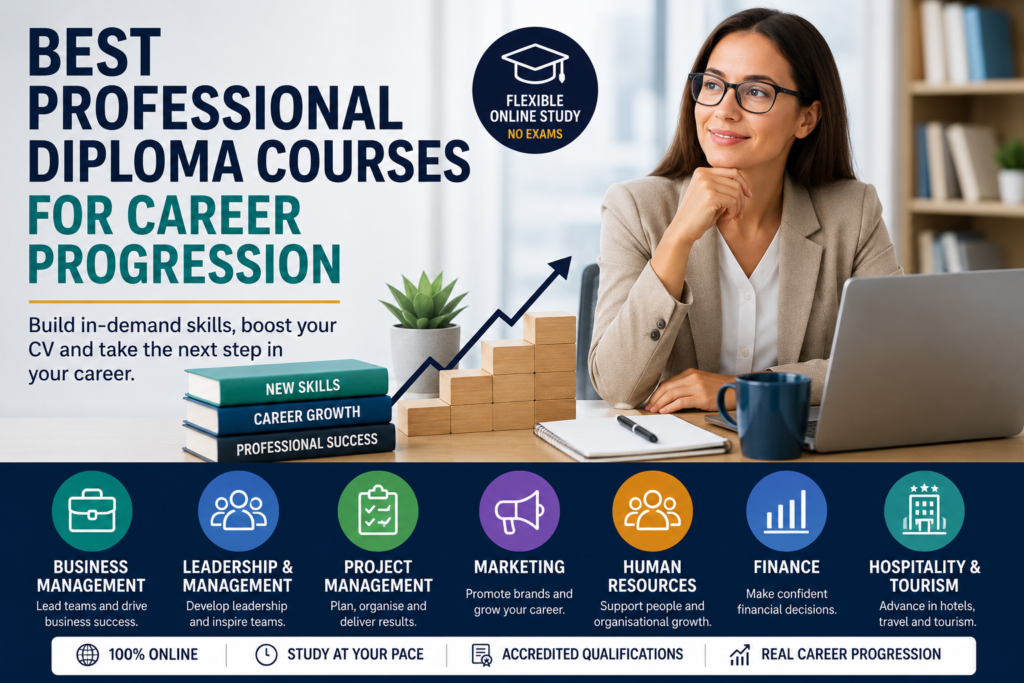
If you are looking for a career progression diploma, the best choice is not simply the course with the most impressive title. The best professional diploma course is the one that matches your current experience, career goals, target industry and preferred way of learning.
This guide explains how to choose the right professional diploma course for career progression and explores some of the most useful subject areas for learners who want to move forward professionally.
What are professional diploma courses?
Professional diploma courses are qualifications designed to develop knowledge and skills in a specific career-related subject area. They are often more focused than a full degree and are usually aimed at learners who want practical, structured study that can support employment, promotion or further learning.
Professional diplomas can be offered at different academic levels. This is important because the word “diploma” can describe many different types of qualification. Some diplomas are introductory, while others sit at higher education level.
In the UK qualification system, Level 4, Level 5 and Level 6 qualifications are higher-level qualifications. GOV.UK lists Level 4 diplomas alongside qualifications such as HNCs, Higher International Certificates, Level 5 diplomas alongside HNDs, Higher International Diplomas and foundation degrees, and Level 6 diplomas alongside honours degrees, graduate diplomas and ordinary degrees.
This does not mean that every professional diploma is the same as a degree. However, it does show why the level of a qualification matters. A Level 4, Level 5 or Level 6 professional diploma can help employers, learners and education providers understand how advanced the study is.
At Click College, professional diplomas are short-course qualifications carrying 40 UK credits. They are designed for learners who want focused study in a specific area, either for continuing professional development, career progression or as a stepping stone towards a larger qualification.
Why choose a professional diploma for career progression?
Professional diplomas can be useful for career progression because they are focused, flexible and career-related.
Many people reach a point in their career where experience alone is no longer enough. They may be good at their job, but need formal knowledge to move into a more senior role. Others may want to change direction but do not yet have relevant qualifications in their new field.
A professional diploma can help by giving structure to your development. It shows that you have studied a subject seriously, completed assessed work and developed knowledge in an area linked to your career goals.
Professional diploma courses can be especially useful if you want to:
- move into a new sector
- apply for a more senior role
- build confidence in a professional subject
- strengthen your CV
- demonstrate commitment to continued learning
- prepare for further study
- gain subject knowledge without committing to a full degree
For many learners, the attraction is flexibility. Online professional diplomas allow learners to study around work, family life and other responsibilities. This makes them particularly suitable for adults who cannot attend fixed classes or take time away from employment.
What makes a professional diploma course good for career progression?
A good career progression diploma should have several key features.
First, it should be relevant to your target career. A qualification in marketing is useful if you want to move into marketing, brand management or digital promotion. A qualification in hospitality management is useful if you want to progress in hotels, tourism, travel or service industries.
Second, it should be at the right level. A Level 4 professional diploma may be suitable if you are new to a subject or want to build foundations. A Level 5 diploma may be better if you already have some knowledge or want more applied management-level study. A Level 6 diploma may suit learners aiming for advanced, strategic or leadership-focused development.
Third, it should be credible. Look for clear information about the qualification level, credit value, awarding or accrediting body, assessment method and progression opportunities.
Fourth, it should fit your life. A course may be excellent, but if it requires fixed attendance, exams or a study schedule you cannot manage, it may not be practical. Flexible online study can make career progression more realistic for busy learners.
Finally, it should support your next step. A professional diploma should not just be interesting; it should help you move towards a specific goal.
1. Business Management professional diplomas
Business management is one of the most versatile choices for career progression.
A professional diploma in business management can be useful because business knowledge applies across almost every industry. Whether you work in hospitality, retail, administration, education, finance, marketing, customer service or operations, understanding how organisations work can support progression.
Business management professional diploma courses may cover areas such as organisational structure, management principles, business operations, decision-making, people management and strategic thinking. These topics are useful for learners who want to move from an operational role into a supervisory or management position.
A business management diploma may be suitable if you want to:
- move into team leadership
- understand how organisations operate
- prepare for management responsibilities
- support a career change into business
- build a foundation for further business study
- strengthen your CV with a broad professional qualification
Business management is often a strong option for learners who are not yet ready to specialise. If you know you want career progression but are unsure whether to focus on marketing, HR, finance or project management, business management can provide a broad foundation.
For this reason, a Professional Diploma in Business Management is one of the best professional diploma courses for learners who want flexibility in their future career direction.
2. Leadership and Management professional diplomas
Leadership and management qualifications are particularly useful for learners who want to move into more senior roles.
Many people are promoted because they are good at their current job, but managing people, leading change and making strategic decisions require a different set of skills. A leadership and management diploma can help learners develop the confidence and knowledge needed for this transition.
A Professional Diploma in Leadership and Management may cover topics such as leadership styles, organisational change, innovation, strategic management, decision-making and team performance. These areas are valuable for learners who already have workplace experience and want to move towards higher responsibility.
This type of career progression diploma may be suitable if you want to:
- become a supervisor or manager
- improve your leadership confidence
- manage teams more effectively
- prepare for senior responsibilities
- understand organisational change
- develop strategic thinking
Leadership and management is especially relevant for professionals who already have experience but need formal study to support their next step. It can also be useful for entrepreneurs, small business owners and team leaders who want to improve how they manage people and performance.
3. Project Management professional diplomas
Project management is another strong choice for career progression because project skills are needed in many sectors.
Organisations frequently need people who can plan work, manage deadlines, coordinate resources, monitor progress and deliver outcomes. These skills are useful in business, construction, technology, education, healthcare, events, marketing, operations and many other fields.
A Professional Diploma in Project Management can help learners understand how projects are planned, organised and controlled. It may also develop knowledge of quality, operations, risk, communication and stakeholder management.
A project management diploma may be suitable if you want to:
- move into project coordination
- improve your organisational skills
- manage deadlines and deliverables more effectively
- support business improvement projects
- progress from administration into management
- develop transferable skills across industries
Project management is particularly useful for career changers because it is not limited to one sector. If you can show that you understand how to manage projects, you may be able to apply this knowledge in different professional settings.
For learners looking for a practical and transferable career progression diploma, project management is often an excellent choice.
4. Marketing and Digital Marketing professional diplomas
Marketing is a strong professional diploma choice for learners interested in communication, branding, customer behaviour and business growth.
Modern organisations need people who understand how to attract customers, build trust, communicate value and use digital channels effectively. This makes marketing knowledge useful across many sectors, including retail, hospitality, education, professional services, tourism, events, technology and entrepreneurship.
A Professional Diploma in Marketing may cover topics such as marketing fundamentals, branding, customer insight, digital marketing, consumer behaviour and campaign planning. A digital marketing diploma may focus more specifically on online channels, content, social media, search, data and digital strategy.
Marketing professional diploma courses may be suitable if you want to:
- move into marketing or communications
- support business growth
- understand customers more effectively
- develop digital marketing knowledge
- improve branding and promotion skills
- support your own business or side project
- progress into marketing management
Marketing can be especially useful for learners who are creative but also interested in strategy and business results. It is also valuable for entrepreneurs and small business owners who need to understand how to promote products or services effectively.
For career progression, marketing diplomas can help learners move from general administration, customer service, sales or business support into more specialist commercial roles.
5. Human Resources professional diplomas
Human resources is a valuable professional diploma route for learners interested in people, recruitment, workplace culture and employee development.
HR plays an important role in organisations of all sizes. It covers recruitment, onboarding, training, employee relations, performance, policies, workforce planning and organisational development. As businesses grow, the need for skilled HR professionals becomes increasingly important.
A Professional Diploma in Human Resources can help learners understand the foundations of HR practice and how people management supports organisational performance.
An HR diploma may be suitable if you want to:
- move into human resources
- support recruitment or onboarding
- develop people-management knowledge
- progress from administration into HR
- understand workplace policies and employee support
- prepare for higher-level HR management study
Human resources can be a good career progression route for learners who enjoy working with people but also want a professional office-based pathway. It can also be useful for managers who are not HR specialists but need to understand recruitment, performance and staff development more clearly.
For career changers, HR can be a practical option because many learners already have transferable skills from administration, customer service, education, care, hospitality or team leadership.
6. Finance and Accounting professional diplomas
Finance is a useful subject for career progression because every organisation needs financial awareness.
Even if you do not want to become an accountant, understanding finance can help you make better decisions, manage budgets, interpret performance and contribute more confidently to business planning.
A Professional Diploma in Finance or Corporate Finance may cover areas such as budgeting, cost control, cash flow, financial planning, accounting principles and business decision-making. More advanced finance diplomas may explore corporate finance, investment decisions and working capital management.
A finance diploma may be suitable if you want to:
- improve business finance knowledge
- move into finance administration
- support budgeting or cost control
- develop confidence with financial information
- prepare for higher-level finance management study
- strengthen your management skills
Finance knowledge is particularly useful for managers, business owners, administrators and professionals who want to understand the numbers behind organisational decisions. It can also support progression into roles involving accounts, operations, procurement, business support or management.
For learners who want a practical and respected career progression diploma, finance is a strong option because financial understanding is valued across many sectors.
7. Hospitality and Tourism professional diplomas
Hospitality and tourism professional diplomas are useful for learners who want to progress in hotels, travel, tourism, events, accommodation, leisure or service-based industries.
Hospitality and tourism are global sectors with many career routes. Learners may begin in front-of-house, customer service, travel operations, accommodation, food and beverage, events or tourism services, then progress towards supervision, management or specialist roles.
A Professional Diploma in Hospitality or Tourism can help learners connect practical service experience with management knowledge. Depending on the course, learners may study areas such as hotel operations, tourism services, customer experience, hospitality revenue, service quality, destination management or strategic hospitality management.
A hospitality and tourism diploma may be suitable if you want to:
- progress in hotel or tourism management
- move from customer service into supervision
- develop specialist industry knowledge
- understand hospitality operations
- build knowledge of travel and tourism services
- prepare for higher-level hospitality and tourism study
- support a career change into the service economy
This route can be especially useful for learners who already have experience in hospitality, retail, travel, customer service or events but want a qualification that supports progression.
For learners interested in a global, people-focused industry, hospitality and tourism can be one of the best professional diploma courses for career development.
8. Hotel Management professional diplomas
Hotel management is a more specialised route within hospitality.
A Professional Diploma in Hotel Management may be useful for learners who want to work in accommodation, front office, guest services, operations or hotel supervision. It can also support learners who already work in a hotel environment and want to move towards management.
Hotel management requires a combination of customer service, operational awareness, people management and commercial understanding. A focused diploma can help learners build knowledge of how hotel services are organised and delivered.
A hotel management diploma may be suitable if you want to:
- work in hotel operations
- progress from front-of-house into supervision
- understand accommodation management
- develop guest service knowledge
- prepare for hospitality management progression
- strengthen your CV for hotel-related roles
This course area may appeal to learners who want a more specific qualification than a general hospitality diploma. It can also be useful for international learners because hotel management is a globally understood career area.
9. Hospitality Revenue Management professional diplomas
Hospitality revenue management is a specialist subject that can be highly useful for career progression in hotels and accommodation businesses.
Revenue management focuses on how hospitality organisations manage pricing, demand, occupancy, bookings and profitability. It connects customer behaviour, market demand, finance and commercial decision-making.
A Professional Diploma in Hospitality Revenue Management may be suitable for learners who already understand hospitality operations and want to develop more commercial knowledge.
This type of diploma may be useful if you want to:
- move into hotel revenue roles
- understand pricing and occupancy decisions
- support accommodation management
- develop commercial hospitality knowledge
- progress towards senior hotel management
- combine hospitality experience with finance awareness
Revenue management is a good example of how professional diploma courses can provide specialist knowledge that may not be covered in depth in a general course. For learners who want to stand out in hospitality management, this can be a valuable route.
10. Strategic professional diplomas at Level 6
Level 6 professional diplomas are often suitable for learners who already have experience or previous study and want to develop more advanced knowledge.
A Level 6 diploma sits at bachelor’s degree level in terms of academic difficulty, although it is not automatically the same as a full bachelor’s degree. Level 6 study is usually more analytical, strategic and independent than Level 4 or Level 5 study.
Strategic professional diplomas may focus on areas such as strategic business management, strategic marketing management, strategic HR management, leadership and management, international business, entrepreneurship, logistics and supply chain management, or strategic hospitality management.
A Level 6 strategic diploma may be suitable if you want to:
- develop senior-level knowledge
- strengthen strategic thinking
- prepare for leadership responsibilities
- build confidence in advanced business concepts
- support postgraduate or further study ambitions
- progress from operational management into strategic roles
These courses are usually best suited to learners who are ready for advanced study. If you are completely new to a subject, a Level 4 or Level 5 route may be more appropriate.
For experienced professionals, however, a Level 6 career progression diploma can provide a focused way to develop higher-level knowledge without committing immediately to a full degree or postgraduate programme.
How to choose the best professional diploma course for your career
The best professional diploma course depends on where you are now and where you want to go next.
If you are new to business or higher-level study, a Level 4 professional diploma may be a sensible starting point. It can help you build foundations without assuming too much previous knowledge.
If you already have experience and want to develop more applied or managerial knowledge, a Level 5 professional diploma may be more suitable.
If you are aiming for senior, strategic or leadership-focused progression, a Level 6 professional diploma may be the better fit, provided you are ready for the academic challenge.
You should also think carefully about your target sector.
Choose business management if you want a broad, flexible qualification.
Choose project management if you want transferable planning and delivery skills.
Choose marketing if you want to work with customers, brands, communication and growth.
Choose HR if you want to work with people, recruitment and workforce development.
Choose finance if you want stronger commercial and financial understanding.
Choose hospitality and tourism if you want to progress in service, travel, hotel or tourism industries.
Choose leadership and management if you want to move into senior responsibility.
A good professional diploma should feel connected to your next career step, not just your general interests.
Are professional diploma courses good for career changers?
Yes, professional diploma courses can be especially useful for career changers.
When you move into a new field, you may already have valuable transferable skills, but employers may want evidence that you understand the new sector. A professional diploma can help bridge that gap.
For example, someone with retail experience may move towards hospitality management. Someone with administrative experience may move towards human resources or project coordination. Someone with customer service experience may move towards marketing, tourism or hotel operations.
A professional diploma helps show that your career change is serious and planned. It gives you language, concepts and knowledge that are relevant to your new direction.
It can also help you test the subject before committing to a larger qualification. This makes it a lower-risk route for learners who are exploring a new professional path.
Are professional diploma courses useful for promotion?
Professional diploma courses can also support promotion.
Many people are promoted because they are reliable, experienced and capable. However, promotion often requires more than technical ability. It may require leadership, communication, decision-making, financial awareness, project planning or strategic thinking.
A professional diploma can help you develop these areas in a structured way. It can also give you evidence of professional development to discuss with employers.
For example, if you work in hospitality and want to become a supervisor, a diploma in hospitality management or hotel management may support your progression. If you work in administration and want to move into project coordination, a project management diploma may be useful. If you already manage people but want to develop your leadership style, a leadership and management diploma may be appropriate.
A professional diploma does not guarantee promotion, but it can strengthen your case by showing commitment and relevant learning.
Why online professional diploma courses are popular
Online professional diploma courses are popular because they fit around real life.
Many learners cannot attend campus-based classes because they are working full time, caring for family, living overseas or balancing multiple commitments. Online study allows them to continue progressing without needing to relocate or follow a fixed timetable.
At Click College, courses are designed for flexible online learning. Learners study at their own pace and complete coursework assignments rather than traditional exams. This makes the learning model suitable for independent learners who want control over when and where they study.
Online learning can also help develop useful professional habits, including self-discipline, organisation, written communication and independent research. These are skills that employers often value.
Can a professional diploma lead to further study?
In many cases, a professional diploma can support further study, although progression depends on the qualification, subject, level and receiving institution.
At Click College, professional diplomas are designed as focused 40-credit qualifications. In some cases, they may be carried forward into higher qualifications such as the Higher International Certificate, Higher International Diploma and the International Graduate Diploma, subject to programme structure and academic alignment. This means a learner may begin with a shorter qualification and later decide to continue towards a larger award.
This is useful for learners who are not ready to commit to a full 120-credit, 240-credit or 360-credit pathway immediately. A professional diploma can provide a more manageable starting point.
However, learners should always check progression routes before enrolling if their main aim is further study. Universities and education providers set their own entry requirements, so progression is not automatic in every case.
Which professional diploma course is best?
There is no single best professional diploma course for everyone.
The best course is the one that fits your career goal.
For a broad management route, business management is often best.
For team leadership and senior responsibility, leadership and management may be best.
For transferable organisational skills, project management is a strong option.
For brand, customer and digital roles, marketing may be best.
For people-focused office careers, human resources is a useful route.
For commercial confidence, finance may be best.
For service-sector progression, hospitality and tourism, hotel management or hospitality revenue management may be best.
The right choice depends on your current experience, the type of role you want and the level of study you are ready for.
How Click College supports career progression
Click College offers flexible online professional diploma courses for learners who want focused, career-related study.
Our professional diplomas are designed for busy adults, career changers, working professionals and international learners who want to develop knowledge without attending traditional classes. Courses are studied online, with no fixed class timetable and no traditional exams.
Learners can choose from professional diploma courses in areas such as business management, leadership and management, project management, marketing, digital marketing, finance, accounting and finance, human resources, hospitality management, hotel management, tourism, travel and strategic management.
This gives learners the opportunity to choose a course that matches their career direction, whether they want to gain confidence in a new field, support promotion or prepare for further study.
Final thoughts
Professional diploma courses can be a practical and flexible way to support career progression.
They are particularly useful for learners who want focused knowledge, online study and a qualification that connects directly to professional goals. Whether you are aiming for promotion, changing career or returning to education, a career progression diploma can help you take a structured step forward.
The best professional diploma course is not the same for every learner. Business management may be ideal for one person, while project management, marketing, HR, finance or hospitality may be better for another.
The key is to choose a course that is relevant, credible, appropriately levelled and realistic for your lifestyle.
For many learners, a professional diploma is a smart first step. It offers a manageable way to build knowledge, strengthen your CV and move towards the next stage of your career.
Frequently asked questions
What are the best professional diploma courses for career progression?
The best professional diploma courses for career progression are usually those linked directly to your career goals. Popular options include business management, leadership and management, project management, marketing, finance, human resources, hospitality management, hotel management and tourism.
Is a professional diploma good for career progression?
Yes, a professional diploma can support career progression by helping you develop relevant knowledge, strengthen your CV and show commitment to professional development. It is especially useful when the subject is closely linked to the role or sector you want to enter.
What is a career progression diploma?
A career progression diploma is a professional diploma chosen specifically to support promotion, career change or further study. It should help you develop knowledge that is relevant to your next professional step.
Which professional diploma is best for management?
Business management, leadership and management, project management and strategic business management are all useful options for learners who want to move into management or develop stronger leadership skills.
Which professional diploma is best for career change?
The best professional diploma for career change depends on the industry you want to enter. Marketing, HR, project management, hospitality, tourism and business management are often good choices because they provide transferable professional knowledge.
Are online professional diploma courses recognised?
Online professional diploma courses can be recognised when they are credible, properly structured, assessed and linked to a clear qualification level. Employers usually care about the relevance and quality of the qualification, not only the mode of study.
Can I study a professional diploma while working?
Yes. Many professional diploma courses are designed for working adults. Online, self-paced study can make it easier to learn alongside employment, family responsibilities or other commitments.
Do professional diploma courses have exams?
This depends on the provider. At Click College, courses are assessed through coursework assignments rather than traditional exams, allowing learners to demonstrate understanding through written work.
Can a professional diploma lead to a higher qualification?
In some cases, yes. Professional diplomas may support progression into higher-level study, depending on the course structure, subject alignment and provider requirements. Learners should check progression options before enrolling.
Is a professional diploma better than a degree for career progression?
A degree may be better where a full university qualification is required. However, a professional diploma may be better if you want focused, flexible and career-related study without committing to a full degree immediately.
Explore Online Professional Diplomas
Take Your Next Step Today
Ready to advance your professional management career with an accredited, flexible qualification? Visit Click College to explore their comprehensive online courses or discover detailed information about their range of qualifications.
For further enquiries or to enrol today, visit the Click College website and begin your journey toward professional excellence.:
Ready to enrol?


Recent Posts
Professional Diploma or Higher Qualification Pathway: Which Should You Choose?
Professional Diploma or Higher Qualification Pathway: Which Should You Choose? Choosing the right online qualification is not always simply a question of choosing the longest course or the highest level. For many learners, the better question is: what kind of study route fits my goals right now? Some learners want a focused qualification in one […]
Professional Diploma in Leadership and Management: Course Guide
Professional Diploma in Leadership and Management: Course Guide A Professional Diploma in Leadership and Management is designed for learners who want to develop advanced leadership, strategic thinking and organisational management skills without committing immediately to a full degree programme. Leadership and management are essential in almost every sector. Whether you work in business, education, hospitality, […]
Professional Diploma in Business Management: Who Is It For?
Professional Diploma in Business Management: Who Is It For? A Professional Diploma in Business Management is designed for learners who want to build practical business knowledge without committing immediately to a full degree or long higher education programme. It can be a useful option for people who want to understand how organisations work, how teams […]