Front of House vs Back of House in Hospitality: How the Two Sides Work Together
A hotel can have a warm welcome, a stylish lobby and friendly reception staff, yet still disappoint a guest if their room is not ready, a maintenance fault goes unresolved or breakfast arrives late. Equally, an immaculate room and well-run kitchen cannot compensate for a confusing check-in or a guest who cannot get help when something goes wrong.
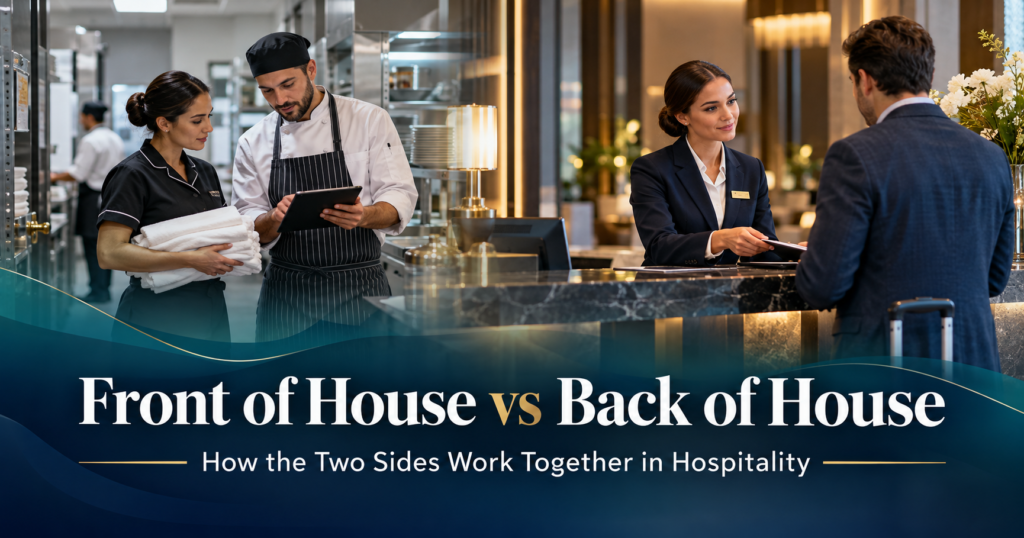
That is why front of house and back of house should not be seen as competing parts of a hospitality business. They are two sides of one service system. Front of house is where guests see and experience the service. Back of house is where much of the preparation, coordination and problem-solving takes place. The guest experience depends on both working together.
What is the difference between front of house and back of house?
In hospitality, front of house describes the customer-facing areas, people and activities. In a hotel, this usually includes reception, concierge or guest services, hosts, restaurant servers and other staff who communicate directly with guests. Their work includes welcoming arrivals, answering questions, taking payments, managing queues, handling requests and helping guests feel informed and valued.
Back of house describes the operational teams and activities that support the service behind the scenes. This may include housekeeping, kitchen teams, reservations, maintenance, stores, laundry, purchasing and administration. Guests may not see much of this work, but they experience its results in the cleanliness of a room, the timing of a meal, the accuracy of a booking and the reliability of the facilities.
| Area | Front of house | Back of house |
|---|---|---|
| Main purpose | Delivers visible, guest-facing service | Prepares, supports and maintains the service |
| Typical hotel teams | Reception, concierge, guest relations, restaurant hosts and servers | Housekeeping, kitchen, reservations, maintenance, laundry and stores |
| Guest contact | Frequent and direct | Usually indirect, although some teams may meet guests when required |
| Daily priorities | Welcome, communication, speed, reassurance and problem handling | Readiness, quality, safety, timing, stock, standards and reliable systems |
| How success is noticed | The guest feels recognised, informed and well looked after | The guest finds that everything is ready, clean, safe and working as expected |
The labels are useful, but not rigid. A chef may speak to guests at an open kitchen or during an event. A maintenance technician may explain a repair. Housekeeping may respond to an in-room request. The distinction is about the primary purpose of the work, not whether a team member is ever visible to guests.
Front of house: where expectations meet reality
Front-of-house staff often manage the first and last moments of a guest stay. Before the guest has seen their room or eaten a meal, they may already have formed an impression from the booking confirmation, arrival signage, queue, greeting and clarity of the check-in process.
In a hotel, front-of-house work commonly includes:
- Confirming reservations, checking guests in and processing departures.
- Answering questions about rooms, facilities, transport, dining and local services.
- Coordinating immediate requests with other departments.
- Communicating realistic updates when something is delayed.
- Listening to concerns and taking ownership of the next step.
This is why front of house is more than being polite. It is an operational communication hub. A receptionist needs accurate room status from housekeeping, reliable booking information from reservations and a clear route for escalating faults to maintenance. Without that information, even a highly professional welcome can turn into vague promises and repeated explanations.
The people-facing side of the operation is explored further in Customer Service Delivery in Hospitality: What Really Defines a Great Experience. Consistent service depends on both communication skills and the systems that give staff accurate information.
Back of house: the work guests rely on without always seeing
Back-of-house work is often least visible when it is working well. A guest enters a room that is clean, stocked and ready. A meal arrives at the expected standard. The heating works. A booking is recorded correctly. None of this happens by accident.
Housekeeping and room readiness
Housekeeping is responsible for cleaning and preparing rooms and public areas, replenishing supplies, reporting faults and keeping room-status information up to date. A room may be physically clean but still not ready to release if an inspection, linen delivery or maintenance check is outstanding.
This makes room status a vital handover point. Reception should not promise a room based on assumption; housekeeping needs an accurate way to communicate whether the room is vacant, being cleaned, inspected, out of order or ready for occupancy.
Kitchen operations and food service
Kitchen teams plan, prepare and produce food, while front-of-house restaurant teams communicate orders, dietary needs, timing and guest feedback. Food businesses have legal responsibilities to ensure food is safe, train staff in hygiene and manage food-safety risks, including allergens.[1]
The operational lesson is clear: a server cannot manage guest expectations properly without reliable information from the kitchen, and kitchen teams need accurate orders and realistic demand information from the restaurant. “Your meal will be out shortly” is not a useful update if nobody has checked what is happening at the pass.
Reservations and pre-arrival accuracy
Reservations teams manage bookings, amendments, cancellations and availability. Their work affects the guest journey before arrival. Accurate notes about accessibility needs, room preferences, celebrations, group bookings, arrival times or dietary requirements can help front-of-house and operational teams prepare appropriately.
When important details are missing or not shared, the guest may experience the failure at reception, even though the cause began before the stay.
Maintenance and facility reliability
Maintenance teams inspect, repair and service equipment and facilities. In a hotel this may include guest-room fixtures, air conditioning, lighting, plumbing, lifts, kitchen equipment and public spaces. The Health and Safety Executive explains that maintenance is used both to prevent problems and to put faults right; planned maintenance improves reliability and can reduce breakdowns.[2]
For front-of-house teams, maintenance communication matters as much as the repair itself. Staff need to know what has been reported, who owns the task, whether a room or facility should be taken out of use and when they can give a guest a realistic update.
The handovers that make or break the guest experience
Many hospitality problems are not caused by one team failing to work hard. They arise when a handover is unclear, delayed or based on incomplete information.
Five handovers are especially important:
- Reservations to reception: booking details, special requests, payment information and arrival notes must be correct and accessible.
- Housekeeping to reception: room status must be updated promptly and accurately, particularly around busy arrival times.
- Reception to maintenance: faults need clear descriptions, priority levels and a named owner rather than an informal message that disappears between shifts.
- Kitchen to restaurant team: delays, unavailable dishes and dietary queries need prompt, factual communication.
- All departments to the next shift: unresolved requests should be recorded with an agreed next action, not left for the guest to explain again.
A worked example: the room that is not ready
Imagine a family arriving at 3 pm, the hotel’s published check-in time. Reception finds that the allocated room is still marked as being cleaned. The family are tired after travelling and have young children with them.
A weak front-of-house response might be: “Housekeeping is still working on it. Please take a seat.” It gives no ownership, no timescale and no explanation of what will happen next.
In a coordinated operation, reception checks the live room-status system, contacts the housekeeping supervisor and establishes whether the room needs only a final inspection or whether there is a fault preventing release. The receptionist then gives the family a realistic update, secures their luggage, offers a suitable waiting option and checks whether another appropriate room can be made available.
If a maintenance issue is involved, the team should not simply guess at the timing. The duty manager can decide whether to prioritise the repair, reallocate the family or take another proportionate step. The difference is not merely faster service; it is clear ownership across departments.
If the delay becomes a complaint, the response should move beyond passing the guest between teams. Hotel Service Recovery: Handling Complaints and Rebuilding Guest Trust explains how hotels can acknowledge the impact, resolve the practical problem and learn from recurring failures.
Front of house vs back of house is not a hierarchy
Guest-facing roles are sometimes treated as the ‘visible’ part of hospitality and therefore the most important. In reality, both sides create value. A receptionist may make the guest feel welcome, but that welcome is supported by a room that has been prepared, facilities that function, a booking that is accurate and colleagues who can respond when circumstances change.
The reverse is also true. Behind-the-scenes teams need clear, respectful information from front of house. A last-minute room move, an urgent dietary request or an early arrival should be communicated as a specific operational need, not passed over as a vague demand from ‘the guest’.
Managers can strengthen this relationship by:
- Making responsibilities and escalation routes clear.
- Using shared, up-to-date systems for room status, requests and faults.
- Holding short, focused shift briefings during busy periods.
- Giving staff permission to share realistic information rather than optimistic guesses.
- Reviewing recurring handover failures across departments, not blaming an individual team in isolation.
This also connects to the service-profit-chain principle: staff need the information, support and authority to deliver the standards expected of them. Happy Teams, Happier Guests: The Service-Profit Chain in Hospitality considers how internal service quality shapes the guest experience.
Building operational knowledge for hospitality management
Understanding how front of house and back of house work together is useful for staff moving towards supervisory or management responsibility. Click College offers several hospitality and tourism routes for developing this wider operational perspective.
| Course | Level and credits | Focus |
|---|---|---|
| Professional Diploma in Hotel Management | Level 5, 40 credits | A focused route covering front office operations, housekeeping management and guest service delivery. |
| Higher International Certificate in Hospitality & Tourism Management | Level 4, 120 credits | A broader foundation in hospitality and tourism management. |
| Higher International Diploma in Hospitality & Tourism Management | Level 5, 240 credits in total | Extended study across business, operations, people, customer experience and hospitality management. |
| International Graduate Diploma in Hospitality & Tourism Management | Level 6, 360 credits in total | A comprehensive route incorporating earlier levels and more advanced strategic hospitality study. |
Compare the Hospitality & Tourism Management pathways and choose the course that best fits your existing experience and longer-term goals.
Frequently asked questions
Is housekeeping front of house or back of house?
Housekeeping is normally a back-of-house function because its main role is to prepare and maintain rooms and public areas. Housekeeping staff may still interact with guests, particularly when responding to requests or working in guest areas.
Is a hotel kitchen back of house?
Yes. Kitchen production is usually back of house, while restaurant hosts and serving teams are front of house. An open kitchen may be visible to guests, but its main operational purpose remains food preparation and production.
Why is communication between front of house and back of house important?
It allows teams to give guests accurate information, coordinate requests, prevent avoidable delays and resolve problems without asking the guest to repeat themselves.
Can a small hotel have separate front- and back-of-house teams?
Yes, although the same person may cover more than one responsibility. The distinction still helps managers map where guest communication, preparation, maintenance and handovers need to happen.
References
[1] GOV.UK: Running a food business
[2] Health and Safety Executive: Maintenance of work equipment
Build Your Future in Hospitality and Tourism
Understanding customer expectations and perceived service quality is valuable for people who want to manage hotels, restaurants and other customer-facing operations.
Studying hospitality and tourism management courses can help learners develop knowledge of service delivery, operations, customer experience and quality improvement.
| Course | Level | Credits | Focus |
|---|---|---|---|
| Professional Diploma in Hospitality Management | 5 | 40 | A focused route covering hospitality operations and service excellence. |
| Professional Diploma in Hotel Management | 5 | 40 | Applied knowledge for hotel operations and guest-service management. |
| Higher International Certificate in Hospitality & Tourism Management | 4 | 120 | A broad higher-level introduction to hospitality and tourism management. |
| Higher International Diploma in Hospitality & Tourism Management | 4–5 | 240 total | Extended study supporting progression in hospitality and tourism management. |
| International Graduate Diploma in Hospitality & Tourism Management | 4–6 | 360 total | A comprehensive graduate-level pathway across hospitality and tourism management. |
All courses are 100% online and self-paced, with no classes, no fixed schedules, no deadlines and no exams. Assessment is completed through coursework, with tutor support available throughout your studies.
Compare Click College’s Hospitality and Tourism Management courses.
Explore Hospitality Courses
Start your journey in hospitality and tourism with an accredited Click College course. Enrol today and build the skills, knowledge, and confidence to progress into a management role.







Recent Posts
How to Build Trust Before a Customer Buys
How to Build Trust Before a Customer Buys Before a customer buys from an unfamiliar business, they are making more than a price comparison. They are deciding whether the offer is genuine, whether the organisation will deliver what it promises and whether help will be available if something goes wrong. That is why trust is […]
Why Customers Switch: The Trust and Value Signals That Drive Churn
Why Customers Switch: The Trust and Value Signals That Drive Churn Customers rarely switch simply because a competitor is cheaper. They switch when the relationship no longer feels safe, fair or worth the effort. A price rise may trigger the search, but unclear charges, poor support, weak proof and uncertainty about what happens next are […]
How to Find and Fix Friction in the Buying Journey
How to Find and Fix Friction in the Buying Journey Customers rarely decide not to buy for one dramatic reason. More often, small difficulties build up: a confusing product page, unclear pricing, a slow reply, an awkward form, conflicting information or a delivery promise that feels uncertain. Each issue may appear minor in isolation. Together, […]