From Compliance to Culture: How Responsible Organisations Integrate Law, Ethics and Sustainability
In the modern business environment, organisations are judged not only by their financial performance but also by the responsibility of their behaviour. Legal compliance, ethical conduct and sustainability commitments are no longer separate issues managed by isolated departments. Increasingly, they must be integrated into the very fabric of how organisations operate.
For leading organisations, responsibility is not an afterthought or a marketing message. It is embedded within governance structures, strategic decision-making, performance measurement and risk management processes. When these responsibilities are effectively integrated, they strengthen organisational resilience, enhance stakeholder trust and support long-term success.
Understanding how this integration occurs provides valuable insight into the difference between organisations that simply comply with expectations and those that genuinely lead in responsible business practice.
The Meaning of Integrated Responsibility
Legal, ethical and sustainability responsibilities represent three closely related dimensions of responsible organisational behaviour.
Legal responsibilities establish the minimum standards organisations must follow in areas such as employment law, consumer protection, environmental regulation and corporate governance.
Ethical responsibilities extend beyond the law, guiding organisations to act with integrity, fairness and transparency even where legal rules may not fully address complex situations.
Sustainability responsibilities focus on the long-term impact organisations have on the environment, society and economic systems.
When these responsibilities operate independently, gaps often emerge. An organisation may comply with legal requirements yet still behave in ways that damage public trust. Alternatively, it may promote sustainability goals while failing to ensure ethical behaviour within its supply chain.
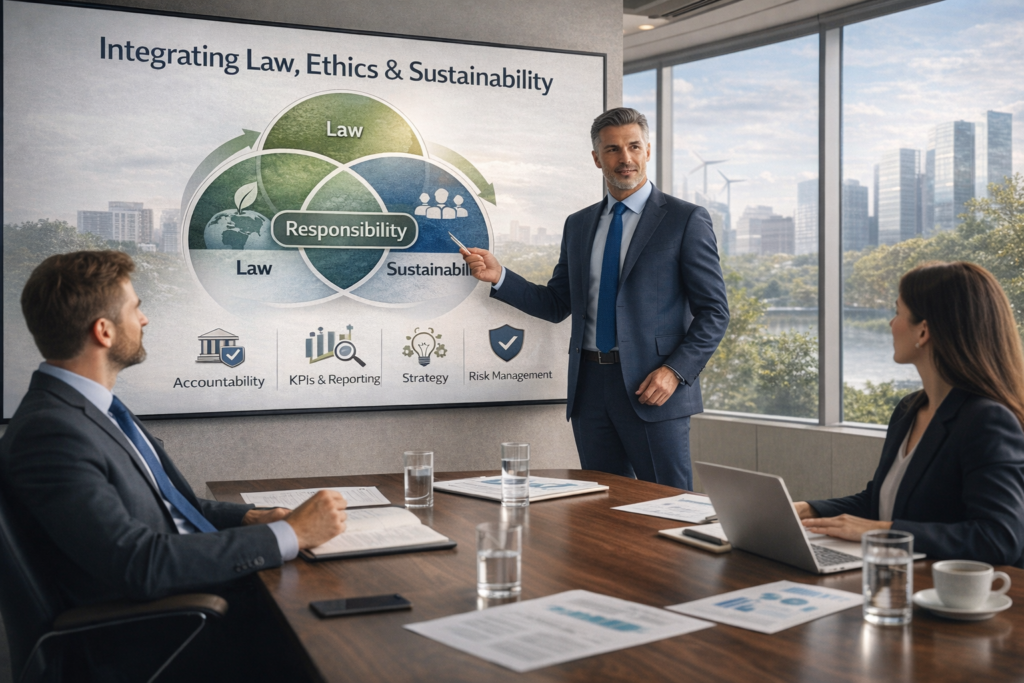
Integration occurs when these responsibilities reinforce each other and shape everyday organisational decision-making. Rather than being managed separately, they become embedded within the systems that govern how the organisation functions.
Governance as the Foundation of Responsible Organisations
Effective governance is essential for integrating responsible business practices. Governance structures determine how organisations are directed, controlled and held accountable.
In organisations where responsibility is fully integrated, boards of directors and senior leadership teams actively oversee issues such as compliance, ethical conduct and sustainability performance. These topics are discussed regularly at the highest levels rather than being delegated entirely to specialist departments.
Governance integration involves several key elements:
- clear accountability for legal compliance and ethical standards
- oversight of environmental and social sustainability goals
- transparent reporting on organisational performance
- systems that encourage open discussion of ethical concerns
Importantly, evaluating governance requires more than identifying whether committees or policies exist. The critical question is whether these structures genuinely influence behaviour.
An organisation may publish sustainability commitments or ethical codes, but if leadership decisions consistently prioritise short-term financial gains at the expense of responsible practices, integration remains weak. Conversely, organisations where governance systems actively shape strategy and operational decisions demonstrate a much stronger commitment to responsible management.
Measuring Responsibility Through Key Performance Indicators
For responsible practices to influence organisational behaviour, they must also be incorporated into how performance is measured.
Key Performance Indicators (KPIs) allow organisations to monitor progress, evaluate outcomes and communicate expectations across departments. In organisations where responsibility is genuinely embedded, sustainability and ethical considerations appear alongside traditional financial metrics.
Examples of responsible performance indicators may include:
- reductions in greenhouse gas emissions
- improvements in employee wellbeing and workplace safety
- progress toward diversity and inclusion goals
- responsible sourcing within supply chains
- reductions in environmental waste or energy consumption
By measuring these areas, organisations signal that responsible behaviour is not optional but central to how success is defined.
However, the effectiveness of KPIs depends on their quality and influence. Vague sustainability targets or symbolic indicators may do little to alter behaviour. Meaningful integration occurs when KPIs are measurable, regularly reviewed and linked to managerial accountability or incentives.
When leaders and employees understand that responsible performance affects evaluations and decision-making, responsible behaviour becomes embedded within organisational culture.
Strategy and the Alignment of Responsibility with Long-Term Goals
Perhaps the clearest evidence of integration appears within organisational strategy.
Responsible organisations do not treat legal compliance, ethics and sustainability as external constraints. Instead, they incorporate these considerations into the long-term decisions that shape markets, products, investments and partnerships.
Strategic integration can take many forms:
- investing in environmentally sustainable technologies
- redesigning products to reduce environmental impact
- selecting suppliers based on ethical labour practices
- developing services that support social wellbeing
- avoiding markets or practices that conflict with ethical principles
In these situations, responsibility becomes a driver of innovation and competitive advantage rather than a limitation.
Organisations that integrate sustainability into strategy are often better prepared for emerging challenges such as climate regulation, supply-chain disruptions or shifts in consumer expectations. By anticipating these changes, they can adapt more effectively than organisations that treat responsibility as a secondary concern.
Risk Management and Organisational Resilience
Risk management provides another important lens through which integration can be evaluated.
Modern organisations face a wide range of risks related to legal compliance, ethical misconduct and environmental or social impacts. These risks include regulatory penalties, reputational crises, supply-chain disruptions and stakeholder backlash.
Responsible organisations incorporate these risks into formal risk management frameworks. Legal, ethical and sustainability risks are monitored alongside financial and operational risks, ensuring that leadership teams consider them when making strategic decisions.
Examples of responsible risk management include:
- auditing supply chains to identify labour or environmental risks
- implementing anti-corruption training and reporting mechanisms
- monitoring environmental impacts and climate-related risks
- strengthening data protection and privacy safeguards
When risk management systems actively address these issues, organisations become better equipped to prevent crises and respond effectively when challenges arise.
Distinguishing Genuine Integration from Surface-Level Commitments
As sustainability and ethical responsibility have gained prominence, some organisations have been criticised for presenting commitments that are not fully reflected in their behaviour. Terms such as “greenwashing” describe situations where organisations promote responsible values without implementing meaningful change.
Evaluating integration therefore requires careful consideration of whether an organisation’s actions align with its stated principles.
Signs of strong integration include:
- governance systems that actively oversee responsible practices
- transparent reporting on sustainability performance
- measurable targets supported by clear performance indicators
- decision-making processes that reflect ethical considerations
- consistent behaviour across global operations and supply chains
In contrast, weak integration may be revealed when organisations make public commitments without supporting policies, measurement systems or operational changes.
Responsible organisations recognise that trust is built not through promises alone but through consistent behaviour over time.
Responsibility as a Strategic Advantage
Integrating legal, ethical and sustainability responsibilities ultimately strengthens organisational resilience and reputation. When responsible behaviour becomes part of an organisation’s identity, it supports stronger relationships with stakeholders, including customers, employees, investors and regulators.
These relationships represent valuable assets. Trust encourages customer loyalty, attracts talented employees and improves investor confidence. In many industries, responsible behaviour has become a key differentiator between organisations competing in increasingly transparent markets.
At the same time, integration helps organisations anticipate emerging risks and adapt to evolving expectations. Businesses that embed responsibility into governance, strategy and performance measurement are often better positioned to navigate regulatory change, technological disruption and shifting social priorities.
The Future of Responsible Organisations
As public awareness of environmental and social challenges grows, expectations placed on organisations will continue to evolve. Legal requirements may expand, ethical scrutiny may intensify and sustainability performance will increasingly influence investment and consumer behaviour.
Organisations that view responsibility as an integral part of their identity will be better prepared for this future. Those that treat it merely as a compliance obligation may struggle to maintain credibility in a world where transparency and accountability are becoming the norm.
The most successful organisations recognise that legal compliance, ethical conduct and sustainability are not competing priorities. Instead, they are mutually reinforcing elements of responsible leadership that contribute to long-term organisational success.
.
Interested in developing a deeper understanding of responsible business and strategic management?
Explore Click College’s online business courses designed to help learners explore the legal, ethical and strategic dimensions of modern organisations while building the skills needed for today’s business environment.
Click College offers a wide range of fully online accredited business management courses and qualifications to suit different academic backgrounds and career goals. Our programmes range from short 40 credit Professional Diplomas through to the 360 credit International Graduate Diploma, which is academically comparable to a bachelor’s degree. All courses are open access and available to learners worldwide.
With courses available in business management, marketing, finance, HR, hospitality & tourism and project management, Click College provides flexible learning pathways to support professional development, career progression or further study.
All Courses
Explore our courses and find a qualification that fits your goals and your schedule.
First Year of Undergraduate (Level 4 – 120 Credits)
The Higher International Certificate courses are accredited and delivered at Level 4 of the UK FHEQ framework, making them academically comparable to the first year of undergraduate study.
Years One and Two of Undergraduate (Level 5 – 240 Credits)
The Higher International Diploma courses are accredited and available with 240 Credits at Level 5 of the UK FHEQ framework, making it academically comparable to a Foundation Degree (UK) or an Associate Degree (US).
Degree-Comparable International Graduate Diploma (Level 6 – 360 Credits)
The International Graduate Diploma is accredited and delivered at Level 6 of the UK FHEQ framework. With 360 credits, it is academically comparable to a UK bachelor’s degree in terms of level and credit.



Recent Posts
Professional Diploma or Higher Qualification Pathway: Which Should You Choose?
Professional Diploma or Higher Qualification Pathway: Which Should You Choose? Choosing the right online qualification is not always simply a question of choosing the longest course or the highest level. For many learners, the better question is: what kind of study route fits my goals right now? Some learners want a focused qualification in one […]
Professional Diploma in Leadership and Management: Course Guide
Professional Diploma in Leadership and Management: Course Guide A Professional Diploma in Leadership and Management is designed for learners who want to develop advanced leadership, strategic thinking and organisational management skills without committing immediately to a full degree programme. Leadership and management are essential in almost every sector. Whether you work in business, education, hospitality, […]
Professional Diploma in Business Management: Who Is It For?
Professional Diploma in Business Management: Who Is It For? A Professional Diploma in Business Management is designed for learners who want to build practical business knowledge without committing immediately to a full degree or long higher education programme. It can be a useful option for people who want to understand how organisations work, how teams […]