Why Ethical Conduct Matters in Business
How integrity, fairness and transparency build trust and long-term success
In today’s business environment, organisations are judged not only by what they produce, but by how they behave. Customers, employees and investors increasingly expect organisations to act responsibly, treat people fairly and make decisions with integrity.
This is where ethical conduct becomes essential. Ethical conduct refers to behaving in a way that reflects honesty, fairness, responsibility and respect for others. While laws establish the minimum standards organisations must follow, ethics go further by guiding behaviour in situations where the law may not provide clear answers.
Businesses that prioritise ethical conduct often build stronger reputations, more loyal customers and more committed employees. Those that ignore it risk damaging trust, morale and long-term success.
What Is Ethical Conduct in Business?
Ethical conduct means making decisions based on moral principles and responsible judgement, considering how those decisions affect employees, customers, suppliers and the wider community.
Ethics influence everyday workplace behaviour, from how staff interact with each other to how organisations communicate with customers and manage challenges. In well-run organisations, ethical principles are embedded in company culture and guide employees when facing difficult decisions.
Importantly, ethical conduct is not just the responsibility of leaders. It is a shared responsibility across the organisation, shaping behaviour at every level.
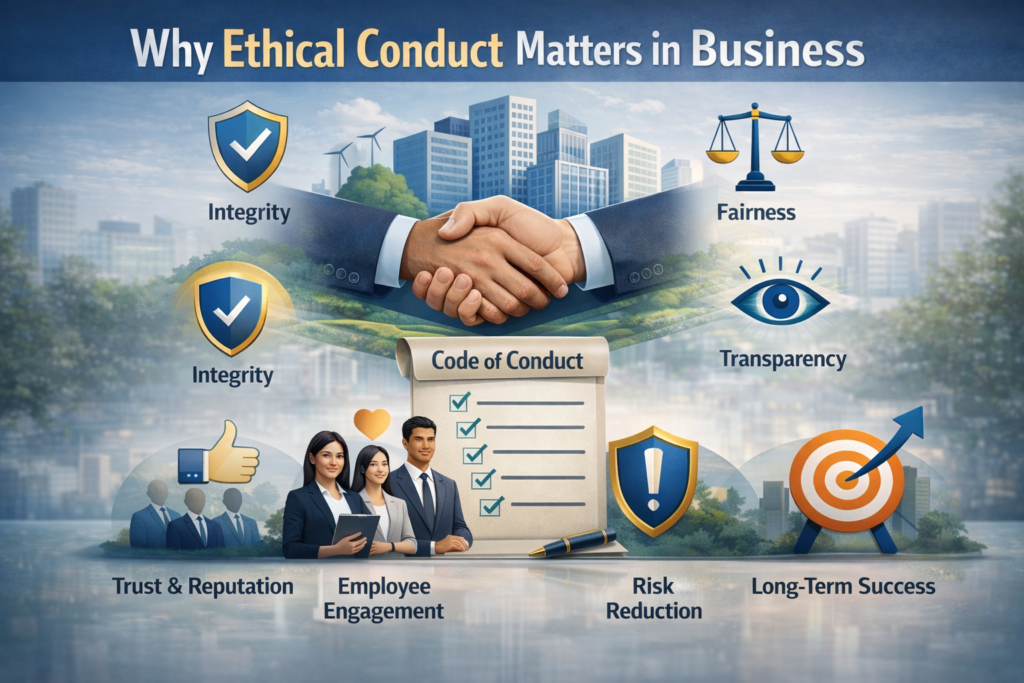
Integrity: The Foundation of Trust
One of the most important ethical principles in business is integrity.
Integrity means doing the right thing even when it may be difficult or inconvenient. It involves honesty in communication, keeping promises and accepting responsibility when mistakes occur.
Organisations that act with integrity earn trust from employees, customers and partners. When stakeholders believe an organisation is honest and reliable, they are more likely to maintain long-term relationships with it.
A lack of integrity can have the opposite effect. Misleading customers, hiding safety issues or exaggerating performance may produce short-term benefits, but these actions often lead to reputational damage, legal problems and loss of trust.
Fairness: Treating People Consistently and Respectfully
Another key ethical principle is fairness.
Fairness means treating people objectively and without discrimination. In the workplace, this influences recruitment decisions, pay structures, promotion opportunities and performance evaluations.
Employees are far more motivated and productive when they feel they are treated fairly. When fairness is absent, workplaces can experience low morale, conflict and high staff turnover.
Fairness also matters in relationships with customers and suppliers. Honest pricing, transparent communication and respectful negotiation demonstrate that an organisation values ethical behaviour and responsible decision-making.
Transparency: The Power of Openness
Transparency refers to openness in communication and decision making.
Transparent organisations provide clear information about policies, decisions and performance. They avoid misleading statements and explain changes that affect employees or customers.
Transparency helps build trust because stakeholders feel informed and respected. When organisations communicate honestly — even when facing challenges — they are more likely to maintain credibility.
In contrast, a lack of transparency can quickly damage relationships. When information is hidden or unclear, rumours and uncertainty often replace trust.
Codes of Conduct: Guiding Ethical Behaviour
Many organisations support ethical behaviour through codes of conduct.
A code of conduct is a formal document that outlines expected standards of behaviour within the organisation. It typically covers areas such as:
- honesty and integrity
- confidentiality and data protection
- conflicts of interest
- anti-bribery and corruption
- respectful treatment of colleagues and customers
These guidelines help employees understand how ethical principles apply to their daily work. They also provide a clear framework for addressing ethical dilemmas and resolving disputes.
When organisations publicly share their codes of conduct, they demonstrate a commitment to responsible business practices.
Why Ethical Conduct Supports Long-Term Success
Ethical conduct is not simply about avoiding wrongdoing — it plays a critical role in organisational success.
Businesses that act ethically often benefit from:
Stronger reputation
Customers and investors are more likely to trust organisations known for responsible behaviour.
Higher employee engagement
People prefer to work in organisations that treat individuals fairly and operate with integrity.
Reduced organisational risk
Many corporate scandals arise from unethical decision making rather than a lack of legal knowledge.
Better long-term decision making
Ethics encourage organisations to consider long-term consequences rather than focusing only on short-term profit.
When ethics guide decision making, organisations can build sustainable relationships with stakeholders and maintain credibility in competitive markets.
Ethical Challenges in the Real World
Even organisations with strong ethical values can face difficult decisions.
Businesses may experience tension between profitability and responsibility, or between speed and careful decision making. Ethical dilemmas arise when organisations must weigh different priorities and consider the consequences of each option.
To support responsible decision making, many organisations provide ethics training, confidential reporting channels and dedicated ethics officers. These systems allow employees to raise concerns, seek advice and report potential issues safely.
Creating a culture where ethical behaviour is encouraged and supported helps organisations navigate these challenges responsibly.
Ethics as a Competitive Advantage
In modern business, ethical conduct is no longer optional. It has become a key factor in building trust, protecting reputation and ensuring long-term success.
Organisations that demonstrate integrity, fairness and transparency are more likely to earn the confidence of employees, customers and communities. Over time, this trust becomes a powerful competitive advantage.
For students studying business and management, understanding ethical conduct is essential. Ethical decision making shapes organisational culture, strengthens leadership and ensures businesses contribute positively to society.
Interested in learning more about how businesses operate responsibly?
Explore Click College’s online business courses designed to help you understand the legal, ethical and strategic foundations of modern organisations.
Click College offers a wide range of fully online accredited business management courses and qualifications to suit different academic backgrounds and career goals. Our programmes range from short 40 credit Professional Diplomas through to the 360 credit International Graduate Diploma, which is academically comparable to a bachelor’s degree. All courses are open access and available to learners worldwide.
With courses available in business management, marketing, finance, HR, hospitality & tourism and project management, Click College provides flexible learning pathways to support professional development, career progression or further study.
All Courses
Explore our courses and find a qualification that fits your goals and your schedule.
First Year of Undergraduate (Level 4 – 120 Credits)
The Higher International Certificate courses are accredited and delivered at Level 4 of the UK FHEQ framework, making them academically comparable to the first year of undergraduate study.
Years One and Two of Undergraduate (Level 5 – 240 Credits)
The Higher International Diploma courses are accredited and available with 240 Credits at Level 5 of the UK FHEQ framework, making it academically comparable to a Foundation Degree (UK) or an Associate Degree (US).
Degree-Comparable International Graduate Diploma (Level 6 – 360 Credits)
The International Graduate Diploma is accredited and delivered at Level 6 of the UK FHEQ framework. With 360 credits, it is academically comparable to a UK bachelor’s degree in terms of level and credits.



Recent Posts
Professional Diploma or Higher Qualification Pathway: Which Should You Choose?
Professional Diploma or Higher Qualification Pathway: Which Should You Choose? Choosing the right online qualification is not always simply a question of choosing the longest course or the highest level. For many learners, the better question is: what kind of study route fits my goals right now? Some learners want a focused qualification in one […]
Professional Diploma in Leadership and Management: Course Guide
Professional Diploma in Leadership and Management: Course Guide A Professional Diploma in Leadership and Management is designed for learners who want to develop advanced leadership, strategic thinking and organisational management skills without committing immediately to a full degree programme. Leadership and management are essential in almost every sector. Whether you work in business, education, hospitality, […]
Professional Diploma in Business Management: Who Is It For?
Professional Diploma in Business Management: Who Is It For? A Professional Diploma in Business Management is designed for learners who want to build practical business knowledge without committing immediately to a full degree or long higher education programme. It can be a useful option for people who want to understand how organisations work, how teams […]