Service-Based vs Product-Based Organisations: Key Differences in Business Operations
Introduction
In modern business environments, organisations are commonly classified as either service-based or product-based. While both types aim to create value and satisfy customer needs, they differ significantly in how that value is produced, delivered, and evaluated. These distinctions are particularly relevant in sectors such as hospitality, tourism, and retail, where the nature of the offering shapes both operational strategy and customer experience. Understanding these differences provides an essential foundation for analysing how businesses compete and maintain quality in different contexts.
Tangibility and the Nature of the Offering
A fundamental distinction between service-based and product-based organisations lies in the nature of what they offer. Product-based organisations focus on the creation of tangible goods—items such as electronics, clothing, or furniture—which can be physically handled, stored, and inspected prior to purchase. In contrast, service-based organisations provide intangible outputs, including experiences, assistance, and activities. Businesses such as hotels, airlines, and restaurants exemplify this approach, as they deliver value through interaction rather than ownership.
The intangible nature of services introduces a degree of uncertainty for customers. Unlike products, which can be evaluated before purchase, services are typically assessed only after or during consumption. As a result, customers rely heavily on signals such as brand reputation, online reviews, and prior experience when forming expectations (Zeithaml, Bitner and Gremler, 2018). This reliance increases the importance of trust and consistency in service-based organisations, where perceived quality often determines customer loyalty.
Customer Involvement and the Co-Creation of Value
Another defining feature of service-based organisations is the level of customer involvement in the production process. In product-based organisations, production and consumption are typically separated. Goods are manufactured in controlled environments and distributed through supply chains before reaching the customer. This separation allows firms to standardise processes and maintain consistency through quality control mechanisms.
In contrast, service-based organisations involve customers directly in the delivery process. The concept of co-creation of value highlights how customers actively participate in shaping their own experience (Grönroos, 2008). For example, a hotel guest checking in or a diner interacting with restaurant staff contributes to the outcome of the service encounter. This interaction introduces variability, as the quality of the service depends not only on organisational processes but also on customer behaviour and expectations.
Measuring Quality in Products and Services
The way in which quality is defined and assessed differs significantly between product-based and service-based organisations. In manufacturing contexts, quality is often measured using objective criteria such as durability, reliability, and conformance to specifications. These attributes can be monitored through established quality control systems before the product reaches the customer.
Service quality, however, is more complex and subjective. It is influenced by both functional and emotional factors, including responsiveness, empathy, and the overall service environment. The SERVQUAL model developed by Parasuraman, Zeithaml and Berry (1988) emphasises dimensions such as reliability, assurance, and responsiveness as key determinants of perceived service quality.
Because services are experienced rather than owned, customer perception plays a central role. A technically efficient service may still be judged negatively if it fails to meet expectations in terms of communication or personal interaction. This highlights the importance of managing both operational performance and customer experience simultaneously.
Simultaneous Production and Consumption
One of the most important characteristics that differentiates service-based organisations is simultaneous production and consumption. Unlike physical goods, which are produced in advance and consumed later, services are typically created and experienced in real time.
This concept reflects the inseparability of production and consumption in service contexts (Lovelock and Wirtz, 2021). For instance, in a restaurant, the preparation and consumption of a meal occur within the same timeframe, with the customer actively engaged throughout the process. Similarly, a hotel check-in is delivered and received simultaneously, with no opportunity to produce the service in advance.
The implication is that services do not exist independently of the customer. Instead, they are realised through interaction, making each service encounter unique and context-dependent.
Operational Implications of Real-Time Service Delivery
The real-time nature of service delivery has significant implications for organisational management. First, it limits the ability to standardise processes to the same extent as in manufacturing environments. While procedures can be established, the variability introduced by human interaction means that outcomes cannot be fully controlled.
Second, simultaneous production and consumption reduce the opportunity to identify and correct errors before they affect the customer. In product-based organisations, defects can often be detected during inspection stages. In service-based organisations, however, mistakes are experienced immediately. A delayed meal, an unprepared hotel room, or ineffective communication during a booking process can directly impact customer satisfaction at the moment it occurs.
This immediacy places considerable emphasis on employee performance. Staff must be capable of responding quickly and effectively to problems, often in real time. As noted by Bowen and Schneider (2014), frontline employees play a critical role in shaping customer perceptions and organisational outcomes in service environments.
Case Application: The Restaurant Experience
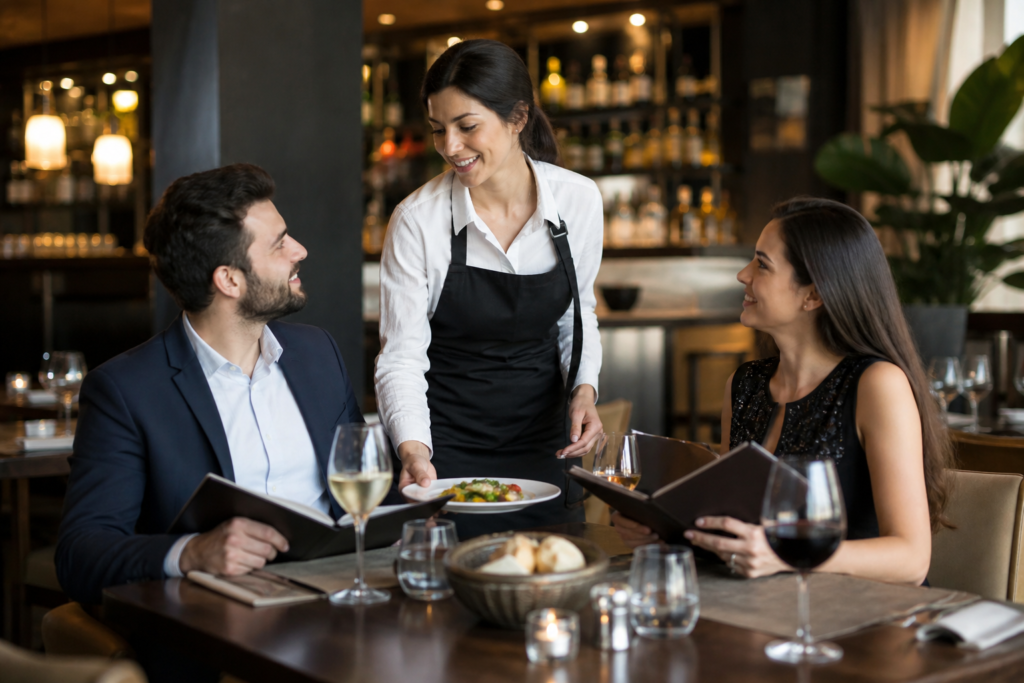
The restaurant setting provides a clear illustration of how these concepts operate in practice. When a customer dines in a restaurant, the service is not pre-produced in its entirety. Instead, it unfolds through a sequence of interactions involving ordering, preparation, service delivery, and customer engagement.
The customer experiences multiple elements simultaneously, including food quality, staff behaviour, and the atmosphere of the environment. Any disruption—such as delays or errors—becomes immediately apparent and can influence overall satisfaction. This example demonstrates how service quality is co-created in real time and why consistency is particularly challenging in service-based organisations.
Why These Distinctions Matter in Business Practice
Recognising the differences between service-based and product-based organisations is essential for understanding how businesses design their operations and manage customer relationships. While product-based organisations can rely more heavily on standardisation and pre-delivery quality control, service-based organisations must prioritise real-time performance, employee behaviour, and customer interaction.
These distinctions also explain why strategies that are effective in manufacturing contexts may not translate directly to service environments. The emphasis shifts from controlling production processes to managing experiences, perceptions, and relationships as they occur.
References
Bowen, D.E. and Schneider, B. (2014) A service climate synthesis and future research agenda. Journal of Service Research, 17(1), pp. 5–22.
Grönroos, C. (2008) ‘Service logic revisited: who creates value? And who co‐creates?’, European Business Review, 20(4), pp. 298–314.
Lovelock, C. and Wirtz, J. (2021) Services Marketing: People, Technology, Strategy. 9th edn. Singapore: World Scientific.
Parasuraman, A., Zeithaml, V.A. and Berry, L.L. (1988) ‘SERVQUAL: A multiple-item scale for measuring consumer perceptions of service quality’, Journal of Retailing, 64(1), pp. 12–40.
Zeithaml, V.A., Bitner, M.J. and Gremler, D.D. (2018) Services Marketing: Integrating Customer Focus Across the Firm. 7th edn. New York: McGraw-Hill.
View Courses in Hospitality and Tourism…
Start your journey in hospitality and tourism with an accredited Click College course. Enrol today and build the skills, knowledge, and confidence to progress into a management role.







Recent Posts
Professional Diploma or Higher Qualification Pathway: Which Should You Choose?
Professional Diploma or Higher Qualification Pathway: Which Should You Choose? Choosing the right online qualification is not always simply a question of choosing the longest course or the highest level. For many learners, the better question is: what kind of study route fits my goals right now? Some learners want a focused qualification in one […]
Professional Diploma in Leadership and Management: Course Guide
Professional Diploma in Leadership and Management: Course Guide A Professional Diploma in Leadership and Management is designed for learners who want to develop advanced leadership, strategic thinking and organisational management skills without committing immediately to a full degree programme. Leadership and management are essential in almost every sector. Whether you work in business, education, hospitality, […]
Professional Diploma in Business Management: Who Is It For?
Professional Diploma in Business Management: Who Is It For? A Professional Diploma in Business Management is designed for learners who want to build practical business knowledge without committing immediately to a full degree or long higher education programme. It can be a useful option for people who want to understand how organisations work, how teams […]