What Is the Role of Marketing in an Organisation?
When people hear the word marketing, they often think of advertising, social media posts or sales promotions. These activities are part of marketing, but they do not tell the whole story.
The role of marketing in an organisation is much broader. Marketing management helps a business understand its customers, create genuine value, communicate a clear offer and build lasting relationships. It also connects customer needs with decisions made across the organisation, from product design and pricing to operations and customer service.
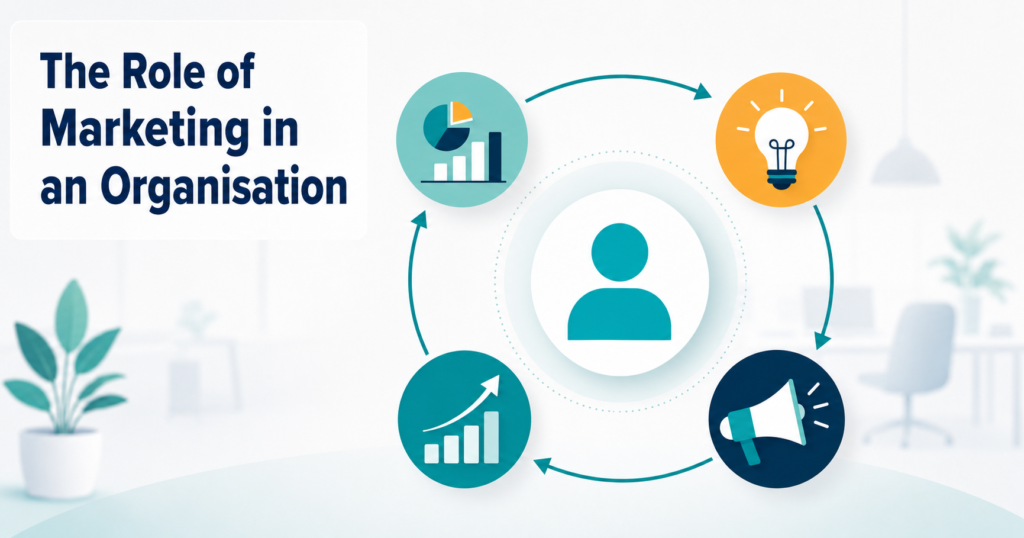
In this guide, we explore the purpose of marketing, its contribution to organisational goals and why customer insight, satisfaction and market orientation are so important.
What Is Marketing?
Marketing is an ongoing management process through which an organisation identifies, anticipates and responds to customer needs. These foundations are explored in Click College’s Professional Diploma in Marketing. In practice, marketing helps the organisation decide:
- What products, services or experiences to offer
- Which customer groups to serve
- How to create and communicate value
- How to compete effectively in its chosen market
This means marketing begins long before an advertisement is created. It influences the offer itself: its features, quality, service standards, price, accessibility and overall customer experience.
Effective marketing also continues after a sale. Feedback, reviews, complaints and customer behaviour help an organisation assess whether it is delivering what it promised and identify where improvements are needed.
What Is the Purpose of Marketing?
The main purpose of marketing is to create customer value in a way that also supports the organisation’s objectives.
Customers judge value by comparing what they receive with what they must give up. Price is important, but it is only one part of this judgement. Customers may also consider the time, effort, uncertainty and inconvenience involved in choosing and using an offer.
Customer value can therefore take several forms:
- Functional value: The product or service performs well, solves a problem or provides reliable results.
- Emotional value: The experience creates confidence, reassurance, enjoyment or reduced stress.
- Social value: The offer supports the customer’s identity, status, community or personal values.
- Convenience value: The organisation makes the offer easy to find, buy, use, return or access.
Strong marketing considers the complete package rather than focusing on a single feature. For example, a competitively priced service may still offer poor value if booking is difficult, support is slow or the customer feels uncertain throughout the process.
The Role of a Value Proposition
A value proposition is a clear promise explaining why a particular customer should choose an organisation’s offer rather than an alternative. It should identify:
- Who the offer is for
- What problem or need it addresses
- What benefits it provides
- Why it is meaningfully different
A value proposition must be credible. If an organisation promises speed, personal support or high quality, its staff, systems and operations must deliver that experience consistently. A strong promotional message cannot compensate for a weak customer experience.
When the promise and the experience match, customers are more likely to trust the organisation. When they do not, even a technically acceptable product can leave customers feeling disappointed or misled.
How Marketing Creates Customer Satisfaction
Customer satisfaction is the judgement a customer makes after comparing expectations with actual performance.
- If performance falls below expectations, the customer is likely to be dissatisfied.
- If performance matches expectations, the customer is likely to feel satisfied.
- If performance exceeds expectations, the customer may feel particularly pleased and become a strong advocate for the organisation.
However, satisfaction, service quality and customer experience are not exactly the same.
Service quality concerns how well a service is delivered, including reliability, responsiveness and the confidence created by staff. Customer experience covers the entire journey across every touchpoint, such as the website, purchasing process, delivery, support, returns and complaints. Customer satisfaction is the customer’s overall evaluation following some or all of that experience.
Satisfaction matters because it can influence what customers do next. Satisfied customers may be more likely to remain with the organisation, make repeat purchases and recommend it to others. Dissatisfied customers may complain, switch to a competitor or share negative feedback.
Over time, these behaviours can affect reputation, customer retention, market share and financial performance. Customer satisfaction is therefore a strategic concern, not simply a customer-service measure.
How Marketing Supports Organisational Goals
Organisations pursue different goals. A commercial business may prioritise revenue, profit or market share, while a charity, public body or educational organisation may focus on participation, awareness or wider social impact.
Marketing acts as a bridge between these goals and the market. It turns broad strategic aims into practical choices about customers, positioning, the offer and the marketing mix.
1. Identifying Target Markets
Marketing helps an organisation divide a broad market into meaningful customer groups and decide which segments to prioritise. This allows resources to be concentrated on customers whose needs the organisation is well placed to meet.
A clearly defined target market also makes it easier to design relevant services and produce focused communications. Trying to appeal to everyone can lead to an unclear offer that appeals strongly to no one.
2. Establishing a Clear Position
Positioning is the place an organisation wants to hold in the customer’s mind. It answers a simple question: what should people associate with this organisation rather than its competitors?
That position might be based on quality, affordability, convenience, specialist expertise, innovation or personal service. Clear positioning can strengthen recognition, trust and perceived value.
3. Shaping Products and Services
Customer insight helps organisations choose the features, standards and experiences that matter most to their target market. This reduces the risk of investing in changes that customers do not value and helps the organisation improve its offer over time.
4. Coordinating the Marketing Mix
The marketing mix turns strategy into action. Product decisions shape what is offered. Price affects affordability, profitability and perceptions of value. Place determines how easily customers can access the offer. Promotion builds awareness and explains why the offer is relevant.
These decisions must work together. A premium position, for example, needs to be supported by suitable quality, service, pricing, distribution and communication.
Why Marketing Must Work With Other Departments
Marketing cannot create value alone. Because it influences the promises made to customers, it must work closely with other organisational functions. This connection is also central to the wider study of Business Management, where marketing is considered alongside finance, operations, leadership and organisational decision-making.
- Operations delivers the promised quality, availability, speed and reliability.
- Finance considers budgets, costs, margins and whether the proposed activity is sustainable.
- Customer service provides insight into recurring questions, complaints, expectations and unmet needs.
- Sales shares direct knowledge about buyer concerns, objections and decision-making.
- Product or service teams turn customer insight into improvements and new solutions.
When departments work in isolation, customers may receive inconsistent messages or experiences. Marketing might promise quick delivery, for instance, while operations lacks the capacity to provide it. Coordination helps ensure that what the organisation says matches what it does.
What Is Market Orientation?
Market orientation is an organisation-wide approach that begins with the market rather than with whatever the organisation already produces. It combines three important elements:
- A strong understanding of customers
- Awareness of competitors and alternative solutions
- A coordinated response across the organisation
A market-oriented organisation continually asks what customers are trying to achieve, what frustrates them and what a better experience would look like. It also studies competitors without simply copying them. The aim is to identify opportunities to provide distinctive value.
Most importantly, insight must lead to action. Information gathered by marketing should influence product development, operations, customer service, pricing and digital experiences. Market orientation is therefore a way of managing the whole organisation, not just the marketing department.
How Organisations Develop Customer Insight
Customer insight is valuable when it improves a decision. Organisations can gather insight from:
- Surveys, interviews and focus groups
- Online reviews and customer feedback
- Complaints and customer-service records
- Website, purchasing and usage data
- Customer retention and cancellation patterns
- Competitor analysis
- Conversations handled by frontline staff
No single source provides a complete picture. Survey responses show what customers say, while behavioural data can reveal what they actually do. Combining different sources allows an organisation to identify patterns, test assumptions and make more informed choices.
Learners who want to examine this area in greater depth can explore the Higher International Diploma in Marketing Management, which includes market research, insight generation and data-informed marketing decisions.
These insights might lead a business to simplify an online journey, change a service feature, adjust its pricing, focus on a different customer group or rewrite a message that customers find unclear.
What Happens When Market Orientation Is Weak?
An organisation with weak market orientation may become too focused on its existing products, internal preferences or short-term sales targets. This can lead to:
- Misunderstanding customer needs
- Investing in features customers do not value
- Overlooking changes in competitor activity
- Making promises the organisation cannot deliver
- Creating inconsistent customer journeys
- Wasting marketing resources
- Losing customers to more responsive competitors
The risk is not only a disappointing campaign. Over time, poor insight and weak coordination can reduce customer value, satisfaction, loyalty and organisational performance.
How Can Marketing Performance Be Measured?
Marketing should be measured against the organisational goal it is intended to support. Useful measures may include:
- Growth: Enquiries, new customers, conversion rates and sales volume
- Profitability: Profit margin, customer acquisition cost and customer lifetime value
- Reputation: Brand awareness, customer sentiment, trust and relevant brand associations
- Customer relationships: Retention, repeat purchase, satisfaction and recommendations
- Digital performance: Website traffic, engagement, lead generation and online conversions
Tracking large numbers of disconnected figures can create noise rather than insight. The most useful measures show whether marketing decisions are helping the organisation achieve a clearly defined goal.
Develop Your Marketing Knowledge with Click College
If you would like to develop these ideas through structured study, Click College offers flexible online routes for different levels of experience and professional goals:
- The Professional Diploma in Marketing provides a shorter introduction to essential marketing concepts and practice.
- The Higher International Certificate in Marketing Management develops a broader foundation in marketing, business and organisational studies.
- The Higher International Diploma in Marketing Management advances into strategic marketing, consumer behaviour, digital practice, research and customer insight.
- The International Graduate Diploma in Marketing Management supports higher-level study in strategic decision-making, global marketing, consumer psychology and brand management.
You can compare the full pathway on the Marketing Management courses page. If you are deciding where to begin, read the complete guide to Click College courses and qualifications or learn more about how online study works.
Key Takeaways
The role of marketing in an organisation is to understand the market and help the organisation create, communicate and deliver meaningful customer value. It influences who the organisation serves, what it offers, how it competes and how it builds sustainable customer relationships.
Marketing is most effective when it is treated as an organisation-wide management process. Customer insight must inform real decisions, departments must work together and the experience delivered must match the value promised.
Understanding these principles can help learners, managers and aspiring marketing professionals see why marketing is central to organisational performance—not simply a department responsible for advertising.
Develop Your Marketing and ManagementSkills
Want to develop your understanding of marketing and business management? Explore Click College’s Marketing Management courses and choose the flexible online qualification that best supports your next step.
Alternatively, view our Business Management courses and start studying online today.







Recent Posts
How to Build Trust Before a Customer Buys
How to Build Trust Before a Customer Buys Before a customer buys from an unfamiliar business, they are making more than a price comparison. They are deciding whether the offer is genuine, whether the organisation will deliver what it promises and whether help will be available if something goes wrong. That is why trust is […]
Why Customers Switch: The Trust and Value Signals That Drive Churn
Why Customers Switch: The Trust and Value Signals That Drive Churn Customers rarely switch simply because a competitor is cheaper. They switch when the relationship no longer feels safe, fair or worth the effort. A price rise may trigger the search, but unclear charges, poor support, weak proof and uncertainty about what happens next are […]
How to Find and Fix Friction in the Buying Journey
How to Find and Fix Friction in the Buying Journey Customers rarely decide not to buy for one dramatic reason. More often, small difficulties build up: a confusing product page, unclear pricing, a slow reply, an awkward form, conflicting information or a delivery promise that feels uncertain. Each issue may appear minor in isolation. Together, […]