What Is an FHEQ Level? UK Higher Education Levels Explained
Introduction
When choosing an online qualification, you may see courses described as Level 4, Level 5 or Level 6. You may also see references to an FHEQ level.
An FHEQ level tells you how academically advanced a higher education qualification is. The term comes from the Framework for Higher Education Qualifications, which is used to describe the levels of higher education qualifications in England, Wales and Northern Ireland [1].
Understanding FHEQ levels is useful because it helps you compare qualifications more clearly. For example, it can help you understand whether a course is similar in level to the first year of university, the second year of university or bachelor’s degree-level study.
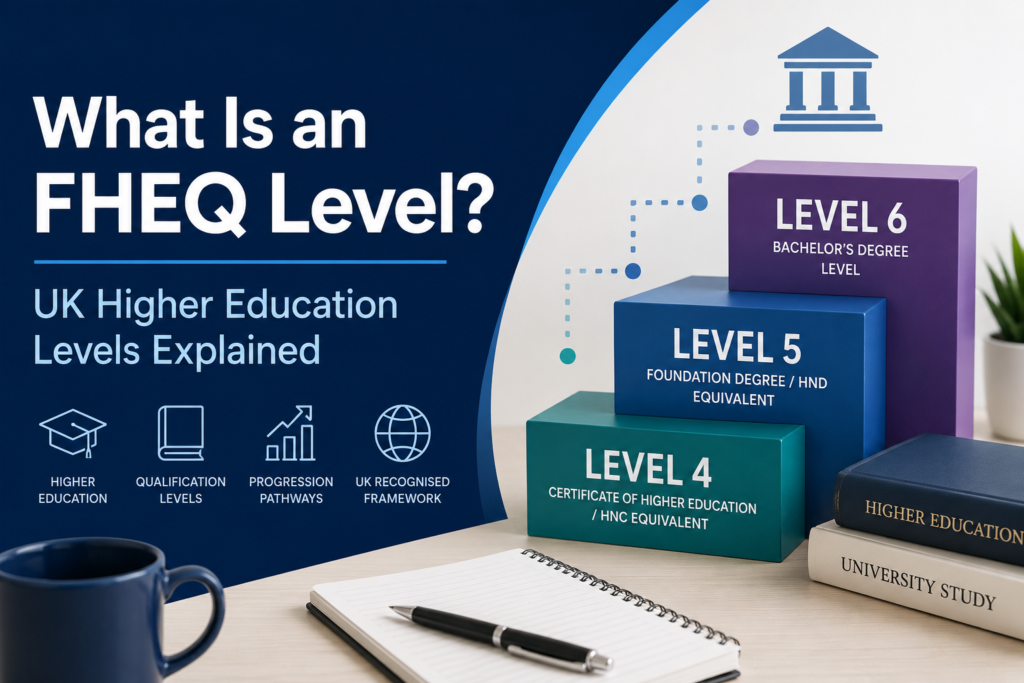
For Click College learners, this is especially important because Click College offers flexible online qualifications across Level 4, Level 5 and Level 6.
You can compare Click College qualification levels here.
What does FHEQ mean?
FHEQ stands for Framework for Higher Education Qualifications.
It is a UK higher education framework that helps describe the academic level of higher education qualifications. The Quality Assurance Agency explains that qualification frameworks set out different levels of higher education qualifications and the requirements for each of those levels [1].
In simple terms, the FHEQ helps answer questions such as:
- How advanced is this qualification?
- What type of knowledge and skills does the qualification represent?
- Is this course at undergraduate level?
- Is this course at bachelor’s degree level?
- What qualification could I progress to next?
This is helpful because qualification names can sometimes be confusing. A certificate, diploma or graduate diploma may sound similar, but the level and size of the qualification can vary.
The FHEQ gives learners a clearer way to understand the academic level of a qualification.
What is an FHEQ level?
An FHEQ level is a way of describing how advanced a higher education qualification is.
In England, Wales and Northern Ireland, higher education qualifications are typically described across FHEQ Levels 4 to 8 [1].
Each level represents a different stage of academic complexity:
| FHEQ level | Broad academic stage |
|---|---|
| Level 4 | First stage of higher education |
| Level 5 | Intermediate undergraduate-level study |
| Level 6 | Bachelor’s degree-level study |
| Level 7 | Master’s degree-level study |
| Level 8 | Doctoral-level study |
Click College focuses on career-focused qualifications at Levels 4, 5 and 6, which means learners can follow a structured online pathway through undergraduate-level study.
You can explore Click College qualifications here:
https://clickcollege.com/qualifications
What is FHEQ Level 4?
FHEQ Level 4 is the first stage of higher education. It is commonly compared with the first year of undergraduate study.
GOV.UK lists examples of Level 4 qualifications including a Certificate of Higher Education, Higher National Certificate, Level 4 Certificate and Level 4 Diploma [2].
At Level 4, learners are usually developing:
- foundational knowledge of a subject area
- the ability to explain key concepts
- confidence with academic study
- early analytical and problem-solving skills
- understanding of how theory applies to real situations
Level 4 can be a good starting point for learners who are new to higher education or returning to study after a break.
At Click College, the Higher International Certificate is a Level 4 qualification designed to provide a structured introduction to university-level study.
>> View the Higher International Certificate route.
What is FHEQ Level 5?
FHEQ Level 5 is the next stage after Level 4. It is commonly compared with the second year of undergraduate study.
GOV.UK lists examples of Level 5 qualifications including a Diploma of Higher Education, Foundation Degree, Higher National Diploma, Level 5 Certificate and Level 5 Diploma [2].
At Level 5, learners are expected to go beyond describing ideas. They begin to:
- apply concepts to more complex situations
- compare different approaches
- evaluate information more critically
- use evidence to support decisions
- develop more independent judgement
This level may be suitable for learners who have already completed Level 4 study, have relevant professional experience, or want to progress towards more advanced management or specialist roles.
At Click College, the Higher International Diploma provides a Level 5 pathway for learners who want to build on Level 4 knowledge and move further through undergraduate-level study.
>> View the Higher International Diploma route.
What is FHEQ Level 6?
FHEQ Level 6 is bachelor’s degree level. It is usually associated with the final stage of undergraduate study.
GOV.UK lists examples of Level 6 qualifications including bachelor’s degrees with honours, graduate diplomas, Level 6 Certificates and Level 6 Diplomas [2].
At Level 6, learners are expected to show more advanced academic and professional ability. This may include:
- critical analysis
- independent thinking
- evaluation of complex information
- application of theory to professional situations
- development of well-supported arguments and recommendations
For learners aiming to demonstrate graduate-level knowledge, Level 6 is often an important academic milestone.
At Click College, the International Graduate Diploma provides a Level 6 route for learners who want to develop higher-level knowledge in career-focused subjects.
View the International Graduate Diploma route.
FHEQ Levels 4, 5 and 6 compared
The easiest way to understand FHEQ levels is to compare them side by side.
| FHEQ level | Common comparison | Typical learner focus |
|---|---|---|
| Level 4 | First year of undergraduate study / HNC-style level | Build subject foundations |
| Level 5 | Second year of undergraduate study / HND-style level | Apply and evaluate knowledge |
| Level 6 | Bachelor’s degree-level study | Analyse, judge and apply ideas at a higher level |
For many learners, these levels form a clear progression route:
Level 4 → Level 5 → Level 6
This allows learners to build confidence gradually rather than having to commit to a traditional university route from the start.
Is an FHEQ level the same as a qualification title?
No. The level and the title are different.
The qualification title tells you what the qualification is called.
The FHEQ level tells you how academically advanced it is.
For example, a “diploma” could exist at different levels depending on the qualification. A Level 4 Diploma and a Level 6 Diploma are not the same academic level, even though both use the word “diploma”.
This is why learners should always look beyond the course title and check:
- the level
- the credit value
- the subject area
- the awarding or accrediting body
- the progression route
- the assessment method
This helps you choose a qualification that fits your current experience and future career goals.
How do FHEQ levels relate to credits?
FHEQ levels describe the difficulty or academic demand of a qualification.
Credits describe the size or volume of learning.
These two things work together.
For example, a course could be at Level 4 but have a smaller or larger credit value. A short professional diploma may involve fewer credits than a full higher education qualification, even if both are useful for career development.
The QAA’s Higher Education Credit Framework for England explains that credit supports transparency and helps represent the amount of learning achieved [3].
A common UK credit principle is:
1 credit = approximately 10 hours of learning [3].
This means:
| Credit value | Click College Approximate learning time |
|---|---|
| 40 credits | Around 2-6 months |
| 120 credits | Around 6-12 months |
| 240 credits | Around 12-24 months |
| 360 credits | Around 24-36 months |
Read more about Click College qualification credits.
How does an FHEQ level differ from an RQF level?
FHEQ and RQF levels are related, but they are not exactly the same.
The FHEQ is used for higher education qualifications.
The RQF, or Regulated Qualifications Framework, is used for regulated qualifications in England and Northern Ireland more broadly.
Ofqual explains that RQF level descriptors describe the general knowledge and skills associated with qualifications at each level, and that Levels 4 to 8 are intended to be consistent with the five levels of the FHEQ in England, Wales and Northern Ireland [4].
So, while FHEQ and RQF levels can often be compared at Levels 4 to 8, they are used in different contexts.
For learners, the key point is simple:
FHEQ Levels 4, 5 and 6 are higher education levels.
Why do FHEQ levels matter to online learners?
FHEQ levels are especially useful for online learners because they help make course comparison clearer.
When searching online, you may see many different course titles, such as:
- certificate
- diploma
- professional diploma
- higher diploma
- graduate diploma
- degree pathway
- top-up qualification
Without understanding the level, it can be hard to know how these courses compare.
An FHEQ level helps you understand whether the course is:
- introductory higher education
- intermediate undergraduate-level study
- bachelor’s degree-level study
- postgraduate-level study
This makes it easier to choose a course that is neither too basic nor too advanced for your current stage.
Which FHEQ level should I start with?
The right starting point depends on your current education, work experience and confidence.
| Your background | Possible starting point |
|---|---|
| New to higher education | Level 4 |
| Some prior study or relevant experience | Level 4 or Level 5 |
| Existing Level 5 qualification or equivalent experience | Level 6 |
| Looking for focused career development | Professional Diploma |
| Wanting a full pathway | International Graduate Diploma as this incorporates Level 4, then Level 5, then Level 6 |
If you are unsure, Level 4 is often the most accessible starting point because it introduces higher education-level study in a structured way.
Learners with previous qualifications or substantial relevant experience may be able to consider a higher starting point depending on the course and eligibility.
What should I check before choosing a qualification level?
Before choosing a course, it is useful to check:
- The level
This tells you how advanced the learning is. - The credits
This tells you the size of the qualification. - The subject area
This should match your career goals. - The assessment method
Some learners prefer coursework-based assessment rather than exams. - The study method
Online, flexible study can be especially useful for working adults. - The progression route
Check whether the qualification can lead to further study. - Recognition and accreditation
Look at who accredits or awards the qualification and how the level is described.
Click College explains its qualification levels and pathways to help learners compare options before choosing a course.
You can view the qualification levels page here.
FHEQ levels explained in simple terms
Here is a plain-English summary:
FHEQ Level 4
This is the beginning of higher education. It is often compared with the first year of university.
FHEQ Level 5
This is the next stage of undergraduate-level study. It is often compared with the second year of university.
FHEQ Level 6
This is bachelor’s degree level. It is associated with more advanced analysis and independent judgement.
FHEQ Level 7
This is master’s degree level.
FHEQ Level 8
This is doctoral level.
For most Click College learners, the most relevant levels are Level 4, Level 5 and Level 6.
Study FHEQ-aligned qualification levels online with Click College
Understanding FHEQ levels can help you make a more informed choice about your next step in education.
Whether you are starting higher education for the first time, returning to study as an adult learner, or looking to progress in your career, knowing the difference between Level 4, Level 5 and Level 6 can help you choose the right course.
Click College offers flexible online qualifications across a range of career-focused subject areas, including business, management, marketing, finance, human resources, hospitality and tourism, and project management.
To compare Click College qualification levels and choose your next step, click here.
FAQs
What does FHEQ level mean?
An FHEQ level describes the academic level of a higher education qualification. It helps show how advanced the learning is within the UK higher education system [1].
What does FHEQ stand for?
FHEQ stands for Framework for Higher Education Qualifications.
What level is the first year of university?
The first year of undergraduate study is commonly associated with Level 4 [2].
What level is the second year of university?
The second year of undergraduate study is commonly associated with Level 5 [2].
What level is a bachelor’s degree?
A bachelor’s degree is commonly associated with Level 6 [2].
Is Level 4 higher education?
Yes. Level 4 is the first stage of higher education in England, Wales and Northern Ireland.
Is Level 5 the same as an HND?
Level 5 is the level commonly associated with Higher National Diplomas, Foundation Degrees and other Level 5 qualifications [2].
Is Level 6 the same as a degree?
Level 6 is bachelor’s degree level. However, the exact qualification title, credit value and awarding arrangements still matter.
Are FHEQ and RQF levels the same?
They are related but not identical. The FHEQ is used for higher education qualifications, while the RQF is used for regulated qualifications in England and Northern Ireland. Ofqual explains that Levels 4 to 8 are intended to be consistent with the five FHEQ levels [4].
Can I study FHEQ-level qualifications online?
Yes. Click College offers flexible online qualifications across Level 4, Level 5 and Level 6.
>> Explore available courses here:
References
[1] The Quality Assurance Agency for Higher Education (QAA)
Qualifications Frameworks
Used to explain the purpose of higher education qualification frameworks and how they set out different levels and requirements.
https://www.qaa.ac.uk/the-quality-code/qualifications-frameworks
[2] GOV.UK
What qualification levels mean: England, Wales and Northern Ireland
Used to support comparisons between Level 4, Level 5, Level 6 and common qualification examples such as HNCs, HNDs, Foundation Degrees and bachelor’s degrees.
https://www.gov.uk/what-different-qualification-levels-mean/list-of-qualification-levels
[3] The Quality Assurance Agency for Higher Education (QAA)
Higher Education Credit Framework for England: Advice on Academic Credit Arrangements
Used to explain how credit values represent learning volume and support comparison between qualifications.
https://www.qaa.ac.uk/docs/qaa/quality-code/higher-education-credit-framework-for-england.pdf
[4] Ofqual / GOV.UK
Qualification and Component Levels
Used to explain RQF level descriptors and how Levels 4–8 are intended to be consistent with FHEQ levels.
https://assets.publishing.service.gov.uk/government/uploads/system/uploads/attachment_data/file/734361/qualification-and-component-levels.pdf
[5] UK ENIC
Guide to the Education Systems of the UK
Used to support the explanation that the UK has several qualification frameworks, including the FHEQ, RQF, SCQF and CQFW.
https://www.enic.org.uk/Documents/Guide%20to%20the%20UK%20education%20systems_final.pdf
Take Your Next Step Today
Ready to advance your professional management career with an accredited, flexible qualification? Visit Click College to explore their comprehensive online courses or discover detailed information about their range of qualifications.
For further enquiries or to enrol today, visit the Click College website and begin your journey toward professional excellence.



Recent Posts
Professional Diploma or Higher Qualification Pathway: Which Should You Choose?
Professional Diploma or Higher Qualification Pathway: Which Should You Choose? Choosing the right online qualification is not always simply a question of choosing the longest course or the highest level. For many learners, the better question is: what kind of study route fits my goals right now? Some learners want a focused qualification in one […]
Professional Diploma in Leadership and Management: Course Guide
Professional Diploma in Leadership and Management: Course Guide A Professional Diploma in Leadership and Management is designed for learners who want to develop advanced leadership, strategic thinking and organisational management skills without committing immediately to a full degree programme. Leadership and management are essential in almost every sector. Whether you work in business, education, hospitality, […]
Professional Diploma in Business Management: Who Is It For?
Professional Diploma in Business Management: Who Is It For? A Professional Diploma in Business Management is designed for learners who want to build practical business knowledge without committing immediately to a full degree or long higher education programme. It can be a useful option for people who want to understand how organisations work, how teams […]