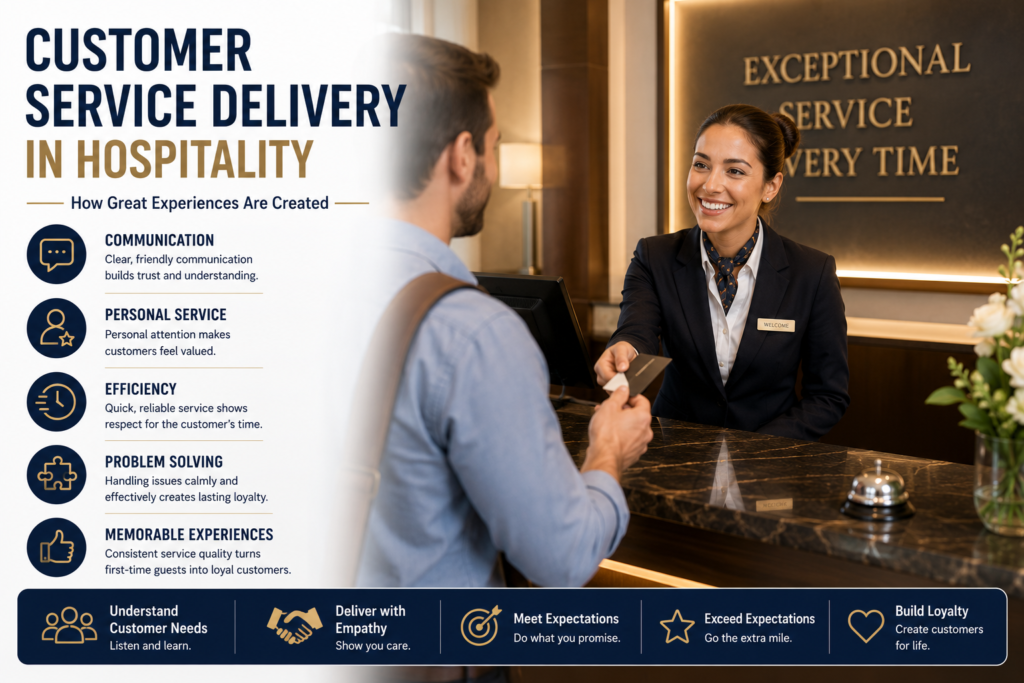
Customer Service Delivery in Hospitality: How Great Experiences Are Created
Introduction
In hospitality, customers rarely judge a business only by the product or service itself. More often, they remember how they were treated.
A hotel room may be comfortable, but a poor check-in experience can still leave guests dissatisfied. A restaurant may serve excellent food, but slow service or poor communication can damage the overall experience. This is why customer service delivery sits at the centre of hospitality operations.
Hospitality businesses do not simply provide accommodation, meals or travel services. They create experiences. Every interaction between staff and customers shapes how the business is perceived, influencing satisfaction, reputation and customer loyalty.
For students studying hospitality or business management, understanding customer service delivery provides valuable insight into how successful businesses combine operational efficiency with human interaction to create positive experiences.
What is customer service delivery?
Customer service delivery refers to the way a service is provided to customers throughout their experience with a business.
In hospitality, this includes:
- communication with customers
- speed and efficiency of service
- staff professionalism
- problem-solving
- responsiveness
- consistency of service quality
Unlike many industries, hospitality services are usually delivered directly to the customer in real time. Customers are often present while the service is happening, meaning they immediately experience both good and bad service.
This makes customer service delivery one of the most important operational practices within hospitality management.
Why customer service matters in hospitality
Hospitality is a people-focused industry. Customers often judge their experience based on personal interaction rather than physical products alone.
For example, guests may remember:
- how friendly reception staff were
- whether waiting times were reasonable
- how quickly problems were resolved
- how professional employees appeared
- whether communication was clear and helpful
These factors strongly influence customer satisfaction and business reputation.
In highly competitive hospitality markets, good customer service can also become a major advantage. Customers are more likely to return to businesses where they feel valued and supported, even when competitors offer similar prices or facilities.
The real-time nature of hospitality service
One of the defining characteristics of hospitality is that services are delivered in real time.
A hotel receptionist checks in guests face-to-face. Restaurant staff interact directly with diners. Airline employees assist passengers throughout their journey. Because customers experience the service immediately, there is very little opportunity to hide operational mistakes.
If delays occur, communication is poor or staff appear unprofessional, customers notice instantly. This creates pressure for businesses to ensure operations run smoothly while maintaining positive customer interaction.
For this reason, hospitality businesses invest heavily in staff training, communication skills and operational planning.
Understanding different customer expectations
Another challenge in customer service delivery is that customer expectations are rarely the same.
Different customers want different experiences depending on:
- the type of business
- the price they pay
- the purpose of their visit
- personal preferences
- cultural expectations
A business traveller staying in a hotel may prioritise efficiency, fast check-in and reliable internet access. A family on holiday may expect a more relaxed atmosphere and additional support. Restaurant customers may want quick service during lunch but a slower, more personalised experience in the evening.
This means hospitality businesses must remain flexible while still maintaining consistent standards.
The importance of communication
Communication is one of the most important parts of customer service delivery.
Customers want clear information, realistic expectations and reassurance when problems occur. Good communication helps reduce uncertainty and improves the customer experience even during busy periods.
For example, if a restaurant experiences delays, customers are often more understanding when staff explain the situation politely and professionally. In hotels, clear communication about check-in times, facilities or booking details helps avoid confusion and frustration.
Strong communication also improves teamwork behind the scenes, helping departments coordinate more effectively during busy periods.
Customer service during peak demand
Delivering good customer service becomes more challenging when businesses are busy.
Hotels during holiday seasons, restaurants on weekends and tourist attractions during school breaks all experience increased pressure on staff and operations. Customers, however, still expect the same level of attention and professionalism.
This means hospitality businesses must organise staffing and workflows carefully to maintain service quality under pressure.
For example, restaurant staff may need to manage multiple tables at once while still responding quickly to customer requests. Hotel employees may handle large numbers of arrivals during peak check-in periods while maintaining professionalism and efficiency.
This demonstrates how customer service delivery is closely linked to staffing and operational planning. You can explore this further in our article on staffing in hospitality and managing people in a high-demand service industry.
Technology and customer service
Technology has become an important part of customer service delivery within hospitality.
Online bookings, mobile check-in, digital menus and automated communication systems all help improve convenience and efficiency for customers. These systems can reduce waiting times and simplify many operational processes.
However, hospitality still depends heavily on personal interaction. Customers may appreciate digital convenience, but they still value empathy, reassurance and human communication when problems arise.
The most successful hospitality businesses therefore combine technology with strong interpersonal service.
You can learn more about this in our guide to technology in hospitality operations and how digital systems are transforming service.
Complaint handling and service recovery
No hospitality business operates perfectly all the time. Delays, misunderstandings and operational mistakes can happen, especially in fast-moving environments.
What matters most is how businesses respond when problems occur.
Effective complaint handling is a major part of customer service delivery because it shows customers that the business takes their concerns seriously. Staff must be trained to remain calm, listen carefully and resolve issues quickly and professionally.
In many cases, strong service recovery can actually improve customer impressions because customers feel supported and valued.
Poor complaint handling, however, can quickly damage customer trust and reputation.
Customer service and business reputation
Customer service delivery has a direct impact on business reputation.
Positive experiences often lead to repeat business, recommendations and favourable online reviews. Negative experiences, particularly in the age of social media and review platforms, can spread quickly and influence future customer decisions.
Because of this, hospitality businesses must treat customer service as a long-term operational priority rather than simply a short-term task.
Consistent service quality helps businesses build trust, strengthen customer loyalty and remain competitive in crowded markets.
Real-world example: customer service in a busy restaurant
A busy restaurant serving office workers during lunch and families in the evening provides a good example of customer service delivery in practice.
During peak periods, staff must manage orders quickly while still communicating effectively with customers. If delays occur, employees may need to explain waiting times, reassure customers and respond professionally to complaints.
In this type of environment, teamwork becomes essential. Front-of-house staff, kitchen employees and managers must coordinate closely to ensure service remains organised and customers feel supported.
This demonstrates that customer service delivery is not only about friendliness — it also depends on operational organisation, communication and problem-solving.
Why customer service matters for your career
For students studying hospitality or business management, customer service delivery provides some of the most valuable and transferable skills in the industry.
Employers consistently look for individuals who can communicate effectively, work under pressure and respond professionally to customer needs. These skills are relevant across hotels, restaurants, tourism, events and many other service sectors.
Understanding customer service delivery also helps students develop leadership, teamwork and problem-solving abilities that support progression into management roles.
At Click College, these practical hospitality concepts are integrated into our Level 4–6 Business and Hospitality programmes, helping students build industry-relevant knowledge and professional confidence.
Explore Hospitality Management Courses
Start your journey in hospitality and tourism with an accredited Click College course. Enrol today and build the skills, knowledge, and confidence to progress into a management role.







Recent Posts
Professional Diploma or Higher Qualification Pathway: Which Should You Choose?
Professional Diploma or Higher Qualification Pathway: Which Should You Choose? Choosing the right online qualification is not always simply a question of choosing the longest course or the highest level. For many learners, the better question is: what kind of study route fits my goals right now? Some learners want a focused qualification in one […]
Professional Diploma in Leadership and Management: Course Guide
Professional Diploma in Leadership and Management: Course Guide A Professional Diploma in Leadership and Management is designed for learners who want to develop advanced leadership, strategic thinking and organisational management skills without committing immediately to a full degree programme. Leadership and management are essential in almost every sector. Whether you work in business, education, hospitality, […]
Professional Diploma in Business Management: Who Is It For?
Professional Diploma in Business Management: Who Is It For? A Professional Diploma in Business Management is designed for learners who want to build practical business knowledge without committing immediately to a full degree or long higher education programme. It can be a useful option for people who want to understand how organisations work, how teams […]