Staffing in Hospitality: Managing People in a High-Demand Service Industry
Introduction
Walk into any busy hotel, restaurant or event venue and one thing becomes immediately clear — hospitality is powered by people.
Behind every smooth customer experience is a team working together to deliver service in real time. Unlike many industries where processes can be automated or delayed, hospitality relies heavily on human interaction. This makes staffing one of the most important and challenging aspects of hospitality operations.
For students and future managers, understanding how staffing works in hospitality provides valuable insight into how businesses maintain service quality, respond to changing demand and operate efficiently in a fast-moving environment.
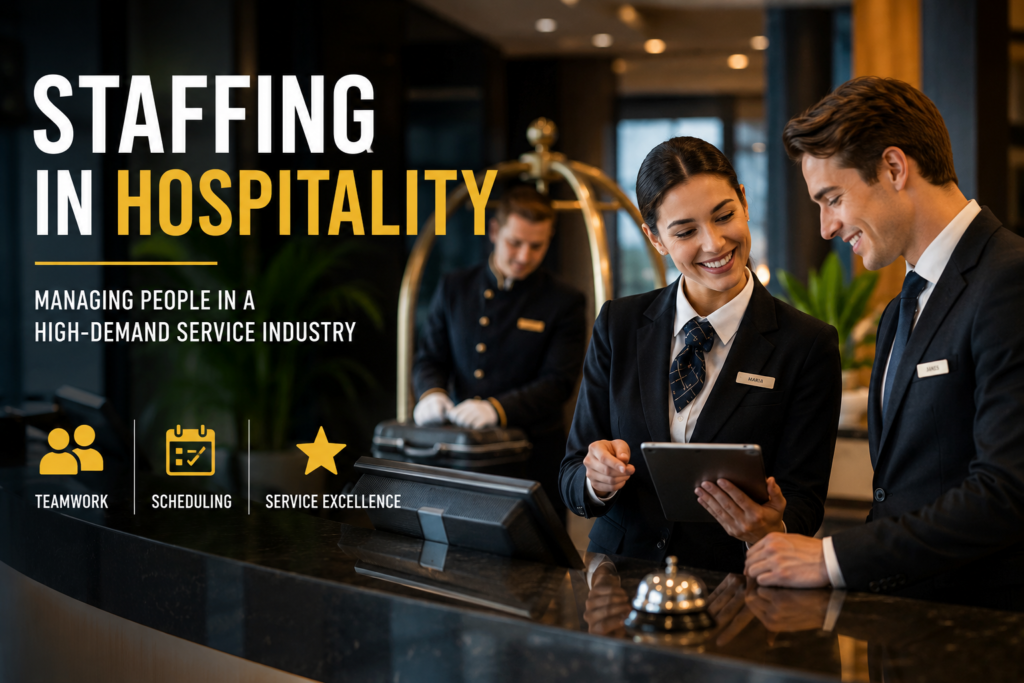
Why staffing is central to hospitality operations
In hospitality, staff are not just part of the operation — they are the operation.
Customers don’t just interact with a product; they interact with people. Whether it’s a receptionist welcoming a guest, a waiter taking an order or a team member handling a complaint, staff behaviour directly shapes the customer experience.
This means staffing decisions have a direct impact on:
- service quality
- customer satisfaction
- business reputation
- operational efficiency
Even a well-designed service can fail if there are not enough staff available or if employees are not properly trained. At the same time, having too many staff during quiet periods can increase costs and reduce profitability.
Balancing these factors is one of the key challenges in hospitality management.
The challenge of changing demand
One of the main reasons staffing is complex in hospitality is that demand is rarely consistent.
Customer numbers can increase or decrease depending on:
- time of day
- day of the week
- season
- holidays and events
- weather and travel patterns
A hotel, for example, may experience high occupancy during summer and much lower demand in winter. A restaurant may be busiest in the evenings and on weekends, while quieter during weekday afternoons.
Because of this, staffing cannot remain fixed. Businesses must constantly adjust the number of employees available to match demand.
This is closely linked to how businesses manage demand overall. If you want to understand how customer numbers are predicted and influenced, it’s worth exploring how demand management in hospitality helps balance capacity and customer flow.
Flexible staffing in practice
To respond to changing demand, hospitality businesses rely on flexible staffing arrangements.
This often includes shift work, where employees are scheduled at different times depending on expected demand. Peak periods require more staff, while quieter periods require fewer. Many businesses also use part-time or seasonal employees to cope with busy periods such as holidays or major events.
For example, a seaside hotel may recruit additional staff during the summer season when guest numbers increase significantly. A restaurant may schedule more team members on Friday and Saturday evenings than during weekday lunches.
This flexibility allows businesses to remain efficient while still maintaining service standards. However, it also requires careful planning to ensure that staffing levels are neither too high nor too low.
Skills and training in hospitality staffing
Having the right number of staff is only part of the challenge. Employees must also have the right skills.
In hospitality, staff are expected to perform both operational tasks and customer-facing roles. This means they need a combination of technical ability and interpersonal skills. Communication, professionalism and problem-solving are just as important as completing tasks correctly.
Training plays a key role in ensuring consistency. Businesses often provide guidance on service standards, communication techniques and how to handle different customer situations. This helps ensure that customers receive a similar level of service regardless of who is working.
These skills are closely connected to customer service delivery. You can explore this further in our guide to how customer service delivery in hospitality creates positive customer experiences.
Staffing under pressure
Hospitality environments are often fast-paced, especially during busy periods. Staff may need to manage multiple tasks at once while still providing a high level of service.
For example, restaurant employees may be responsible for several tables at the same time, while hotel staff may be handling a large number of check-ins during peak arrival times. In these situations, teamwork and communication become essential.
Well-organised teams are able to maintain efficiency without appearing rushed. Clear roles, good coordination and strong leadership help ensure that service remains smooth even when demand is high.
This highlights the importance of operational planning. Staffing decisions must be aligned with other areas of operations, including service delivery and demand management.
The link between staffing and customer experience
Staffing decisions have a direct impact on how customers experience a service.
If there are too few staff, customers may face long waiting times, reduced attention and lower service quality. If staff are not properly trained, communication may be unclear and problems may not be handled effectively.
On the other hand, well-staffed and well-trained teams can create positive experiences even during busy periods. Customers feel supported, informed and valued, which increases satisfaction and encourages repeat business.
This is why staffing is not just about numbers — it is about delivering the right experience at the right time.
Balancing cost and quality
One of the most important responsibilities in hospitality operations is balancing labour costs with service quality.
Staff wages represent a significant expense for most hospitality businesses. Managers must therefore control staffing levels carefully to avoid unnecessary costs. However, reducing staff too much can negatively affect service quality and customer satisfaction.
This creates a constant trade-off. Businesses must find the point where they can operate efficiently while still delivering a high standard of service.
Understanding this balance is a key part of hospitality management and is closely linked to broader operational strategies such as pricing and revenue management.
Why staffing matters for your career
For students studying hospitality or business, staffing provides a clear example of how operational decisions affect real-world outcomes.
Learning how to plan staffing levels, manage teams and respond to changing demand helps develop skills that are highly valued by employers. These include leadership, communication, organisation and problem-solving.
Hospitality is a people-focused industry, and those who can manage teams effectively are often the ones who progress into management roles.
At Click College, these practical skills are developed through our Level 4–6 Business and Hospitality courses, helping students prepare for real industry environments and future leadership positions.
View Courses in Hospitality and Tourism…
Start your journey in hospitality and tourism with an accredited Click College course. Enrol today and build the skills, knowledge, and confidence to progress into a management role.







Recent Posts
Professional Diploma or Higher Qualification Pathway: Which Should You Choose?
Professional Diploma or Higher Qualification Pathway: Which Should You Choose? Choosing the right online qualification is not always simply a question of choosing the longest course or the highest level. For many learners, the better question is: what kind of study route fits my goals right now? Some learners want a focused qualification in one […]
Professional Diploma in Leadership and Management: Course Guide
Professional Diploma in Leadership and Management: Course Guide A Professional Diploma in Leadership and Management is designed for learners who want to develop advanced leadership, strategic thinking and organisational management skills without committing immediately to a full degree programme. Leadership and management are essential in almost every sector. Whether you work in business, education, hospitality, […]
Professional Diploma in Business Management: Who Is It For?
Professional Diploma in Business Management: Who Is It For? A Professional Diploma in Business Management is designed for learners who want to build practical business knowledge without committing immediately to a full degree or long higher education programme. It can be a useful option for people who want to understand how organisations work, how teams […]