Demand Management in Hospitality: Strategies to Balance Demand and Maximise Revenue
Introduction
One of the biggest challenges in hospitality is that customer demand rarely stays consistent. A hotel may be fully booked during the summer but much quieter during winter. Restaurants often experience busy evenings and slower afternoons, while tourist attractions can see dramatic increases in visitors during holidays and weekends.
Because hospitality businesses operate in environments where customer numbers constantly change, they must manage demand carefully to remain profitable and maintain service quality. This is where demand management becomes an essential part of hospitality operations.
For students studying hospitality or business management, understanding demand management helps explain how businesses plan ahead, respond to changing customer behaviour and make operational decisions that improve both efficiency and customer satisfaction.
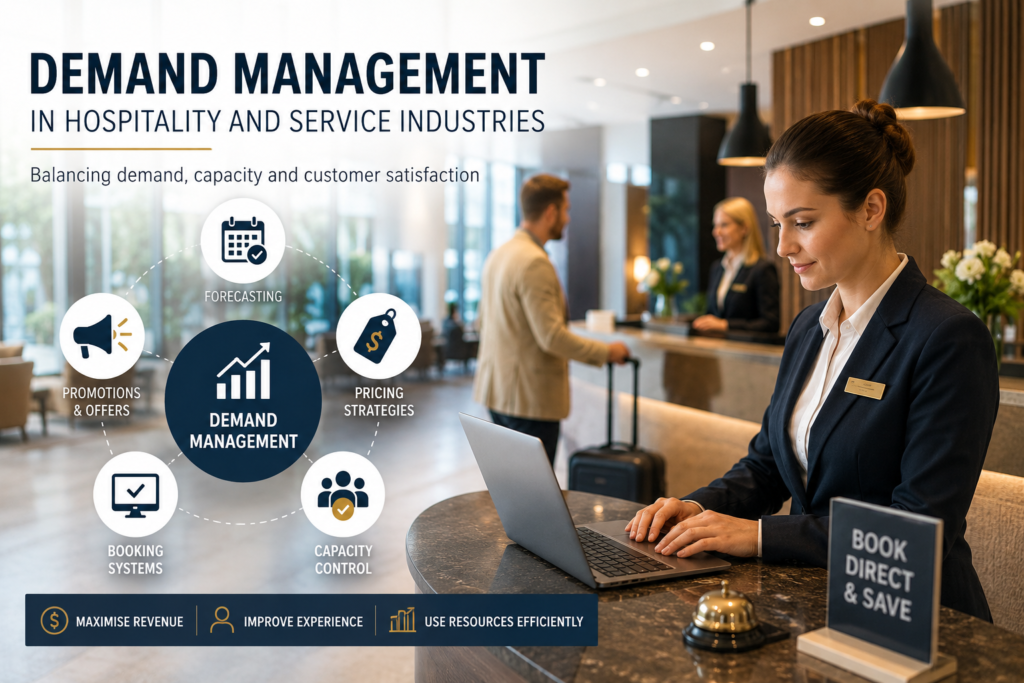
What is demand management?
Demand management is the process of predicting, influencing and controlling customer demand so that it matches the available capacity of a business.
In hospitality, capacity includes things such as:
- hotel rooms
- restaurant tables
- staff availability
- attraction entry limits
- transport seats
- service time
The aim is to avoid situations where resources are either underused or overwhelmed. If demand is too low, businesses lose revenue because their facilities and staff are not being fully utilised. If demand is too high, customers may experience overcrowding, delays and reduced service quality.
Demand management helps businesses find the right balance between customer demand and operational capacity.
Why demand management is important in hospitality
Demand management is especially important in hospitality because services are perishable. Unlike physical products, hospitality services usually cannot be stored and sold later.
For example, an empty hotel room tonight cannot be sold tomorrow. An unsold airline seat or an unused restaurant table during dinner service represents lost income that cannot be recovered.
This creates pressure for hospitality businesses to forecast demand accurately and make operational decisions that maximise the use of available capacity.
At the same time, customer demand in hospitality can change quickly. Seasonal trends, local events, holidays, weather conditions and customer behaviour all influence how busy a business becomes. Managers must therefore respond constantly to changing patterns.
Understanding changing customer demand
Demand within hospitality is influenced by a wide range of internal and external factors.
Hotels in tourist destinations often experience strong seasonal demand, while city hotels may depend more heavily on business travel and events. Restaurants usually see demand increase during evenings and weekends, while attractions may become busiest during school holidays.
These variations make hospitality operations highly unpredictable. Businesses cannot rely on demand remaining stable, which is why forecasting and planning are so important.
Managers often analyse:
- previous booking patterns
- seasonal trends
- local events
- customer behaviour
- market conditions
- economic factors
This information helps businesses estimate future demand more accurately and prepare accordingly.
Pricing as a demand management strategy
One of the most common ways hospitality businesses manage demand is through pricing.
Prices are often adjusted depending on how busy a business expects to be. During periods of high demand, prices may increase because customers are willing to pay more. During quieter periods, businesses may lower prices or introduce special offers to encourage bookings.
This is visible across the hospitality industry. Hotels often charge higher room rates during peak holiday periods or major events. Restaurants may offer lunch promotions or early evening menus during quieter times. Attractions frequently introduce discounted weekday tickets to increase visitor numbers outside peak periods.
The goal is not simply to increase prices, but to spread customer demand more effectively and improve overall profitability.
This strategy is closely connected to operational profitability. You can explore this further in our article on revenue management in hospitality and pricing strategies that drive profitability.
Booking systems and reservations
Booking systems are another major part of demand management in hospitality.
Advance reservations allow businesses to estimate future demand and prepare resources more effectively. Hotels can predict occupancy levels, restaurants can organise seating arrangements and attractions can manage visitor flow more efficiently.
Digital booking systems also reduce uncertainty. Managers can use booking data to plan staffing levels, prepare stock and coordinate operations more accurately.
Some hospitality businesses go further by introducing:
- timed entry systems
- deposits
- cancellation policies
- minimum stay requirements
- pre-booking rules
These systems help businesses control customer flow and avoid overcrowding during busy periods.
Technology now plays a major role in these processes. Our guide to technology in hospitality operations and how digital systems are transforming service explains how digital tools support modern hospitality businesses.
Balancing demand with customer experience
Demand management is not just about maximising sales. It is also about protecting the customer experience.
If demand becomes too high, service quality may suffer. Customers may experience long waiting times, overcrowding or reduced attention from staff. In hospitality, this can quickly damage customer satisfaction and business reputation.
For example, a restaurant that accepts too many bookings may struggle to deliver efficient service. A hotel operating beyond comfortable capacity may place excessive pressure on staff and facilities.
Successful demand management therefore involves controlling customer numbers in a way that maintains quality while still supporting profitability.
Customer experience remains central to hospitality operations. You can learn more about this in our guide to customer service delivery in hospitality and how great experiences are created.
Staffing and operational planning
Demand management also has a direct impact on staffing decisions.
When businesses expect higher demand, they often increase staffing levels to maintain service quality. During quieter periods, staffing may be reduced to control labour costs.
This means staffing and demand management are closely connected. Accurate forecasting allows businesses to schedule the right number of employees at the right times.
For example, hotels may recruit seasonal workers during peak tourist seasons, while restaurants may schedule additional staff for weekends or special events.
Managing this balance effectively is one of the most important operational challenges within hospitality. Our article on staffing in hospitality and managing people in a high-demand service industry explores this area further.
Real-world example: managing demand in a theme park
A good example of demand management can be seen in theme parks during school holidays.
Visitor numbers often increase dramatically during these periods, creating pressure on rides, facilities and staff. To manage this, many theme parks use advance online booking, timed entry systems and pricing strategies designed to spread demand more evenly.
During quieter periods, discounted tickets and promotional offers may encourage more visitors to attend. During peak periods, visitor numbers may be limited to reduce overcrowding and protect the customer experience.
This demonstrates how hospitality and leisure businesses actively manage customer demand rather than simply reacting to it.
Why demand management matters for your career
For students studying hospitality or business management, demand management provides valuable insight into how operational decisions affect real business performance.
Understanding forecasting, pricing strategies and customer behaviour helps develop analytical and commercial skills that employers value highly. These skills are important across hotels, tourism, restaurants, events and many other service industries.
Demand management also demonstrates how hospitality businesses balance customer satisfaction with profitability, making it a key area for anyone interested in management or leadership roles.
At Click College, these practical concepts are integrated into our Level 4–6 Business and Hospitality programmes, helping students build industry-relevant knowledge and operational understanding.
View Courses in Hospitality and Tourism…
Start your journey in hospitality and tourism with an accredited Click College course. Enrol today and build the skills, knowledge, and confidence to progress into a management role.







Recent Posts
Professional Diploma or Higher Qualification Pathway: Which Should You Choose?
Professional Diploma or Higher Qualification Pathway: Which Should You Choose? Choosing the right online qualification is not always simply a question of choosing the longest course or the highest level. For many learners, the better question is: what kind of study route fits my goals right now? Some learners want a focused qualification in one […]
Professional Diploma in Leadership and Management: Course Guide
Professional Diploma in Leadership and Management: Course Guide A Professional Diploma in Leadership and Management is designed for learners who want to develop advanced leadership, strategic thinking and organisational management skills without committing immediately to a full degree programme. Leadership and management are essential in almost every sector. Whether you work in business, education, hospitality, […]
Professional Diploma in Business Management: Who Is It For?
Professional Diploma in Business Management: Who Is It For? A Professional Diploma in Business Management is designed for learners who want to build practical business knowledge without committing immediately to a full degree or long higher education programme. It can be a useful option for people who want to understand how organisations work, how teams […]