Revenue Management in Hospitality: Pricing Strategies That Drive Profitability
Introduction
In hospitality, increasing profit is not always about serving more customers. Often, it is about making better use of the capacity a business already has.
A hotel has a fixed number of rooms. A restaurant has a limited number of tables. An airline has a set number of seats on each flight. Because hospitality services cannot usually be stored and sold later, businesses must find ways to maximise the value of what they already have available. This is where revenue management becomes one of the most important operational practices in the hospitality industry.
For students studying hospitality or business management, understanding revenue management provides insight into how businesses make pricing decisions, respond to demand and improve financial performance in highly competitive markets.
>> See the Click College Professional Diploma in Hospitality Revenue Management (EduQual Level 5)
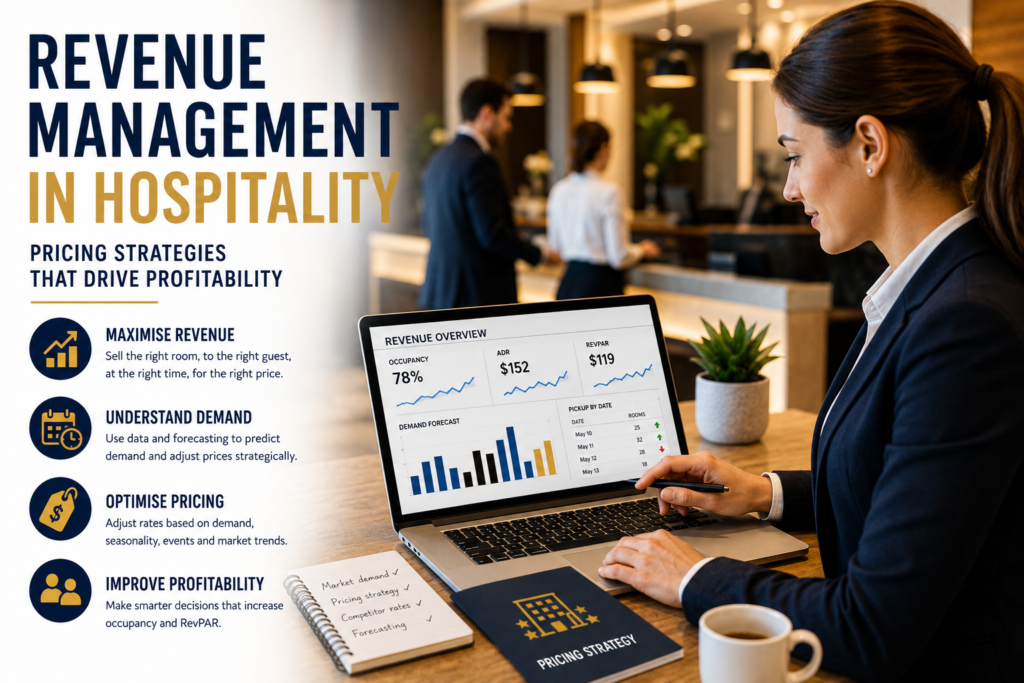
What is revenue management?
Revenue management is the process of using pricing, forecasting and demand analysis to maximise income from limited capacity.
In hospitality, businesses constantly try to sell the right product, to the right customer, at the right time, for the right price. This involves analysing customer behaviour, predicting demand patterns and adjusting prices strategically.
For example, hotel room prices may increase during busy holiday periods and decrease during quieter seasons. Airlines often change ticket prices daily depending on demand, while restaurants may introduce special offers during quieter times to encourage more bookings.
Revenue management is therefore closely linked to operational planning because it helps businesses improve profitability while making better use of available resources.
Why revenue management is important in hospitality
Revenue management is especially important in hospitality because services are perishable. If a hotel room remains empty for one night, that opportunity to generate income is permanently lost. The same applies to empty restaurant tables, unsold attraction tickets or vacant airline seats.
This creates pressure for businesses to predict customer demand accurately and make pricing decisions that encourage customers to book at the right times.
At the same time, hospitality businesses often operate with high fixed costs. Hotels, for example, still need to pay for buildings, utilities, staffing and maintenance even during quieter periods. Revenue management helps businesses cover these costs more effectively by maximising income whenever possible.
The relationship between demand and pricing
One of the core ideas behind revenue management is that prices should reflect demand.
When demand is high, businesses may increase prices because customers are willing to pay more. During quieter periods, prices may be lowered to attract additional customers and reduce unused capacity.
This strategy is visible across the hospitality industry. Hotels often charge significantly higher rates during summer holidays, concerts or major sporting events. Restaurants may offer lunch promotions or early evening menus during quieter hours. Airlines regularly adjust fares based on travel dates, booking patterns and seat availability.
The goal is not simply to charge more, but to balance demand in a way that improves overall profitability.
This approach is closely connected to how businesses manage changing customer numbers. To understand this further, explore our guide to demand management in hospitality and how businesses balance demand with capacity.
Forecasting and predicting customer behaviour
Effective revenue management depends heavily on forecasting.
Hospitality businesses analyse a wide range of information to estimate future demand, including:
- previous booking patterns
- seasonal trends
- local events
- customer behaviour
- market conditions
- competitor pricing
For example, a city hotel may predict increased demand during a major conference or concert weekend. A seaside resort may prepare for higher occupancy during school holidays. Restaurants may analyse booking trends to identify their busiest times and plan promotions during quieter periods.
Accurate forecasting allows businesses to make informed decisions about pricing, staffing and operational planning.
Revenue management in hotels
Hotels provide some of the clearest examples of revenue management in practice.
Room prices often change depending on:
- occupancy levels
- booking dates
- seasonality
- local events
- room availability
- customer demand
A customer booking several months in advance may pay a lower rate than someone booking at the last minute during a busy weekend. Hotels may also offer package deals, discounted midweek stays or premium pricing during peak periods.
The aim is to maximise revenue across all available rooms while maintaining occupancy levels that support profitability.
Revenue management also influences decisions about upgrades, cancellation policies and minimum stay requirements.
Revenue management in restaurants and tourism
Revenue management is not limited to hotels.
Restaurants use pricing strategies to encourage customers during quieter periods, often through lunch menus, early dining offers or promotional events. These strategies help spread customer demand more evenly throughout the day.
Tourism and leisure businesses use similar approaches. Attractions may offer lower ticket prices during weekdays, while airlines and transport providers regularly adjust fares based on booking patterns and demand forecasts.
In all cases, the goal is the same: improve the use of available capacity while protecting profitability.
Technology and revenue management
Modern revenue management relies heavily on technology.
Hotels and hospitality businesses now use software systems that track bookings, analyse customer trends and recommend pricing changes automatically. Online booking platforms also allow businesses to respond quickly to market conditions and competitor pricing.
Technology makes revenue management more accurate and responsive, but human decision-making still remains important. Managers must interpret data carefully and balance profitability with customer expectations.
This growing role of digital systems is transforming hospitality operations more broadly. You can learn more in our article on technology in hospitality operations and how digital systems are transforming service.
Balancing profitability and customer perception
Although revenue management helps businesses increase income, pricing decisions must still feel fair to customers.
If prices rise too sharply or appear inconsistent, customers may feel frustrated or lose trust in the business. Hospitality companies therefore need to balance commercial goals with customer satisfaction and reputation.
For example, a hotel may increase prices during peak demand, but if service quality falls at the same time, customers may view the higher price negatively. This shows that revenue management cannot operate in isolation — it must work alongside customer service and operational quality.
Strong customer experiences remain essential regardless of pricing strategy. Our guide to customer service delivery in hospitality and how businesses create positive experiences explores this relationship further.
Why revenue management matters for your career
For students studying hospitality or business management, revenue management provides valuable insight into how strategic decisions affect real business performance.
Understanding pricing strategies, forecasting and customer behaviour helps develop analytical and commercial skills that are highly valued across the hospitality industry. These skills are relevant in hotels, tourism, events, restaurants and many other service sectors.
Revenue management also demonstrates how operational decisions connect directly to profitability, making it an important area for anyone interested in management or leadership roles.
At Click College, these practical business concepts are embedded within our Level 4–6 Business and Hospitality programmes, helping students build industry-relevant knowledge and professional skills.
Want to Study Hospitality Revenue Management?
>> See the Click College Professional Diploma in Hospitality Revenue Management (EduQual Level 5)
Final thoughts
Revenue management plays a central role in hospitality because businesses must maximise income from limited and perishable capacity.
By analysing demand, adjusting pricing and forecasting customer behaviour, hospitality businesses can improve profitability while making better operational decisions. However, successful revenue management is not just about increasing prices — it is about balancing commercial performance with customer satisfaction and long-term reputation.
For anyone studying hospitality operations, understanding revenue management provides a clear picture of how successful businesses turn operational planning into financial success.
View Courses in Hospitality and Tourism…
Start your journey in hospitality and tourism with an accredited Click College course. Enrol today and build the skills, knowledge, and confidence to progress into a management role.







Recent Posts
Professional Diploma or Higher Qualification Pathway: Which Should You Choose?
Professional Diploma or Higher Qualification Pathway: Which Should You Choose? Choosing the right online qualification is not always simply a question of choosing the longest course or the highest level. For many learners, the better question is: what kind of study route fits my goals right now? Some learners want a focused qualification in one […]
Professional Diploma in Leadership and Management: Course Guide
Professional Diploma in Leadership and Management: Course Guide A Professional Diploma in Leadership and Management is designed for learners who want to develop advanced leadership, strategic thinking and organisational management skills without committing immediately to a full degree programme. Leadership and management are essential in almost every sector. Whether you work in business, education, hospitality, […]
Professional Diploma in Business Management: Who Is It For?
Professional Diploma in Business Management: Who Is It For? A Professional Diploma in Business Management is designed for learners who want to build practical business knowledge without committing immediately to a full degree or long higher education programme. It can be a useful option for people who want to understand how organisations work, how teams […]