Accessible Hospitality: What Hotels Need to Consider Beyond Step-Free Access
An accessible hotel is not defined only by whether a guest can enter the building. A guest may be able to reach reception but struggle to use the website, book an appropriate room, understand the information provided, move confidently around the property, communicate a need or receive help when something goes wrong.
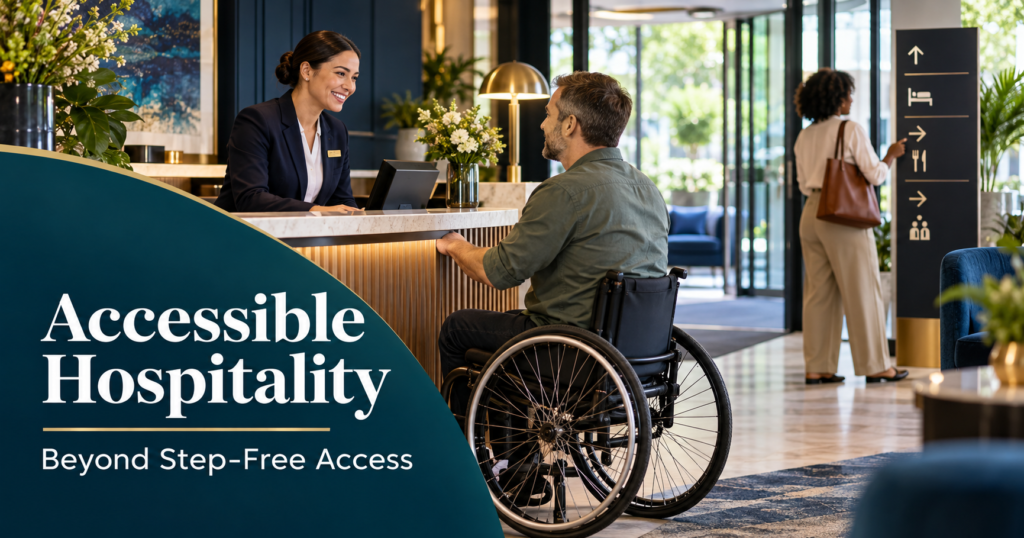
Accessible hospitality means designing and delivering the whole experience so that more people can use it with dignity, confidence and as much independence as possible. Step-free access, accessible bathrooms and lifts are important, but they are only part of the picture. Information, staff practice, lighting, noise, digital systems, food service, communication and emergency arrangements all matter too.
For hotels and other hospitality businesses, inclusion is both a service-quality issue and a legal consideration. In Great Britain, the Equality Act 2010 places duties on service providers in relation to discrimination and reasonable adjustments for disabled people.[1][2] This article provides general educational information, not legal advice; businesses should consider their own circumstances and seek appropriate specialist advice where needed.
What does accessible hospitality mean?
Accessible hospitality is the removal or reduction of barriers that may prevent people from using and enjoying a hotel, restaurant, attraction or tourism service. It recognises that access needs are varied. They may relate to mobility, sight, hearing, speech, neurodiversity, learning disability, long-term health conditions, mental health, temporary injury, age, pregnancy or caring responsibilities.
An inclusive approach does not require staff to make assumptions about a guest. It means creating clear choices, sharing accurate information and being ready to listen and respond respectfully when someone identifies a need.
VisitEngland’s Accessible and Inclusive Tourism Toolkit frames accessibility across physical, digital and operational measures. It is a helpful reminder that accessible tourism is not an add-on to the guest experience; it is part of how a business welcomes people and delivers service.[3]
Accessible hospitality is a guest-journey issue
The most useful way to understand accessibility is to follow the guest journey rather than only inspecting the building.
| Guest-journey stage | Possible barrier | More inclusive practice |
|---|---|---|
| Research and booking | Incomplete accessibility information, inaccessible booking forms, unclear room descriptions | Provide accurate accessibility details, photographs, measurements where useful, and a clear route to ask questions before booking. |
| Arrival | Steps, unclear drop-off arrangements, poor signage, long or confusing check-in processes | Give clear arrival information, maintain accessible routes and offer a calm, respectful check-in process. |
| Stay | Inaccessible bedroom features, unsuitable lighting or noise, unclear controls, missing information | Make room features clear, ensure faults are handled promptly and offer information in an accessible format where possible. |
| Food, facilities and events | Limited seating choice, poor allergen communication, crowded routes, inaccessible menus or service counters | Plan circulation space, communicate dietary information carefully and provide practical alternatives without making assumptions. |
| Departure and follow-up | Inaccessible feedback channels, unresolved concerns or a guest having to repeat their needs | Offer more than one feedback route and use recurring issues to improve the service. |
This perspective prevents a common mistake: treating accessibility as something that only concerns the facilities team. Reception, reservations, housekeeping, food and beverage, maintenance, marketing and managers all affect whether a guest can use the service successfully.
The Equality Act and reasonable adjustments
The Equality Act 2010 applies to organisations providing services to the public. Section 29 addresses services and public functions, while section 20 sets out the duty to make reasonable adjustments.[1][2]
In practical hospitality terms, reasonable adjustments may involve changing a policy or way of doing something, providing an auxiliary aid or service, or making physical features more accessible where the legal duty applies. What is reasonable depends on the circumstances. It can include the nature of the service, the barrier, the resources available, practicality, safety and the likely effectiveness of an adjustment.
The important management lesson is that businesses should think ahead. Waiting until a guest arrives to discover that an essential part of the service cannot be used is rarely good service and may make a barrier much harder to resolve. The Equality and Human Rights Commission’s current statutory code provides guidance for service providers on the Equality Act framework.[4]
Beyond ramps and lifts: six areas hotels should consider
1. Accurate and honest information
Accessible information is the starting point for many guests. A vague statement that a hotel is “accessible” does not explain whether there are steps at the entrance, whether a bathroom has a roll-in shower, whether a restaurant route is level or whether an assistance dog is welcome.
Good information describes what is actually available. It does not over-promise. Helpful details can include entrance routes, parking and drop-off arrangements, lift dimensions where relevant, bedroom and bathroom features, hearing or visual-support provision, dining access and a direct contact route for questions.
2. Physical space and movement
Step-free access remains important, but so do route widths, door operation, seating arrangements, reception height, bedroom layouts, bathroom features, lighting, contrast and clear wayfinding. Small obstructions can create significant difficulty when corridors become storage areas or furniture is rearranged without considering circulation.
The goal is not a single ‘special’ route that feels separate from the guest experience. Wherever practical, inclusive design allows people to use the same welcoming spaces and services as other guests.
3. Digital accessibility
The guest journey often begins online. A website, booking form or confirmation email can create a barrier before the guest reaches the property. Hotels should consider readable content, meaningful headings, clear forms, keyboard usability, alternative text for important images and contact options beyond a phone-only route.
Digital accessibility also includes operational communication. Can a guest receive information in writing if that is easier? Can pre-arrival details be shared in a clear, structured format? Is important guest information available without relying only on a QR code or a small-print leaflet?
4. Staff communication and confidence
Staff do not need to know every individual’s circumstances to provide inclusive service. They do need to avoid assumptions, listen carefully, use respectful language and know how to find help or escalate a request.
A useful starting approach is simple: ask the guest what would help, explain what can be done and follow through. Do not speak only to a companion when the guest is present, move mobility equipment without permission or promise a feature that has not been checked.
Clear processes also help staff respond consistently. The principles discussed in Customer Service Delivery in Hospitality: What Really Defines a Great Experience apply here: good service combines communication, responsiveness and reliable systems.
5. Sensory and cognitive accessibility
Accessibility is not only about physical mobility. Busy lobbies, loud music, harsh lighting, complex signage, unexpected changes and crowded breakfast areas can affect guests in different ways.
Hotels can consider quieter seating options, clear and predictable instructions, visible signage, good lighting without unnecessary glare, information in straightforward language and staff who can explain processes calmly. These measures may help many guests, not only those who identify themselves as disabled.
6. Service recovery and emergency planning
An otherwise accessible stay can become difficult when a lift fails, an accessible room is taken out of service, a booking request has been missed or an evacuation procedure does not account for the guest’s needs.
Hotels need clear escalation routes. Staff should know who to contact, what information to record and when to offer a realistic alternative. Where an issue affects a guest, communication should be direct and respectful—not a sequence of vague updates or repeated requests for the guest to explain the same need.
Hotel Service Recovery: Handling Complaints and Rebuilding Guest Trust explores the wider importance of ownership, proportionate action and learning from service failures.
A worked example: accessible-room booking
Imagine a guest who uses a wheelchair books an accessible room online. The room description states that it has an accessible bathroom, but it does not specify the shower arrangement or whether the route from reception involves steps. The guest contacts the hotel shortly before arrival and discovers that the allocated room does not meet their requirements.
A weak response would be to say that the booking was made online and nothing can be changed. A stronger response begins by checking the facts, identifying the guest’s immediate needs and exploring appropriate options. The hotel may have another suitable room, be able to modify the allocation, provide accurate route information, arrange practical assistance or explain honestly what cannot be provided.
After the immediate issue is resolved, managers should examine why the information was incomplete and whether the booking system, room data or staff handover needs improving. That is the difference between treating accessibility as an individual exception and using the experience to improve the service for future guests.
Making accessibility part of normal operations
Accessible hospitality is most effective when it is built into routine management rather than treated as a one-off project. Hotels can make a practical start by:
- Reviewing the journey from website to departure and identifying barriers at each stage.
- Checking that accessibility information is specific, current and easy to find.
- Involving disabled people and people with lived experience when reviewing changes.
- Ensuring teams know how to record and escalate access-related requests or faults.
- Including accessibility in maintenance, procurement and refurbishment decisions.
- Reviewing complaints, feedback and near-misses for recurring themes.
- Providing staff with appropriate guidance and opportunities to build confidence.
It is also important not to confuse compliance with completion. Laws and standards matter, but a genuinely inclusive service asks a broader question: can a guest use the experience with dignity, clarity and confidence?
Accessibility strengthens service quality for everyone
Many inclusive changes benefit a wide range of guests. Clearer signs can help someone unfamiliar with the property. Better lighting can support older guests and anyone arriving tired after travel. Accurate online information helps families, guests with temporary injuries and people planning a complex journey. A calm, well-explained check-in benefits everyone.
This does not mean every guest has identical needs. It means hotels can make their services more flexible, understandable and reliable. That is closely connected to customer segmentation: Different Guests, Different Needs: Customer Segmentation in Hospitality explains why one standard experience does not suit every visitor.
Develop inclusive hospitality-management expertise
Accessible hospitality requires operational judgement, service design, team coordination and an understanding of the guest experience. Click College offers several online hospitality and tourism routes for developing that broader capability.
| Course | Level and credits | Focus |
|---|---|---|
| Professional Diploma in Hotel Management | Level 5, 40 credits | Focused knowledge of hotel operations, front office, housekeeping and guest service. |
| Higher International Certificate in Hospitality & Tourism Management | Level 4, 120 credits | A broad foundation in hospitality and tourism management. |
| Higher International Diploma in Hospitality & Tourism Management | Level 5, 240 credits in total | Extended study across operations, people, customer experience and hospitality management. |
| International Graduate Diploma in Hospitality & Tourism Management | Level 6, 360 credits in total | A comprehensive route combining earlier levels with more advanced strategic hospitality study. |
Compare the Hospitality & Tourism Management pathways and choose the route that best matches your experience and professional goals.
Frequently asked questions
Is accessible hospitality only about wheelchair access?
No. Wheelchair access is important, but accessible hospitality also includes information, communication, sensory environments, digital systems, staff practice and the ability to respond well to different access requirements.
What are reasonable adjustments in hospitality?
Reasonable adjustments are changes that service providers may need to make to reduce substantial disadvantage for disabled people. What is reasonable depends on the circumstances. Businesses should refer to current authoritative guidance and seek specialist advice where appropriate.
How can a hotel make its website more accessible?
Start with clear content, accurate accessibility information, structured headings, readable forms, useful alternative text for important images and more than one way to contact the hotel with questions.
Why should hotels provide detailed accessibility information?
It helps guests decide whether the property meets their needs before booking, reduces uncertainty and enables the hotel to prepare appropriately. Accurate detail is more useful than a general claim that a hotel is accessible.
References
[1] Equality Act 2010, section 20: Reasonable adjustments
[2] Equality Act 2010, section 29: Services and public functions
[3] VisitEngland Accessible and Inclusive Tourism Toolkit for Businesses
Build Your Future in Hospitality and Tourism
Understanding customer expectations and perceived service quality is valuable for people who want to manage hotels, restaurants and other customer-facing operations.
Studying hospitality and tourism management courses can help learners develop knowledge of service delivery, operations, customer experience and quality improvement.
| Course | Level | Credits | Focus |
|---|---|---|---|
| Professional Diploma in Hospitality Management | 5 | 40 | A focused route covering hospitality operations and service excellence. |
| Professional Diploma in Hotel Management | 5 | 40 | Applied knowledge for hotel operations and guest-service management. |
| Higher International Certificate in Hospitality & Tourism Management | 4 | 120 | A broad higher-level introduction to hospitality and tourism management. |
| Higher International Diploma in Hospitality & Tourism Management | 4–5 | 240 total | Extended study supporting progression in hospitality and tourism management. |
| International Graduate Diploma in Hospitality & Tourism Management | 4–6 | 360 total | A comprehensive graduate-level pathway across hospitality and tourism management. |
All courses are 100% online and self-paced, with no classes, no fixed schedules, no deadlines and no exams. Assessment is completed through coursework, with tutor support available throughout your studies.
Compare Click College’s Hospitality and Tourism Management courses.
Explore Hospitality Courses
Start your journey in hospitality and tourism with an accredited Click College course. Enrol today and build the skills, knowledge, and confidence to progress into a management role.







Recent Posts
How to Build Trust Before a Customer Buys
How to Build Trust Before a Customer Buys Before a customer buys from an unfamiliar business, they are making more than a price comparison. They are deciding whether the offer is genuine, whether the organisation will deliver what it promises and whether help will be available if something goes wrong. That is why trust is […]
Why Customers Switch: The Trust and Value Signals That Drive Churn
Why Customers Switch: The Trust and Value Signals That Drive Churn Customers rarely switch simply because a competitor is cheaper. They switch when the relationship no longer feels safe, fair or worth the effort. A price rise may trigger the search, but unclear charges, poor support, weak proof and uncertainty about what happens next are […]
How to Find and Fix Friction in the Buying Journey
How to Find and Fix Friction in the Buying Journey Customers rarely decide not to buy for one dramatic reason. More often, small difficulties build up: a confusing product page, unclear pricing, a slow reply, an awkward form, conflicting information or a delivery promise that feels uncertain. Each issue may appear minor in isolation. Together, […]