Different Guests, Different Needs: Customer Segmentation in Hospitality
Why can two guests stay in the same hotel and leave with completely different opinions? One may appreciate a fast, self-service check-in; another may find the same process impersonal or difficult to use. A family may value flexible meals and space, while a business traveller may be concerned mainly with reliable Wi-Fi, a quiet room and a quick departure.
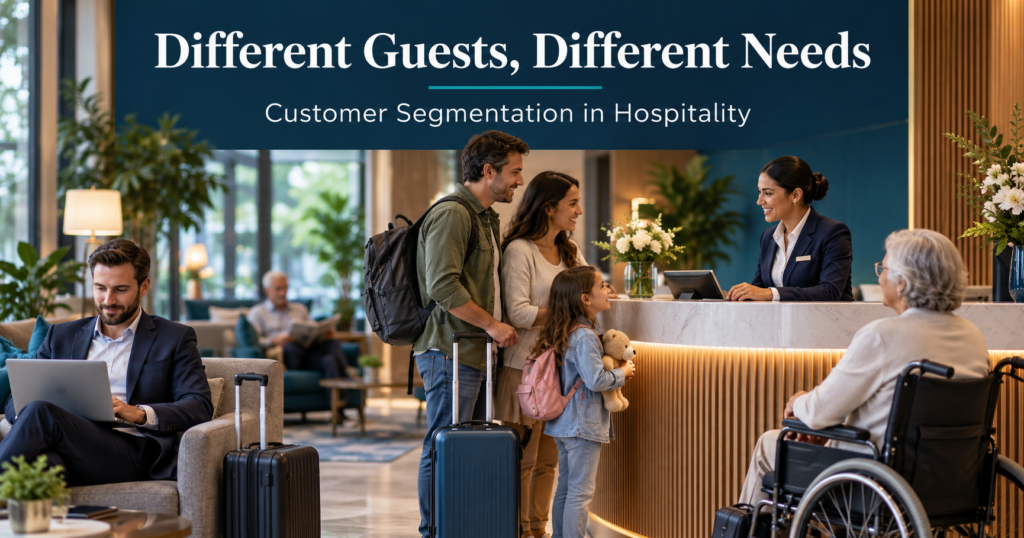
Customer segmentation in hospitality is the process of grouping guests according to meaningful similarities so that a business can design a more relevant service. It does not mean treating people as stereotypes. Done well, it helps a hotel, restaurant, attraction or travel business understand likely needs, protect consistent service standards and give guests appropriate choices.
The best approach is to segment by factors that directly affect the experience: the purpose of the visit, the guest’s practical needs, their booking and service preferences, and the value they seek. Individual preferences still matter, so segmentation should guide service design rather than replace listening to the customer.
What is customer segmentation in hospitality?
Customer segmentation divides a broad market into smaller groups whose needs or behaviours are sufficiently similar to inform a service decision. In hospitality, those decisions might include room design, check-in methods, food service, communications, staffing levels, packages or accessibility information.
For example, a city-centre hotel may serve conference delegates during the week and leisure visitors at weekends. The same building and staff team can support both groups, but the service priorities may differ. Delegates may value speed, workspace and early breakfast. Leisure guests may be more interested in local recommendations, flexible arrival times and family-friendly facilities.
Segmentation is therefore not about deciding that one group is more important than another. It is about asking a practical management question:
Which differences are likely to change what guests need from us, and how can we respond without compromising fairness or basic service quality?
Start with needs, not labels
It can be tempting to segment only by age, income or nationality. These factors may sometimes reveal broad market patterns, but they do not explain every individual’s preferences. Not every younger guest wants a fully digital experience, and not every older guest wants face-to-face service. Likewise, cultural awareness should support respectful communication and choice, not assumptions about how a person will behave.
A stronger approach begins with the circumstances of the visit. A guest travelling alone for a business meeting may have more in common with another time-pressed traveller than with every other person of the same age. A parent travelling with a child may need different facilities from a couple travelling for a weekend break, regardless of their income or background.
This matters operationally. Segmentation that focuses on genuine needs makes it easier to improve the experience. Segmentation based on assumptions risks irrelevant marketing, poor service choices and an impersonal guest journey.
Four useful ways to segment hospitality guests
1. Travel purpose
Travel purpose is often one of the most useful starting points because it shapes the guest’s priorities. Common examples include business trips, family holidays, short leisure breaks, group travel, events and visits to friends or relatives.
A business traveller may value a predictable arrival, good connectivity, a work surface, quiet surroundings and an efficient invoice. A leisure traveller may welcome advice about local activities, dining options and transport. Families may place more emphasis on room configuration, child-friendly food, flexible timings and practical information before arrival.
The point is not that every guest in a category wants exactly the same service. Instead, the category helps the business decide which options and information should be easy to find.
2. Needs and access requirements
Some guests need particular features or adjustments to use a service comfortably and independently. These needs can relate to mobility, sight, hearing, neurodiversity, long-term health conditions, food allergies or dietary requirements. They may also relate to the needs of a carer, companion or assistance dog.
Accessibility should not be treated as a niche extra. Under the Equality Act 2010, service providers have a duty to make reasonable adjustments for disabled people.[1] VisitEngland’s accessible and inclusive tourism toolkit also encourages tourism businesses to consider accessibility across the customer journey, from information and booking to arrival and the visitor experience.[2]
For hospitality managers, this means providing accurate access information, making reasonable adjustments where needed, training staff to communicate respectfully and avoiding the assumption that a guest will disclose every need in advance. An accessible service is often a clearer and more convenient service for many customers.
3. Booking and service behaviour
Guests can also be grouped by how they prefer to plan and use the service. Some book early and value certainty; others book at short notice and value speed. Some prefer a mobile check-in and digital communications; others want the reassurance of speaking to a person.
Behavioural segmentation can help businesses offer choice without creating unnecessary complexity. A hotel might provide online pre-arrival information, mobile check-in and a staffed reception desk. A restaurant might allow online reservations while ensuring that guests can still contact the team directly about allergies or access needs.
The objective is not to force every guest through one channel. It is to make the preferred route straightforward while keeping support available.
4. Value preferences
Guests define value differently. A price-conscious visitor may prefer a simple, reliable room in a convenient location. Another guest may be willing to pay more for a larger room, flexible cancellation, premium dining or additional support. Both are making a value judgement based on what matters to them.
Understanding value preferences can shape the service offer. A budget hotel may concentrate on a reliable sleep, clean facilities and a fast arrival experience. A resort may package activities, dining and family facilities. A business hotel may provide flexible workspaces and efficient services that reduce friction during a short stay.
Price positioning is therefore part of customer segmentation: it shapes the combination of benefits a guest reasonably expects, but it never removes the expectation of honesty, safety, cleanliness and respectful service.
Customer segments and likely service priorities
| Guest situation | Likely priorities | Useful service response |
|---|---|---|
| Business traveller | Speed, reliable Wi-Fi, quiet space, clear billing | Express or digital check-in, workspace information, early breakfast options |
| Family or group | Space, safety, flexible food and practical information | Suitable room options, clear family facilities, helpful arrival and dining guidance |
| Short-break leisure guest | Local experience, ease and value | Local recommendations, simple booking, well-explained packages |
| Accessibility-led need | Accurate information, independence and respectful support | Clear access details, reasonable adjustments, trained staff and easy contact routes |
| Price-conscious guest | Total cost, reliability and convenience | Transparent pricing, clean functional facilities, efficient service |
| Guest seeking premium service | Comfort, choice, privacy and personalisation | Flexible options, discreet assistance and consistent attention to detail |
This is an editorial planning table, not a rulebook. It should prompt managers to test the service against real feedback rather than assume that a segment predicts every individual preference.
A worked example: one hotel, three guest groups
Consider a hotel near a railway station and conference venue. During the week, it receives business travellers attending meetings. At weekends, it hosts couples on short breaks and families visiting local attractions.
The hotel identifies three recurring needs:
- Weekday business guests want a fast arrival, strong Wi-Fi, a quiet workspace and a dependable early breakfast.
- Couples on short breaks often want flexible arrival, restaurant suggestions and a room that feels comfortable and distinctive.
- Families need practical room information, clarity about food options, safe facilities and guidance on local activities.
The hotel does not need three separate identities. It can make targeted improvements within one consistent brand: a clear online guide for each travel purpose, a check-in process with both digital and staff-supported options, early breakfast availability, family room information and a concise local guide.
The management team then reviews feedback by travel purpose, alongside general service indicators such as cleanliness and staff helpfulness. This helps it see whether an issue affects everyone or one group in particular. For example, repeated comments about confusing family-room information can be addressed without changing the service for business travellers.
Consistency and personalisation must work together
Segmentation does not mean delivering an unpredictable service. Every guest should receive core standards of safety, cleanliness, courtesy, accuracy and fair treatment. The role of segmentation is to add appropriate flexibility around those standards.
For instance, a hotel may have one check-in standard: every guest is welcomed, their booking is confirmed accurately and any issue is resolved clearly. Within that standard, one guest may use a mobile key while another prefers assistance at reception. The experience differs, but the quality principle remains the same.
This balance is central to customer service delivery in hospitality. Good service systems make different guest journeys possible without leaving staff unsure about the basic standard they must protect.
How to use segmentation responsibly
Responsible segmentation is evidence-led and regularly reviewed. Managers should use booking patterns, surveys, reviews, service enquiries and operational data to understand recurring needs. They should also be alert to who may be excluded by a process that appears convenient for the majority.
Four safeguards are particularly useful:
- Use evidence, not assumptions. Test whether a proposed segment reflects real customer needs and behaviour.
- Offer choices where practical. A digital option is useful, but so is a clear human support route.
- Avoid treating personal characteristics as a script. Ask, listen and respond to the individual guest.
- Review the experience end to end. Booking, arrival, use of facilities, problem resolution and departure should all work for the guests the business aims to serve.
This approach turns segmentation into a service-improvement tool rather than a narrow marketing exercise. It also strengthens the wider service-quality approach that hospitality organisations need to manage consistently.
Develop hospitality management expertise
Knowing how to identify customer needs and design an appropriate service is valuable across hotels, restaurants, attractions and tourism businesses. Click College offers several online routes for developing hospitality management knowledge:
- The Professional Diploma in Hotel Management is a focused 40-credit route for developing hotel-management knowledge and practice.
- The Higher International Certificate in Hospitality and Tourism Management is a 120-credit Level 4 foundation.
- The Higher International Diploma in Hospitality and Tourism Management extends the programme through Level 5, totalling 240 credits.
- The International Graduate Diploma in Hospitality and Tourism Management is a comprehensive Level 6 route comprising 360 credits in total.
Explore the full Hospitality and Tourism Management course pathway and select the route that fits your experience and professional goals.
Frequently asked questions
What is customer segmentation in hospitality?
Customer segmentation is the process of grouping guests by meaningful similarities that affect what they need or value from a hospitality business. Examples include travel purpose, booking behaviour, access needs and value preferences.
Is demographic segmentation enough for hospitality businesses?
No. Demographic information can sometimes help identify broad patterns, but it should not be used as a substitute for understanding why a guest is travelling and what they need. Travel purpose, behaviour and individual preferences are often more useful for service design.
How can hotels avoid stereotyping guests?
Hotels can use segmentation to identify options and likely needs, then let the individual guest choose what is relevant. Accurate information, respectful questions and flexible service routes are more reliable than assumptions based on age, nationality or family status.
Why is accessibility part of customer segmentation?
Access requirements can directly affect how a guest books, arrives and uses a service. Including accessibility in service planning helps a business remove barriers and provide clearer information for a wider range of guests.
Can a small hospitality business use customer segmentation?
Yes. A small business can begin by reviewing its most common guest types, recurring questions, booking patterns and feedback. Even modest changes, such as clearer information for families or a better arrival guide for business visitors, can make the service more relevant.
References
[1] Equality Act 2010, Section 20: Duty to Make Adjustments
[2] VisitEngland Accessible and Inclusive Tourism Toolkit for Businesses
Build Your Future in Hospitality and Tourism
Understanding customer expectations and perceived service quality is valuable for people who want to manage hotels, restaurants and other customer-facing operations.
Studying hospitality and tourism management courses can help learners develop knowledge of service delivery, operations, customer experience and quality improvement.
| Course | Level | Credits | Focus |
|---|---|---|---|
| Professional Diploma in Hospitality Management | 5 | 40 | A focused route covering hospitality operations and service excellence. |
| Professional Diploma in Hotel Management | 5 | 40 | Applied knowledge for hotel operations and guest-service management. |
| Higher International Certificate in Hospitality & Tourism Management | 4 | 120 | A broad higher-level introduction to hospitality and tourism management. |
| Higher International Diploma in Hospitality & Tourism Management | 4–5 | 240 total | Extended study supporting progression in hospitality and tourism management. |
| International Graduate Diploma in Hospitality & Tourism Management | 4–6 | 360 total | A comprehensive graduate-level pathway across hospitality and tourism management. |
All courses are 100% online and self-paced, with no classes, no fixed schedules, no deadlines and no exams. Assessment is completed through coursework, with tutor support available throughout your studies.
Compare Click College’s Hospitality and Tourism Management courses.
Explore Hospitality Courses
Start your journey in hospitality and tourism with an accredited Click College course. Enrol today and build the skills, knowledge, and confidence to progress into a management role.







Recent Posts
Accessible Hospitality: What Hotels Need to Consider Beyond Step-Free Access
Accessible Hospitality: What Hotels Need to Consider Beyond Step-Free Access An accessible hotel is not defined only by whether a guest can enter the building. A guest may be able to reach reception but struggle to use the website, book an appropriate room, understand the information provided, move confidently around the property, communicate a need […]
Preventive vs Reactive Hotel Maintenance: Which Approach Protects the Guest Experience?
Preventive vs Reactive Hotel Maintenance: Which Approach Protects the Guest Experience? Few guests think about hotel maintenance when everything works. They expect the room key to open the door, the shower to run, the air conditioning to be comfortable, the lift to operate and the restaurant equipment to support a smooth meal service. Maintenance becomes […]
Front of House vs Back of House in Hospitality: How the Two Sides Work Together
Front of House vs Back of House in Hospitality: How the Two Sides Work Together A hotel can have a warm welcome, a stylish lobby and friendly reception staff, yet still disappoint a guest if their room is not ready, a maintenance fault goes unresolved or breakfast arrives late. Equally, an immaculate room and well-run […]