Service Quality in Service-Based Organisations: Why It Matters More Than Product Quality
Introduction
Service quality is one of the most significant features that differentiates service-based organisations from product-based organisations. While both types of organisations aim to deliver value to customers, the way quality is defined, measured, and managed differs considerably. In product-based contexts, quality is typically associated with the physical characteristics of a good. In contrast, service-based organisations must focus on the customer’s experience, perceptions, and overall satisfaction. This distinction is particularly important in industries such as hospitality, where the success of a business depends heavily on how services are delivered in real time.
The Nature of Service Quality
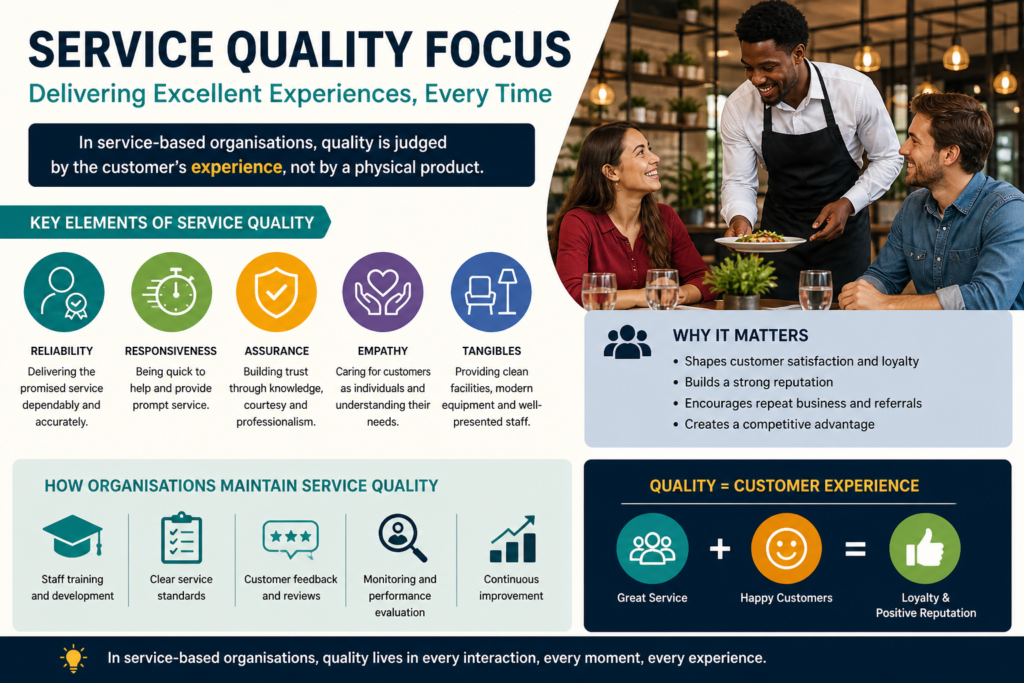
In service-based organisations, quality is primarily judged through the customer’s experience rather than through a tangible output. This means that customers evaluate not only what is delivered but also how it is delivered. Factors such as staff behaviour, responsiveness, communication, cleanliness, and reliability all contribute to perceptions of service quality.
The SERVQUAL model developed by Parasuraman, Zeithaml and Berry (1988) highlights key dimensions of service quality, including reliability, responsiveness, assurance, empathy, and tangibles. These dimensions demonstrate that service quality extends beyond technical outcomes and includes emotional and experiential elements. As a result, customers may form positive or negative judgements based on relatively subtle aspects of interaction, such as tone of voice or attentiveness.
In contrast, product-based organisations focus more on measurable attributes such as durability, design, and performance. These qualities can often be standardised and assessed before the product reaches the customer, making quality control more predictable.
The Challenge of Managing Service Quality
Managing service quality is inherently more complex than managing product quality. This is largely due to the involvement of people, the real-time nature of service delivery, and the participation of customers in the process. Unlike products, services cannot be stored, inspected, or corrected before consumption in the same way.
For example, a hotel may offer well-designed rooms and high-quality facilities, but poor staff behaviour or slow response times can lead to negative customer perceptions. Similarly, a restaurant may provide well-prepared food, but issues such as unclean tables or delays in service can undermine the overall experience. These examples illustrate that service quality depends on both technical delivery and human performance.
Because services are delivered in real time, errors are often experienced immediately by the customer. This limits the organisation’s ability to correct problems before they affect satisfaction, increasing the importance of consistency and staff competence.
Monitoring and Improving Service Quality
Given its importance, service-based organisations invest significant resources in monitoring and improving service quality. Unlike product-based organisations, which rely heavily on technical quality control systems, service organisations must adopt more customer-focused approaches.
Common methods include the use of customer feedback systems, online reviews, surveys, and complaint analysis. These tools help organisations understand how customers perceive the service and identify areas for improvement. In addition, techniques such as mystery shopping and staff performance evaluations are often used to assess service delivery in practice.
Zeithaml, Bitner and Gremler (2018) emphasise that maintaining service quality requires a continuous focus on customer expectations and perceptions. Organisations must not only meet expectations but aim to exceed them in order to build customer loyalty and positive reputation.
The Role of Employees in Service Quality
A key difference between service-based and product-based organisations lies in the role of employees in quality delivery. In service environments, employees are central to the value creation process. Their behaviour, communication skills, and ability to respond to customer needs directly influence the perceived quality of the service.
Bowen and Schneider (2014) argue that frontline employees play a critical role in shaping the service climate of an organisation. Their interactions with customers can enhance trust, satisfaction, and long-term relationships. This places a strong emphasis on recruitment, training, and performance management in service-based organisations.
In product-based organisations, although employees are important in production and quality control, the final product can exist independently of customer interaction. This reduces the direct impact of employee behaviour on customer perceptions at the point of consumption.
Consistency and Customer Expectations
Consistency is a central concern in service quality management. Customers expect a reliable standard each time they engage with a service-based organisation. However, achieving consistency is challenging due to the variability introduced by human interaction and changing customer expectations.
A service that is perceived as excellent on one occasion may be judged differently on another if expectations are not met consistently. This makes it essential for organisations to establish clear service standards and ensure that employees are trained to deliver them effectively across different situations.
Consistency is less difficult to achieve in product-based organisations, where standardised production processes can ensure uniformity across large volumes of goods.
Case Application: Restaurant Reputation and Service Standards
The importance of service quality focus can be illustrated through the example of a restaurant that has built its reputation on consistent service standards. While the quality of the food is important, the restaurant’s success is strongly linked to how customers are treated throughout their visit.
Staff greet customers warmly, communicate clearly, handle complaints professionally, and maintain a clean and comfortable environment. These elements contribute to a positive overall experience, encouraging repeat visits and recommendations. Over time, the restaurant becomes known not only for its food but also for its service quality.
This example demonstrates that in service-based organisations, reputation is closely tied to the consistency and quality of service delivery rather than to a physical product alone.
Why Service Quality Focus Shapes Business Strategy
The emphasis on service quality requires a different managerial approach compared to product-based organisations. Service businesses cannot rely solely on systems, processes, or physical resources. Instead, they must develop a strong customer-focused culture and support employees in delivering high-quality interactions.
Poor service quality can lead to immediate dissatisfaction, negative reviews, and reputational damage. In contrast, consistently high service quality can create competitive advantage through customer loyalty and positive word-of-mouth. This makes service quality a central strategic priority rather than a purely operational concern.
References
Bowen, D.E. and Schneider, B. (2014) ‘A service climate synthesis and future research agenda’, Journal of Service Research, 17(1), pp. 5–22.
Parasuraman, A., Zeithaml, V.A. and Berry, L.L. (1988) ‘SERVQUAL: A multiple-item scale for measuring consumer perceptions of service quality’, Journal of Retailing, 64(1), pp. 12–40.
Zeithaml, V.A., Bitner, M.J. and Gremler, D.D. (2018) Services Marketing: Integrating Customer Focus Across the Firm. 7th edn. New York: McGraw-Hill.
View Courses in Hospitality and Tourism…
Start your journey in hospitality and tourism with an accredited Click College course. Enrol today and build the skills, knowledge, and confidence to progress into a management role.







Recent Posts
Professional Diploma or Higher Qualification Pathway: Which Should You Choose?
Professional Diploma or Higher Qualification Pathway: Which Should You Choose? Choosing the right online qualification is not always simply a question of choosing the longest course or the highest level. For many learners, the better question is: what kind of study route fits my goals right now? Some learners want a focused qualification in one […]
Professional Diploma in Leadership and Management: Course Guide
Professional Diploma in Leadership and Management: Course Guide A Professional Diploma in Leadership and Management is designed for learners who want to develop advanced leadership, strategic thinking and organisational management skills without committing immediately to a full degree programme. Leadership and management are essential in almost every sector. Whether you work in business, education, hospitality, […]
Professional Diploma in Business Management: Who Is It For?
Professional Diploma in Business Management: Who Is It For? A Professional Diploma in Business Management is designed for learners who want to build practical business knowledge without committing immediately to a full degree or long higher education programme. It can be a useful option for people who want to understand how organisations work, how teams […]